Apoptosis Signaling
Live??? Or Die???
Vijay Avin BR, Molecular Biomedicine Laboratory, Sahyadri
Sceince College, Shimoga, Karnataka, India
Life of cell
• Mitosis checkpoints
• Apoptosis will be
triggered to prevent
cells from
becoming cancers
and harming the
body
Cell death by injury
-Mechanical damage
-Exposure to toxic chemicals
Cell death by suicide
-Internal signals
-External signals
• Definition
Apo: apart
Ptosis: fallen
– Shedding of leaves from tress
• During embriogenesis ------ occurs as
PCD
• Post-embrional life------- as apoptosis
apoptosis
• Apoptosis is used as a synonymous for
PCD but PCD is physiological death,
occurs only during embriogenesis.
• It is a functional death and it is a good
mechanism to eliminate wasted, useless,
unwanted, or crippled cells!
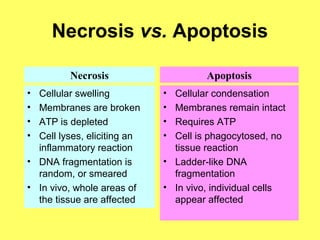
Necrosis vs. Apoptosis
• Cellular condensation
• Membranes remain intact
• Requires ATP
• Cell is phagocytosed, no
tissue reaction
• Ladder-like DNA
fragmentation
• In vivo, individual cells
appear affected
• Cellular swelling
• Membranes are broken
• ATP is depleted
• Cell lyses, eliciting an
inflammatory reaction
• DNA fragmentation is
random, or smeared
• In vivo, whole areas of
the tissue are affected
Necrosis Apoptosis
NECROSIS Vs APOPTOSIS
Wilde, 1999
Why have we developed such a
self-destructive system?
• A. PCD allows a constant selection for the
fittest cell in a colony
• Every cell carries the molecular machinery
to do PCD!
• Cells that are sensitive to extracellular
signals will survive, cell that cannot
compete with their more vital sisters will
undergo apoptosis.
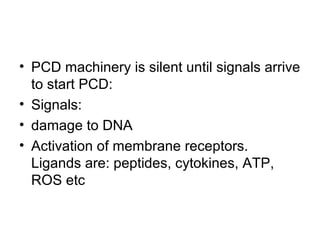
• PCD machinery is silent until signals arrive
to start PCD:
• Signals:
• damage to DNA
• Activation of membrane receptors.
Ligands are: peptides, cytokines, ATP,
ROS etc
• Fas receptor?
Receptors for growth factors, cytokines
and hormones
• Membrane alterations cause apoptosis.
What kind of membrane alterations ??
Phospholipid redistributions, changes in
membrane charge, carbohydrate and
surface markers.
Proteins involved in apoptosis
• Fas ligand (FasL or CD95L) is a type-II transmembrane protein that belongs to the
tumor necrosis factor (TNF) family
• Fas-Associated protein with Death Domain (FADD) is an adaptor molecule that
bridges the Fas-receptor, and other death receptors,
• Apoptotic protease activating factor 1, also known as APAF1
• Bcl-2 (B-cell lymphoma 2) is the founding member of the Bcl-2 family of apoptosis
regulator proteins encoded by the BCL2gene
Caspases
• Inflammatory Caspases: -1, -4, and -5
• Initiator Caspases: -2, -8, -9, and -10
– Long N-terminal domain
– Interact with effector caspases
• Effector Caspases: -3, -6, and -7
– Little to no N-terminal domain
– Initiate cell death
• The Mitochondrial Apoptosis-Induced Channel (or MAC),
• BAK: Bcl-2 homologous antagonist killer
• BAX: Bcl-2 associated x protein
• BID: BH3 interacting domain death agonist, a pro-apoptotic protein
• BAD: The Bcl-2-associated death promoter (BAD) protein is a pro-apoptotic
member of the Bcl-2 gene family which is involved in initiating apoptosis. BAD is a
member of the BH3-only family
STAGES OF APOPTOSIS
Sherman et al., 1997
Induction of apoptosis related genes, signal transduction
membrane
blebbing &
changes
mitochondrial
leakage
organelle
reduction
cell
shrinkage
nuclear
fragmentation
chromatin
condensation
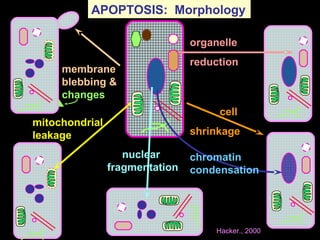
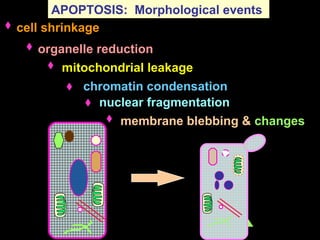
APOPTOSIS: Morphology
Hacker., 2000
membrane blebbing & changes
mitochondrial leakage
organelle reduction
cell shrinkage
nuclear fragmentation
chromatin condensation
APOPTOSIS: Morphological events
Bleb
Blebbing & Apoptotic bodies
The control retained over the cell
membrane & cytoskeleton allows intact
pieces of the cell to separate for
recognition & phagocytosis by MΦs
Apoptotic body
MΦ MΦ
Apoptosis: Pathways
Death
Ligands
Effector
Caspase 3
Death
Receptors
Initiator
Caspase 8
Cell
death
DNA damage & p53
Mitochondria/
Cytochrome C
Initiator
Caspase 9
“Extrinsic Pathway”
“Intrinsic Pathway”
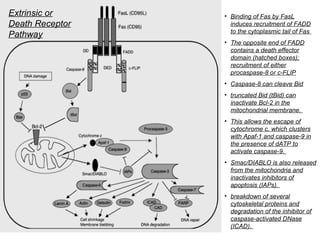
• Binding of Fas by FasL
induces recruitment of FADD
to the cytoplasmic tail of Fas
• The opposite end of FADD
contains a death effector
domain (hatched boxes);
recruitment of either
procaspase-8 or c-FLIP
• Caspase-8 can cleave Bid
• truncated Bid (tBid) can
inactivate Bcl-2 in the
mitochondrial membrane.
• This allows the escape of
cytochrome c, which clusters
with Apaf-1 and caspase-9 in
the presence of dATP to
activate caspase-9.
• Smac/DIABLO is also released
from the mitochondria and
inactivates inhibitors of
apoptosis (IAPs).
• breakdown of several
cytoskeletal proteins and
degradation of the inhibitor of
caspase-activated DNase
(ICAD).
Extrinsic or
Death Receptor
Pathway
MAJOR PLAYERS IN
APOPTOSIS
• Caspases
• Adaptor proteins
• Bcl-2 family
Modulation of apoptosis
• Apoptotic cell death can be switched to
necrosis during oxidative stress by 2
mechanisms:
Inactivation of caspases due to oxidation
of their active site thiol group by oxidants
Decrease in ATP due to failure of
mitochondrial energy production by
oxidants
• NO can also have dual effects on
apoptosis
NO is reactive, unstable free radical gas that
can easily cross cell membranes.
L-Arg------ NO
Low NO: Neurotransmitter, regulator in
vasodilation and platelet aggregation.
High NO: Cytotoxicity
NO may also mediate
apoptosis:
How???
• Formation of iron-nitrosyl complexes with
FeS-containing enzymes: This leads to
impairment of mitochondrial function
ATP depletion.
• NO may directly damage DNA-
mutagenesis
• Generation of OONO- Apoptosis
• NO may inactivate several antioxidant
enzymes (CAT, GPx, SOD etc)
• NO exposure or activation may inhibit
apoptosis in
Lymphocytes
Endothelial cells
Neurons
Hepatocytes
Kidney cells
How??
• Direct inhibition of caspase (S-nitrosylation of the active
site Cys)
• R-S-NO is important component of signal transduction
cascades.
• S-nitrosylation can regulate many proteins:
• Enzymes
• Ion channels
• G-proteins
• Transcription factors
• NO may act as a modular switch to control protein
function via –SH groups.
For example, S-nitrosylation was shown to occur in:
• Calpain
• NF-KB
• AP-1
These are all implicated in the regulation of apoptosis.
• Nitrosylation/denitrosylation- may serve as a
regulatory mechanism just like….?
Importance of Apoptosis
• Important in normal physiology / development
– Development: Immune systems maturation,
Morphogenesis, Neural development
– Adult: Immune privilege, DNA Damage and wound
repair.
• Excess apoptosis
– Neurodegenerative diseases
• Deficient apoptosis
– Cancer
– Autoimmunity
The bcl-2 family
BH4 BH3 BH1 BH2 TMN C
Receptor domain
phosphorylation
Raf-1
calcineurin Pore
formation
Membrane
anchor
Ligand
domain
Group I
Group II
Group III
Bcl-2
bax
Bad
bid
bik
Back
P53 & Apoptosis
p53 first arrests cell growth between G1 → S
This allows for DNA repair during delay
If the damage is too extensive then p53
induces gene activation leading to
apoptosis (programmed cell death)
Thank u

Apoptosis signalling

  • 1.
    Apoptosis Signaling Live??? OrDie??? Vijay Avin BR, Molecular Biomedicine Laboratory, Sahyadri Sceince College, Shimoga, Karnataka, India
  • 2.
    Life of cell •Mitosis checkpoints • Apoptosis will be triggered to prevent cells from becoming cancers and harming the body
  • 3.
    Cell death byinjury -Mechanical damage -Exposure to toxic chemicals Cell death by suicide -Internal signals -External signals
  • 4.
    • Definition Apo: apart Ptosis:fallen – Shedding of leaves from tress • During embriogenesis ------ occurs as PCD • Post-embrional life------- as apoptosis
  • 5.
    apoptosis • Apoptosis isused as a synonymous for PCD but PCD is physiological death, occurs only during embriogenesis. • It is a functional death and it is a good mechanism to eliminate wasted, useless, unwanted, or crippled cells!
  • 6.
    Necrosis vs. Apoptosis •Cellular condensation • Membranes remain intact • Requires ATP • Cell is phagocytosed, no tissue reaction • Ladder-like DNA fragmentation • In vivo, individual cells appear affected • Cellular swelling • Membranes are broken • ATP is depleted • Cell lyses, eliciting an inflammatory reaction • DNA fragmentation is random, or smeared • In vivo, whole areas of the tissue are affected Necrosis Apoptosis
  • 7.
  • 8.
    Why have wedeveloped such a self-destructive system? • A. PCD allows a constant selection for the fittest cell in a colony • Every cell carries the molecular machinery to do PCD! • Cells that are sensitive to extracellular signals will survive, cell that cannot compete with their more vital sisters will undergo apoptosis.
  • 9.
    • PCD machineryis silent until signals arrive to start PCD: • Signals: • damage to DNA • Activation of membrane receptors. Ligands are: peptides, cytokines, ATP, ROS etc
  • 10.
    • Fas receptor? Receptorsfor growth factors, cytokines and hormones • Membrane alterations cause apoptosis. What kind of membrane alterations ?? Phospholipid redistributions, changes in membrane charge, carbohydrate and surface markers.
  • 12.
    Proteins involved inapoptosis • Fas ligand (FasL or CD95L) is a type-II transmembrane protein that belongs to the tumor necrosis factor (TNF) family • Fas-Associated protein with Death Domain (FADD) is an adaptor molecule that bridges the Fas-receptor, and other death receptors, • Apoptotic protease activating factor 1, also known as APAF1 • Bcl-2 (B-cell lymphoma 2) is the founding member of the Bcl-2 family of apoptosis regulator proteins encoded by the BCL2gene Caspases • Inflammatory Caspases: -1, -4, and -5 • Initiator Caspases: -2, -8, -9, and -10 – Long N-terminal domain – Interact with effector caspases • Effector Caspases: -3, -6, and -7 – Little to no N-terminal domain – Initiate cell death • The Mitochondrial Apoptosis-Induced Channel (or MAC), • BAK: Bcl-2 homologous antagonist killer • BAX: Bcl-2 associated x protein • BID: BH3 interacting domain death agonist, a pro-apoptotic protein • BAD: The Bcl-2-associated death promoter (BAD) protein is a pro-apoptotic member of the Bcl-2 gene family which is involved in initiating apoptosis. BAD is a member of the BH3-only family
  • 13.
    STAGES OF APOPTOSIS Shermanet al., 1997 Induction of apoptosis related genes, signal transduction
  • 14.
  • 15.
    membrane blebbing &changes mitochondrial leakage organelle reduction cell shrinkage nuclear fragmentation chromatin condensation APOPTOSIS: Morphological events
  • 16.
    Bleb Blebbing & Apoptoticbodies The control retained over the cell membrane & cytoskeleton allows intact pieces of the cell to separate for recognition & phagocytosis by MΦs Apoptotic body MΦ MΦ
  • 17.
    Apoptosis: Pathways Death Ligands Effector Caspase 3 Death Receptors Initiator Caspase8 Cell death DNA damage & p53 Mitochondria/ Cytochrome C Initiator Caspase 9 “Extrinsic Pathway” “Intrinsic Pathway”
  • 20.
    • Binding ofFas by FasL induces recruitment of FADD to the cytoplasmic tail of Fas • The opposite end of FADD contains a death effector domain (hatched boxes); recruitment of either procaspase-8 or c-FLIP • Caspase-8 can cleave Bid • truncated Bid (tBid) can inactivate Bcl-2 in the mitochondrial membrane. • This allows the escape of cytochrome c, which clusters with Apaf-1 and caspase-9 in the presence of dATP to activate caspase-9. • Smac/DIABLO is also released from the mitochondria and inactivates inhibitors of apoptosis (IAPs). • breakdown of several cytoskeletal proteins and degradation of the inhibitor of caspase-activated DNase (ICAD). Extrinsic or Death Receptor Pathway
  • 22.
    MAJOR PLAYERS IN APOPTOSIS •Caspases • Adaptor proteins • Bcl-2 family
  • 23.
    Modulation of apoptosis •Apoptotic cell death can be switched to necrosis during oxidative stress by 2 mechanisms: Inactivation of caspases due to oxidation of their active site thiol group by oxidants Decrease in ATP due to failure of mitochondrial energy production by oxidants
  • 24.
    • NO canalso have dual effects on apoptosis NO is reactive, unstable free radical gas that can easily cross cell membranes. L-Arg------ NO Low NO: Neurotransmitter, regulator in vasodilation and platelet aggregation. High NO: Cytotoxicity
  • 25.
    NO may alsomediate apoptosis: How??? • Formation of iron-nitrosyl complexes with FeS-containing enzymes: This leads to impairment of mitochondrial function ATP depletion. • NO may directly damage DNA- mutagenesis • Generation of OONO- Apoptosis • NO may inactivate several antioxidant enzymes (CAT, GPx, SOD etc)
  • 26.
    • NO exposureor activation may inhibit apoptosis in Lymphocytes Endothelial cells Neurons Hepatocytes Kidney cells
  • 27.
    How?? • Direct inhibitionof caspase (S-nitrosylation of the active site Cys) • R-S-NO is important component of signal transduction cascades. • S-nitrosylation can regulate many proteins: • Enzymes • Ion channels • G-proteins • Transcription factors • NO may act as a modular switch to control protein function via –SH groups.
  • 28.
    For example, S-nitrosylationwas shown to occur in: • Calpain • NF-KB • AP-1 These are all implicated in the regulation of apoptosis. • Nitrosylation/denitrosylation- may serve as a regulatory mechanism just like….?
  • 29.
    Importance of Apoptosis •Important in normal physiology / development – Development: Immune systems maturation, Morphogenesis, Neural development – Adult: Immune privilege, DNA Damage and wound repair. • Excess apoptosis – Neurodegenerative diseases • Deficient apoptosis – Cancer – Autoimmunity
  • 30.
    The bcl-2 family BH4BH3 BH1 BH2 TMN C Receptor domain phosphorylation Raf-1 calcineurin Pore formation Membrane anchor Ligand domain Group I Group II Group III Bcl-2 bax Bad bid bik Back
  • 31.
    P53 & Apoptosis p53first arrests cell growth between G1 → S This allows for DNA repair during delay If the damage is too extensive then p53 induces gene activation leading to apoptosis (programmed cell death)
  • 32.

Editor's Notes

  • #3 For some this may be a review but this is a diagram showing the importance of cell apoptosis in checkpoints during mitosis. Before entering a phase of mitosis, checkpoints are set up that inspect that everything is going according to plan. If it is, the cell proceeds on its path to reproduction, however if everything is not as it should be the caspase cascade is triggered and the cell is destroyed.
  • #12 Fas ligand (FasL or CD95L) is a type-II transmembrane protein that belongs to the tumor necrosis factor (TNF) family Fas-Associated protein with Death Domain (FADD) is an adaptor molecule that bridges the Fas-receptor, and other death receptors, Apoptotic protease activating factor 1, also known as APAF1 Bcl-2 (B-cell lymphoma 2) is the founding member of the Bcl-2 family of apoptosis regulator proteins encoded by the BCL2gene Inflammatory Caspases: -1, -4, and -5 Initiator Caspases: -2, -8, -9, and -10 Long N-terminal domain Interact with effector caspases Effector Caspases: -3, -6, and -7 Little to no N-terminal domain Initiate cell death The Mitochondrial Apoptosis-Induced Channel (or MAC), BAK: Bcl-2 homologous antagonist killer BAX: Bcl-2 associated x protein
  • #18 http://www.youtube.com/watch?v=9KTDz-ZisZ0
  • #19 In a healthy cell, the outer membranes of its mitochondria display the protein Bcl-2 on their surface. Internal damage to the cell (e.g., from reactive oxygen species) causes Bcl-2 to activate a related protein, Bax, which punches holes in the outer mitochondrial membrane, causing cytochrome c to leak out. The released cytochrome c binds to the protein Apaf-1 ("apoptotic protease activating factor-1"). Using the energy provided by ATP, these complexes aggregate to form apoptosomes. The apoptosomes bind to and activate caspase-9. Caspase-9 is one of a family of over a dozen caspases. They are all proteases. They get their name because they cleave proteins — mostly each other — at aspartic acid (Asp) residues). Caspase-9 cleaves and, in so doing, activates other caspases (caspase-3 and -7). The activation of these "executioner" caspases creates an expanding cascade of proteolytic activity (rather like that in blood clotting and complement activation) which leads to digestion of structural proteins in the cytoplasm, degradation of chromosomal DNA, and phagocytosis of the cell.
  • #26 Superoxide dismutase SOD Glutathione peroxidase GPx or plasma glutathione peroxidase  Catalase
  • #29 A calpain (pronounced /ˈkælpeɪn/;[1] EC 3.4.22.52, EC 3.4.22.53) is a protein belonging to the family of calcium-dependent, non-lysosomal cysteine proteases (proteolytic enzymes) In the field of molecular biology, the activator protein 1 (AP-1) is a transcription factor which is a heterodimeric protein composed of proteins belonging to the c-Fos, c-Jun, ATF and JDP families NF-κB (nuclear factor kappa-light-chain-enhancer of activated B cells) is a protein complex that controls the transcription of DNA and Receptor activator of nuclear factor kappa B (RANK), which is a type of TNFR, is a central activator of NF-κB. Osteoprotegerin (OPG), which is a decoy receptor homolog for RANK ligand, inhibits RANK by binding to RANKL, and, thus, osteoprotegerin is tightly involved in regulating NF-κB activation