MAPkinase
BHAGYA SIRIPALLI,
Pharmacology, SVIPS
PSG COLLEGE OF
PHARMACY
1
Contents
MAP kinase pathway
Requirement for signal transduction
RAS activation
Kinase cascade
Inactivation of RAS
Activation of transcription factors by MAP
kinase
MAPkinase
Map kinase is an enzyme that translocate the signal to the nucleus and activates many
transcriptional factors by phosphorylating many different proteins.
A mitogen-activated protein kinase (MAPK or MAP kinase) is a type of protein
kinase that is specific to the amino acids serine and threonine (i.e., a serine/threonine-
specific protein kinase). MAPKs are involved in directing cellular responses to a diverse
array of stimuli, such as mitogens, osmotic stress, heat shock and proinflammatory
cytokines.
They regulate cell functions including proliferation, gene
expression, differentiation, mitosis, cell survival, and apoptosis.
MAP kinases are found in eukaryotes only, but they are fairly diverse and encountered in
all animals, fungi and plants, and even in an array of unicellular eukaryotes.
MAPkinasepathway
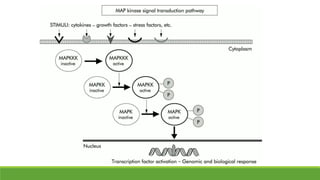
Signal passes from activated RAS to cascade of protein kinases
This cascade transmits signals downstream from activated RAS protein to MAP kinase
Then MAP kinase translocate the signal to the nucleus and activates transcriptional factors
This whole process is called “MAP kinase pathway”
Requirement for signaltransduction
Signal – that is to be passed
Receptor- to which the ligand bind
Adaptor proteins – form link between membrane bound receptor and protein is to be
activated
Protein cascade – lead to the activation of transcriptional factors
Transcriptional factors – which carry out transcription process
RAS Activation
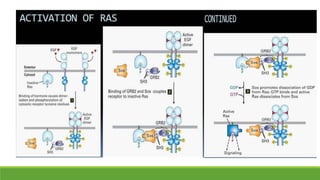
Epidermal growth factor receptor (EGFR) is a receptor linked tyrosine kinase which is
activated by extracellular ligand Epidermal growth factor (EGF)
Binding of EGR to EGFR leads to the EGFR phosphorylation on tyrosine residues
Docking proteins such as GRB2 contain an SH2 domain binds to the phosphotyrosine residue
of the receptor
Now SOs protein (guanine nucleotide exchange factor) binds to the SH2 domain of the GRB2
protein and forms GRB2 SOs complex.
This GRB2 SOs complex promotes the phosphorylation so the GDP in RAS is replaced with GTP.
Now that the GDP in RAS is converted to GTP, the RAS become active.
This activated RAS starts the kinase cascade.
Kinasecascade
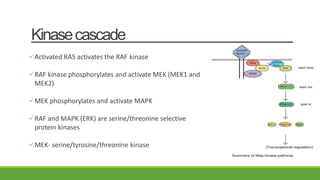
Activated RAS activates the RAF kinase
RAF kinase phosphorylates and activate MEK (MEK1 and
MEK2)
MEK phosphorylates and activate MAPK
RAF and MAPK (ERK) are serine/threonine selective
protein kinases
MEK- serine/tyrosine/threonine kinase
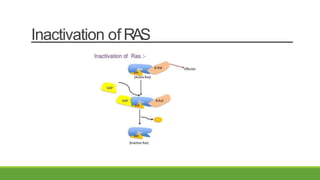
Inactivation of RAS
Activation of transcription factorsby
MAP-kinase
Early response genes (genes which are induced before cells enter the S-phase and
replicate their DNA )
One such gene encodes the transcription factor “C-Fos”
C-Fos with other factors induces expression of many genes encoding proteins which are
necessary for cells to progress through the cell cycle
Enhancers that regulate the C-Fos genes contain a serum response factor (SRF) and
ternary complex factor (TCF)
By modifying these two factors MAPK induces transcription of C-Fos
Activation of transcription factorsby
MAP-kinase contd.,
In Cytosol:
MAPK phosphorylates and activates a kinase P90 RSK, which translocate to the nucleus and
phosphorylates a specific serine in SRF
In Nucleus:
MPAK directly phosphorylates specific serine in TCF
Association of phosphorylated TCF with two molecules of phosphorylated SRF forms an
active trimeric factor
Activation of transcription factorsby
MAP-kinase contd.,
Scaffold proteins
Scaffold strategy prevent cross-talk between different MAPK modules
Atleast 5 parallel MAPK modules can operate in a mammalian cell
These modules make use of atleast 12 MAP kinases, 7 MAP kinase kinases and 7 MAP kinas
kinase kinase
JAK-STATpathway
JAK Janus kinase, STAT– Signal Transducer and Activation of Transcription
This signalling pathway transmits information from chemical signals outside the cell,
which cause DNA transcription and activity
4 JAK proteins – JAK1, JAK 2, JAK 3, TYK2
JAKs contains a FERM domain, an SH2 related domain, a kinase domain and a
pseudokinase domain
Kinase domain allows JAK to phosphorylate proteins
7 STATproteins STAT1,STAT2,STAT3,STAT4,STAT5A, STAT5B, STAT6
STATcontain many different domains, most conserved region is the SH2 domain
JAK-STATpathwaymechanism
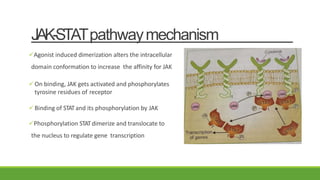
Agonist induced dimerization alters the intracellular
domain conformation to increase the affinity for JAK
On binding, JAK gets activated and phosphorylates
tyrosine residues of receptor
Binding of STATand its phosphorylation by JAK
Phosphorylation STATdimerize and translocate to
the nucleus to regulate gene transcription
Movement of STATsfrom cytosol to the
nucleus
STATdimers have to pass through nucleus pore complex (NPCs) which is present along the
nucleus envelope
Toenable STATsto move into the nucleus, an amino acid sequence on STATs, called nuclear
localisation signal (NLS) is bound by proteins called importins
After entering, a protein called Ran binds to the importins releasing them from the STAT dimer
STATdimer is then free in the nucleus
Specific STAT– specific importin proteins
Integration with other signalling
pathways
JAKs phosphorylate cytokine receptors which can
bind Grb2 protein
Grb2 activates Sos proteins MAPK
signalling
Phosphorylated cytokine receptors ca also bound
by P13k
P13k activates AKT
Thus JAK-STAT is able to interconnect with other
cell-signalling pathways such as P13k/ AKT/ mTOR/
pathway.
Regulation
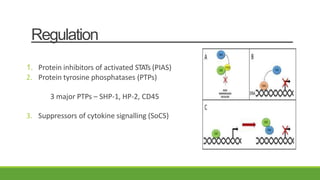
1. Protein inhibitors of activated STATs (PIAS)
2. Protein tyrosine phosphatases (PTPs)
3 major PTPs – SHP-1, HP-2, CD45
3. Suppressors of cytokine signalling (SoCS)
Map kinase

Map kinase

  • 1.
  • 2.
    Contents MAP kinase pathway Requirementfor signal transduction RAS activation Kinase cascade Inactivation of RAS Activation of transcription factors by MAP kinase
  • 3.
    MAPkinase Map kinase isan enzyme that translocate the signal to the nucleus and activates many transcriptional factors by phosphorylating many different proteins. A mitogen-activated protein kinase (MAPK or MAP kinase) is a type of protein kinase that is specific to the amino acids serine and threonine (i.e., a serine/threonine- specific protein kinase). MAPKs are involved in directing cellular responses to a diverse array of stimuli, such as mitogens, osmotic stress, heat shock and proinflammatory cytokines. They regulate cell functions including proliferation, gene expression, differentiation, mitosis, cell survival, and apoptosis. MAP kinases are found in eukaryotes only, but they are fairly diverse and encountered in all animals, fungi and plants, and even in an array of unicellular eukaryotes.
  • 4.
    MAPkinasepathway Signal passes fromactivated RAS to cascade of protein kinases This cascade transmits signals downstream from activated RAS protein to MAP kinase Then MAP kinase translocate the signal to the nucleus and activates transcriptional factors This whole process is called “MAP kinase pathway”
  • 6.
    Requirement for signaltransduction Signal– that is to be passed Receptor- to which the ligand bind Adaptor proteins – form link between membrane bound receptor and protein is to be activated Protein cascade – lead to the activation of transcriptional factors Transcriptional factors – which carry out transcription process
  • 7.
    RAS Activation Epidermal growthfactor receptor (EGFR) is a receptor linked tyrosine kinase which is activated by extracellular ligand Epidermal growth factor (EGF) Binding of EGR to EGFR leads to the EGFR phosphorylation on tyrosine residues Docking proteins such as GRB2 contain an SH2 domain binds to the phosphotyrosine residue of the receptor Now SOs protein (guanine nucleotide exchange factor) binds to the SH2 domain of the GRB2 protein and forms GRB2 SOs complex. This GRB2 SOs complex promotes the phosphorylation so the GDP in RAS is replaced with GTP. Now that the GDP in RAS is converted to GTP, the RAS become active. This activated RAS starts the kinase cascade.
  • 9.
    Kinasecascade Activated RAS activatesthe RAF kinase RAF kinase phosphorylates and activate MEK (MEK1 and MEK2) MEK phosphorylates and activate MAPK RAF and MAPK (ERK) are serine/threonine selective protein kinases MEK- serine/tyrosine/threonine kinase
  • 10.
  • 11.
    Activation of transcriptionfactorsby MAP-kinase Early response genes (genes which are induced before cells enter the S-phase and replicate their DNA ) One such gene encodes the transcription factor “C-Fos” C-Fos with other factors induces expression of many genes encoding proteins which are necessary for cells to progress through the cell cycle Enhancers that regulate the C-Fos genes contain a serum response factor (SRF) and ternary complex factor (TCF) By modifying these two factors MAPK induces transcription of C-Fos
  • 12.
    Activation of transcriptionfactorsby MAP-kinase contd., In Cytosol: MAPK phosphorylates and activates a kinase P90 RSK, which translocate to the nucleus and phosphorylates a specific serine in SRF In Nucleus: MPAK directly phosphorylates specific serine in TCF Association of phosphorylated TCF with two molecules of phosphorylated SRF forms an active trimeric factor
  • 13.
    Activation of transcriptionfactorsby MAP-kinase contd., Scaffold proteins Scaffold strategy prevent cross-talk between different MAPK modules Atleast 5 parallel MAPK modules can operate in a mammalian cell These modules make use of atleast 12 MAP kinases, 7 MAP kinase kinases and 7 MAP kinas kinase kinase
  • 15.
    JAK-STATpathway JAK Janus kinase,STAT– Signal Transducer and Activation of Transcription This signalling pathway transmits information from chemical signals outside the cell, which cause DNA transcription and activity 4 JAK proteins – JAK1, JAK 2, JAK 3, TYK2 JAKs contains a FERM domain, an SH2 related domain, a kinase domain and a pseudokinase domain Kinase domain allows JAK to phosphorylate proteins 7 STATproteins STAT1,STAT2,STAT3,STAT4,STAT5A, STAT5B, STAT6 STATcontain many different domains, most conserved region is the SH2 domain
  • 16.
    JAK-STATpathwaymechanism Agonist induced dimerizationalters the intracellular domain conformation to increase the affinity for JAK On binding, JAK gets activated and phosphorylates tyrosine residues of receptor Binding of STATand its phosphorylation by JAK Phosphorylation STATdimerize and translocate to the nucleus to regulate gene transcription
  • 17.
    Movement of STATsfromcytosol to the nucleus STATdimers have to pass through nucleus pore complex (NPCs) which is present along the nucleus envelope Toenable STATsto move into the nucleus, an amino acid sequence on STATs, called nuclear localisation signal (NLS) is bound by proteins called importins After entering, a protein called Ran binds to the importins releasing them from the STAT dimer STATdimer is then free in the nucleus Specific STAT– specific importin proteins
  • 18.
    Integration with othersignalling pathways JAKs phosphorylate cytokine receptors which can bind Grb2 protein Grb2 activates Sos proteins MAPK signalling Phosphorylated cytokine receptors ca also bound by P13k P13k activates AKT Thus JAK-STAT is able to interconnect with other cell-signalling pathways such as P13k/ AKT/ mTOR/ pathway.
  • 19.
    Regulation 1. Protein inhibitorsof activated STATs (PIAS) 2. Protein tyrosine phosphatases (PTPs) 3 major PTPs – SHP-1, HP-2, CD45 3. Suppressors of cytokine signalling (SoCS)