
Chapter 7 
Cash and 
Receivables 
Skyline College 
Lecture Notes
Pivotal Issues When Managing 
Cash and Receivables 
1. Cash needs 
2. Credit policies 
3. Level of accounts receivable 
4. Financing receivables 
5. Ethical estimates on credit sale 
losses 
Copyright © Houghton Mifflin Company. All rights reserved. 7–2
Cash Considerations 
Most liquid of all assets 
Central to operating cycle 
Consists of: 
Currency and coins on 
hand 
Checks and money 
orders from customers 
Deposits in checking 
and savings accounts 
Cash may include a 
compensating balance—a 
minimum amount required 
by a bank for a credit-granting 
agreement. 
Copyright © Houghton Mifflin Company. All rights reserved. 7–3
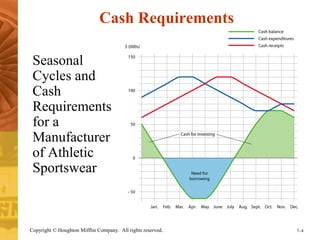
Cash Requirements 
Seasonal 
Cycles and 
Cash 
Requirements 
for a 
Manufacturer 
of Athletic 
Sportswear 
Copyright © Houghton Mifflin Company. All rights reserved. 7–4
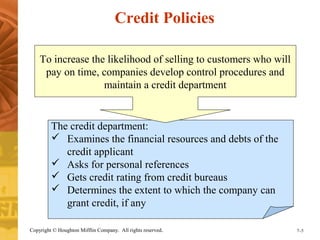
Credit Policies 
To increase the likelihood of selling to customers who will 
pay on time, companies develop control procedures and 
maintain a credit department 
The credit department: 
 Examines the financial resources and debts of the 
credit applicant 
 Asks for personal references 
 Gets credit rating from credit bureaus 
 Determines the extent to which the company can 
grant credit, if any 
Copyright © Houghton Mifflin Company. All rights reserved. 7–5
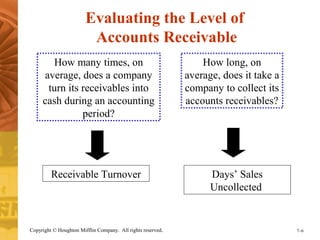
Evaluating the Level of 
Accounts Receivable 
How many times, on 
average, does a company 
turn its receivables into 
cash during an accounting 
period? 
How long, on 
average, does it take a 
company to collect its 
accounts receivables? 
Receivable Turnover Days’ Sales 
Uncollected 
Copyright © Houghton Mifflin Company. All rights reserved. 7–6
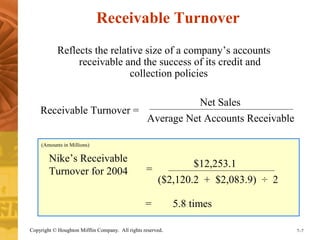
Receivable Turnover 
Reflects the relative size of a company’s accounts 
receivable and the success of its credit and 
collection policies 
Receivable Turnover = 
Net Sales 
Average Net Accounts Receivable 
$12,253.1 
($2,120.2 + $2,083.9) ÷ 2 
(Amounts in Millions) 
Nike’s Receivable 
Turnover for 2004 
= 
= 5.8 times 
Copyright © Houghton Mifflin Company. All rights reserved. 7–7
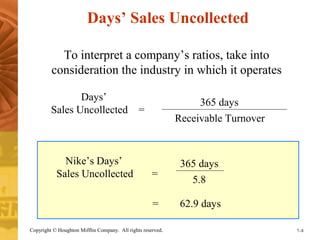
Days’ Sales Uncollected 
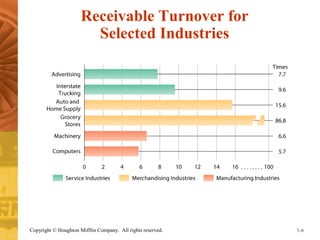
To interpret a company’s ratios, take into 
consideration the industry in which it operates 
Days’ 
Sales Uncollected = 
Nike’s Days’ 
Sales Uncollected = 
365 days 
Receivable Turnover 
365 days 
5.8 
= 62.9 days 
Copyright © Houghton Mifflin Company. All rights reserved. 7–8
Receivable Turnover for 
Selected Industries 
Copyright © Houghton Mifflin Company. All rights reserved. 7–9
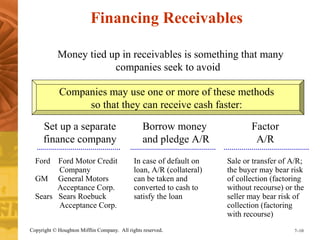
Financing Receivables 
Money tied up in receivables is something that many 
companies seek to avoid 
Companies may use one or more of these methods 
so that they can receive cash faster: 
Set up a separate 
finance company 
Borrow money 
and pledge A/R 
In case of default on 
loan, A/R (collateral) 
can be taken and 
converted to cash to 
satisfy the loan 
Factor 
A/R 
Sale or transfer of A/R; 
the buyer may bear risk 
of collection (factoring 
without recourse) or the 
seller may bear risk of 
collection (factoring 
with recourse) 
Ford Ford Motor Credit 
Company 
GM General Motors 
Acceptance Corp. 
Sears Sears Roebuck 
Acceptance Corp. 
Copyright © Houghton Mifflin Company. All rights reserved. 7–10
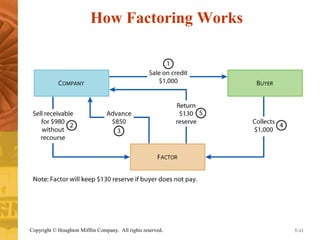
How Factoring Works 
Copyright © Houghton Mifflin Company. All rights reserved. 7–11
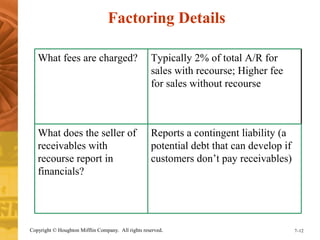
Factoring Details 
Typically 2% of total A/R for 
sales with recourse; Higher fee 
for sales without recourse 
Reports a contingent liability (a 
potential debt that can develop if 
customers don’t pay receivables) 
What fees are charged? 
What does the seller of 
receivables with 
recourse report in 
financials? 
Copyright © Houghton Mifflin Company. All rights reserved. 7–12
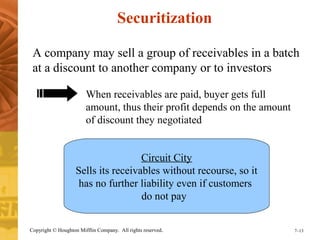
Securitization 
A company may sell a group of receivables in a batch 
at a discount to another company or to investors 
When receivables are paid, buyer gets full 
amount, thus their profit depends on the amount 
of discount they negotiated 
Circuit City 
Sells its receivables without recourse, so it 
has no further liability even if customers 
do not pay 
Copyright © Houghton Mifflin Company. All rights reserved. 7–13
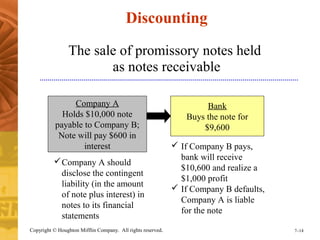
Discounting 
The sale of promissory notes held 
as notes receivable 
Company A 
Holds $10,000 note 
payable to Company B; 
Note will pay $600 in 
Bank 
Buys the note for 
$9,600 
interest  If Company B pays, 
bank will receive 
$10,600 and realize a 
$1,000 profit 
 If Company B defaults, 
Company A is liable 
for the note 
Company A should 
disclose the contingent 
liability (in the amount 
of note plus interest) in 
notes to its financial 
statements 
Copyright © Houghton Mifflin Company. All rights reserved. 7–14
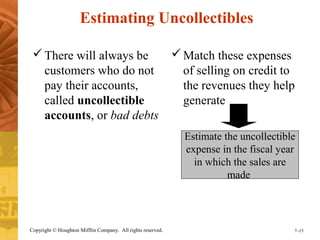
Estimating Uncollectibles 
There will always be 
customers who do not 
pay their accounts, 
called uncollectible 
accounts, or bad debts 
Match these expenses 
of selling on credit to 
the revenues they help 
generate 
Estimate the uncollectible 
expense in the fiscal year 
in which the sales are 
made 
Copyright © Houghton Mifflin Company. All rights reserved. 7–15
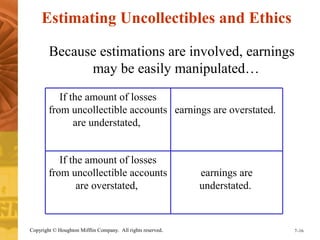
Estimating Uncollectibles and Ethics 
Because estimations are involved, earnings 
may be easily manipulated… 
earnings are overstated. 
earnings are 
understated. 
If the amount of losses 
from uncollectible accounts 
are understated, 
If the amount of losses 
from uncollectible accounts 
are overstated, 
Copyright © Houghton Mifflin Company. All rights reserved. 7–16
Discussion: Ethics in the World 
WorldCom increased revenues and hid losses 
by continuing to bill customers for service 
for years after the customers had stopped 
paying. 
Q. What impact do you think WorldCom’s 
actions had on Accounts Receivable and 
Sales? 
Copyright © Houghton Mifflin Company. All rights reserved. 7–17
Cash Equivalents 
Investments like time deposits or certificates of 
deposit (CDs) that have a term of 90 days or less 
Nike’s Annual Report, 2005 
Cash and equivalents represent cash and short-term, highly liquid 
investments with original maturities of three months or less at the time 
of purchase. The carrying amounts reflected in the consolidated 
balance sheet for cash and equivalents approximate fair value due to 
their short maturities. 
Copyright © Houghton Mifflin Company. All rights reserved. 7–18
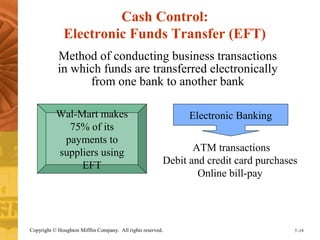
Cash Control: 
Electronic Funds Transfer (EFT) 
Method of conducting business transactions 
in which funds are transferred electronically 
from one bank to another bank 
Wal-Mart makes 
75% of its 
payments to 
suppliers using 
EFT 
Electronic Banking 
ATM transactions 
Debit and credit card purchases 
Online bill-pay 
Copyright © Houghton Mifflin Company. All rights reserved. 7–19
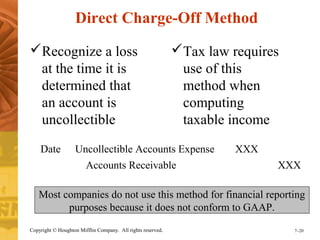
Direct Charge-Off Method 
Recognize a loss 
at the time it is 
determined that 
an account is 
uncollectible 
Date Uncollectible Accounts Expense XXX 
Tax law requires 
use of this 
method when 
computing 
taxable income 
Accounts Receivable XXX 
Most companies do not use this method for financial reporting 
purposes because it does not conform to GAAP. 
Copyright © Houghton Mifflin Company. All rights reserved. 7–20
The Allowance Method 
Losses from bad debts are matched against the 
sales they help generate 
At the time of sale, management cannot 
identify which customers will not pay 
To observe the matching rule, losses from 
uncollectible accounts must be estimated 
The estimate becomes an expense in the fiscal 
year in which the sales are made 
Copyright © Houghton Mifflin Company. All rights reserved. 7–21
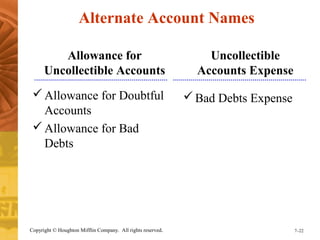
Alternate Account Names 
Allowance for 
Uncollectible Accounts 
Uncollectible 
Accounts Expense 
Allowance for Doubtful 
Accounts 
Allowance for Bad 
Debts 
Bad Debts Expense 
Copyright © Houghton Mifflin Company. All rights reserved. 7–22
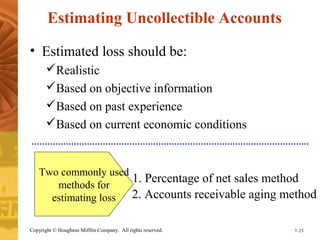
Estimating Uncollectible Accounts 
• Estimated loss should be: 
Realistic 
Based on objective information 
Based on past experience 
Based on current economic conditions 
Two commonly used 
methods for 
estimating loss 
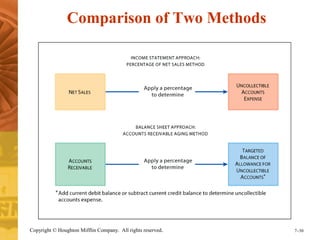
1. Percentage of net sales method 
2. Accounts receivable aging method 
Copyright © Houghton Mifflin Company. All rights reserved. 7–23
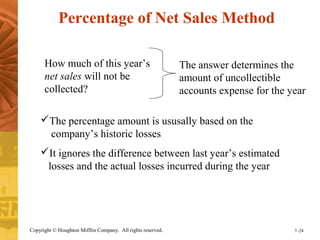
Percentage of Net Sales Method 
How much of this year’s 
net sales will not be 
collected? 
The answer determines the 
amount of uncollectible 
accounts expense for the year 
The percentage amount is ususally based on the 
company’s historic losses 
It ignores the difference between last year’s estimated 
losses and the actual losses incurred during the year 
Copyright © Houghton Mifflin Company. All rights reserved. 7–24
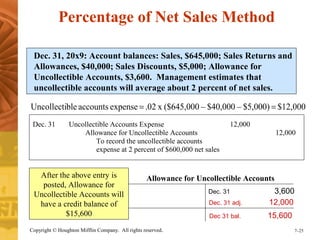
Percentage of Net Sales Method 
Dec. 31, 20x9: Account balances: Sales, $645,000; Sales Returns and 
Allowances, $40,000; Sales Discounts, $5,000; Allowance for 
Uncollectible Accounts, $3,600. Management estimates that 
uncollectible accounts will average about 2 percent of net sales. 
Uncollectible accounts expense = .02 x ($645,000 – $40,000 – $5,000) = $12,000 
Dec. 31 Uncollectible Accounts Expense 12,000 
Allowance for Uncollectible Accounts 12,000 
To record the uncollectible accounts 
expense at 2 percent of $600,000 net sales 
Allowance for Uncollectible Accounts 
Dec. 31 3,600 
Dec. 31 adj. 12,000 
Dec 31 bal. 15,600 
After the above entry is 
posted, Allowance for 
Uncollectible Accounts will 
have a credit balance of 
$15,600 
Copyright © Houghton Mifflin Company. All rights reserved. 7–25
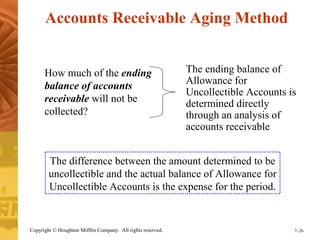
Accounts Receivable Aging Method 
How much of the ending 
balance of accounts 
receivable will not be 
collected? 
The ending balance of 
Allowance for 
Uncollectible Accounts is 
determined directly 
through an analysis of 
accounts receivable 
The difference between the amount determined to be 
uncollectible and the actual balance of Allowance for 
Uncollectible Accounts is the expense for the period. 
Copyright © Houghton Mifflin Company. All rights reserved. 7–26
7–27 
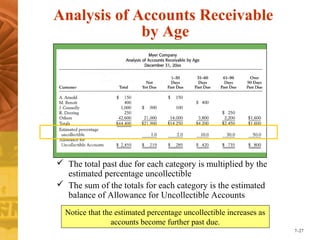
Analysis of Accounts Receivable 
by Age 
 The total past due for each category is multiplied by the 
estimated percentage uncollectible 
 The sum of the totals for each category is the estimated 
balance of Allowance for Uncollectible Accounts 
Notice that the estimated percentage uncollectible increases as 
accounts become further past due.
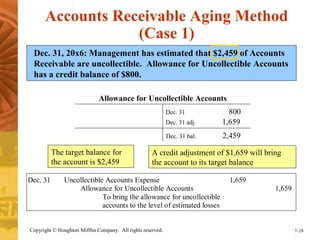
Accounts Receivable Aging Method 
(Case 1) 
Dec. 31, 20x6: Management has estimated that $2,459 of Accounts 
Receivable are uncollectible. Allowance for Uncollectible Accounts 
has a credit balance of $800. 
Allowance for Uncollectible Accounts 
Dec. 31 800 
Dec. 31 adj. 1,659 
Dec. 31 bal. 2,459 
A credit adjustment of $1,659 will bring 
the account to its target balance 
The target balance for 
the account is $2,459 
Dec. 31 Uncollectible Accounts Expense 1,659 
Allowance for Uncollectible Accounts 1,659 
To bring the allowance for uncollectible 
accounts to the level of estimated losses 
Copyright © Houghton Mifflin Company. All rights reserved. 7–28
Accounts Receivable Aging Method 
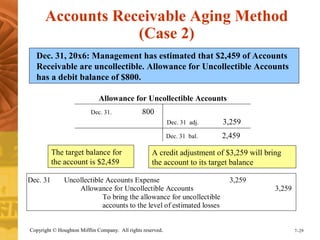
(Case 2) 
Dec. 31, 20x6: Management has estimated that $2,459 of Accounts 
Receivable are uncollectible. Allowance for Uncollectible Accounts 
has a debit balance of $800. 
Allowance for Uncollectible Accounts 
Dec. 31. 800 
Dec. 31 adj. 3,259 
Dec. 31 bal. 2,459 
A credit adjustment of $3,259 will bring 
the account to its target balance 
The target balance for 
the account is $2,459 
Dec. 31 Uncollectible Accounts Expense 3,259 
Allowance for Uncollectible Accounts 3,259 
To bring the allowance for uncollectible 
accounts to the level of estimated losses 
Copyright © Houghton Mifflin Company. All rights reserved. 7–29
Comparison of Two Methods 
Copyright © Houghton Mifflin Company. All rights reserved. 7–30
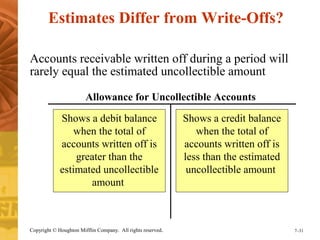
Estimates Differ from Write-Offs? 
Accounts receivable written off during a period will 
rarely equal the estimated uncollectible amount 
Allowance for Uncollectible Accounts 
Shows a credit balance 
when the total of 
accounts written off is 
less than the estimated 
uncollectible amount 
Shows a debit balance 
when the total of 
accounts written off is 
greater than the 
estimated uncollectible 
amount 
Copyright © Houghton Mifflin Company. All rights reserved. 7–31
Writing Off an Uncollectible Account 
When it becomes clear an account will not 
be collected, the amount should be written 
off to: 
• Allowance for Uncollectible Accounts 
• Accounts Receivable 
The uncollectible amount was already 
accounted for as an expense when the 
allowance was established 
Copyright © Houghton Mifflin Company. All rights reserved. 7–32
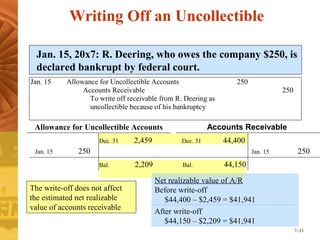
Jan. 15, 20x7: R. Deering, who owes the company $250, is 
declared bankrupt by federal court. 
7–33 
Writing Off an Uncollectible 
Jan. 15 Allowance for Uncollectible Accounts 250 
Accounts Receivable 250 
To write off receivable from R. Deering as 
uncollectible because of his bankruptcy 
Allowance for Uncollectible Accounts 
D e c . 3 1 2 , 4 5 9 
Bal. 2,209 
Net realizable value of A/R 
Before write-off 
$44,400 – $2,459 = $41,941 
Jan. 15 250 
The write-off does not affect 
the estimated net realizable 
value of accounts receivable 
Accounts Receivable 
Dec. 31 44,400 
Jan. 15 250 
Bal. 44,150 
After write-off 
$44,150 – $2,209 = $41,941
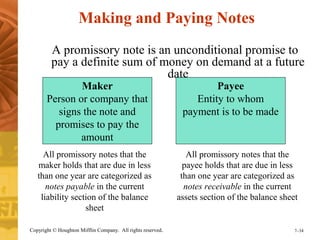
Making and Paying Notes 
A promissory note is an unconditional promise to 
pay a definite sum of money on demand at a future 
date 
Maker 
Person or company that 
signs the note and 
promises to pay the 
amount 
Payee 
Entity to whom 
payment is to be made 
All promissory notes that the 
payee holds that are due in less 
than one year are categorized as 
notes receivable in the current 
assets section of the balance sheet 
All promissory notes that the 
maker holds that are due in less 
than one year are categorized as 
notes payable in the current 
liability section of the balance 
sheet 
Copyright © Houghton Mifflin Company. All rights reserved. 7–34
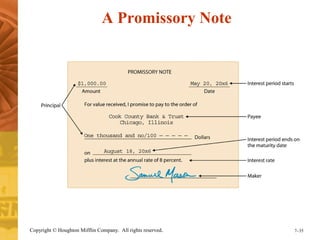
A Promissory Note 
Copyright © Houghton Mifflin Company. All rights reserved. 7–35
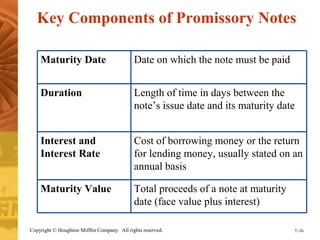
Key Components of Promissory Notes 
Maturity Date Date on which the note must be paid 
Length of time in days between the 
note’s issue date and its maturity date 
Cost of borrowing money or the return 
for lending money, usually stated on an 
annual basis 
Total proceeds of a note at maturity 
date (face value plus interest) 
Duration 
Interest and 
Interest Rate 
Maturity Value 
Copyright © Houghton Mifflin Company. All rights reserved. 7–36

Cash receivables management

  • 1.
    Chapter 7 Cashand Receivables Skyline College Lecture Notes
  • 2.
    Pivotal Issues WhenManaging Cash and Receivables 1. Cash needs 2. Credit policies 3. Level of accounts receivable 4. Financing receivables 5. Ethical estimates on credit sale losses Copyright © Houghton Mifflin Company. All rights reserved. 7–2
  • 3.
    Cash Considerations Mostliquid of all assets Central to operating cycle Consists of: Currency and coins on hand Checks and money orders from customers Deposits in checking and savings accounts Cash may include a compensating balance—a minimum amount required by a bank for a credit-granting agreement. Copyright © Houghton Mifflin Company. All rights reserved. 7–3
  • 4.
    Cash Requirements Seasonal Cycles and Cash Requirements for a Manufacturer of Athletic Sportswear Copyright © Houghton Mifflin Company. All rights reserved. 7–4
  • 5.
    Credit Policies Toincrease the likelihood of selling to customers who will pay on time, companies develop control procedures and maintain a credit department The credit department:  Examines the financial resources and debts of the credit applicant  Asks for personal references  Gets credit rating from credit bureaus  Determines the extent to which the company can grant credit, if any Copyright © Houghton Mifflin Company. All rights reserved. 7–5
  • 6.
    Evaluating the Levelof Accounts Receivable How many times, on average, does a company turn its receivables into cash during an accounting period? How long, on average, does it take a company to collect its accounts receivables? Receivable Turnover Days’ Sales Uncollected Copyright © Houghton Mifflin Company. All rights reserved. 7–6
  • 7.
    Receivable Turnover Reflectsthe relative size of a company’s accounts receivable and the success of its credit and collection policies Receivable Turnover = Net Sales Average Net Accounts Receivable $12,253.1 ($2,120.2 + $2,083.9) ÷ 2 (Amounts in Millions) Nike’s Receivable Turnover for 2004 = = 5.8 times Copyright © Houghton Mifflin Company. All rights reserved. 7–7
  • 8.
    Days’ Sales Uncollected To interpret a company’s ratios, take into consideration the industry in which it operates Days’ Sales Uncollected = Nike’s Days’ Sales Uncollected = 365 days Receivable Turnover 365 days 5.8 = 62.9 days Copyright © Houghton Mifflin Company. All rights reserved. 7–8
  • 9.
    Receivable Turnover for Selected Industries Copyright © Houghton Mifflin Company. All rights reserved. 7–9
  • 10.
    Financing Receivables Moneytied up in receivables is something that many companies seek to avoid Companies may use one or more of these methods so that they can receive cash faster: Set up a separate finance company Borrow money and pledge A/R In case of default on loan, A/R (collateral) can be taken and converted to cash to satisfy the loan Factor A/R Sale or transfer of A/R; the buyer may bear risk of collection (factoring without recourse) or the seller may bear risk of collection (factoring with recourse) Ford Ford Motor Credit Company GM General Motors Acceptance Corp. Sears Sears Roebuck Acceptance Corp. Copyright © Houghton Mifflin Company. All rights reserved. 7–10
  • 11.
    How Factoring Works Copyright © Houghton Mifflin Company. All rights reserved. 7–11
  • 12.
    Factoring Details Typically2% of total A/R for sales with recourse; Higher fee for sales without recourse Reports a contingent liability (a potential debt that can develop if customers don’t pay receivables) What fees are charged? What does the seller of receivables with recourse report in financials? Copyright © Houghton Mifflin Company. All rights reserved. 7–12
  • 13.
    Securitization A companymay sell a group of receivables in a batch at a discount to another company or to investors When receivables are paid, buyer gets full amount, thus their profit depends on the amount of discount they negotiated Circuit City Sells its receivables without recourse, so it has no further liability even if customers do not pay Copyright © Houghton Mifflin Company. All rights reserved. 7–13
  • 14.
    Discounting The saleof promissory notes held as notes receivable Company A Holds $10,000 note payable to Company B; Note will pay $600 in Bank Buys the note for $9,600 interest  If Company B pays, bank will receive $10,600 and realize a $1,000 profit  If Company B defaults, Company A is liable for the note Company A should disclose the contingent liability (in the amount of note plus interest) in notes to its financial statements Copyright © Houghton Mifflin Company. All rights reserved. 7–14
  • 15.
    Estimating Uncollectibles Therewill always be customers who do not pay their accounts, called uncollectible accounts, or bad debts Match these expenses of selling on credit to the revenues they help generate Estimate the uncollectible expense in the fiscal year in which the sales are made Copyright © Houghton Mifflin Company. All rights reserved. 7–15
  • 16.
    Estimating Uncollectibles andEthics Because estimations are involved, earnings may be easily manipulated… earnings are overstated. earnings are understated. If the amount of losses from uncollectible accounts are understated, If the amount of losses from uncollectible accounts are overstated, Copyright © Houghton Mifflin Company. All rights reserved. 7–16
  • 17.
    Discussion: Ethics inthe World WorldCom increased revenues and hid losses by continuing to bill customers for service for years after the customers had stopped paying. Q. What impact do you think WorldCom’s actions had on Accounts Receivable and Sales? Copyright © Houghton Mifflin Company. All rights reserved. 7–17
  • 18.
    Cash Equivalents Investmentslike time deposits or certificates of deposit (CDs) that have a term of 90 days or less Nike’s Annual Report, 2005 Cash and equivalents represent cash and short-term, highly liquid investments with original maturities of three months or less at the time of purchase. The carrying amounts reflected in the consolidated balance sheet for cash and equivalents approximate fair value due to their short maturities. Copyright © Houghton Mifflin Company. All rights reserved. 7–18
  • 19.
    Cash Control: ElectronicFunds Transfer (EFT) Method of conducting business transactions in which funds are transferred electronically from one bank to another bank Wal-Mart makes 75% of its payments to suppliers using EFT Electronic Banking ATM transactions Debit and credit card purchases Online bill-pay Copyright © Houghton Mifflin Company. All rights reserved. 7–19
  • 20.
    Direct Charge-Off Method Recognize a loss at the time it is determined that an account is uncollectible Date Uncollectible Accounts Expense XXX Tax law requires use of this method when computing taxable income Accounts Receivable XXX Most companies do not use this method for financial reporting purposes because it does not conform to GAAP. Copyright © Houghton Mifflin Company. All rights reserved. 7–20
  • 21.
    The Allowance Method Losses from bad debts are matched against the sales they help generate At the time of sale, management cannot identify which customers will not pay To observe the matching rule, losses from uncollectible accounts must be estimated The estimate becomes an expense in the fiscal year in which the sales are made Copyright © Houghton Mifflin Company. All rights reserved. 7–21
  • 22.
    Alternate Account Names Allowance for Uncollectible Accounts Uncollectible Accounts Expense Allowance for Doubtful Accounts Allowance for Bad Debts Bad Debts Expense Copyright © Houghton Mifflin Company. All rights reserved. 7–22
  • 23.
    Estimating Uncollectible Accounts • Estimated loss should be: Realistic Based on objective information Based on past experience Based on current economic conditions Two commonly used methods for estimating loss 1. Percentage of net sales method 2. Accounts receivable aging method Copyright © Houghton Mifflin Company. All rights reserved. 7–23
  • 24.
    Percentage of NetSales Method How much of this year’s net sales will not be collected? The answer determines the amount of uncollectible accounts expense for the year The percentage amount is ususally based on the company’s historic losses It ignores the difference between last year’s estimated losses and the actual losses incurred during the year Copyright © Houghton Mifflin Company. All rights reserved. 7–24
  • 25.
    Percentage of NetSales Method Dec. 31, 20x9: Account balances: Sales, $645,000; Sales Returns and Allowances, $40,000; Sales Discounts, $5,000; Allowance for Uncollectible Accounts, $3,600. Management estimates that uncollectible accounts will average about 2 percent of net sales. Uncollectible accounts expense = .02 x ($645,000 – $40,000 – $5,000) = $12,000 Dec. 31 Uncollectible Accounts Expense 12,000 Allowance for Uncollectible Accounts 12,000 To record the uncollectible accounts expense at 2 percent of $600,000 net sales Allowance for Uncollectible Accounts Dec. 31 3,600 Dec. 31 adj. 12,000 Dec 31 bal. 15,600 After the above entry is posted, Allowance for Uncollectible Accounts will have a credit balance of $15,600 Copyright © Houghton Mifflin Company. All rights reserved. 7–25
  • 26.
    Accounts Receivable AgingMethod How much of the ending balance of accounts receivable will not be collected? The ending balance of Allowance for Uncollectible Accounts is determined directly through an analysis of accounts receivable The difference between the amount determined to be uncollectible and the actual balance of Allowance for Uncollectible Accounts is the expense for the period. Copyright © Houghton Mifflin Company. All rights reserved. 7–26
  • 27.
    7–27 Analysis ofAccounts Receivable by Age  The total past due for each category is multiplied by the estimated percentage uncollectible  The sum of the totals for each category is the estimated balance of Allowance for Uncollectible Accounts Notice that the estimated percentage uncollectible increases as accounts become further past due.
  • 28.
    Accounts Receivable AgingMethod (Case 1) Dec. 31, 20x6: Management has estimated that $2,459 of Accounts Receivable are uncollectible. Allowance for Uncollectible Accounts has a credit balance of $800. Allowance for Uncollectible Accounts Dec. 31 800 Dec. 31 adj. 1,659 Dec. 31 bal. 2,459 A credit adjustment of $1,659 will bring the account to its target balance The target balance for the account is $2,459 Dec. 31 Uncollectible Accounts Expense 1,659 Allowance for Uncollectible Accounts 1,659 To bring the allowance for uncollectible accounts to the level of estimated losses Copyright © Houghton Mifflin Company. All rights reserved. 7–28
  • 29.
    Accounts Receivable AgingMethod (Case 2) Dec. 31, 20x6: Management has estimated that $2,459 of Accounts Receivable are uncollectible. Allowance for Uncollectible Accounts has a debit balance of $800. Allowance for Uncollectible Accounts Dec. 31. 800 Dec. 31 adj. 3,259 Dec. 31 bal. 2,459 A credit adjustment of $3,259 will bring the account to its target balance The target balance for the account is $2,459 Dec. 31 Uncollectible Accounts Expense 3,259 Allowance for Uncollectible Accounts 3,259 To bring the allowance for uncollectible accounts to the level of estimated losses Copyright © Houghton Mifflin Company. All rights reserved. 7–29
  • 30.
    Comparison of TwoMethods Copyright © Houghton Mifflin Company. All rights reserved. 7–30
  • 31.
    Estimates Differ fromWrite-Offs? Accounts receivable written off during a period will rarely equal the estimated uncollectible amount Allowance for Uncollectible Accounts Shows a credit balance when the total of accounts written off is less than the estimated uncollectible amount Shows a debit balance when the total of accounts written off is greater than the estimated uncollectible amount Copyright © Houghton Mifflin Company. All rights reserved. 7–31
  • 32.
    Writing Off anUncollectible Account When it becomes clear an account will not be collected, the amount should be written off to: • Allowance for Uncollectible Accounts • Accounts Receivable The uncollectible amount was already accounted for as an expense when the allowance was established Copyright © Houghton Mifflin Company. All rights reserved. 7–32
  • 33.
    Jan. 15, 20x7:R. Deering, who owes the company $250, is declared bankrupt by federal court. 7–33 Writing Off an Uncollectible Jan. 15 Allowance for Uncollectible Accounts 250 Accounts Receivable 250 To write off receivable from R. Deering as uncollectible because of his bankruptcy Allowance for Uncollectible Accounts D e c . 3 1 2 , 4 5 9 Bal. 2,209 Net realizable value of A/R Before write-off $44,400 – $2,459 = $41,941 Jan. 15 250 The write-off does not affect the estimated net realizable value of accounts receivable Accounts Receivable Dec. 31 44,400 Jan. 15 250 Bal. 44,150 After write-off $44,150 – $2,209 = $41,941
  • 34.
    Making and PayingNotes A promissory note is an unconditional promise to pay a definite sum of money on demand at a future date Maker Person or company that signs the note and promises to pay the amount Payee Entity to whom payment is to be made All promissory notes that the payee holds that are due in less than one year are categorized as notes receivable in the current assets section of the balance sheet All promissory notes that the maker holds that are due in less than one year are categorized as notes payable in the current liability section of the balance sheet Copyright © Houghton Mifflin Company. All rights reserved. 7–34
  • 35.
    A Promissory Note Copyright © Houghton Mifflin Company. All rights reserved. 7–35
  • 36.
    Key Components ofPromissory Notes Maturity Date Date on which the note must be paid Length of time in days between the note’s issue date and its maturity date Cost of borrowing money or the return for lending money, usually stated on an annual basis Total proceeds of a note at maturity date (face value plus interest) Duration Interest and Interest Rate Maturity Value Copyright © Houghton Mifflin Company. All rights reserved. 7–36