



Chapter 4 
Establishing Good Billing Practices 
to Avoid Collection Headaches 
In this chapter: 
•Getting prompt payment through effective billing practices 
•Keeping your billing practices organized 
•Training employees on billing procedures
Accounting and Billing operation 
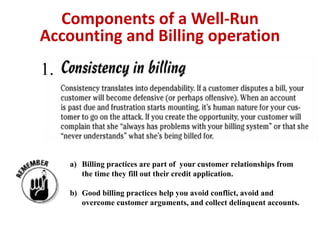
1. 
Components of a Well-Run 
a) Billing practices are part of your customer relationships from 
the time they fill out their credit application. 
b) Good billing practices help you avoid conflict, avoid and 
overcome customer arguments, and collect delinquent accounts.
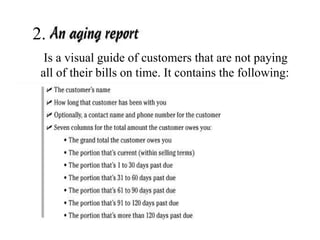
2. 
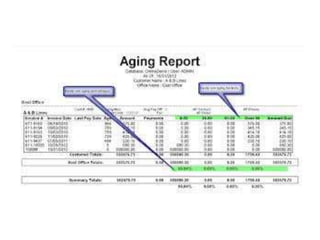
Is a visual guide of customers that are not paying 
all of their bills on time. It contains the following:
3. Interest charges for late payments 
• Charging interest on delinquent accounts, can 
help prompt your customer to want to pay your 
bills before interest starts to accrue. 
• You should disclose interest charges in your 
purchase contracts or credit applications.
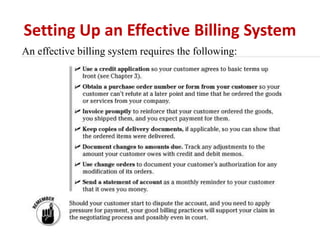
Setting Up an Effective Billing System 
An effective billing system requires the following:
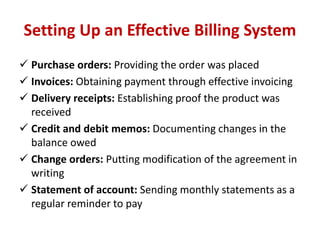
Setting Up an Effective Billing System 
 Purchase orders: Providing the order was placed 
 Invoices: Obtaining payment through effective invoicing 
 Delivery receipts: Establishing proof the product was 
received 
 Credit and debit memos: Documenting changes in the 
balance owed 
 Change orders: Putting modification of the agreement in 
writing 
 Statement of account: Sending monthly statements as a 
regular reminder to pay
Setting Up an Effective Billing System 
Purchase Orders are documents that your 
customer ordered your product or service. 
Invoices are the bill for the product or services 
rendered by your company to your customer. 
Delivery receipts are provided by carriers such 
as trucking companies that deliver your goods 
to your customers.
Credit & Debit Memos 
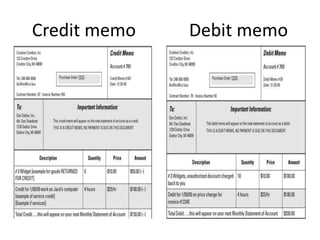
• Credit memo - is issued 
by you to document 
products or services 
that you provided to 
your customer but that 
were not received or 
were rejected or 
returned. 
• Debit memo – is 
typically issued when 
the customer fails to 
pay an invoice or pays 
less than the entire 
amount that is due.
Credit memo Debit memo
Change Orders 
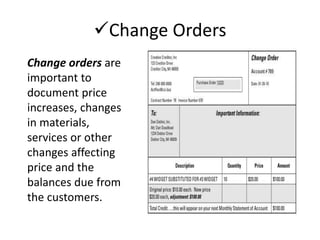
Change orders are 
important to 
document price 
increases, changes 
in materials, 
services or other 
changes affecting 
price and the 
balances due from 
the customers.
Statements of Account 
• A customer’s statement of account is a 
running ledger of the customers credit 
transactions, including all payments, 
payments, debits and credits. 
• It is a summary of your transactions with your 
customers over the course of billing period 
(usually in 30 days).
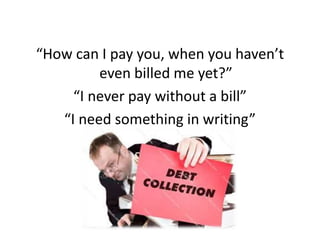
“How can I pay you, when you haven’t 
even billed me yet?” 
“I never pay without a bill” 
“I need something in writing”
Keeping Your Bills Accurate 
Creating an effective billing system 
Maintaining precise records 
 Making sure your forms don’t conflict with each other 
 Keep key records, like customer checks 
Sidestepping billing discrepancies by putting 
everything in writing
Getting Bad Accounts Off the Books: 
You Gotta Know When to Fold ‘Em 
• If the customer has been turned over for collection, 
the collection agencies make demands for payment 
using their own letters to pay the debt. 
• If a debtor files for bankruptcy and the debt is being 
handled by the bankruptcy court, you may be in 
violation of the bankruptcy law if you still send bills 
and notices to the debtor.
Training Your Staff in Billing Matters 
Inputting data accurately 
Using the correct forms 
Respecting confidential and sensitive data
Chapter 5 
Spotting and Reacting to 
Changes in Habit 
In this chapter: 
•Setting controls to maintain cash flow 
•Avoiding payment slowdowns 
•Dealing with customers’ excuses for slow payment 
•Handling changes in customers’ payment behavior 
•Tracking down elusive customers
General Controls for Keeping Your 
Cash Flow Steady 
Be aware of slowing payments 
Be ready to respond to customers bad habits 
Be considerate, yet firm 
Be prepared to reduce a line of credit, require 
(COD) cash on credit or cut off deliveries or 
services 
Be honest in your 
communications
Tailoring Your Strategy: A Short Leash 
for New Customers 
A. Setting tighter controls for newer customers 
 Put the customer on a short leash, such as a 15-day watch 
list, so you detect a slowdown in payments almost 
immediately. 
 Be ready to turn off the credit faucet: No credit if no 
payment. 
 Hold up further deliveries of your goods or services until 
the customer pay his late invoices. 
 Get additional assurance of payment, such as liens, 
guarantees, and promissory notes.
Tailoring Your Strategy: A Short Leash 
for New Customers (continued) 
B. Helping out timely payers 
 Extending their payment terms ( for example , payments 
due in 45 days instead of 30). 
 Forgiving some service charges on the account 
 Offering a discount for early payment
Spotting Trends and Patterns of Payment 
Keeping an eye (and ear) on your customer 
Monitoring industry trends and bracing for 
slowdowns 
Speeding up slow payers 
• Starting with a letter 
• Following up with a phone call 
Reacting to customers’ excuses, bad habits, and 
broken promises
Spotting Dubious Changes 
Changes in ownership of a client business 
Changes of address or phone number 
Changes in order volume 
• A decline in orders often precedes a decline in payment 
diligence. 
• An unexpected increase in orders 
Changes in financial situation 
Changes in customer attitude 
Changes your customer’s understanding of 
purchase or credit terms
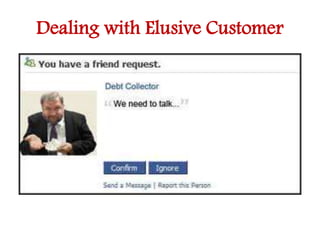
Dealing with Elusive Customer 
1) Breaking free from voice mail jail 
2) Detouring around the disconnected phone 
 Showing up on the debtor’s doorstep 
 E-mailing 
 Faxing 
 Texting 
Elusion is a definite red flag. Put the customer at the 
top of your list for monitoring payments and 
exercise extreme caution when considering any 
further extensions of credit.
Dealing with Elusive Customer
Chapter 7 
When Your Late-Paying 
Customer Turns into Your Debtor 
In this chapter: 
•Creating a sense of urgency for payments 
•Using frequent payment reminders effectively 
•Establishing a good paper trail
Creating an Atmosphere of Urgency 
Interest and penalties 
Attention getting words and “big red letters” 
Frequent reminders 
Multiple of modes of contact 
Making a phone call
Communicating Effective 
Reminders to Pay 
Writing effective collection letters 
• Keep it short 
• Use simple words, short sentences and paragraphs 
• Customize the letter 
• Demand payment by a specific date 
Special concerns for consumer debtors 
Still not paid? Escalating your approach 
Customizing your notification approach 
Don’t forget the power of a phone call
Documenting the File: Having Good 
Notes When You Need Them 
Your customer’s entire credit file 
Notes of phone calls made or received, along with 
dates and responses 
Notes made by employees of your company 
Copies of all follow-up statements 
Copies of all demand letters and follow up 
correspondence
Documenting the File: Having Good 
Notes When You Need Them 
1) The paper trail: How good records help you both 
in and out of court 
2) Anticipating reactions: Playing devil’s advocate 
3) Pursuing written admissions of the debt
Establishing Good Billing Practices to Avoid Collection Headaches

Establishing Good Billing Practices to Avoid Collection Headaches

  • 2.
    Chapter 4 EstablishingGood Billing Practices to Avoid Collection Headaches In this chapter: •Getting prompt payment through effective billing practices •Keeping your billing practices organized •Training employees on billing procedures
  • 3.
    Accounting and Billingoperation 1. Components of a Well-Run a) Billing practices are part of your customer relationships from the time they fill out their credit application. b) Good billing practices help you avoid conflict, avoid and overcome customer arguments, and collect delinquent accounts.
  • 4.
    2. Is avisual guide of customers that are not paying all of their bills on time. It contains the following:
  • 6.
    3. Interest chargesfor late payments • Charging interest on delinquent accounts, can help prompt your customer to want to pay your bills before interest starts to accrue. • You should disclose interest charges in your purchase contracts or credit applications.
  • 7.
    Setting Up anEffective Billing System An effective billing system requires the following:
  • 8.
    Setting Up anEffective Billing System  Purchase orders: Providing the order was placed  Invoices: Obtaining payment through effective invoicing  Delivery receipts: Establishing proof the product was received  Credit and debit memos: Documenting changes in the balance owed  Change orders: Putting modification of the agreement in writing  Statement of account: Sending monthly statements as a regular reminder to pay
  • 9.
    Setting Up anEffective Billing System Purchase Orders are documents that your customer ordered your product or service. Invoices are the bill for the product or services rendered by your company to your customer. Delivery receipts are provided by carriers such as trucking companies that deliver your goods to your customers.
  • 10.
    Credit & DebitMemos • Credit memo - is issued by you to document products or services that you provided to your customer but that were not received or were rejected or returned. • Debit memo – is typically issued when the customer fails to pay an invoice or pays less than the entire amount that is due.
  • 11.
  • 12.
    Change Orders Changeorders are important to document price increases, changes in materials, services or other changes affecting price and the balances due from the customers.
  • 13.
    Statements of Account • A customer’s statement of account is a running ledger of the customers credit transactions, including all payments, payments, debits and credits. • It is a summary of your transactions with your customers over the course of billing period (usually in 30 days).
  • 14.
    “How can Ipay you, when you haven’t even billed me yet?” “I never pay without a bill” “I need something in writing”
  • 15.
    Keeping Your BillsAccurate Creating an effective billing system Maintaining precise records  Making sure your forms don’t conflict with each other  Keep key records, like customer checks Sidestepping billing discrepancies by putting everything in writing
  • 16.
    Getting Bad AccountsOff the Books: You Gotta Know When to Fold ‘Em • If the customer has been turned over for collection, the collection agencies make demands for payment using their own letters to pay the debt. • If a debtor files for bankruptcy and the debt is being handled by the bankruptcy court, you may be in violation of the bankruptcy law if you still send bills and notices to the debtor.
  • 17.
    Training Your Staffin Billing Matters Inputting data accurately Using the correct forms Respecting confidential and sensitive data
  • 19.
    Chapter 5 Spottingand Reacting to Changes in Habit In this chapter: •Setting controls to maintain cash flow •Avoiding payment slowdowns •Dealing with customers’ excuses for slow payment •Handling changes in customers’ payment behavior •Tracking down elusive customers
  • 20.
    General Controls forKeeping Your Cash Flow Steady Be aware of slowing payments Be ready to respond to customers bad habits Be considerate, yet firm Be prepared to reduce a line of credit, require (COD) cash on credit or cut off deliveries or services Be honest in your communications
  • 21.
    Tailoring Your Strategy:A Short Leash for New Customers A. Setting tighter controls for newer customers  Put the customer on a short leash, such as a 15-day watch list, so you detect a slowdown in payments almost immediately.  Be ready to turn off the credit faucet: No credit if no payment.  Hold up further deliveries of your goods or services until the customer pay his late invoices.  Get additional assurance of payment, such as liens, guarantees, and promissory notes.
  • 22.
    Tailoring Your Strategy:A Short Leash for New Customers (continued) B. Helping out timely payers  Extending their payment terms ( for example , payments due in 45 days instead of 30).  Forgiving some service charges on the account  Offering a discount for early payment
  • 23.
    Spotting Trends andPatterns of Payment Keeping an eye (and ear) on your customer Monitoring industry trends and bracing for slowdowns Speeding up slow payers • Starting with a letter • Following up with a phone call Reacting to customers’ excuses, bad habits, and broken promises
  • 24.
    Spotting Dubious Changes Changes in ownership of a client business Changes of address or phone number Changes in order volume • A decline in orders often precedes a decline in payment diligence. • An unexpected increase in orders Changes in financial situation Changes in customer attitude Changes your customer’s understanding of purchase or credit terms
  • 25.
    Dealing with ElusiveCustomer 1) Breaking free from voice mail jail 2) Detouring around the disconnected phone  Showing up on the debtor’s doorstep  E-mailing  Faxing  Texting Elusion is a definite red flag. Put the customer at the top of your list for monitoring payments and exercise extreme caution when considering any further extensions of credit.
  • 26.
  • 28.
    Chapter 7 WhenYour Late-Paying Customer Turns into Your Debtor In this chapter: •Creating a sense of urgency for payments •Using frequent payment reminders effectively •Establishing a good paper trail
  • 29.
    Creating an Atmosphereof Urgency Interest and penalties Attention getting words and “big red letters” Frequent reminders Multiple of modes of contact Making a phone call
  • 30.
    Communicating Effective Remindersto Pay Writing effective collection letters • Keep it short • Use simple words, short sentences and paragraphs • Customize the letter • Demand payment by a specific date Special concerns for consumer debtors Still not paid? Escalating your approach Customizing your notification approach Don’t forget the power of a phone call
  • 31.
    Documenting the File:Having Good Notes When You Need Them Your customer’s entire credit file Notes of phone calls made or received, along with dates and responses Notes made by employees of your company Copies of all follow-up statements Copies of all demand letters and follow up correspondence
  • 32.
    Documenting the File:Having Good Notes When You Need Them 1) The paper trail: How good records help you both in and out of court 2) Anticipating reactions: Playing devil’s advocate 3) Pursuing written admissions of the debt