MEANING OF PROVISIONS
The term “provision” means any amount written
off or retained by way of providing depreciation ,
or retained by way of providing for any known
liability .
Accounting Treatment for Provisions
Provision for Doubtful debts
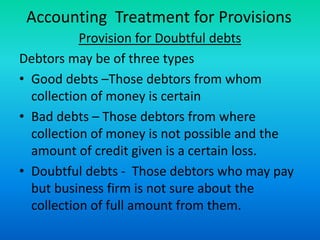
Debtors may be of three types
• Good debts –Those debtors from whom
collection of money is certain
• Bad debts – Those debtors from where
collection of money is not possible and the
amount of credit given is a certain loss.
• Doubtful debts - Those debtors who may pay
but business firm is not sure about the
collection of full amount from them.
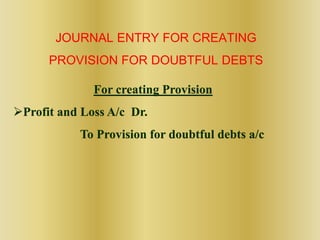
JOURNAL ENTRY FOR CREATING
PROVISION FOR DOUBTFUL DEBTS
For creating Provision
Profit and Loss A/c Dr.
To Provision for doubtful debts a/c
Anysumwhich isappropriated outof profitand
lossappropriationaccountand is not meantto
coverupliability, contingency, commitment,or
reduction inthevalueof anasset isareserve.
RESERVES
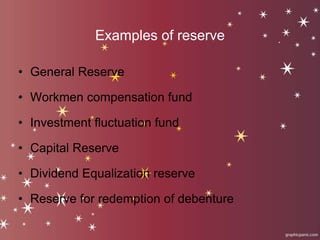
Examples of reserve
• General Reserve
• Workmen compensation fund
• Investment fluctuation fund
• Capital Reserve
• Dividend Equalization reserve
• Reserve for redemption of debenture
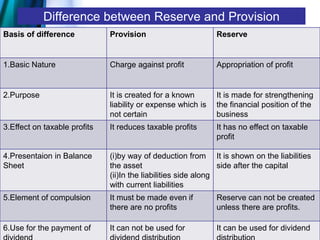
Difference between Reserve and Provision
Basis of difference Provision Reserve
1.Basic Nature Charge against profit Appropriation of profit
2.Purpose It is created for a known
liability or expense which is
not certain
It is made for strengthening
the financial position of the
business
3.Effect on taxable profits It reduces taxable profits It has no effect on taxable
profit
4.Presentaion in Balance
Sheet
(i)by way of deduction from
the asset
(ii)In the liabilities side along
with current liabilities
It is shown on the liabilities
side after the capital
5.Element of compulsion It must be made even if
there are no profits
Reserve can not be created
unless there are profits.
6.Use for the payment of It can not be used for It can be used for dividend
TYPES OF RESERVES
• General reserve
• Specific reserve
• Revenue reserve
• Capital reserve
General Reserve
• When the purpose for which the reserve is
created is not specified, it is called general
reserve. It is also termed as free
• reserve.
SPECIFIC RESERVE
Specific reserve is created for some specific purpose
and can be utilized only for that purpose.
• Examples
(i).Dividend equalization reserve. This reserve is
created to stabilize or maintain dividend rate.
(ii)Workmen compensation fund. It is created to
provide for claims of the workers due to accident
(iii)Investment fluctuation fund. It is created to provide
for claims of the workers due to accident
(iv)Debenture redemption reserve. It is created to
provide funds for redemption of debentures
Revenue Reserve
• Revenue reserves are created from revenue profits
which arise out of the normal operating activities of the
business.
Examples
• General reserve
• Workmen compensation fund
• Investment fluctuation fund
• Dividend equalization reserve
CAPITAL RESERVE
These are created out of capital profits which do not arise
from the normal operating activities. Such reserves are not
available for distribution as dividend.
Examples of capital profits are: -
Premium on issue of shares or debentures
Profit on sale of fixed assets
Profit on redemption of debentures
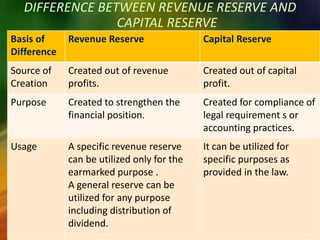
DIFFERENCE BETWEEN REVENUE RESERVE AND
CAPITAL RESERVE
Basis of
Difference
Revenue Reserve Capital Reserve
Source of
Creation
Created out of revenue
profits.
Created out of capital
profit.
Purpose Created to strengthen the
financial position.
Created for compliance of
legal requirement s or
accounting practices.
Usage A specific revenue reserve
can be utilized only for the
earmarked purpose .
A general reserve can be
utilized for any purpose
including distribution of
dividend.
It can be utilized for
specific purposes as
provided in the law.
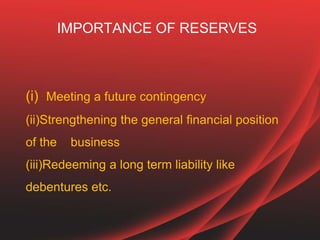
(i) Meeting a future contingency
(ii)Strengthening the general financial position
of the business
(iii)Redeeming a long term liability like
debentures etc.
IMPORTANCE OF RESERVES
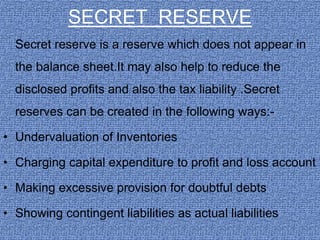
SECRET RESERVE
Secret reserve is a reserve which does not appear in
the balance sheet.It may also help to reduce the
disclosed profits and also the tax liability .Secret
reserves can be created in the following ways:-
• Undervaluation of Inventories
• Charging capital expenditure to profit and loss account
• Making excessive provision for doubtful debts
• Showing contingent liabilities as actual liabilities
….

Reserves and provisions

  • 1.
    MEANING OF PROVISIONS Theterm “provision” means any amount written off or retained by way of providing depreciation , or retained by way of providing for any known liability .
  • 3.
    Accounting Treatment forProvisions Provision for Doubtful debts Debtors may be of three types • Good debts –Those debtors from whom collection of money is certain • Bad debts – Those debtors from where collection of money is not possible and the amount of credit given is a certain loss. • Doubtful debts - Those debtors who may pay but business firm is not sure about the collection of full amount from them.
  • 4.
    JOURNAL ENTRY FORCREATING PROVISION FOR DOUBTFUL DEBTS For creating Provision Profit and Loss A/c Dr. To Provision for doubtful debts a/c
  • 5.
    Anysumwhich isappropriated outofprofitand lossappropriationaccountand is not meantto coverupliability, contingency, commitment,or reduction inthevalueof anasset isareserve.
  • 6.
  • 7.
    Examples of reserve •General Reserve • Workmen compensation fund • Investment fluctuation fund • Capital Reserve • Dividend Equalization reserve • Reserve for redemption of debenture
  • 8.
    Difference between Reserveand Provision Basis of difference Provision Reserve 1.Basic Nature Charge against profit Appropriation of profit 2.Purpose It is created for a known liability or expense which is not certain It is made for strengthening the financial position of the business 3.Effect on taxable profits It reduces taxable profits It has no effect on taxable profit 4.Presentaion in Balance Sheet (i)by way of deduction from the asset (ii)In the liabilities side along with current liabilities It is shown on the liabilities side after the capital 5.Element of compulsion It must be made even if there are no profits Reserve can not be created unless there are profits. 6.Use for the payment of It can not be used for It can be used for dividend
  • 9.
    TYPES OF RESERVES •General reserve • Specific reserve • Revenue reserve • Capital reserve
  • 10.
    General Reserve • Whenthe purpose for which the reserve is created is not specified, it is called general reserve. It is also termed as free • reserve.
  • 11.
    SPECIFIC RESERVE Specific reserveis created for some specific purpose and can be utilized only for that purpose. • Examples (i).Dividend equalization reserve. This reserve is created to stabilize or maintain dividend rate. (ii)Workmen compensation fund. It is created to provide for claims of the workers due to accident (iii)Investment fluctuation fund. It is created to provide for claims of the workers due to accident (iv)Debenture redemption reserve. It is created to provide funds for redemption of debentures
  • 12.
    Revenue Reserve • Revenuereserves are created from revenue profits which arise out of the normal operating activities of the business. Examples • General reserve • Workmen compensation fund • Investment fluctuation fund • Dividend equalization reserve
  • 13.
    CAPITAL RESERVE These arecreated out of capital profits which do not arise from the normal operating activities. Such reserves are not available for distribution as dividend. Examples of capital profits are: - Premium on issue of shares or debentures Profit on sale of fixed assets Profit on redemption of debentures
  • 14.
    DIFFERENCE BETWEEN REVENUERESERVE AND CAPITAL RESERVE Basis of Difference Revenue Reserve Capital Reserve Source of Creation Created out of revenue profits. Created out of capital profit. Purpose Created to strengthen the financial position. Created for compliance of legal requirement s or accounting practices. Usage A specific revenue reserve can be utilized only for the earmarked purpose . A general reserve can be utilized for any purpose including distribution of dividend. It can be utilized for specific purposes as provided in the law.
  • 15.
    (i) Meeting afuture contingency (ii)Strengthening the general financial position of the business (iii)Redeeming a long term liability like debentures etc. IMPORTANCE OF RESERVES
  • 16.
    SECRET RESERVE Secret reserveis a reserve which does not appear in the balance sheet.It may also help to reduce the disclosed profits and also the tax liability .Secret reserves can be created in the following ways:- • Undervaluation of Inventories • Charging capital expenditure to profit and loss account • Making excessive provision for doubtful debts • Showing contingent liabilities as actual liabilities
  • 17.