


Copyright © 2003 by The McGraw-Hill Companies, Inc. All rights reserved.
Chapter Procedural Justice And 11 
Ethics in Employee 
Copyright © 2003 by The McGraw-Hill Companies, Inc. All rights reserved. 
Relations
Copyright © 2003 by The McGraw-Hill Companies, Inc. All rights reserved. 
DDeeffiinniittiioonnss 
 Employee relations – all of the practices that implement the 
philosophy and policy of an organization with respect to 
employment 
 Justice – the maintenance or administration of what is just, 
especially by the impartial adjustment of conflicting claims or the 
assignment of merited rewards or punishments 
 Procedural justice –the fairness of the procedures used to make 
decisions. Procedures are fair to the extent that they are consistent 
across persons and over time, free from bias, based on accurate 
information, correctable, and based on prevailing moral and ethical 
standards
Copyright © 2003 by The McGraw-Hill Companies, Inc. All rights reserved. 
DDeeffiinniittiioonnss 
 Distributive justice –fairness of the outcomes of decisions, for 
example, in the allocation of bonuses or merit pay, or in making 
reasonable accommodations for employees with disabilities 
 Due process – in legal proceedings provides individuals with rights 
as set forth by the Constitution of the United States. 
 Protects individual rights with respect to state, municipal, and federal 
government processes 
 Normally does not apply to work situations. 
 Employee rights to due process are based on a collective bargaining 
agreement, on legislative protections, or on procedures provided 
unilaterally by an employer
Copyright © 2003 by The McGraw-Hill Companies, Inc. All rights reserved. 
DDeeffiinniittiioonnss 
 Ethical decisions about behavior – concern one’s conformity to 
moral standards or to the standards of conduct of a given profession 
or group 
 Ethical decisions take account not only of one’s own interests, but also 
equally of the interests of those affected by the decision
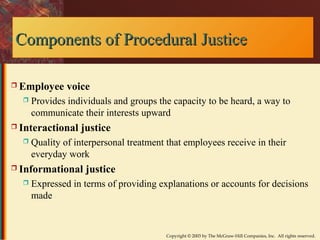
Components of PPrroocceedduurraall JJuussttiiccee 
Copyright © 2003 by The McGraw-Hill Companies, Inc. All rights reserved. 
 Employee voice 
 Provides individuals and groups the capacity to be heard, a way to 
communicate their interests upward 
 Interactional justice 
 Quality of interpersonal treatment that employees receive in their 
everyday work 
 Informational justice 
 Expressed in terms of providing explanations or accounts for decisions 
made
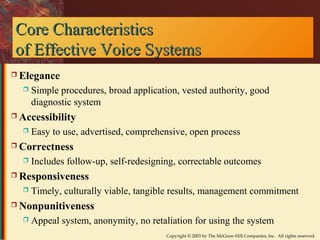
CCoorree CChhaarraacctteerriissttiiccss 
ooff EEffffeeccttiivvee VVooiiccee SSyysstteemmss 
Copyright © 2003 by The McGraw-Hill Companies, Inc. All rights reserved. 
 Elegance 
 Simple procedures, broad application, vested authority, good 
diagnostic system 
 Accessibility 
 Easy to use, advertised, comprehensive, open process 
 Correctness 
 Includes follow-up, self-redesigning, correctable outcomes 
 Responsiveness 
 Timely, culturally viable, tangible results, management commitment 
 Nonpunitiveness 
 Appeal system, anonymity, no retaliation for using the system
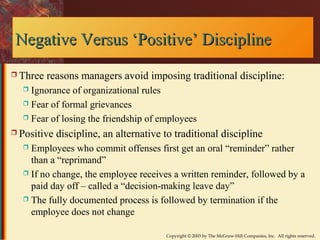
Negative Versus ‘‘PPoossiittiivvee’’ DDiisscciipplliinnee 
 Three reasons managers avoid imposing traditional discipline: 
 Ignorance of organizational rules 
 Fear of formal grievances 
 Fear of losing the friendship of employees 
 Positive discipline, an alternative to traditional discipline 
 Employees who commit offenses first get an oral “reminder” rather 
than a “reprimand” 
 If no change, the employee receives a written reminder, followed by a 
paid day off – called a “decision-making leave day” 
 The fully documented process is followed by termination if the 
employee does not change 
Copyright © 2003 by The McGraw-Hill Companies, Inc. All rights reserved.
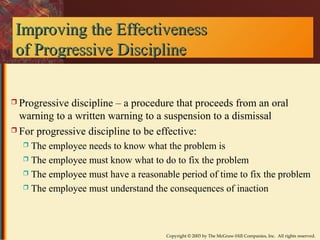
IImmpprroovviinngg tthhee EEffffeeccttiivveenneessss 
ooff PPrrooggrreessssiivvee DDiisscciipplliinnee 
 Progressive discipline – a procedure that proceeds from an oral 
warning to a written warning to a suspension to a dismissal 
 For progressive discipline to be effective: 
 The employee needs to know what the problem is 
 The employee must know what to do to fix the problem 
 The employee must have a reasonable period of time to fix the problem 
 The employee must understand the consequences of inaction 
Copyright © 2003 by The McGraw-Hill Companies, Inc. All rights reserved.
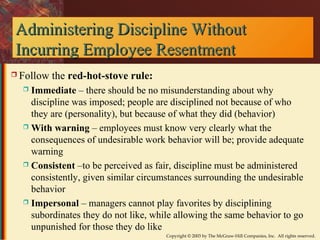
Administering DDiisscciipplliinnee WWiitthhoouutt 
IInnccuurrrriinngg EEmmppllooyyeeee RReesseennttmmeenntt 
Copyright © 2003 by The McGraw-Hill Companies, Inc. All rights reserved. 
 Follow the red-hot-stove rule: 
 Immediate – there should be no misunderstanding about why 
discipline was imposed; people are disciplined not because of who 
they are (personality), but because of what they did (behavior) 
 With warning – employees must know very clearly what the 
consequences of undesirable work behavior will be; provide adequate 
warning 
 Consistent –to be perceived as fair, discipline must be administered 
consistently, given similar circumstances surrounding the undesirable 
behavior 
 Impersonal – managers cannot play favorites by disciplining 
subordinates they do not like, while allowing the same behavior to go 
unpunished for those they do like
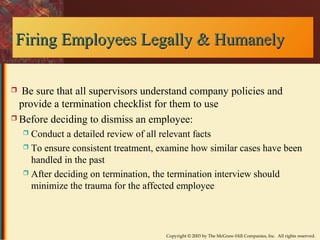
Firing Employees LLeeggaallllyy && HHuummaanneellyy 
 Be sure that all supervisors understand company policies and 
provide a termination checklist for them to use 
 Before deciding to dismiss an employee: 
 Conduct a detailed review of all relevant facts 
 To ensure consistent treatment, examine how similar cases have been 
handled in the past 
 After deciding on termination, the termination interview should 
minimize the trauma for the affected employee 
Copyright © 2003 by The McGraw-Hill Companies, Inc. All rights reserved.
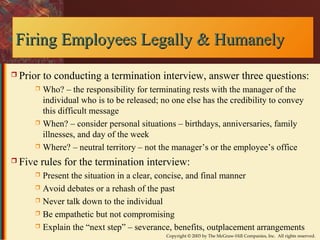
Firing Employees LLeeggaallllyy && HHuummaanneellyy 
 Prior to conducting a termination interview, answer three questions: 
 Who? – the responsibility for terminating rests with the manager of the 
individual who is to be released; no one else has the credibility to convey 
this difficult message 
 When? – consider personal situations – birthdays, anniversaries, family 
illnesses, and day of the week 
 Where? – neutral territory – not the manager’s or the employee’s office 
 Five rules for the termination interview: 
 Present the situation in a clear, concise, and final manner 
 Avoid debates or a rehash of the past 
 Never talk down to the individual 
 Be empathetic but not compromising 
 Explain the “next step” – severance, benefits, outplacement arrangements 
Copyright © 2003 by The McGraw-Hill Companies, Inc. All rights reserved.
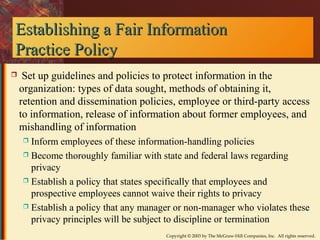
Establishing aa FFaaiirr IInnffoorrmmaattiioonn 
PPrraaccttiiccee PPoolliiccyy 
 Set up guidelines and policies to protect information in the 
organization: types of data sought, methods of obtaining it, 
retention and dissemination policies, employee or third-party access 
to information, release of information about former employees, and 
mishandling of information 
 Inform employees of these information-handling policies 
 Become thoroughly familiar with state and federal laws regarding 
privacy 
 Establish a policy that states specifically that employees and 
prospective employees cannot waive their rights to privacy 
 Establish a policy that any manager or non-manager who violates these 
privacy principles will be subject to discipline or termination 
Copyright © 2003 by The McGraw-Hill Companies, Inc. All rights reserved.
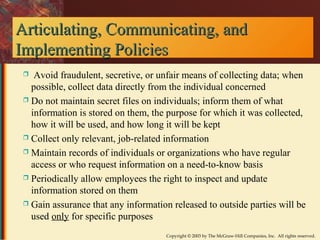
Articulating, CCoommmmuunniiccaattiinngg,, aanndd 
IImmpplleemmeennttiinngg PPoolliicciieess 
 Avoid fraudulent, secretive, or unfair means of collecting data; when 
possible, collect data directly from the individual concerned 
 Do not maintain secret files on individuals; inform them of what 
information is stored on them, the purpose for which it was collected, 
how it will be used, and how long it will be kept 
 Collect only relevant, job-related information 
 Maintain records of individuals or organizations who have regular 
access or who request information on a need-to-know basis 
 Periodically allow employees the right to inspect and update 
information stored on them 
 Gain assurance that any information released to outside parties will be 
used only for specific purposes 
Copyright © 2003 by The McGraw-Hill Companies, Inc. All rights reserved.
Copyright © 2003 by The McGraw-Hill Companies, Inc. All rights reserved. 
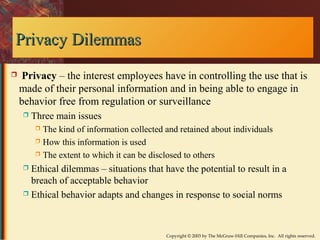
PPrriivvaaccyy DDiilleemmmmaass 
 Privacy – the interest employees have in controlling the use that is 
made of their personal information and in being able to engage in 
behavior free from regulation or surveillance 
 Three main issues 
 The kind of information collected and retained about individuals 
 How this information is used 
 The extent to which it can be disclosed to others 
 Ethical dilemmas – situations that have the potential to result in a 
breach of acceptable behavior 
 Ethical behavior adapts and changes in response to social norms

ethics in employee relations

  • 1.
    Copyright © 2003by The McGraw-Hill Companies, Inc. All rights reserved.
  • 2.
    Chapter Procedural JusticeAnd 11 Ethics in Employee Copyright © 2003 by The McGraw-Hill Companies, Inc. All rights reserved. Relations
  • 3.
    Copyright © 2003by The McGraw-Hill Companies, Inc. All rights reserved. DDeeffiinniittiioonnss  Employee relations – all of the practices that implement the philosophy and policy of an organization with respect to employment  Justice – the maintenance or administration of what is just, especially by the impartial adjustment of conflicting claims or the assignment of merited rewards or punishments  Procedural justice –the fairness of the procedures used to make decisions. Procedures are fair to the extent that they are consistent across persons and over time, free from bias, based on accurate information, correctable, and based on prevailing moral and ethical standards
  • 4.
    Copyright © 2003by The McGraw-Hill Companies, Inc. All rights reserved. DDeeffiinniittiioonnss  Distributive justice –fairness of the outcomes of decisions, for example, in the allocation of bonuses or merit pay, or in making reasonable accommodations for employees with disabilities  Due process – in legal proceedings provides individuals with rights as set forth by the Constitution of the United States.  Protects individual rights with respect to state, municipal, and federal government processes  Normally does not apply to work situations.  Employee rights to due process are based on a collective bargaining agreement, on legislative protections, or on procedures provided unilaterally by an employer
  • 5.
    Copyright © 2003by The McGraw-Hill Companies, Inc. All rights reserved. DDeeffiinniittiioonnss  Ethical decisions about behavior – concern one’s conformity to moral standards or to the standards of conduct of a given profession or group  Ethical decisions take account not only of one’s own interests, but also equally of the interests of those affected by the decision
  • 6.
    Components of PPrroocceedduurraallJJuussttiiccee Copyright © 2003 by The McGraw-Hill Companies, Inc. All rights reserved.  Employee voice  Provides individuals and groups the capacity to be heard, a way to communicate their interests upward  Interactional justice  Quality of interpersonal treatment that employees receive in their everyday work  Informational justice  Expressed in terms of providing explanations or accounts for decisions made
  • 7.
    CCoorree CChhaarraacctteerriissttiiccss ooffEEffffeeccttiivvee VVooiiccee SSyysstteemmss Copyright © 2003 by The McGraw-Hill Companies, Inc. All rights reserved.  Elegance  Simple procedures, broad application, vested authority, good diagnostic system  Accessibility  Easy to use, advertised, comprehensive, open process  Correctness  Includes follow-up, self-redesigning, correctable outcomes  Responsiveness  Timely, culturally viable, tangible results, management commitment  Nonpunitiveness  Appeal system, anonymity, no retaliation for using the system
  • 8.
    Negative Versus ‘‘PPoossiittiivvee’’DDiisscciipplliinnee  Three reasons managers avoid imposing traditional discipline:  Ignorance of organizational rules  Fear of formal grievances  Fear of losing the friendship of employees  Positive discipline, an alternative to traditional discipline  Employees who commit offenses first get an oral “reminder” rather than a “reprimand”  If no change, the employee receives a written reminder, followed by a paid day off – called a “decision-making leave day”  The fully documented process is followed by termination if the employee does not change Copyright © 2003 by The McGraw-Hill Companies, Inc. All rights reserved.
  • 9.
    IImmpprroovviinngg tthhee EEffffeeccttiivveenneessss ooff PPrrooggrreessssiivvee DDiisscciipplliinnee  Progressive discipline – a procedure that proceeds from an oral warning to a written warning to a suspension to a dismissal  For progressive discipline to be effective:  The employee needs to know what the problem is  The employee must know what to do to fix the problem  The employee must have a reasonable period of time to fix the problem  The employee must understand the consequences of inaction Copyright © 2003 by The McGraw-Hill Companies, Inc. All rights reserved.
  • 10.
    Administering DDiisscciipplliinnee WWiitthhoouutt IInnccuurrrriinngg EEmmppllooyyeeee RReesseennttmmeenntt Copyright © 2003 by The McGraw-Hill Companies, Inc. All rights reserved.  Follow the red-hot-stove rule:  Immediate – there should be no misunderstanding about why discipline was imposed; people are disciplined not because of who they are (personality), but because of what they did (behavior)  With warning – employees must know very clearly what the consequences of undesirable work behavior will be; provide adequate warning  Consistent –to be perceived as fair, discipline must be administered consistently, given similar circumstances surrounding the undesirable behavior  Impersonal – managers cannot play favorites by disciplining subordinates they do not like, while allowing the same behavior to go unpunished for those they do like
  • 11.
    Firing Employees LLeeggaallllyy&& HHuummaanneellyy  Be sure that all supervisors understand company policies and provide a termination checklist for them to use  Before deciding to dismiss an employee:  Conduct a detailed review of all relevant facts  To ensure consistent treatment, examine how similar cases have been handled in the past  After deciding on termination, the termination interview should minimize the trauma for the affected employee Copyright © 2003 by The McGraw-Hill Companies, Inc. All rights reserved.
  • 12.
    Firing Employees LLeeggaallllyy&& HHuummaanneellyy  Prior to conducting a termination interview, answer three questions:  Who? – the responsibility for terminating rests with the manager of the individual who is to be released; no one else has the credibility to convey this difficult message  When? – consider personal situations – birthdays, anniversaries, family illnesses, and day of the week  Where? – neutral territory – not the manager’s or the employee’s office  Five rules for the termination interview:  Present the situation in a clear, concise, and final manner  Avoid debates or a rehash of the past  Never talk down to the individual  Be empathetic but not compromising  Explain the “next step” – severance, benefits, outplacement arrangements Copyright © 2003 by The McGraw-Hill Companies, Inc. All rights reserved.
  • 13.
    Establishing aa FFaaiirrIInnffoorrmmaattiioonn PPrraaccttiiccee PPoolliiccyy  Set up guidelines and policies to protect information in the organization: types of data sought, methods of obtaining it, retention and dissemination policies, employee or third-party access to information, release of information about former employees, and mishandling of information  Inform employees of these information-handling policies  Become thoroughly familiar with state and federal laws regarding privacy  Establish a policy that states specifically that employees and prospective employees cannot waive their rights to privacy  Establish a policy that any manager or non-manager who violates these privacy principles will be subject to discipline or termination Copyright © 2003 by The McGraw-Hill Companies, Inc. All rights reserved.
  • 14.
    Articulating, CCoommmmuunniiccaattiinngg,, aanndd IImmpplleemmeennttiinngg PPoolliicciieess  Avoid fraudulent, secretive, or unfair means of collecting data; when possible, collect data directly from the individual concerned  Do not maintain secret files on individuals; inform them of what information is stored on them, the purpose for which it was collected, how it will be used, and how long it will be kept  Collect only relevant, job-related information  Maintain records of individuals or organizations who have regular access or who request information on a need-to-know basis  Periodically allow employees the right to inspect and update information stored on them  Gain assurance that any information released to outside parties will be used only for specific purposes Copyright © 2003 by The McGraw-Hill Companies, Inc. All rights reserved.
  • 15.
    Copyright © 2003by The McGraw-Hill Companies, Inc. All rights reserved. PPrriivvaaccyy DDiilleemmmmaass  Privacy – the interest employees have in controlling the use that is made of their personal information and in being able to engage in behavior free from regulation or surveillance  Three main issues  The kind of information collected and retained about individuals  How this information is used  The extent to which it can be disclosed to others  Ethical dilemmas – situations that have the potential to result in a breach of acceptable behavior  Ethical behavior adapts and changes in response to social norms