Accounting
Account Receivable
Presentation
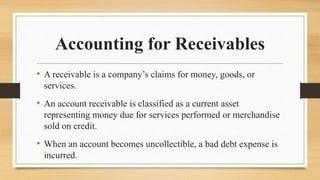
Accounting for Receivables
• A receivable is a company’s claims for money, goods, or
services.
• An account receivable is classified as a current asset
representing money due for services performed or merchandise
sold on credit.
• When an account becomes uncollectible, a bad debt expense is
incurred.
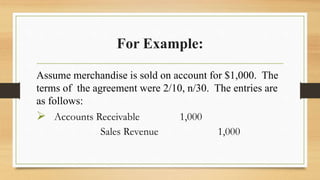
For Example:
Assume merchandise is sold on account for $1,000. The
terms of the agreement were 2/10, n/30. The entries are
as follows:
 Accounts Receivable 1,000
Sales Revenue 1,000
Uncollectible Accounts
Some receivables will never be
collected and must be written off as
uncollectible.
Uncollectible Accounts Occurs:
• When customers do not pay for items or services
purchased on credit.
• Bad Debts are uncollectible accounts receivables.
• The uncollectible expense is placed on the income
statement as a selling expense.
DEFINITION OF 'BAD DEBT'
• A debt that is not collectible and therefore worthless to the creditor.
This occurs after all attempts are made to collect on the debt. Bad
debt is usually a product of the debtor going into bankruptcy or
where the additional cost of pursuing the debt is more than the
amount the creditor could collect. This debt, once considered to be
bad, will be written off by the company as an expense.
There is an upside and a downside to selling goods and services to customers on
credit. The upside is that selling on credit encourages people to buy. For the most
part, people pay their bills when they are due. The downside is that there will
inevitably be customers who will either delay paying their bills or will never pay.
The latter are referred to as Bad Debts.
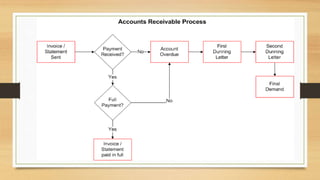
All businesses must investigate outstanding accounts receivable in order to
identify and account for bad debts. This can be challenging because it is
sometimes difficult to know whether the customer is late with the payment or is
unable to pay. Assumptions must be made in this regard, because the records need
to reflect the company’s current financial position as accurately as possible.
Generally Accepted Accounting Principles (GAAP) provides two accounting
methods for doubtful accounts and bad debts: the direct (write-off ) method and
the allowance method.
Account receivable presentation

Account receivable presentation

  • 1.
  • 2.
    Accounting for Receivables •A receivable is a company’s claims for money, goods, or services. • An account receivable is classified as a current asset representing money due for services performed or merchandise sold on credit. • When an account becomes uncollectible, a bad debt expense is incurred.
  • 3.
    For Example: Assume merchandiseis sold on account for $1,000. The terms of the agreement were 2/10, n/30. The entries are as follows:  Accounts Receivable 1,000 Sales Revenue 1,000
  • 4.
    Uncollectible Accounts Some receivableswill never be collected and must be written off as uncollectible.
  • 5.
    Uncollectible Accounts Occurs: •When customers do not pay for items or services purchased on credit. • Bad Debts are uncollectible accounts receivables. • The uncollectible expense is placed on the income statement as a selling expense.
  • 6.
    DEFINITION OF 'BADDEBT' • A debt that is not collectible and therefore worthless to the creditor. This occurs after all attempts are made to collect on the debt. Bad debt is usually a product of the debtor going into bankruptcy or where the additional cost of pursuing the debt is more than the amount the creditor could collect. This debt, once considered to be bad, will be written off by the company as an expense.
  • 7.
    There is anupside and a downside to selling goods and services to customers on credit. The upside is that selling on credit encourages people to buy. For the most part, people pay their bills when they are due. The downside is that there will inevitably be customers who will either delay paying their bills or will never pay. The latter are referred to as Bad Debts. All businesses must investigate outstanding accounts receivable in order to identify and account for bad debts. This can be challenging because it is sometimes difficult to know whether the customer is late with the payment or is unable to pay. Assumptions must be made in this regard, because the records need to reflect the company’s current financial position as accurately as possible. Generally Accepted Accounting Principles (GAAP) provides two accounting methods for doubtful accounts and bad debts: the direct (write-off ) method and the allowance method.