

Prepared by: 
Chapter 
12 
Fernando & Yvonn 
Quijano 
General Equilibrium 
and the Efficiency 
of Perfect Competition 
© 2007 Prentice Hall Business Publishing Principles of Economics 8e by Case and Fair
noititep mo C t cef re P f o 
HC 
General Equilibrium 12 
and the Efficiency 
Chapter Outline of Perfect Competition 
General Equilibrium Analysis 
A Technological Advance: The 
Electronic 
Calculator 
Market Adjustment to Changes in 
Demand 
Formal Proof of a General Competitive 
Equilibrium 
Allocative Efficiency and 
Competitive 
Equilibrium 
Pareto Efficiency 
The Efficiency of Perfect Competition 
Perfect Competition versus Real Markets 
The Sources of Market Failure 
Imperfect Markets 
Public Goods 
Externalities 
Imperfect Information 
Evaluating the Market Mechanism 
2 of 
22 © 2007 Prentice Hall Business Publishing Principles of Economics 8e by Case and Fair
noititep mo C t cef re P f o 
HC 
THE EFFICIENCY OF PERFECT 
COMPETITION 
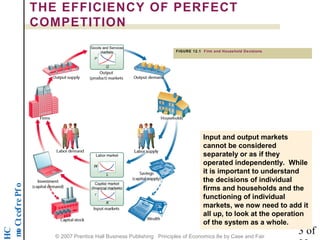
FIGURE 12.1 Firm and Household Decisions 
Input and output markets 
cannot be considered 
separately or as if they 
operated independently. While 
it is important to understand 
the decisions of individual 
firms and households and the 
functioning of individual 
markets, we now need to add it 
all up, to look at the operation 
of the system as a whole. 
3 of 
22 © 2007 Prentice Hall Business Publishing Principles of Economics 8e by Case and Fair
noititep mo C t cef re P f o 
HC 
THE EFFICIENCY OF PERFECT 
COMPETITION 
partial equilibrium analysis The process 
of examining the equilibrium conditions in 
individual markets and for households and 
firms separately. 
general equilibrium The condition that 
exists when all markets in an economy are 
in simultaneous equilibrium. 
efficiency The condition in which the 
economy is producing what people want at 
least possible cost. 
4 of 
22 © 2007 Prentice Hall Business Publishing Principles of Economics 8e by Case and Fair
noititep mo C t cef re P f o 
HC 
GENERAL EQUILIBRIUM ANALYSIS 
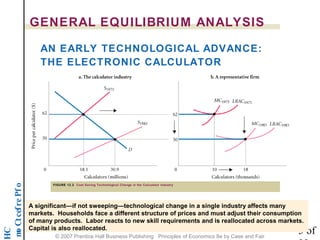
AN EARLY TECHNOLOGICAL ADVANCE: 
THE ELECTRONIC CALCULATOR 
FIGURE 12.2 Cost Saving Technological Change in the Calculator Industry 
A significant—if not sweeping—technological change in a single industry affects many 
markets. Households face a different structure of prices and must adjust their consumption 
of many products. Labor reacts to new skill requirements and is reallocated across markets. 
Capital is also reallocated. 
5 of 
22 © 2007 Prentice Hall Business Publishing Principles of Economics 8e by Case and Fair
noititep mo C t cef re P f o 
HC 
GENERAL EQUILIBRIUM ANALYSIS 
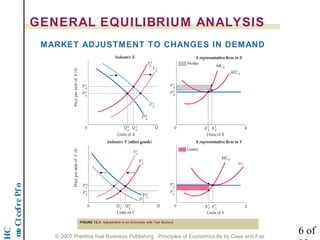
MARKET ADJUSTMENT TO CHANGES IN DEMAND 
FIGURE 12.3 Adjustment in an Economy with Two Sectors 
6 of 
22 © 2007 Prentice Hall Business Publishing Principles of Economics 8e by Case and Fair
noititep mo C t cef re P f o 
HC 
GENERAL EQUILIBRIUM ANALYSIS 
FORMAL PROOF OF A GENERAL COMPETITIVE 
EQUILIBRIUM 
Economic theorists have struggled with the question of 
whether a set of prices that equates supply and 
demand in all markets simultaneously can actually exist 
when there are literally thousands and thousands of 
markets. If such a set of prices were not possible, the 
result could be continuous cycles of expansion, 
contraction, and instability. 
7 of 
22 © 2007 Prentice Hall Business Publishing Principles of Economics 8e by Case and Fair
noititep mo C t cef re P f o 
HC 
ALLOCATIVE EFFICIENCY 
AND COMPETITIVE EQUILIBRIUM 
PARETO EFFICIENCY 
Pareto efficiency or Pareto optimality A 
condition in which no change is possible that will 
make some members of society better off 
without making some other members of society 
worse off. 
8 of 
22 © 2007 Prentice Hall Business Publishing Principles of Economics 8e by Case and Fair
noititep mo C t cef re P f o 
HC 
ALLOCATIVE EFFICIENCY 
AND COMPETITIVE EQUILIBRIUM 
THE EFFICIENCY OF PERFECT COMPETITION 
The three basic questions discussed previously included: 
1. What gets produced? What determines the final mix of output? 
2. How is it produced? How do capital, labor, and land get divided up 
among firms? In other words, what is the allocation of resources 
among producers? 
3. Who gets what is produced? What determines which households get 
how much? What is the distribution of output among consuming 
households? 
To demonstrate that the perfectly competitive system leads to an 
efficient, or Pareto optimal, allocation of resources, we need to 
show that no changes are possible that will make some people 
better off without making others worse off. 
9 of 
22 © 2007 Prentice Hall Business Publishing Principles of Economics 8e by Case and Fair
ALLOCATIVE EFFICIENCY 
AND COMPETITIVE EQUILIBRIUM 
Efficient Allocation of Resources among Firms 
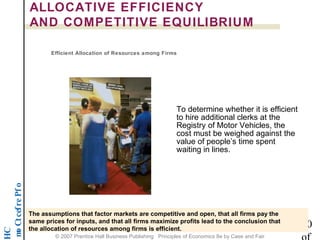
To determine whether it is efficient 
to hire additional clerks at the 
Registry of Motor Vehicles, the 
cost must be weighed against the 
value of people’s time spent 
waiting in lines. 
o f P e r f e c t C o m p 10 
HC 
of 
The assumptions that factor markets are competitive and open, that all firms pay the 
same prices for inputs, and that all firms maximize profits lead to the conclusion that 
the allocation of resources among firms is efficient. 
© 2007 Prentice Hall Business Publishing Principles of Economics 8e by Case and Fair
ALLOCATIVE EFFICIENCY 
AND COMPETITIVE EQUILIBRIUM 
Efficient Distribution of Outputs among 
Households 
We all know that people have different tastes and preferences, and that they will 
buy very different things in very different combinations. As long as everyone 
shops freely in the same markets, no redistribution of final outputs among people 
will make them better off. If you and I buy in the same markets and pay the same 
prices, and I buy what I want and you buy what you want, we cannot possibly end 
up with the wrong combination of things. Free and open markets are essential to 
this result. 
o f P e r f e c t C o m p 11 
HC 
of 
© 2007 Prentice Hall Business Publishing Principles of Economics 8e by Case and Fair
ALLOCATIVE EFFICIENCY 
AND COMPETITIVE EQUILIBRIUM 
Producing What People Want: The Efficient 
Mix of Output 
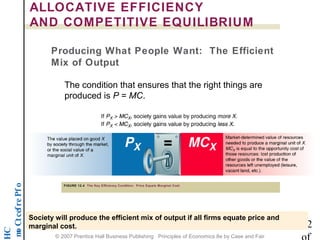
The condition that ensures that the right things are 
produced is P = MC. 
o f P e r f e c t C o m p 12 
HC 
of 
FIGURE 12.4 The Key Efficiency Condition: Price Equals Marginal Cost 
Society will produce the efficient mix of output if all firms equate price and 
marginal cost. 
© 2007 Prentice Hall Business Publishing Principles of Economics 8e by Case and Fair
ALLOCATIVE EFFICIENCY 
AND COMPETITIVE EQUILIBRIUM 
o f P e r f e c t C o m p 13 
HC 
of 
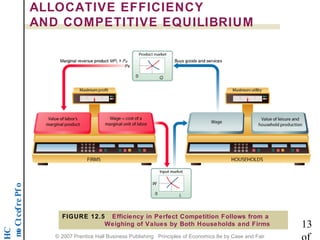
FIGURE 12.5 Efficiency in Perfect Competition Follows from a 
Weighing of Values by Both Households and Firms 
© 2007 Prentice Hall Business Publishing Principles of Economics 8e by Case and Fair
ALLOCATIVE EFFICIENCY 
AND COMPETITIVE EQUILIBRIUM 
PERFECT COMPETITION VERSUS REAL MARKETS 
We have built a model of a perfectly competitive 
market system that produces an efficient allocation 
of resources, an efficient mix of output, and an 
efficient distribution of output. The perfectly 
competitive model is built on a set of assumptions, 
all of which must hold for our conclusions to be fully 
valid. 
These assumptions do not always hold in real-world 
markets. 
o f P e r f e c t C o m p 14 
HC 
of 
© 2007 Prentice Hall Business Publishing Principles of Economics 8e by Case and Fair
THE SOURCES OF MARKET FAILURE 
market failure Occurs when resources 
are misallocated, or allocated inefficiently. 
The result is waste or lost value. 
There are four important sources of market failure: 
(1) imperfect market structure, or noncompetitive 
behavior, 
(2) the existence of public goods, 
(3) the presence of external costs and benefits, and 
(4) imperfect information. 
o f P e r f e c t C o m p 15 
HC 
of 
© 2007 Prentice Hall Business Publishing Principles of Economics 8e by Case and Fair
THE SOURCES OF MARKET FAILURE 
IMPERFECT MARKETS 
imperfect condition An industry in which 
single firms have some control over price and 
competition. Imperfectly competitive industries 
give rise to an inefficient allocation of resources. 
monopoly An industry composed of only one 
firm that produces a product for which there are 
no close substitutes and in which significant 
barriers exist to prevent new firms from entering 
the industry. 
o f P e r f e c t C o m p 16 
HC 
of 
In all imperfectly competitive industries, output is lower—the product is 
underproduced—and price is higher than it would be under perfect competition. 
The equilibrium condition P = MC does not hold, and the system does not 
produce the most efficient product mix. 
© 2007 Prentice Hall Business Publishing Principles of Economics 8e by Case and Fair
THE SOURCES OF MARKET FAILURE 
PUBLIC GOODS 
public goods, or social goods Goods or 
services that bestow collective benefits on 
members of society. Generally, no one can be 
excluded from enjoying their benefits. The 
classic example is national defense. 
private goods Products produced by firms for 
sale to individual households. 
o f P e r f e c t C o m p 17 
HC 
of 
© 2007 Prentice Hall Business Publishing Principles of Economics 8e by Case and Fair
THE SOURCES OF MARKET FAILURE 
A classic example of a public 
good is a park such as 
Central Park in Manhattan 
producing collective benefits 
for New Yorkers and tourists. 
o f P e r f e c t C o m p 18 
HC 
Private provision of public goods fails. A completely laissez-faire market system 
will not produce everything that all members of a society might want. Citizens 
must band together to ensure that desired public goods are produced, and this is 
generally accomplished through government spending financed by taxes. 
of 
© 2007 Prentice Hall Business Publishing Principles of Economics 8e by Case and Fair
THE SOURCES OF MARKET FAILURE 
EXTERNALITIES 
externality A cost or benefit resulting from 
some activity or transaction that is imposed 
or bestowed on parties outside the activity 
or transaction. 
o f P e r f e c t C o m p 19 
HC 
of 
The market does not always force consideration of all the costs and benefits of 
decisions. Yet for an economy to achieve an efficient allocation of resources, all 
costs and benefits must be weighed. 
© 2007 Prentice Hall Business Publishing Principles of Economics 8e by Case and Fair
THE SOURCES OF MARKET FAILURE 
IMPERFECT INFORMATION 
imperfect information The absence of full 
knowledge concerning product characteristics, 
available prices, and so forth. 
o f P e r f e c t C o m p 20 
HC 
The conclusion that markets work efficiently rests heavily on the assumption that 
consumers and producers have full knowledge of product characteristics, 
available prices, and so forth. The absence of full information can lead to 
transactions that are ultimately disadvantageous. 
of 
© 2007 Prentice Hall Business Publishing Principles of Economics 8e by Case and Fair
EVALUATING THE MARKET MECHANISM 
Freely functioning markets in the real world do 
not always produce an efficient allocation of 
resources, and this result provides a potential 
role for government in the economy 
o f P e r f e c t C o m p 21 
HC 
of 
© 2007 Prentice Hall Business Publishing Principles of Economics 8e by Case and Fair
REVIEW TERMS AND CONCEPTS 
efficiency 
externality 
general equilibrium 
imperfect competition 
imperfect information 
market failure 
monopoly 
Pareto efficiency, or Pareto 
optimality 
partial equilibrium analysis 
private goods 
public goods, or social 
goods 
Key efficiency condition in 
perfect competition: 
PX = MCX 
o f P e r f e c t C o m p 22 
HC 
of 
© 2007 Prentice Hall Business Publishing Principles of Economics 8e by Case and Fair

Perfect Competition

  • 1.
    Prepared by: Chapter 12 Fernando & Yvonn Quijano General Equilibrium and the Efficiency of Perfect Competition © 2007 Prentice Hall Business Publishing Principles of Economics 8e by Case and Fair
  • 2.
    noititep mo Ct cef re P f o HC General Equilibrium 12 and the Efficiency Chapter Outline of Perfect Competition General Equilibrium Analysis A Technological Advance: The Electronic Calculator Market Adjustment to Changes in Demand Formal Proof of a General Competitive Equilibrium Allocative Efficiency and Competitive Equilibrium Pareto Efficiency The Efficiency of Perfect Competition Perfect Competition versus Real Markets The Sources of Market Failure Imperfect Markets Public Goods Externalities Imperfect Information Evaluating the Market Mechanism 2 of 22 © 2007 Prentice Hall Business Publishing Principles of Economics 8e by Case and Fair
  • 3.
    noititep mo Ct cef re P f o HC THE EFFICIENCY OF PERFECT COMPETITION FIGURE 12.1 Firm and Household Decisions Input and output markets cannot be considered separately or as if they operated independently. While it is important to understand the decisions of individual firms and households and the functioning of individual markets, we now need to add it all up, to look at the operation of the system as a whole. 3 of 22 © 2007 Prentice Hall Business Publishing Principles of Economics 8e by Case and Fair
  • 4.
    noititep mo Ct cef re P f o HC THE EFFICIENCY OF PERFECT COMPETITION partial equilibrium analysis The process of examining the equilibrium conditions in individual markets and for households and firms separately. general equilibrium The condition that exists when all markets in an economy are in simultaneous equilibrium. efficiency The condition in which the economy is producing what people want at least possible cost. 4 of 22 © 2007 Prentice Hall Business Publishing Principles of Economics 8e by Case and Fair
  • 5.
    noititep mo Ct cef re P f o HC GENERAL EQUILIBRIUM ANALYSIS AN EARLY TECHNOLOGICAL ADVANCE: THE ELECTRONIC CALCULATOR FIGURE 12.2 Cost Saving Technological Change in the Calculator Industry A significant—if not sweeping—technological change in a single industry affects many markets. Households face a different structure of prices and must adjust their consumption of many products. Labor reacts to new skill requirements and is reallocated across markets. Capital is also reallocated. 5 of 22 © 2007 Prentice Hall Business Publishing Principles of Economics 8e by Case and Fair
  • 6.
    noititep mo Ct cef re P f o HC GENERAL EQUILIBRIUM ANALYSIS MARKET ADJUSTMENT TO CHANGES IN DEMAND FIGURE 12.3 Adjustment in an Economy with Two Sectors 6 of 22 © 2007 Prentice Hall Business Publishing Principles of Economics 8e by Case and Fair
  • 7.
    noititep mo Ct cef re P f o HC GENERAL EQUILIBRIUM ANALYSIS FORMAL PROOF OF A GENERAL COMPETITIVE EQUILIBRIUM Economic theorists have struggled with the question of whether a set of prices that equates supply and demand in all markets simultaneously can actually exist when there are literally thousands and thousands of markets. If such a set of prices were not possible, the result could be continuous cycles of expansion, contraction, and instability. 7 of 22 © 2007 Prentice Hall Business Publishing Principles of Economics 8e by Case and Fair
  • 8.
    noititep mo Ct cef re P f o HC ALLOCATIVE EFFICIENCY AND COMPETITIVE EQUILIBRIUM PARETO EFFICIENCY Pareto efficiency or Pareto optimality A condition in which no change is possible that will make some members of society better off without making some other members of society worse off. 8 of 22 © 2007 Prentice Hall Business Publishing Principles of Economics 8e by Case and Fair
  • 9.
    noititep mo Ct cef re P f o HC ALLOCATIVE EFFICIENCY AND COMPETITIVE EQUILIBRIUM THE EFFICIENCY OF PERFECT COMPETITION The three basic questions discussed previously included: 1. What gets produced? What determines the final mix of output? 2. How is it produced? How do capital, labor, and land get divided up among firms? In other words, what is the allocation of resources among producers? 3. Who gets what is produced? What determines which households get how much? What is the distribution of output among consuming households? To demonstrate that the perfectly competitive system leads to an efficient, or Pareto optimal, allocation of resources, we need to show that no changes are possible that will make some people better off without making others worse off. 9 of 22 © 2007 Prentice Hall Business Publishing Principles of Economics 8e by Case and Fair
  • 10.
    ALLOCATIVE EFFICIENCY ANDCOMPETITIVE EQUILIBRIUM Efficient Allocation of Resources among Firms To determine whether it is efficient to hire additional clerks at the Registry of Motor Vehicles, the cost must be weighed against the value of people’s time spent waiting in lines. o f P e r f e c t C o m p 10 HC of The assumptions that factor markets are competitive and open, that all firms pay the same prices for inputs, and that all firms maximize profits lead to the conclusion that the allocation of resources among firms is efficient. © 2007 Prentice Hall Business Publishing Principles of Economics 8e by Case and Fair
  • 11.
    ALLOCATIVE EFFICIENCY ANDCOMPETITIVE EQUILIBRIUM Efficient Distribution of Outputs among Households We all know that people have different tastes and preferences, and that they will buy very different things in very different combinations. As long as everyone shops freely in the same markets, no redistribution of final outputs among people will make them better off. If you and I buy in the same markets and pay the same prices, and I buy what I want and you buy what you want, we cannot possibly end up with the wrong combination of things. Free and open markets are essential to this result. o f P e r f e c t C o m p 11 HC of © 2007 Prentice Hall Business Publishing Principles of Economics 8e by Case and Fair
  • 12.
    ALLOCATIVE EFFICIENCY ANDCOMPETITIVE EQUILIBRIUM Producing What People Want: The Efficient Mix of Output The condition that ensures that the right things are produced is P = MC. o f P e r f e c t C o m p 12 HC of FIGURE 12.4 The Key Efficiency Condition: Price Equals Marginal Cost Society will produce the efficient mix of output if all firms equate price and marginal cost. © 2007 Prentice Hall Business Publishing Principles of Economics 8e by Case and Fair
  • 13.
    ALLOCATIVE EFFICIENCY ANDCOMPETITIVE EQUILIBRIUM o f P e r f e c t C o m p 13 HC of FIGURE 12.5 Efficiency in Perfect Competition Follows from a Weighing of Values by Both Households and Firms © 2007 Prentice Hall Business Publishing Principles of Economics 8e by Case and Fair
  • 14.
    ALLOCATIVE EFFICIENCY ANDCOMPETITIVE EQUILIBRIUM PERFECT COMPETITION VERSUS REAL MARKETS We have built a model of a perfectly competitive market system that produces an efficient allocation of resources, an efficient mix of output, and an efficient distribution of output. The perfectly competitive model is built on a set of assumptions, all of which must hold for our conclusions to be fully valid. These assumptions do not always hold in real-world markets. o f P e r f e c t C o m p 14 HC of © 2007 Prentice Hall Business Publishing Principles of Economics 8e by Case and Fair
  • 15.
    THE SOURCES OFMARKET FAILURE market failure Occurs when resources are misallocated, or allocated inefficiently. The result is waste or lost value. There are four important sources of market failure: (1) imperfect market structure, or noncompetitive behavior, (2) the existence of public goods, (3) the presence of external costs and benefits, and (4) imperfect information. o f P e r f e c t C o m p 15 HC of © 2007 Prentice Hall Business Publishing Principles of Economics 8e by Case and Fair
  • 16.
    THE SOURCES OFMARKET FAILURE IMPERFECT MARKETS imperfect condition An industry in which single firms have some control over price and competition. Imperfectly competitive industries give rise to an inefficient allocation of resources. monopoly An industry composed of only one firm that produces a product for which there are no close substitutes and in which significant barriers exist to prevent new firms from entering the industry. o f P e r f e c t C o m p 16 HC of In all imperfectly competitive industries, output is lower—the product is underproduced—and price is higher than it would be under perfect competition. The equilibrium condition P = MC does not hold, and the system does not produce the most efficient product mix. © 2007 Prentice Hall Business Publishing Principles of Economics 8e by Case and Fair
  • 17.
    THE SOURCES OFMARKET FAILURE PUBLIC GOODS public goods, or social goods Goods or services that bestow collective benefits on members of society. Generally, no one can be excluded from enjoying their benefits. The classic example is national defense. private goods Products produced by firms for sale to individual households. o f P e r f e c t C o m p 17 HC of © 2007 Prentice Hall Business Publishing Principles of Economics 8e by Case and Fair
  • 18.
    THE SOURCES OFMARKET FAILURE A classic example of a public good is a park such as Central Park in Manhattan producing collective benefits for New Yorkers and tourists. o f P e r f e c t C o m p 18 HC Private provision of public goods fails. A completely laissez-faire market system will not produce everything that all members of a society might want. Citizens must band together to ensure that desired public goods are produced, and this is generally accomplished through government spending financed by taxes. of © 2007 Prentice Hall Business Publishing Principles of Economics 8e by Case and Fair
  • 19.
    THE SOURCES OFMARKET FAILURE EXTERNALITIES externality A cost or benefit resulting from some activity or transaction that is imposed or bestowed on parties outside the activity or transaction. o f P e r f e c t C o m p 19 HC of The market does not always force consideration of all the costs and benefits of decisions. Yet for an economy to achieve an efficient allocation of resources, all costs and benefits must be weighed. © 2007 Prentice Hall Business Publishing Principles of Economics 8e by Case and Fair
  • 20.
    THE SOURCES OFMARKET FAILURE IMPERFECT INFORMATION imperfect information The absence of full knowledge concerning product characteristics, available prices, and so forth. o f P e r f e c t C o m p 20 HC The conclusion that markets work efficiently rests heavily on the assumption that consumers and producers have full knowledge of product characteristics, available prices, and so forth. The absence of full information can lead to transactions that are ultimately disadvantageous. of © 2007 Prentice Hall Business Publishing Principles of Economics 8e by Case and Fair
  • 21.
    EVALUATING THE MARKETMECHANISM Freely functioning markets in the real world do not always produce an efficient allocation of resources, and this result provides a potential role for government in the economy o f P e r f e c t C o m p 21 HC of © 2007 Prentice Hall Business Publishing Principles of Economics 8e by Case and Fair
  • 22.
    REVIEW TERMS ANDCONCEPTS efficiency externality general equilibrium imperfect competition imperfect information market failure monopoly Pareto efficiency, or Pareto optimality partial equilibrium analysis private goods public goods, or social goods Key efficiency condition in perfect competition: PX = MCX o f P e r f e c t C o m p 22 HC of © 2007 Prentice Hall Business Publishing Principles of Economics 8e by Case and Fair