Management of Non Performing
Assets
MFIS UNIT II
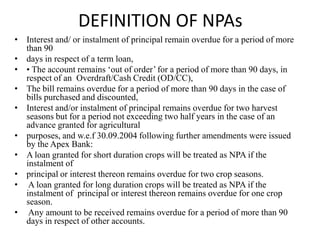
DEFINITION OF NPAs
• Interest and/ or instalment of principal remain overdue for a period of more
than 90
• days in respect of a term loan,
• • The account remains ‘out of order’ for a period of more than 90 days, in
respect of an Overdraft/Cash Credit (OD/CC),
• The bill remains overdue for a period of more than 90 days in the case of
bills purchased and discounted,
• Interest and/or instalment of principal remains overdue for two harvest
seasons but for a period not exceeding two half years in the case of an
advance granted for agricultural
• purposes, and w.e.f 30.09.2004 following further amendments were issued
by the Apex Bank:
• A loan granted for short duration crops will be treated as NPA if the
instalment of
• principal or interest thereon remains overdue for two crop seasons.
• A loan granted for long duration crops will be treated as NPA if the
instalment of principal or interest thereon remains overdue for one crop
season.
• Any amount to be received remains overdue for a period of more than 90
days in respect of other accounts.
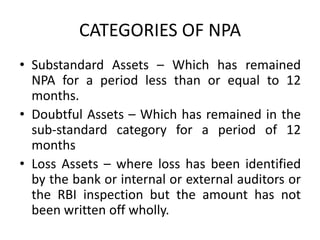
CATEGORIES OF NPA
• Substandard Assets – Which has remained
NPA for a period less than or equal to 12
months.
• Doubtful Assets – Which has remained in the
sub-standard category for a period of 12
months
• Loss Assets – where loss has been identified
by the bank or internal or external auditors or
the RBI inspection but the amount has not
been written off wholly.
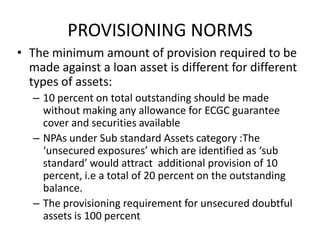
PROVISIONING NORMS
• The minimum amount of provision required to be
made against a loan asset is different for different
types of assets:
– 10 percent on total outstanding should be made
without making any allowance for ECGC guarantee
cover and securities available
– NPAs under Sub standard Assets category :The
‘unsecured exposures’ which are identified as ‘sub
standard’ would attract additional provision of 10
percent, i.e a total of 20 percent on the outstanding
balance.
– The provisioning requirement for unsecured doubtful
assets is 100 percent
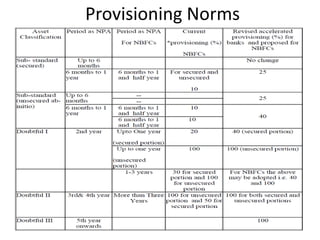
Provisioning Norms
• Accordingly the provisioning norm for advances identified
as doubtful for more than 3 years would be as indicated
below as on March31, 2009.
– (a) Unsecured Portion
The portion of the advance which is not covered by the
realizable value of the tangible security to which the bank
has the valid recourse and the realizable value is estimated
on a realistic basis, provision would be to the extent of
100%.
• (b) Secured Portion
– Upto 1 year : 20% (D1 Category)
– One to three years : 30% (D2 Category)
– More than three years : 100% (D3 Category)
FACTORS CONTRIBUTING TO NPAS
• Poor Credit discipline
• Inadequate Credit & Risk Management
• Diversion of funds by promoters
• Funding of non-viable projects
• In the early 1990s PSBs started suffering from
acute capital inadequacy and lower/ negative
profitability. The parameters set for their
functioning did not project the paramount need
for these corporate goals.
• The banks had little freedom to price products,
cater products to chosen segments or invest
funds in their best interest
Cont...
• Inadequate mechanism to gather and
disseminate credit information amongst
commercial banks
• Effective recovery from defaulting and overdue
borrowers was hampered on account of sizeable
overhang component arising from infirmities in
the existing process of debt
recovery, inadequate legal provisions on
foreclosure and bankruptcy and difficulties in
the execution of court decrees.
IMPACT OF NPAS ON OPERATIONS
• Drain on Profitability
• Impact on capital adequacy
• Adverse effect on credit growth as the
banker’s prime focus becomes zero percent
risk and as a result turn lukewarm to fresh
credit.
• Excessive focus on Credit Risk Management
• High cost of funds due to NPAs
CURRENT STATUS OF NPAS
• Non-performing assets (NPAs) or bad loans of PSU
banks rose by 28.5 percent from Rs 1.83 lakh crore in
March 2013 to Rs 2.36 lakh crore in September 2013.
• The banks have been able to report lower NPA
percentage mostly by providing against or writing off
NPAs.
• The provision to certain extent was facilitated by higher
profits on account of treasury management
• The better Net NPA ratio was also facilitated by higher
credit off take resulting in larger asset portfolio/ book
size.
• education loan contributed 20 percent to total non-
performing assets
Corrective Action Plan to arrest
increasing NPAs
• Early Recognition of Stress and Reporting to
Central Repository of Information on Large
Credits (CRILC)
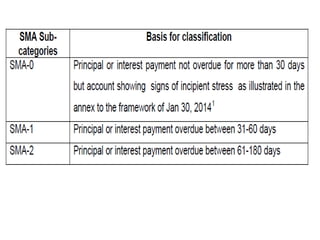
• Before a loan account turns into an
NPA, NBFCs will be required to identify
incipient stress in the account by creating a
sub-asset category viz. ‘Special Mention
Accounts’ (SMA) with the three sub-categories
as given in the table (next):
NPA MANAGEMENT – PREVENTIVE MEASURES
• Formation of the Credit Information Bureau (India) Limited
(CIBIL)
• Compromise settlement schemes
• Measures for faster legal process
– Lok Adalats
– Debt Recovery Tribunals
• Circulation of information on defaulters
• Recovery action against large NPAs
• Asset Reconstruction Company
• Legal Reforms
• Corporate Debt Restructuring (CDR)
• Proposed guidelines on wilful defaults/diversion of funds
• Special Mention Accounts - Additional Precaution at the
Operating Level
Latest Measures by RBI
• The main proposals are:
– Early formation of a lenders’ committee with timelines to agree to a plan for
resolution.
– Incentives for lenders to agree collectively and quickly to a plan – better
regulatory treatment of stressed assets if a resolution plan is underway,
accelerated provisioning if no agreement can be reached.
– Improvement in current restructuring process: Independent evaluation of large
value restructurings mandated, with a focus on viable plans and a fair sharing
of losses (and future possible upside) between promoters and creditors.
– More expensive future borrowing for borrowers who do not co-operate with
lenders in resolution.
– More liberal regulatory treatment of asset sales.
– Lenders can spread loss on sale over two years provided loss is fully disclosed.
– Takeout financing/refinancing possible over a longer period and will not be
construed as restructuring.
– Leveraged buyouts will be allowed for specialised entities for acquisition of
‘stressed companies’.
– Steps to enable better functioning of Asset Reconstruction Companies mooted.
– Sector-specific Companies/Private equity firms encouraged to play active role
in stressed assets market.
• Formation of Joint Lenders’ Forum:As soon as
an account is reported to CRILC as SMA-2, all
lenders, including NBFC-SIs, should form a
lenders’ committee to be called Joint Lenders’
Forum (JLF) under a convener and formulate a
joint corrective action plan (CAP) for early
resolution of the stress in the account.
• Corrective Action Plan (CAP) by JLF:The
options under Corrective Action Plan (CAP) by
the JLF would generally include:
Rectification; Restructuring; Recovery
Compromise Settlement Schemes
• Banks are free to design and implement their
own policies for recovery and write off
incorporation compromise and negotiated
settlements with board approval
• Specific guidelines were issued in May 1999
for one time settlement of small enterprise
sector.
• Guidelines were modified in July 2000 for
recovery of NPAs of Rs.5 crore and less as on
31st March 2007.
Lok Adalats
• Small NPAs up to Rs.20 Lacs
• Speedy Recovery
• Veil of Authority
• Soft Defaulters
• Less expensive
• Easier way to resolve
BIFR AND AAIFR
• BIFR has been given the power to consider revival and
rehabilitation of companies under the Sick Industrial
Companies (Special Provisions) Act of 1985 (SICA),
which has been repealed by passing of the Sick
Industrial Companies (Special Provisions) Repeal Bill
of 2001.
• The board of Directors shall make a reference to BIFR
within sixty days from the date of finalization of the
duly audited accounts for the financial year at the end
of which the company becomes sick
• The company making reference to BIFR to prepare a
scheme for its revival and rehabilitation and submit
the same to BIFR the procedure is same as laid down
under the CPC.
• The shelter of BIFR misused by defaulting and
dishonest borrowers
• It is a time consuming process
SALE OF NPA TO OTHER BANKS
• A NPA is eligible for sale to other banks only if it has
remained a NPA for at least two years in the books of
the selling bank
• The NPA must be held by the purchasing bank at least
for a period of 15 months before it is sold to other
banks but not to bank, which originally sold the NPA.
• The NPA may be classified as standard in the books of
the purchasing bank for a period of 90 days from date
of purchase and thereafter it would depend on the
record of recovery with reference to cash flows
estimated while purchasing
• The bank may purchase/ sell NPA only on without
recourse basis
• If the sale is conducted below the net book value, the
short fall should be debited to P&L account and if it is
higher, the excess provision will be utilized to meet
the loss on account of sale of other NPA.
SARFESI Act 2002
• SARFESI provides for enforcement of security
interests in movable (tangible or intangible
assets including accounts receivable) and
immovable property without the intervention of
the court
• The bank and FI may call upon the borrower by
way of a written legal notice to discharge in full
his liabilities within 60 days from the date of
notice, failing which the bank would be entitled
to exercise all or any of the rights set out under
the Act.
• Another option available under the Act is to
takeover the management of the secured assets
• Any person aggrieved by the measures taken by
the bank can proffer an appeal to DRT within 45
days after depositing 75% of the amount
claimed in the notice.
Second Amendment & SARFESI
• The second amendment and SARFESI are a leap
forward but requirement exists to make the
laws predictable, transparent and affordable
enforcement by efficient mechanisms outside of
insolvency
• No definite time frame has been provided for
various stages during the liquidation
proceedings
• Need is felt for more creative and commercial
approach to corporate entities in financial
distress and attempts to revive rather than
applying conservative approach of liquidation
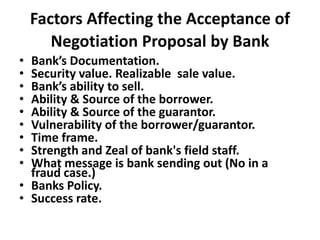
Factors Affecting the Acceptance of
Negotiation Proposal by Bank
• Bank’s Documentation.
• Security value. Realizable sale value.
• Bank’s ability to sell.
• Ability & Source of the borrower.
• Ability & Source of the guarantor.
• Vulnerability of the borrower/guarantor.
• Time frame.
• Strength and Zeal of bank's field staff.
• What message is bank sending out (No in a
fraud case.)
• Banks Policy.
• Success rate.
Management of non performing assets

Management of non performing assets

  • 1.
    Management of NonPerforming Assets MFIS UNIT II
  • 2.
    DEFINITION OF NPAs •Interest and/ or instalment of principal remain overdue for a period of more than 90 • days in respect of a term loan, • • The account remains ‘out of order’ for a period of more than 90 days, in respect of an Overdraft/Cash Credit (OD/CC), • The bill remains overdue for a period of more than 90 days in the case of bills purchased and discounted, • Interest and/or instalment of principal remains overdue for two harvest seasons but for a period not exceeding two half years in the case of an advance granted for agricultural • purposes, and w.e.f 30.09.2004 following further amendments were issued by the Apex Bank: • A loan granted for short duration crops will be treated as NPA if the instalment of • principal or interest thereon remains overdue for two crop seasons. • A loan granted for long duration crops will be treated as NPA if the instalment of principal or interest thereon remains overdue for one crop season. • Any amount to be received remains overdue for a period of more than 90 days in respect of other accounts.
  • 3.
    CATEGORIES OF NPA •Substandard Assets – Which has remained NPA for a period less than or equal to 12 months. • Doubtful Assets – Which has remained in the sub-standard category for a period of 12 months • Loss Assets – where loss has been identified by the bank or internal or external auditors or the RBI inspection but the amount has not been written off wholly.
  • 4.
    PROVISIONING NORMS • Theminimum amount of provision required to be made against a loan asset is different for different types of assets: – 10 percent on total outstanding should be made without making any allowance for ECGC guarantee cover and securities available – NPAs under Sub standard Assets category :The ‘unsecured exposures’ which are identified as ‘sub standard’ would attract additional provision of 10 percent, i.e a total of 20 percent on the outstanding balance. – The provisioning requirement for unsecured doubtful assets is 100 percent
  • 5.
  • 6.
    • Accordingly theprovisioning norm for advances identified as doubtful for more than 3 years would be as indicated below as on March31, 2009. – (a) Unsecured Portion The portion of the advance which is not covered by the realizable value of the tangible security to which the bank has the valid recourse and the realizable value is estimated on a realistic basis, provision would be to the extent of 100%. • (b) Secured Portion – Upto 1 year : 20% (D1 Category) – One to three years : 30% (D2 Category) – More than three years : 100% (D3 Category)
  • 7.
    FACTORS CONTRIBUTING TONPAS • Poor Credit discipline • Inadequate Credit & Risk Management • Diversion of funds by promoters • Funding of non-viable projects • In the early 1990s PSBs started suffering from acute capital inadequacy and lower/ negative profitability. The parameters set for their functioning did not project the paramount need for these corporate goals. • The banks had little freedom to price products, cater products to chosen segments or invest funds in their best interest
  • 8.
    Cont... • Inadequate mechanismto gather and disseminate credit information amongst commercial banks • Effective recovery from defaulting and overdue borrowers was hampered on account of sizeable overhang component arising from infirmities in the existing process of debt recovery, inadequate legal provisions on foreclosure and bankruptcy and difficulties in the execution of court decrees.
  • 9.
    IMPACT OF NPASON OPERATIONS • Drain on Profitability • Impact on capital adequacy • Adverse effect on credit growth as the banker’s prime focus becomes zero percent risk and as a result turn lukewarm to fresh credit. • Excessive focus on Credit Risk Management • High cost of funds due to NPAs
  • 10.
    CURRENT STATUS OFNPAS • Non-performing assets (NPAs) or bad loans of PSU banks rose by 28.5 percent from Rs 1.83 lakh crore in March 2013 to Rs 2.36 lakh crore in September 2013. • The banks have been able to report lower NPA percentage mostly by providing against or writing off NPAs. • The provision to certain extent was facilitated by higher profits on account of treasury management • The better Net NPA ratio was also facilitated by higher credit off take resulting in larger asset portfolio/ book size. • education loan contributed 20 percent to total non- performing assets
  • 11.
    Corrective Action Planto arrest increasing NPAs • Early Recognition of Stress and Reporting to Central Repository of Information on Large Credits (CRILC) • Before a loan account turns into an NPA, NBFCs will be required to identify incipient stress in the account by creating a sub-asset category viz. ‘Special Mention Accounts’ (SMA) with the three sub-categories as given in the table (next):
  • 13.
    NPA MANAGEMENT –PREVENTIVE MEASURES • Formation of the Credit Information Bureau (India) Limited (CIBIL) • Compromise settlement schemes • Measures for faster legal process – Lok Adalats – Debt Recovery Tribunals • Circulation of information on defaulters • Recovery action against large NPAs • Asset Reconstruction Company • Legal Reforms • Corporate Debt Restructuring (CDR) • Proposed guidelines on wilful defaults/diversion of funds • Special Mention Accounts - Additional Precaution at the Operating Level
  • 14.
    Latest Measures byRBI • The main proposals are: – Early formation of a lenders’ committee with timelines to agree to a plan for resolution. – Incentives for lenders to agree collectively and quickly to a plan – better regulatory treatment of stressed assets if a resolution plan is underway, accelerated provisioning if no agreement can be reached. – Improvement in current restructuring process: Independent evaluation of large value restructurings mandated, with a focus on viable plans and a fair sharing of losses (and future possible upside) between promoters and creditors. – More expensive future borrowing for borrowers who do not co-operate with lenders in resolution. – More liberal regulatory treatment of asset sales. – Lenders can spread loss on sale over two years provided loss is fully disclosed. – Takeout financing/refinancing possible over a longer period and will not be construed as restructuring. – Leveraged buyouts will be allowed for specialised entities for acquisition of ‘stressed companies’. – Steps to enable better functioning of Asset Reconstruction Companies mooted. – Sector-specific Companies/Private equity firms encouraged to play active role in stressed assets market.
  • 15.
    • Formation ofJoint Lenders’ Forum:As soon as an account is reported to CRILC as SMA-2, all lenders, including NBFC-SIs, should form a lenders’ committee to be called Joint Lenders’ Forum (JLF) under a convener and formulate a joint corrective action plan (CAP) for early resolution of the stress in the account. • Corrective Action Plan (CAP) by JLF:The options under Corrective Action Plan (CAP) by the JLF would generally include: Rectification; Restructuring; Recovery
  • 16.
    Compromise Settlement Schemes •Banks are free to design and implement their own policies for recovery and write off incorporation compromise and negotiated settlements with board approval • Specific guidelines were issued in May 1999 for one time settlement of small enterprise sector. • Guidelines were modified in July 2000 for recovery of NPAs of Rs.5 crore and less as on 31st March 2007.
  • 17.
    Lok Adalats • SmallNPAs up to Rs.20 Lacs • Speedy Recovery • Veil of Authority • Soft Defaulters • Less expensive • Easier way to resolve
  • 18.
    BIFR AND AAIFR •BIFR has been given the power to consider revival and rehabilitation of companies under the Sick Industrial Companies (Special Provisions) Act of 1985 (SICA), which has been repealed by passing of the Sick Industrial Companies (Special Provisions) Repeal Bill of 2001. • The board of Directors shall make a reference to BIFR within sixty days from the date of finalization of the duly audited accounts for the financial year at the end of which the company becomes sick • The company making reference to BIFR to prepare a scheme for its revival and rehabilitation and submit the same to BIFR the procedure is same as laid down under the CPC. • The shelter of BIFR misused by defaulting and dishonest borrowers • It is a time consuming process
  • 19.
    SALE OF NPATO OTHER BANKS • A NPA is eligible for sale to other banks only if it has remained a NPA for at least two years in the books of the selling bank • The NPA must be held by the purchasing bank at least for a period of 15 months before it is sold to other banks but not to bank, which originally sold the NPA. • The NPA may be classified as standard in the books of the purchasing bank for a period of 90 days from date of purchase and thereafter it would depend on the record of recovery with reference to cash flows estimated while purchasing • The bank may purchase/ sell NPA only on without recourse basis • If the sale is conducted below the net book value, the short fall should be debited to P&L account and if it is higher, the excess provision will be utilized to meet the loss on account of sale of other NPA.
  • 20.
    SARFESI Act 2002 •SARFESI provides for enforcement of security interests in movable (tangible or intangible assets including accounts receivable) and immovable property without the intervention of the court • The bank and FI may call upon the borrower by way of a written legal notice to discharge in full his liabilities within 60 days from the date of notice, failing which the bank would be entitled to exercise all or any of the rights set out under the Act. • Another option available under the Act is to takeover the management of the secured assets • Any person aggrieved by the measures taken by the bank can proffer an appeal to DRT within 45 days after depositing 75% of the amount claimed in the notice.
  • 21.
    Second Amendment &SARFESI • The second amendment and SARFESI are a leap forward but requirement exists to make the laws predictable, transparent and affordable enforcement by efficient mechanisms outside of insolvency • No definite time frame has been provided for various stages during the liquidation proceedings • Need is felt for more creative and commercial approach to corporate entities in financial distress and attempts to revive rather than applying conservative approach of liquidation
  • 22.
    Factors Affecting theAcceptance of Negotiation Proposal by Bank • Bank’s Documentation. • Security value. Realizable sale value. • Bank’s ability to sell. • Ability & Source of the borrower. • Ability & Source of the guarantor. • Vulnerability of the borrower/guarantor. • Time frame. • Strength and Zeal of bank's field staff. • What message is bank sending out (No in a fraud case.) • Banks Policy. • Success rate.

Editor's Notes

  • #12 e Framework for Revitalising Distressed Assets in the Economy (Framework) issued by the Reserve Bank on January 30, 2014. The framework covered in the guidelines, which would be fully effective from April 1, 2014, has outlined a corrective action plan that will incentivize early identification of problem account, timely restructuring of accounts which are considered to be viable, and taking prompt steps by lenders for recovery or sale of unviable accounts. In the background of the above, to the extent it is applicable to NBFCs, the following guidelines are issued to NBFCs.