
Synopsis:
 Accounting
Branches of Accounting
Concept of Creative Accounting
What is Creative Accounting?
Origin of Creative Accounting
Why Creative Accounting?
Situations where Creative Accounting may be resorted
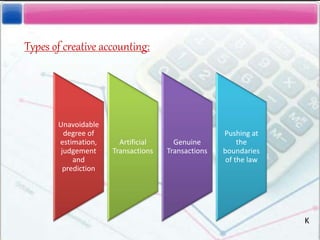
Types of Creative Accounting
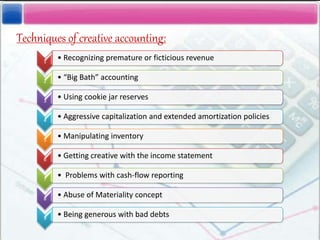
 Techniques of Creative Accounting
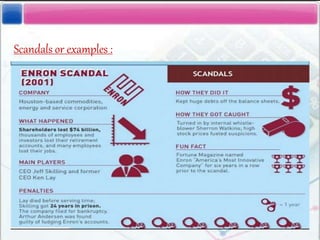
 Scandals
 Significance of Creative Accounting
Effects of or objections against Creative Accounting
Controlling of Creative Accounting and Frauds
 Role of Auditor in Creative Accounting
 Challenges Before the Investigator
Conclusion
Accounting:
“ The art of recording, classifying, summarising and presenting
the financial aspect of business dealings and interpreting the
results thereof.”
“Accounting is the process of identifying, measuring and
communicating economic information to permit informed
judgements and decisions by the users of such information.”
- American Accounting Association(AAA)
s
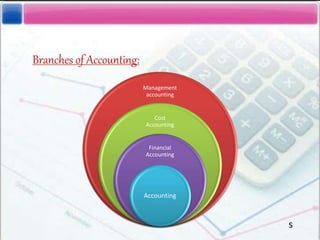
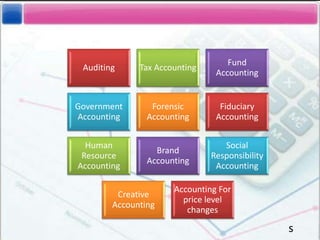
Branches of Accounting:
Management
accounting
Cost
Accounting
Financial
Accounting
Accounting
s
Auditing Tax Accounting
Fund
Accounting
Government
Accounting
Forensic
Accounting
Fiduciary
Accounting
Human
Resource
Accounting
Brand
Accounting
Social
Responsibility
Accounting
Creative
Accounting
Accounting For
price level
changes
s
Concept of Creative accounting:
The term creative accounting refers to systematic
misrepresentation of the true income and assets of corporations or
other organizations.
creative Accounting is at the root of a number of accounting
scandals.
The idea of creative Accounting, Cosmetic accounting or profiteering
is not a new concept to the accounting world. Manipulation of
accounts done in one year often requires the same kind of tailoring to
be made the next year too and thus the process is constant. The
practice often throws financial reporting out of control eventually
results in Frauds of very large magnitude.
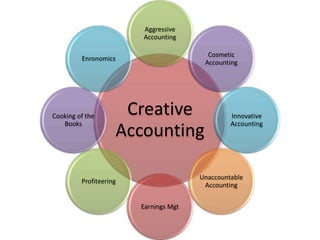
Creative
Accounting
Aggressive
Accounting
Cosmetic
Accounting
Innovative
Accounting
Unaccountable
Accounting
Earnings Mgt
Profiteering
Cooking of the
Books
Enronomics
What is Creative accounting?
Creative Accounting also called Aggressive accounting or
Innovative accounting, is the manipulation of financial numbers,
usually within the letter of the law and accounting standards, but
very much against their spirit and certainly not providing the
“true and fair” view of a company that accounts are supposed to.
A typical aim of creative accounting may also reduce reported
profits in good years to smooth results. Assets and liabilities
may also be manipulated, either to remain within limits such as
debt covenants, or to hide problems.
Origin of creative accounting:
 Creative Accounting has first become popular as a term among financial and
economics journalists in united kingdom media.
 Griffiths (1986), city editor of London Evening Standard, was one who first
brought the “ creative Accounting” topic to the public notice by his seminal book.
By this book he made the public become aware of the fact that the flexibility in the
accounts could be used for Creative accounting (Jones, 2011)
 Naser’s definition 1993
 Shah’s definition 1998
 Arthur levitt, chairman of securities and exchange commission 1998
 Nelson’s (2003) three kinds of management
 Jones(2011) - a deep literature review about earnings management
 “Big bath” approach.
K
why creative accounting ?
 A quarterly or an annual review provides information on the
financial position of a company.
 It is a snapshot of the company position, as well as a history of
change.
 However, the message the review gives is often taken to be about
the future position of the company.
 In particular, investors and the capital market tend to base their
decisions on results to date and the prognosis for the future.
 The shareholder and market reaction is related more and more to
managers’ actions and directors are increasingly judged on profit,
growth and EPS and have large bonuses at stake.
 So companies (and directors) are tempted to use the financial reports
to present the message they want investors to see, and may resort to
creative accounting. K
 Income smoothing
Personal gains
 Fulfilling necessary requirements
 Getting the funding or maintaining it.
 Survive from Bankruptcy
 Profit more
 Pay less tax
 Boost the share price
 To increase (fake) transaction
 To attract investor.
why creative accounting ?
K
Situations where creative accounting
may be resorted to/ methods of
creative accounting:
 Acquisitions, to hide poor results or boost EPS.
 Off-balance sheet financing.
 Valuations- particularly of intangible assets such as goodwill
and brand names.
 Capitalizing R&D or revenue expenses.
 Depreciation.
 Revenue recognition.
 Asset sales.
 failure to write down inventories that have declined in value.
Reflecting higher margins.
s
Types of creative accounting:
Unavoidable
degree of
estimation,
judgement
and
prediction
Artificial
Transactions
Genuine
Transactions
Pushing at
the
boundaries
of the law
K
Techniques of creative accounting:
1
• Recognizing premature or ficticious revenue
2
• “Big Bath” accounting
3
• Using cookie jar reserves
4
• Aggressive capitalization and extended amortization policies
5
• Manipulating inventory
6
• Getting creative with the income statement
7
• Problems with cash-flow reporting
8
• Abuse of Materiality concept
9
• Being generous with bad debts
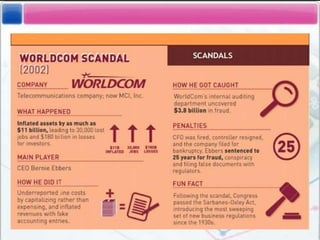
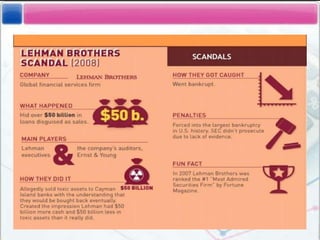
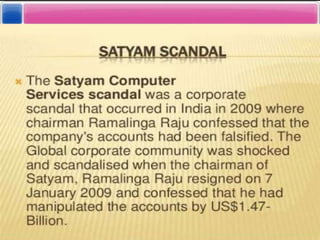
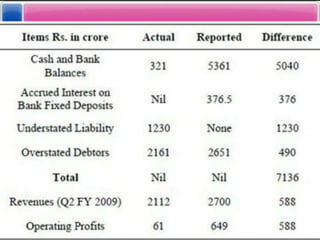
Scandals or examples :
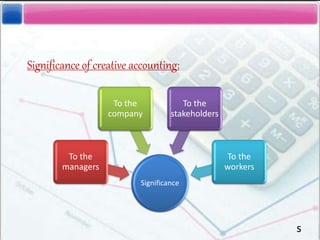
Significance of creative accounting:
Significance
To the
managers
To the
company
To the
stakeholders
To the
workers
s
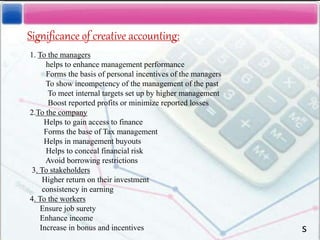
Significance of creative accounting:
1. To the managers
helps to enhance management performance
Forms the basis of personal incentives of the managers
To show incompetency of the management of the past
To meet internal targets set up by higher management
Boost reported profits or minimize reported losses
2.To the company
Helps to gain access to finance
Forms the base of Tax management
Helps in management buyouts
Helps to conceal financial risk
Avoid borrowing restrictions
3. To stakeholders
Higher return on their investment
consistency in earning
4. To the workers
Ensure job surety
Enhance income
Increase in bonus and incentives s
effects of/objections against
creative accounting:
 Creative Accounting practices are not being handled
judiciously.
 Techniques are mostly undertaken with unscrupulous
intentions.
 It misrepresents and misleads the society.
 Affected parties are the investors, creditors and the
employees.
 managers can misuse creative accounting in order to fulfill
their selfish motives.
 Unethical and out of the limit of Accounting Standard.
 Uncontrollable situations and threats to the company.
Controlling of creative accounting and frauds:
Can Creative accounting and fraud ever be stopped?
 probably not
 Part of human nature
 Best we can do is set up a sound conceptual framework and sound
standards
 Promote good ethical conduct
 Be Aware
“Creative accounting could be better called manipulative
accounting because it has more in common with the massage
Parlour than the creativity of the literary saloon.”
- austin mitchell
K
Role of auditor in creativE accounting (Companies act 2013):
s
 Make Report
 Audit report of Government Company.
 Liable to pay Damages (section 245 of the Companies
Act 2013).
 Branch audit.
 Auditing Standards.
 Fraud Reporting.
 Winding up ( Section 305 of the Companies Act 2013).
Role of auditor in in creative accounting
Procedures and tests applied by the auditor to reduce the effect of creative
accounting
in income statement
Sells
Cost of sold goods
Operating expenses
Procedures and tests applied by the auditor to reduce the effects of creative a
accounting
In statement of position
Cash
Current investment
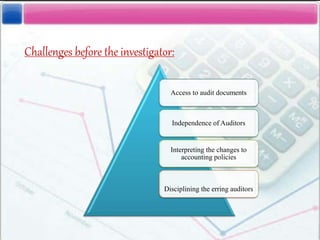
Challenges before the investigator:
Access to audit documents
Independence of Auditors
Interpreting the changes to
accounting policies
Disciplining the erring auditors
Conclusion:
 Creative accounting Legal or illegal?
Creative accounting

Creative accounting

  • 2.
    Synopsis:  Accounting Branches ofAccounting Concept of Creative Accounting What is Creative Accounting? Origin of Creative Accounting Why Creative Accounting? Situations where Creative Accounting may be resorted Types of Creative Accounting  Techniques of Creative Accounting  Scandals  Significance of Creative Accounting Effects of or objections against Creative Accounting Controlling of Creative Accounting and Frauds  Role of Auditor in Creative Accounting  Challenges Before the Investigator Conclusion
  • 3.
    Accounting: “ The artof recording, classifying, summarising and presenting the financial aspect of business dealings and interpreting the results thereof.” “Accounting is the process of identifying, measuring and communicating economic information to permit informed judgements and decisions by the users of such information.” - American Accounting Association(AAA) s
  • 4.
  • 5.
  • 6.
    Concept of Creativeaccounting: The term creative accounting refers to systematic misrepresentation of the true income and assets of corporations or other organizations. creative Accounting is at the root of a number of accounting scandals. The idea of creative Accounting, Cosmetic accounting or profiteering is not a new concept to the accounting world. Manipulation of accounts done in one year often requires the same kind of tailoring to be made the next year too and thus the process is constant. The practice often throws financial reporting out of control eventually results in Frauds of very large magnitude.
  • 7.
  • 8.
    What is Creativeaccounting? Creative Accounting also called Aggressive accounting or Innovative accounting, is the manipulation of financial numbers, usually within the letter of the law and accounting standards, but very much against their spirit and certainly not providing the “true and fair” view of a company that accounts are supposed to. A typical aim of creative accounting may also reduce reported profits in good years to smooth results. Assets and liabilities may also be manipulated, either to remain within limits such as debt covenants, or to hide problems.
  • 9.
    Origin of creativeaccounting:  Creative Accounting has first become popular as a term among financial and economics journalists in united kingdom media.  Griffiths (1986), city editor of London Evening Standard, was one who first brought the “ creative Accounting” topic to the public notice by his seminal book. By this book he made the public become aware of the fact that the flexibility in the accounts could be used for Creative accounting (Jones, 2011)  Naser’s definition 1993  Shah’s definition 1998  Arthur levitt, chairman of securities and exchange commission 1998  Nelson’s (2003) three kinds of management  Jones(2011) - a deep literature review about earnings management  “Big bath” approach. K
  • 10.
    why creative accounting?  A quarterly or an annual review provides information on the financial position of a company.  It is a snapshot of the company position, as well as a history of change.  However, the message the review gives is often taken to be about the future position of the company.  In particular, investors and the capital market tend to base their decisions on results to date and the prognosis for the future.  The shareholder and market reaction is related more and more to managers’ actions and directors are increasingly judged on profit, growth and EPS and have large bonuses at stake.  So companies (and directors) are tempted to use the financial reports to present the message they want investors to see, and may resort to creative accounting. K
  • 12.
     Income smoothing Personalgains  Fulfilling necessary requirements  Getting the funding or maintaining it.  Survive from Bankruptcy  Profit more  Pay less tax  Boost the share price  To increase (fake) transaction  To attract investor. why creative accounting ? K
  • 13.
    Situations where creativeaccounting may be resorted to/ methods of creative accounting:  Acquisitions, to hide poor results or boost EPS.  Off-balance sheet financing.  Valuations- particularly of intangible assets such as goodwill and brand names.  Capitalizing R&D or revenue expenses.  Depreciation.  Revenue recognition.  Asset sales.  failure to write down inventories that have declined in value. Reflecting higher margins. s
  • 14.
    Types of creativeaccounting: Unavoidable degree of estimation, judgement and prediction Artificial Transactions Genuine Transactions Pushing at the boundaries of the law K
  • 15.
    Techniques of creativeaccounting: 1 • Recognizing premature or ficticious revenue 2 • “Big Bath” accounting 3 • Using cookie jar reserves 4 • Aggressive capitalization and extended amortization policies 5 • Manipulating inventory 6 • Getting creative with the income statement 7 • Problems with cash-flow reporting 8 • Abuse of Materiality concept 9 • Being generous with bad debts
  • 16.
  • 21.
    Significance of creativeaccounting: Significance To the managers To the company To the stakeholders To the workers s
  • 22.
    Significance of creativeaccounting: 1. To the managers helps to enhance management performance Forms the basis of personal incentives of the managers To show incompetency of the management of the past To meet internal targets set up by higher management Boost reported profits or minimize reported losses 2.To the company Helps to gain access to finance Forms the base of Tax management Helps in management buyouts Helps to conceal financial risk Avoid borrowing restrictions 3. To stakeholders Higher return on their investment consistency in earning 4. To the workers Ensure job surety Enhance income Increase in bonus and incentives s
  • 23.
    effects of/objections against creativeaccounting:  Creative Accounting practices are not being handled judiciously.  Techniques are mostly undertaken with unscrupulous intentions.  It misrepresents and misleads the society.  Affected parties are the investors, creditors and the employees.  managers can misuse creative accounting in order to fulfill their selfish motives.  Unethical and out of the limit of Accounting Standard.  Uncontrollable situations and threats to the company.
  • 24.
    Controlling of creativeaccounting and frauds: Can Creative accounting and fraud ever be stopped?  probably not  Part of human nature  Best we can do is set up a sound conceptual framework and sound standards  Promote good ethical conduct  Be Aware “Creative accounting could be better called manipulative accounting because it has more in common with the massage Parlour than the creativity of the literary saloon.” - austin mitchell K
  • 25.
    Role of auditorin creativE accounting (Companies act 2013): s  Make Report  Audit report of Government Company.  Liable to pay Damages (section 245 of the Companies Act 2013).  Branch audit.  Auditing Standards.  Fraud Reporting.  Winding up ( Section 305 of the Companies Act 2013).
  • 26.
    Role of auditorin in creative accounting Procedures and tests applied by the auditor to reduce the effect of creative accounting in income statement Sells Cost of sold goods Operating expenses Procedures and tests applied by the auditor to reduce the effects of creative a accounting In statement of position Cash Current investment
  • 27.
    Challenges before theinvestigator: Access to audit documents Independence of Auditors Interpreting the changes to accounting policies Disciplining the erring auditors
  • 28.