Principles and Practices of
Auditing
Unit 6 – Company Auditor and
Audit of Limited Companies
Topics covered under this chapter
• Company Auditor - Appointment, Qualifications, Removal, Powers, Duties
and Liabilities of an Auditor - Civil and Criminal
• Audit Report – Contents of Audit Report – Types of Audit Reports.
• Audit of Limited Companies - Audit of Financial Statements – Balance
Sheet & Profit & Loss Account, Audit of Share Capital and Transfer of
Shares, Kinds of Reserves - Specific, General Capital and Reserves,
Provision and Reserves.
Who is an Auditor?
An auditor is a qualified chartered accountant appointed for the
purpose of examining the accounts of a joint stock company
and giving the report there on to the shareholder every year at
the annual general meeting.
Qualification - Auditor
• A company auditor must be qualified as chartered accountant.
• A chartered accountant is a person who is a member of the Institute
of Chartered Accountants of India (ICAI).
• He will be deemed to be in practice of accountancy, individually or in
partnership with other chartered accountant.
Company Auditor - Appointment
• Appointment of First Auditor – Appointed by the board of directors within
one month of the registration of the company.
• Appointment of Subsequent Auditors – Appointed after the first auditor
every year at every annual general meeting by the shareholders.
• Appointment by Central Government – An order from the central
government involving appointment by Comptroller and Audit General.
• Appointment in case of Casual Vacancy – It is caused by resignation of
existing auditor and is appointed by the board of directors.
Company Auditor - Appointment
• Appointment by Special Resolution – The board of directors will appoint an
auditor by passing a special resolution in the annual general meeting.
• Appointment in place of Retiring Auditor – This appointment takes place at
the event of an auditor’s retirement.
• Appointment through Audit Committee – If the audit committee is
constituted, then all appointments of auditor shall be made after
considering their recommendations.
Company Auditor – Rights & Powers
• Right to receive information and explanation – For the purpose of audit
and drawing conclusions, the auditor has to obtain explanations and
information from the concerned staff of the company.
• Right to accessibility to the books and records – In order to provide
findings on financial statements, the auditor has to access the concerning
books, vouchers, evidences and records of the company.
• Right to visit branches – The results of branch operations have to be
displayed in the financial statements. Hence may have to visit the respective
branches to understand their functioning status.
Company Auditor – Rights & Powers
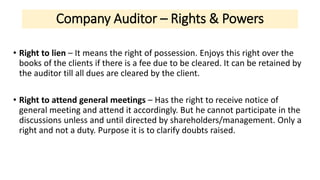
• Right to lien – It means the right of possession. Enjoys this right over the
books of the clients if there is a fee due to be cleared. It can be retained by
the auditor till all dues are cleared by the client.
• Right to attend general meetings – Has the right to receive notice of
general meeting and attend it accordingly. But he cannot participate in the
discussions unless and until directed by shareholders/management. Only a
right and not a duty. Purpose it is to clarify doubts raised.
Company Auditor – Duties & Liabilities
• Duty to enquire – Enquiry on loans & advances, transactions in book
entries, assets & liabilities of the company, regarding shares & debentures,
personal / business expenses.
• Duty to make a report – On financial position of the company at the end of
the financial year. Repot on Balance Sheet and P/L Account.
• Duty to state the following in the audit report – Whether he has obtained
all the required information and explanation from the concerned staff.
Previous years financial statements, observations and his opinion on books
of accounts.
Company Auditor – Duties & Liabilities
• Duty to provide reasons for negative answers – He may have to clarify with
justifiable reasons for the comments made on his report.
• Duty to sign the auditor’s report – Auditor’s Signature is mandatory on the
auditor’s report.
• Duty to certify the prospectus and statutory report – Certification by the
auditor is compulsory.
• Duty to attend audit committee meetings – Important to understand the
proceedings of the audit committee, hence mandatory to attend.
Company Auditor – Ethical Liabilities
• To serve the clients wholeheartedly and be loyal to their duties in work
• To study hard, renew existing knowledge, combine theory and practice
• To abide by state laws and regulations
• To exercise due professional care, fair and practical in handling audit items
• To withdraw or cease from performing audit where auditors have personal
interests involved in the audited items
• To be obliged to safeguard state secrets and the audited bodies’ trade
secrets in the course of audit
• To be modest and prudent, treat others as equals and create a reputable
image
Company Auditor – Legal Status / Position
• An Agent of the Shareholders – Auditor is expected to safeguard the
interests of the shareholders. He has to examine the books of accounts and
report the financial position of the company to the shareholders.
• An Officer of the Company – To some extent auditor is called an officer of
the company as he should be aware of the company policies and will be
auditing the books of that respective company.
• A Servant of the Company – Will be associated with an attitude to serve
and provide professional service to the client. Auditor is paid for the
services rendered.
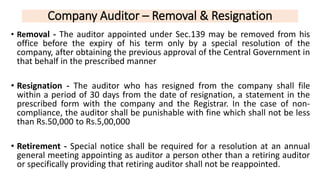
Company Auditor – Removal & Resignation
• Removal - The auditor appointed under Sec.139 may be removed from his
office before the expiry of his term only by a special resolution of the
company, after obtaining the previous approval of the Central Government in
that behalf in the prescribed manner
• Resignation - The auditor who has resigned from the company shall file
within a period of 30 days from the date of resignation, a statement in the
prescribed form with the company and the Registrar. In the case of non-
compliance, the auditor shall be punishable with fine which shall not be less
than Rs.50,000 to Rs.5,00,000
• Retirement - Special notice shall be required for a resolution at an annual
general meeting appointing as auditor a person other than a retiring auditor
or specifically providing that retiring auditor shall not be reappointed.
Audit Report
• It is a signed written document which presents the purpose,
scope and result of the audit. Result of the audit may include
findings, conclusion (opinion) and recommendations.
• The Objective is for the auditor to express his opinion and with
evidence in the form of a report which is referred to as the
auditor’s report.
• The audit report is addressed to the shareholders of the company
but it is also referred by others such as bankers, creditors and
other parties who use the information in the financial
statements.
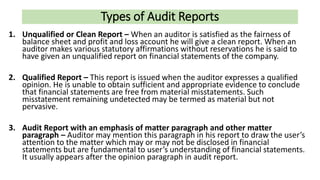
Types of Audit Reports
1. Unqualified or Clean Report – When an auditor is satisfied as the fairness of
balance sheet and profit and loss account he will give a clean report. When an
auditor makes various statutory affirmations without reservations he is said to
have given an unqualified report on financial statements of the company.
2. Qualified Report – This report is issued when the auditor expresses a qualified
opinion. He is unable to obtain sufficient and appropriate evidence to conclude
that financial statements are free from material misstatements. Such
misstatement remaining undetected may be termed as material but not
pervasive.
3. Audit Report with an emphasis of matter paragraph and other matter
paragraph – Auditor may mention this paragraph in his report to draw the user’s
attention to the matter which may or may not be disclosed in financial
statements but are fundamental to user’s understanding of financial statements.
It usually appears after the opinion paragraph in audit report.
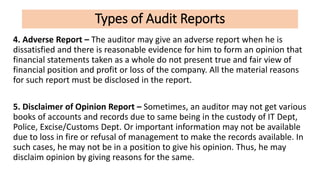
Types of Audit Reports
4. Adverse Report – The auditor may give an adverse report when he is
dissatisfied and there is reasonable evidence for him to form an opinion that
financial statements taken as a whole do not present true and fair view of
financial position and profit or loss of the company. All the material reasons
for such report must be disclosed in the report.
5. Disclaimer of Opinion Report – Sometimes, an auditor may not get various
books of accounts and records due to same being in the custody of IT Dept,
Police, Excise/Customs Dept. Or important information may not be available
due to loss in fire or refusal of management to make the records available. In
such cases, he may not be in a position to give his opinion. Thus, he may
disclaim opinion by giving reasons for the same.
Contents/Elements of Audit Report
1. Title – Title of the report shall clearly indicate that it is an independent
audit report distinguishing from report issued by other persons.
2. Addresses – It shall be addressed to the persons as per circumstances of
his engagement like members/shareholders or those changed with
governance.
3. Introductory Paragraph – It shall include the entity/company whose
financial statements have been audited.
4. Management’s responsibility for financial statement – It is described that
management is responsible for preparation of financial statements as per
financial reporting framework.
Contents/Elements of Audit Report
5. Auditor’s Responsibility – It shall state that the responsibility of auditor is to
express an opinion on financial statement on the basis of audit.
6. Auditor’s Opinion – It shall state the auditor’s opinion on the financial
statements of the company post conducting audit.
7. Date and Place of Auditor’s Report – The date of submitting audit report has to
be clearly mentioned along with the address of the auditor’s office.
8. Auditor’s Signature – Signature of auditor along with his membership number of
ICAI.
9. Reading and Inspection of Auditor’s Report – This report must be read before
the shareholders in general meeting and kept open for inspection if required.
Audit of Share Capital
• Auditor should ensure that the requirements as laid down in
Sections 39 and 11 have been complied with.
• If the authorized capital of the company is more than One
Crore, the permission of the Controller of Capital Issue, be
obtained to raise this capital.
• This certificate should be examined by the Auditor.
Audit of Share Capital
Auditor should examine the following books, accounts and
documents:
• MOA
• AOA
• Prospectus
• Director’s Minute Book
• Share Register, Application of Shares and Application Book
• Letters of Allotment and Allotment Book
• Copies of Letters of Regret, Letter of Calls, Calls Book
• Cash Book, Pass Book, Refunds of excess Application Money
Objectives of Audit of Share Capital
• To see that issue of shares is properly authorized and that there is no
over issue beyond the limit as prescribed in the MOA
• To see that assets received or acquired through the issue of shares have
been received, properly classified, valued and correctly recorded
• To see that provisions relating to rights of shareholders are duly
complied with
• To ensure that generally accepted accounting principles (GAAP) are
followed while preparing the accounts
Audit of Transfer of Shares
• He should examine the AOA regarding the procedure to be followed in case
of transfer of shares
• He should see that the transfer fee is duly received and credited to P&L A/c
and whether money has been deposited in the bank
• He should see whether the transfer is properly stamped
• He should verify the signature of the transferor with the signature on
application form
• He should check the transfer with the Share Register and see that a share has
not been transferred twice
• He should find out whether the transfer has been notified to the transferor
• He should find out whether the old share certificates have been cancelled so
that they may not be issued to other persons
Audit of Transfer of Shares
• When a part of the holding has been transferred, auditor should check the
balance certificates with counterfoils of the certificates
• He should examine the Director’s Minute Book to see that the transfers have
been duly sanctioned by the Board of Directors
• He should compare the total issued capital with the balances on the
Shareholders Account in the Share Book
• He should enquire if NOC had been received from the transferee of shares
• If the shares which have been mortgaged, are transferred, he should see that
due notice had been given to the mortgagee
• Compare the transfer fees received with the number of the transfers lodged
• Compare the Share Ledger balances with the Issued Share Capital
Audit of Financial Statements
Auditor to bear in mind following points –
• He must conduct compliance procedure to ensure the reliance on ICS
• To check various assertions of financial data reflected in BS and P&L
A/c
• To check the correctness, completeness and validity of the data
• Ensure the transactions of the company do not violate the provisions
of Companies Act while examining the financial statements
• Proper reflection of items in BS and P&L A/c such as
revenue/expenditure and assets/liabilities
• Ensure the financial statements reflect true and fair view of the trading
results and financial status of the company
Audit of Financial Statements – Balance Sheet
Examine following items in respect of Liabilities –
• Share Capital
• Reserves and Surplus
• Secured Loans
• Unsecured Loans
• Current Liabilities and Provisions
• A foot note for contingent liability
Audit of Financial Statements – Balance Sheet
Examine following items in respect of Assets –
• Fixed Assets
• Investments
• Current Assets, Loans and Advances
• Miscellaneous Expenditure
• Profit and Loss Account (Debit Balance)
Audit of Financial Statements – Profit & Loss Account
Examine following items with respect to Expenses –
• Consumption of raw materials / purchase of goods
• Opening stock of finished goods, work in progress
• Consumption of stores, spares
• Power and fuel
• Staff expenses – salaries, wages, bonus, welfare, provident fund
• Rent
• Repairs to building and machinery
• Depreciation, Insurances, Taxes, Interests
Audit of Financial Statements – Profit & Loss Account
Examine following items with respect to Revenue –
• Sales
• Closing stock of finished goods / closing work in progress
• Income from investments
• Dividend from subsidiaries
• Miscellaneous income
Reserves
• Reserve refers to retention of profit which is not in the form of
provision.
• Reserves means accumulated or undistributed profits.
• If the provision exceeds the amount which is required to meet the
loss or liability, the excess is to be treated as reserve.
Kinds of Reserves
(A) Revenue Reserve:
Those reserves which are created out of profits available for distribution by
way of dividend. These may be classified as:
(a) General Reserve: Reserve which is not created for any specific purpose.
E.g. General Reserve, Contingency Reserve.
(b) Specific Reserve: Reserve which is created for specific purpose. E.g.
Dividend Equalization Reserve, Debenture Redemption Reserve.
Kinds of Reserves
(B) Capital Reserve:
Those reserves created out of profits of capital nature and not out of
operating profits.
E.g. Profits prior to incorporation, Premium on issue of Shares and
Debentures, Premium on reissue of forfeited shares, Profit on sale of fixed
assets, Profit on revaluation of fixed asset
Revenue Reserves are free for distribution by way of dividend whereas
amount of capital reserve are not free for distribution by way of dividend.
Provision
• It refers to the amounts charged against revenue for
depreciation, renewals and diminution in value of assets or
amounts.
• They are charges against earnings and must be shown in the
profit and loss account.
• In the balance sheet, provisions which represent liabilities will
be shown under the head of Current Liabilities and Provisions.
Differences – Reserve and Provision
Reserve
1. It is created by debiting
Profit and Loss
Appropriation Account.
2. It is an appropriation of
profit.
3. Reserve is created for
unknown liabilities.
4. Creation of reserves
depends upon the financial
policy of the firm.
5. It is discretionary and
auditor is not to worry about
it.
Provision
1. It is debited to Profit and
Loss Account.
2. It is a charge against
profit.
3. Provision is made for a
known liability.
4. Creation of provisions is a
must as these are meant for
meeting known liabilities.
5. It is a must and auditor
should qualify his report if
adequate provisions are not
made.

PPA - Unit 6 - Company Auditor

  • 1.
    Principles and Practicesof Auditing Unit 6 – Company Auditor and Audit of Limited Companies
  • 2.
    Topics covered underthis chapter • Company Auditor - Appointment, Qualifications, Removal, Powers, Duties and Liabilities of an Auditor - Civil and Criminal • Audit Report – Contents of Audit Report – Types of Audit Reports. • Audit of Limited Companies - Audit of Financial Statements – Balance Sheet & Profit & Loss Account, Audit of Share Capital and Transfer of Shares, Kinds of Reserves - Specific, General Capital and Reserves, Provision and Reserves.
  • 3.
    Who is anAuditor? An auditor is a qualified chartered accountant appointed for the purpose of examining the accounts of a joint stock company and giving the report there on to the shareholder every year at the annual general meeting.
  • 4.
    Qualification - Auditor •A company auditor must be qualified as chartered accountant. • A chartered accountant is a person who is a member of the Institute of Chartered Accountants of India (ICAI). • He will be deemed to be in practice of accountancy, individually or in partnership with other chartered accountant.
  • 5.
    Company Auditor -Appointment • Appointment of First Auditor – Appointed by the board of directors within one month of the registration of the company. • Appointment of Subsequent Auditors – Appointed after the first auditor every year at every annual general meeting by the shareholders. • Appointment by Central Government – An order from the central government involving appointment by Comptroller and Audit General. • Appointment in case of Casual Vacancy – It is caused by resignation of existing auditor and is appointed by the board of directors.
  • 6.
    Company Auditor -Appointment • Appointment by Special Resolution – The board of directors will appoint an auditor by passing a special resolution in the annual general meeting. • Appointment in place of Retiring Auditor – This appointment takes place at the event of an auditor’s retirement. • Appointment through Audit Committee – If the audit committee is constituted, then all appointments of auditor shall be made after considering their recommendations.
  • 7.
    Company Auditor –Rights & Powers • Right to receive information and explanation – For the purpose of audit and drawing conclusions, the auditor has to obtain explanations and information from the concerned staff of the company. • Right to accessibility to the books and records – In order to provide findings on financial statements, the auditor has to access the concerning books, vouchers, evidences and records of the company. • Right to visit branches – The results of branch operations have to be displayed in the financial statements. Hence may have to visit the respective branches to understand their functioning status.
  • 8.
    Company Auditor –Rights & Powers • Right to lien – It means the right of possession. Enjoys this right over the books of the clients if there is a fee due to be cleared. It can be retained by the auditor till all dues are cleared by the client. • Right to attend general meetings – Has the right to receive notice of general meeting and attend it accordingly. But he cannot participate in the discussions unless and until directed by shareholders/management. Only a right and not a duty. Purpose it is to clarify doubts raised.
  • 9.
    Company Auditor –Duties & Liabilities • Duty to enquire – Enquiry on loans & advances, transactions in book entries, assets & liabilities of the company, regarding shares & debentures, personal / business expenses. • Duty to make a report – On financial position of the company at the end of the financial year. Repot on Balance Sheet and P/L Account. • Duty to state the following in the audit report – Whether he has obtained all the required information and explanation from the concerned staff. Previous years financial statements, observations and his opinion on books of accounts.
  • 10.
    Company Auditor –Duties & Liabilities • Duty to provide reasons for negative answers – He may have to clarify with justifiable reasons for the comments made on his report. • Duty to sign the auditor’s report – Auditor’s Signature is mandatory on the auditor’s report. • Duty to certify the prospectus and statutory report – Certification by the auditor is compulsory. • Duty to attend audit committee meetings – Important to understand the proceedings of the audit committee, hence mandatory to attend.
  • 11.
    Company Auditor –Ethical Liabilities • To serve the clients wholeheartedly and be loyal to their duties in work • To study hard, renew existing knowledge, combine theory and practice • To abide by state laws and regulations • To exercise due professional care, fair and practical in handling audit items • To withdraw or cease from performing audit where auditors have personal interests involved in the audited items • To be obliged to safeguard state secrets and the audited bodies’ trade secrets in the course of audit • To be modest and prudent, treat others as equals and create a reputable image
  • 12.
    Company Auditor –Legal Status / Position • An Agent of the Shareholders – Auditor is expected to safeguard the interests of the shareholders. He has to examine the books of accounts and report the financial position of the company to the shareholders. • An Officer of the Company – To some extent auditor is called an officer of the company as he should be aware of the company policies and will be auditing the books of that respective company. • A Servant of the Company – Will be associated with an attitude to serve and provide professional service to the client. Auditor is paid for the services rendered.
  • 13.
    Company Auditor –Removal & Resignation • Removal - The auditor appointed under Sec.139 may be removed from his office before the expiry of his term only by a special resolution of the company, after obtaining the previous approval of the Central Government in that behalf in the prescribed manner • Resignation - The auditor who has resigned from the company shall file within a period of 30 days from the date of resignation, a statement in the prescribed form with the company and the Registrar. In the case of non- compliance, the auditor shall be punishable with fine which shall not be less than Rs.50,000 to Rs.5,00,000 • Retirement - Special notice shall be required for a resolution at an annual general meeting appointing as auditor a person other than a retiring auditor or specifically providing that retiring auditor shall not be reappointed.
  • 14.
    Audit Report • Itis a signed written document which presents the purpose, scope and result of the audit. Result of the audit may include findings, conclusion (opinion) and recommendations. • The Objective is for the auditor to express his opinion and with evidence in the form of a report which is referred to as the auditor’s report. • The audit report is addressed to the shareholders of the company but it is also referred by others such as bankers, creditors and other parties who use the information in the financial statements.
  • 15.
    Types of AuditReports 1. Unqualified or Clean Report – When an auditor is satisfied as the fairness of balance sheet and profit and loss account he will give a clean report. When an auditor makes various statutory affirmations without reservations he is said to have given an unqualified report on financial statements of the company. 2. Qualified Report – This report is issued when the auditor expresses a qualified opinion. He is unable to obtain sufficient and appropriate evidence to conclude that financial statements are free from material misstatements. Such misstatement remaining undetected may be termed as material but not pervasive. 3. Audit Report with an emphasis of matter paragraph and other matter paragraph – Auditor may mention this paragraph in his report to draw the user’s attention to the matter which may or may not be disclosed in financial statements but are fundamental to user’s understanding of financial statements. It usually appears after the opinion paragraph in audit report.
  • 16.
    Types of AuditReports 4. Adverse Report – The auditor may give an adverse report when he is dissatisfied and there is reasonable evidence for him to form an opinion that financial statements taken as a whole do not present true and fair view of financial position and profit or loss of the company. All the material reasons for such report must be disclosed in the report. 5. Disclaimer of Opinion Report – Sometimes, an auditor may not get various books of accounts and records due to same being in the custody of IT Dept, Police, Excise/Customs Dept. Or important information may not be available due to loss in fire or refusal of management to make the records available. In such cases, he may not be in a position to give his opinion. Thus, he may disclaim opinion by giving reasons for the same.
  • 17.
    Contents/Elements of AuditReport 1. Title – Title of the report shall clearly indicate that it is an independent audit report distinguishing from report issued by other persons. 2. Addresses – It shall be addressed to the persons as per circumstances of his engagement like members/shareholders or those changed with governance. 3. Introductory Paragraph – It shall include the entity/company whose financial statements have been audited. 4. Management’s responsibility for financial statement – It is described that management is responsible for preparation of financial statements as per financial reporting framework.
  • 18.
    Contents/Elements of AuditReport 5. Auditor’s Responsibility – It shall state that the responsibility of auditor is to express an opinion on financial statement on the basis of audit. 6. Auditor’s Opinion – It shall state the auditor’s opinion on the financial statements of the company post conducting audit. 7. Date and Place of Auditor’s Report – The date of submitting audit report has to be clearly mentioned along with the address of the auditor’s office. 8. Auditor’s Signature – Signature of auditor along with his membership number of ICAI. 9. Reading and Inspection of Auditor’s Report – This report must be read before the shareholders in general meeting and kept open for inspection if required.
  • 19.
    Audit of ShareCapital • Auditor should ensure that the requirements as laid down in Sections 39 and 11 have been complied with. • If the authorized capital of the company is more than One Crore, the permission of the Controller of Capital Issue, be obtained to raise this capital. • This certificate should be examined by the Auditor.
  • 20.
    Audit of ShareCapital Auditor should examine the following books, accounts and documents: • MOA • AOA • Prospectus • Director’s Minute Book • Share Register, Application of Shares and Application Book • Letters of Allotment and Allotment Book • Copies of Letters of Regret, Letter of Calls, Calls Book • Cash Book, Pass Book, Refunds of excess Application Money
  • 21.
    Objectives of Auditof Share Capital • To see that issue of shares is properly authorized and that there is no over issue beyond the limit as prescribed in the MOA • To see that assets received or acquired through the issue of shares have been received, properly classified, valued and correctly recorded • To see that provisions relating to rights of shareholders are duly complied with • To ensure that generally accepted accounting principles (GAAP) are followed while preparing the accounts
  • 22.
    Audit of Transferof Shares • He should examine the AOA regarding the procedure to be followed in case of transfer of shares • He should see that the transfer fee is duly received and credited to P&L A/c and whether money has been deposited in the bank • He should see whether the transfer is properly stamped • He should verify the signature of the transferor with the signature on application form • He should check the transfer with the Share Register and see that a share has not been transferred twice • He should find out whether the transfer has been notified to the transferor • He should find out whether the old share certificates have been cancelled so that they may not be issued to other persons
  • 23.
    Audit of Transferof Shares • When a part of the holding has been transferred, auditor should check the balance certificates with counterfoils of the certificates • He should examine the Director’s Minute Book to see that the transfers have been duly sanctioned by the Board of Directors • He should compare the total issued capital with the balances on the Shareholders Account in the Share Book • He should enquire if NOC had been received from the transferee of shares • If the shares which have been mortgaged, are transferred, he should see that due notice had been given to the mortgagee • Compare the transfer fees received with the number of the transfers lodged • Compare the Share Ledger balances with the Issued Share Capital
  • 24.
    Audit of FinancialStatements Auditor to bear in mind following points – • He must conduct compliance procedure to ensure the reliance on ICS • To check various assertions of financial data reflected in BS and P&L A/c • To check the correctness, completeness and validity of the data • Ensure the transactions of the company do not violate the provisions of Companies Act while examining the financial statements • Proper reflection of items in BS and P&L A/c such as revenue/expenditure and assets/liabilities • Ensure the financial statements reflect true and fair view of the trading results and financial status of the company
  • 25.
    Audit of FinancialStatements – Balance Sheet Examine following items in respect of Liabilities – • Share Capital • Reserves and Surplus • Secured Loans • Unsecured Loans • Current Liabilities and Provisions • A foot note for contingent liability
  • 26.
    Audit of FinancialStatements – Balance Sheet Examine following items in respect of Assets – • Fixed Assets • Investments • Current Assets, Loans and Advances • Miscellaneous Expenditure • Profit and Loss Account (Debit Balance)
  • 27.
    Audit of FinancialStatements – Profit & Loss Account Examine following items with respect to Expenses – • Consumption of raw materials / purchase of goods • Opening stock of finished goods, work in progress • Consumption of stores, spares • Power and fuel • Staff expenses – salaries, wages, bonus, welfare, provident fund • Rent • Repairs to building and machinery • Depreciation, Insurances, Taxes, Interests
  • 28.
    Audit of FinancialStatements – Profit & Loss Account Examine following items with respect to Revenue – • Sales • Closing stock of finished goods / closing work in progress • Income from investments • Dividend from subsidiaries • Miscellaneous income
  • 29.
    Reserves • Reserve refersto retention of profit which is not in the form of provision. • Reserves means accumulated or undistributed profits. • If the provision exceeds the amount which is required to meet the loss or liability, the excess is to be treated as reserve.
  • 30.
    Kinds of Reserves (A)Revenue Reserve: Those reserves which are created out of profits available for distribution by way of dividend. These may be classified as: (a) General Reserve: Reserve which is not created for any specific purpose. E.g. General Reserve, Contingency Reserve. (b) Specific Reserve: Reserve which is created for specific purpose. E.g. Dividend Equalization Reserve, Debenture Redemption Reserve.
  • 31.
    Kinds of Reserves (B)Capital Reserve: Those reserves created out of profits of capital nature and not out of operating profits. E.g. Profits prior to incorporation, Premium on issue of Shares and Debentures, Premium on reissue of forfeited shares, Profit on sale of fixed assets, Profit on revaluation of fixed asset Revenue Reserves are free for distribution by way of dividend whereas amount of capital reserve are not free for distribution by way of dividend.
  • 32.
    Provision • It refersto the amounts charged against revenue for depreciation, renewals and diminution in value of assets or amounts. • They are charges against earnings and must be shown in the profit and loss account. • In the balance sheet, provisions which represent liabilities will be shown under the head of Current Liabilities and Provisions.
  • 33.
    Differences – Reserveand Provision Reserve 1. It is created by debiting Profit and Loss Appropriation Account. 2. It is an appropriation of profit. 3. Reserve is created for unknown liabilities. 4. Creation of reserves depends upon the financial policy of the firm. 5. It is discretionary and auditor is not to worry about it. Provision 1. It is debited to Profit and Loss Account. 2. It is a charge against profit. 3. Provision is made for a known liability. 4. Creation of provisions is a must as these are meant for meeting known liabilities. 5. It is a must and auditor should qualify his report if adequate provisions are not made.