
Presentation on
FINANCIAL MANAGEMENT’S
•INVENTORY MANAGEMENT TECHNIQUES
•RECEIVABLES AND ITS MANAGEMENT
INVENTORY:
Meaning & Definition
• In a manufacturing organization, in
addition to the stock of finished goods,
there will be stock of partly finished goods,
raw materials and stores.
• The collective name of these entire items
is ‘INVENTORY’.
• The term ‘inventory’ refers to thestockpileof
productionafirmis offeringforsaleandthecomponents
that makeuptheproduction.
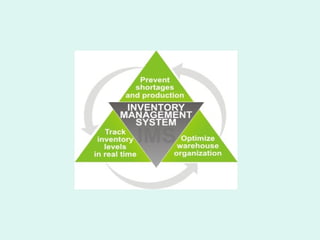
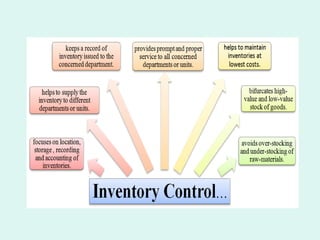
INVENTORY MANAGEMENT
• Inventories consist of raw materials,
stores, spares, packing materials, coal,
petroleum products, works-in-progress
and finished products in stock either at the
factory or deposits.
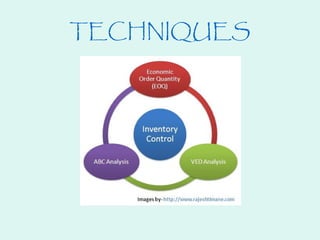
TECHNIQUES
ABC Analysis of Inventories
• The ABC inventory control technique is
based on the principle that a small portion
of the items may typically represent the
bulk of money value of the total inventory
used in the production process, while a
relatively large number of items may from
a small part of the money value of stores.
• The money value is ascertained by
multiplying the quantity of material of each
item by its unit price.
• According to this approach to inventory
control high value items are more closely
controlled than low value items.
• Each item of inventory is given A, B or C
denomination depending upon the amount
spent for that particular item. “A” or the
highest value items should be under the
tight control and under responsibility of the
most experienced personnel, while “C” or
the lowest value may be under simple
ABC Analysis of Inventories
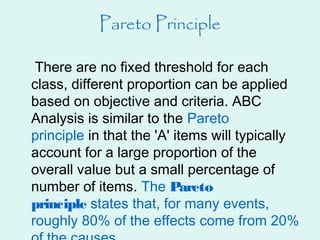
Pareto Principle
There are no fixed threshold for each
class, different proportion can be applied
based on objective and criteria. ABC
Analysis is similar to the Pareto
principle in that the 'A' items will typically
account for a large proportion of the
overall value but a small percentage of
number of items. The Pareto
principle states that, for many events,
roughly 80% of the effects come from 20%
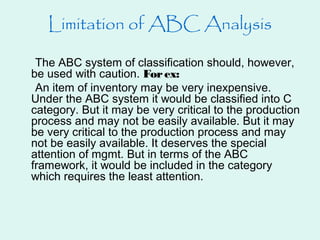
Limitation of ABC Analysis
The ABC system of classification should, however,
be used with caution. Forex:
An item of inventory may be very inexpensive.
Under the ABC system it would be classified into C
category. But it may be very critical to the production
process and may not be easily available. But it may
be very critical to the production process and may
not be easily available. It deserves the special
attention of mgmt. But in terms of the ABC
framework, it would be included in the category
which requires the least attention.
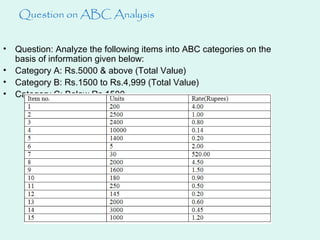
Question on ABC Analysis
• Question: Analyze the following items into ABC categories on the
basis of information given below:
• Category A: Rs.5000 & above (Total Value)
• Category B: Rs.1500 to Rs.4,999 (Total Value)
• Category C: Below Rs.1500
Economic Order Quantity
(EOQ MODEL)
Important questions dealt with in
EOQ Model
• 1.How much to purchase at any one time?
• 2.Other costs associated with ordering
quantity apart from purchase price?
• 3.Material procurement should be done in
one lot or installments?
TERMS
• Ordering cost- cost incurred by the
company at the time of placing an order.
• For e.g.. Handling and transportation cost,
Stationary cost, costs incurred for inviting
quotations and tenders.
• The more the frequency of order, the more
the Ordering cost.
• Carrying cost- cost of carrying the
inventory. Real out of pocket cost,
associated with having inventory on hand.
• For e.g.. Warehouse charges, insurance
lighting, losses due to handling spoilage,
breakage etc.. Along with, amount of
interest lost due to the investment in the
inventory.
• C.C. increases as the quantity of material
Behavior of Carrying Cost &
Ordering Cost
• Both C.C and O.C are variables costs ,
however their behavior is exactly opposite
of each other.
• If orders are frequent, O.C will be more.
• As quantity ordered increases, C.C will
Increase.
• The optimum level of inventory at which
both the O.C and C.C is minimum is called
as Economic order quantity. Also called as
economic lot size.
Fixation Of Level
• Not to purchase too much or too little.
• Setting accurate timing of purchase.
• Objective- To avoid overstocking, avoiding
shortage of material, ordering the material
at right time.
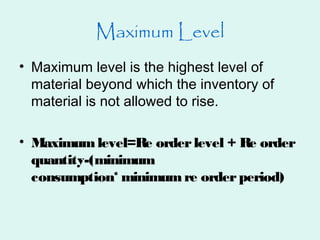
Maximum Level
• Maximum level is the highest level of
material beyond which the inventory of
material is not allowed to rise.
• Maximumlevel=Re orderlevel + Re order
quantity-(minimum
consumption* minimumre orderperiod)
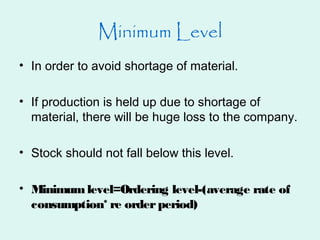
Minimum Level
• In order to avoid shortage of material.
• If production is held up due to shortage of
material, there will be huge loss to the company.
• Stock should not fall below this level.
• Minimumlevel=Ordering level-(average rate of
consumption* re orderperiod)
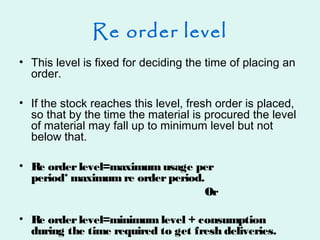
Re order level
• This level is fixed for deciding the time of placing an
order.
• If the stock reaches this level, fresh order is placed,
so that by the time the material is procured the level
of material may fall up to minimum level but not
below that.
• Re orderlevel=maximum usage per
period* maximum re orderperiod.
Or
• Re orderlevel=minimum level + consumption
during the time required to get fresh deliveries.
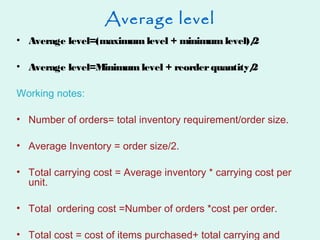
Average level
• Average level=(maximum level + minimum level)/2
• Average level=Minimum level + reorderquantity/2
Working notes:
• Number of orders= total inventory requirement/order size.
• Average Inventory = order size/2.
• Total carrying cost = Average inventory * carrying cost per
unit.
• Total ordering cost =Number of orders *cost per order.
• Total cost = cost of items purchased+ total carrying and
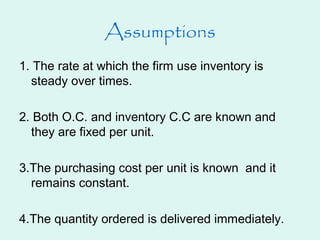
Assumptions
1. The rate at which the firm use inventory is
steady over times.
2. Both O.C. and inventory C.C are known and
they are fixed per unit.
3.The purchasing cost per unit is known and it
remains constant.
4.The quantity ordered is delivered immediately.
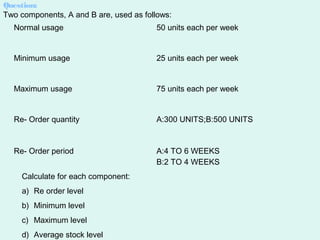
Question:
Two components, A and B are, used as follows:
Normal usage 50 units each per week
Minimum usage 25 units each per week
Maximum usage 75 units each per week
Re- Order quantity A:300 UNITS;B:500 UNITS
Re- Order period A:4 TO 6 WEEKS
B:2 TO 4 WEEKS
Calculate for each component:
a) Re order level
b) Minimum level
c) Maximum level
d) Average stock level
Receivables and management of
Receivables
• Receivables is known as when firm makes
an ordinary sale of goods or service and
does not receive payment, it grant trade
credit and creates accounts receivable
which would be collected in future.
• “In simple terms it known as sales of good
and service in credit and make an
promissory note to receive payment later.”
Receivables
Objectives Of Receivables
• Creating, preserving and collecting A/R.
• Establishing and communicating credit
policies.
• Evaluation of customers and setting credit
lines.
• Maintaining up-to-date records of
accounts receivables.
Reasons To Offer Credit
• Competition
• Market share
• Promotion
• Credit availability to customers
• Customer convenience
• Profit
Receivables management
• Receivables management refers to the
decision a business makes regarding to
the overall credit, collection policies and
the evaluation of individual credit
applicants.
• It is also called trade credit
management.
• It refers to the planning, organizing and
controlling of receivables.
Significance & Purpose of
Receivables management
• The basic purpose of firm's receivable management is
to determine effective credit policy that increases the
efficiency of firm's credit and collection department
and contributes to the maximization of value of the
firm. The specific purposes of receivable management
are as follows:
• To evaluate the creditworthiness of customers before
granting or extending the credit.
• To minimize the cost of investment in receivables.
• To minimize the possible bad debt losses.
• To minimize the cost of running credit
and collection department.
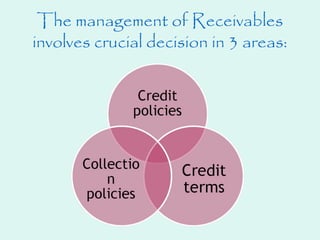
The management of Receivables
involves crucial decision in 3 areas:
Credit Policies
• It provides the framework to determine
whether or not to extend credit to a
customer and how much credit to extend.
• Two broad dimensions:-
• Credit standards
• Credit analysis
Credit Standards
• It represents the basic criteria for the
extension of credit to customers.
• The quantitative basis of establishing
credit standards are:-
• Credit ratings
• Average payment period
• Financial ratios
Following Factors are considered
while deciding the credit standards
• Collection costs
• Investments in receivables or the average
collection period.
• Bad debt expenses.
• Sales volume
Credit Analysis
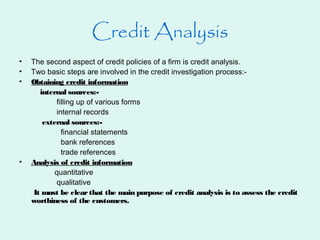
• The second aspect of credit policies of a firm is credit analysis.
• Two basic steps are involved in the credit investigation process:-
• Obtaining credit information
internal sources:-
filling up of various forms
internal records
external sources:-
financial statements
bank references
trade references
• Analysis of credit information
quantitative
qualitative
It must be clearthat the main purpose of credit analysis is to assess the credit
worthiness of the customers.
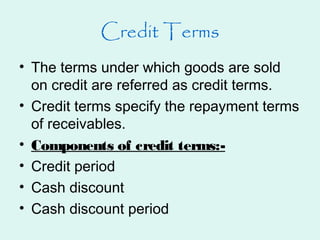
Credit Terms
• The terms under which goods are sold
on credit are referred as credit terms.
• Credit terms specify the repayment terms
of receivables.
• Components of credit terms:-
• Credit period
• Cash discount
• Cash discount period
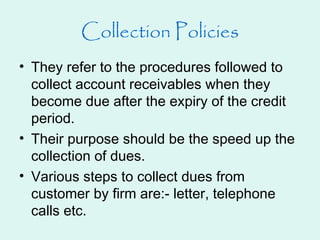
Collection Policies
• They refer to the procedures followed to
collect account receivables when they
become due after the expiry of the credit
period.
• Their purpose should be the speed up the
collection of dues.
• Various steps to collect dues from
customer by firm are:- letter, telephone
calls etc.
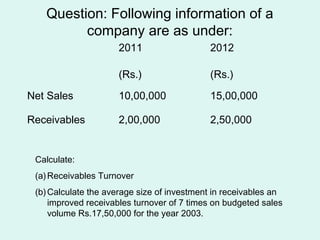
Question: Following information of a
company are as under:
2011 2012
(Rs.) (Rs.)
Net Sales 10,00,000 15,00,000
Receivables 2,00,000 2,50,000
Calculate:
(a)Receivables Turnover
(b)Calculate the average size of investment in receivables an
improved receivables turnover of 7 times on budgeted sales
volume Rs.17,50,000 for the year 2003.
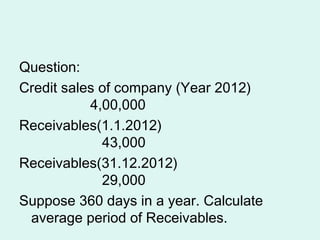
Question:
Credit sales of company (Year 2012)
4,00,000
Receivables(1.1.2012)
43,000
Receivables(31.12.2012)
29,000
Suppose 360 days in a year. Calculate
average period of Receivables.

Inventory management and Receivables (ABC, EOQ Model)

  • 1.
    Presentation on FINANCIAL MANAGEMENT’S •INVENTORYMANAGEMENT TECHNIQUES •RECEIVABLES AND ITS MANAGEMENT
  • 2.
    INVENTORY: Meaning & Definition •In a manufacturing organization, in addition to the stock of finished goods, there will be stock of partly finished goods, raw materials and stores. • The collective name of these entire items is ‘INVENTORY’. • The term ‘inventory’ refers to thestockpileof productionafirmis offeringforsaleandthecomponents that makeuptheproduction.
  • 3.
    INVENTORY MANAGEMENT • Inventoriesconsist of raw materials, stores, spares, packing materials, coal, petroleum products, works-in-progress and finished products in stock either at the factory or deposits.
  • 6.
  • 7.
    ABC Analysis ofInventories • The ABC inventory control technique is based on the principle that a small portion of the items may typically represent the bulk of money value of the total inventory used in the production process, while a relatively large number of items may from a small part of the money value of stores. • The money value is ascertained by multiplying the quantity of material of each item by its unit price.
  • 8.
    • According tothis approach to inventory control high value items are more closely controlled than low value items. • Each item of inventory is given A, B or C denomination depending upon the amount spent for that particular item. “A” or the highest value items should be under the tight control and under responsibility of the most experienced personnel, while “C” or the lowest value may be under simple ABC Analysis of Inventories
  • 9.
    Pareto Principle There areno fixed threshold for each class, different proportion can be applied based on objective and criteria. ABC Analysis is similar to the Pareto principle in that the 'A' items will typically account for a large proportion of the overall value but a small percentage of number of items. The Pareto principle states that, for many events, roughly 80% of the effects come from 20%
  • 10.
    Limitation of ABCAnalysis The ABC system of classification should, however, be used with caution. Forex: An item of inventory may be very inexpensive. Under the ABC system it would be classified into C category. But it may be very critical to the production process and may not be easily available. But it may be very critical to the production process and may not be easily available. It deserves the special attention of mgmt. But in terms of the ABC framework, it would be included in the category which requires the least attention.
  • 11.
    Question on ABCAnalysis • Question: Analyze the following items into ABC categories on the basis of information given below: • Category A: Rs.5000 & above (Total Value) • Category B: Rs.1500 to Rs.4,999 (Total Value) • Category C: Below Rs.1500
  • 12.
  • 13.
    Important questions dealtwith in EOQ Model • 1.How much to purchase at any one time? • 2.Other costs associated with ordering quantity apart from purchase price? • 3.Material procurement should be done in one lot or installments?
  • 14.
    TERMS • Ordering cost-cost incurred by the company at the time of placing an order. • For e.g.. Handling and transportation cost, Stationary cost, costs incurred for inviting quotations and tenders. • The more the frequency of order, the more the Ordering cost.
  • 15.
    • Carrying cost-cost of carrying the inventory. Real out of pocket cost, associated with having inventory on hand. • For e.g.. Warehouse charges, insurance lighting, losses due to handling spoilage, breakage etc.. Along with, amount of interest lost due to the investment in the inventory. • C.C. increases as the quantity of material
  • 16.
    Behavior of CarryingCost & Ordering Cost • Both C.C and O.C are variables costs , however their behavior is exactly opposite of each other. • If orders are frequent, O.C will be more. • As quantity ordered increases, C.C will Increase. • The optimum level of inventory at which both the O.C and C.C is minimum is called as Economic order quantity. Also called as economic lot size.
  • 17.
    Fixation Of Level •Not to purchase too much or too little. • Setting accurate timing of purchase. • Objective- To avoid overstocking, avoiding shortage of material, ordering the material at right time.
  • 18.
    Maximum Level • Maximumlevel is the highest level of material beyond which the inventory of material is not allowed to rise. • Maximumlevel=Re orderlevel + Re order quantity-(minimum consumption* minimumre orderperiod)
  • 19.
    Minimum Level • Inorder to avoid shortage of material. • If production is held up due to shortage of material, there will be huge loss to the company. • Stock should not fall below this level. • Minimumlevel=Ordering level-(average rate of consumption* re orderperiod)
  • 20.
    Re order level •This level is fixed for deciding the time of placing an order. • If the stock reaches this level, fresh order is placed, so that by the time the material is procured the level of material may fall up to minimum level but not below that. • Re orderlevel=maximum usage per period* maximum re orderperiod. Or • Re orderlevel=minimum level + consumption during the time required to get fresh deliveries.
  • 21.
    Average level • Averagelevel=(maximum level + minimum level)/2 • Average level=Minimum level + reorderquantity/2 Working notes: • Number of orders= total inventory requirement/order size. • Average Inventory = order size/2. • Total carrying cost = Average inventory * carrying cost per unit. • Total ordering cost =Number of orders *cost per order. • Total cost = cost of items purchased+ total carrying and
  • 22.
    Assumptions 1. The rateat which the firm use inventory is steady over times. 2. Both O.C. and inventory C.C are known and they are fixed per unit. 3.The purchasing cost per unit is known and it remains constant. 4.The quantity ordered is delivered immediately.
  • 23.
    Question: Two components, Aand B are, used as follows: Normal usage 50 units each per week Minimum usage 25 units each per week Maximum usage 75 units each per week Re- Order quantity A:300 UNITS;B:500 UNITS Re- Order period A:4 TO 6 WEEKS B:2 TO 4 WEEKS Calculate for each component: a) Re order level b) Minimum level c) Maximum level d) Average stock level
  • 24.
  • 25.
    • Receivables isknown as when firm makes an ordinary sale of goods or service and does not receive payment, it grant trade credit and creates accounts receivable which would be collected in future. • “In simple terms it known as sales of good and service in credit and make an promissory note to receive payment later.” Receivables
  • 26.
    Objectives Of Receivables •Creating, preserving and collecting A/R. • Establishing and communicating credit policies. • Evaluation of customers and setting credit lines. • Maintaining up-to-date records of accounts receivables.
  • 27.
    Reasons To OfferCredit • Competition • Market share • Promotion • Credit availability to customers • Customer convenience • Profit
  • 28.
    Receivables management • Receivablesmanagement refers to the decision a business makes regarding to the overall credit, collection policies and the evaluation of individual credit applicants. • It is also called trade credit management. • It refers to the planning, organizing and controlling of receivables.
  • 29.
    Significance & Purposeof Receivables management • The basic purpose of firm's receivable management is to determine effective credit policy that increases the efficiency of firm's credit and collection department and contributes to the maximization of value of the firm. The specific purposes of receivable management are as follows: • To evaluate the creditworthiness of customers before granting or extending the credit. • To minimize the cost of investment in receivables. • To minimize the possible bad debt losses. • To minimize the cost of running credit and collection department.
  • 30.
    The management ofReceivables involves crucial decision in 3 areas:
  • 31.
    Credit Policies • Itprovides the framework to determine whether or not to extend credit to a customer and how much credit to extend. • Two broad dimensions:- • Credit standards • Credit analysis
  • 32.
    Credit Standards • Itrepresents the basic criteria for the extension of credit to customers. • The quantitative basis of establishing credit standards are:- • Credit ratings • Average payment period • Financial ratios
  • 33.
    Following Factors areconsidered while deciding the credit standards • Collection costs • Investments in receivables or the average collection period. • Bad debt expenses. • Sales volume
  • 34.
    Credit Analysis • Thesecond aspect of credit policies of a firm is credit analysis. • Two basic steps are involved in the credit investigation process:- • Obtaining credit information internal sources:- filling up of various forms internal records external sources:- financial statements bank references trade references • Analysis of credit information quantitative qualitative It must be clearthat the main purpose of credit analysis is to assess the credit worthiness of the customers.
  • 35.
    Credit Terms • Theterms under which goods are sold on credit are referred as credit terms. • Credit terms specify the repayment terms of receivables. • Components of credit terms:- • Credit period • Cash discount • Cash discount period
  • 36.
    Collection Policies • Theyrefer to the procedures followed to collect account receivables when they become due after the expiry of the credit period. • Their purpose should be the speed up the collection of dues. • Various steps to collect dues from customer by firm are:- letter, telephone calls etc.
  • 37.
    Question: Following informationof a company are as under: 2011 2012 (Rs.) (Rs.) Net Sales 10,00,000 15,00,000 Receivables 2,00,000 2,50,000 Calculate: (a)Receivables Turnover (b)Calculate the average size of investment in receivables an improved receivables turnover of 7 times on budgeted sales volume Rs.17,50,000 for the year 2003.
  • 38.
    Question: Credit sales ofcompany (Year 2012) 4,00,000 Receivables(1.1.2012) 43,000 Receivables(31.12.2012) 29,000 Suppose 360 days in a year. Calculate average period of Receivables.