Receivables
Accounts Receivable Amounts due from customers for credit sales. Credit sales require: Maintaining a separate account receivable for each customer. Accounting for bad debts that result from credit sales.
Credit Card Sales Customers’ credit is evaluated by the credit card issuer Sales increase by providing purchase options to the customer The risks of extending credit are transferred to the credit card issuer Cash collections are speeded up.
Bank Credit Card Sales With bank credit cards, the seller deposits the credit card sales receipt in the bank just like it deposits a customer’s cheque. The bank increases the balance in the company’s chequing account. The company usually pays a fee of 2% to 5% for the service.
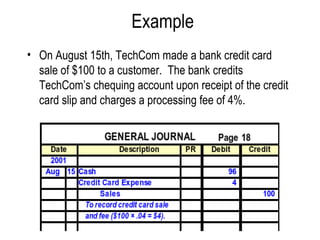
Example On August 15th, TechCom made a bank credit card sale of $100 to a customer.  The bank credits TechCom’s chequing account upon receipt of the credit card slip and charges a processing fee of 4%.
Valuing Accounts Receivable There are two methods used to account for receivables that customers do not pay.   Allowance method—at the end of each accounting period, bad debts expense is estimated and recorded. Method satisfies matching principle—expense is charged in period of related sale. Accounts Receivable are reported at their estimated realizable value (A/Rec less the allowance account). Entry to write-off an uncollectible: debit  Allowance for Doubtful Accounts, credit Accounts Receivable. Writing off an uncollectible does not change the estimated realizable value of Accounts Receivable.
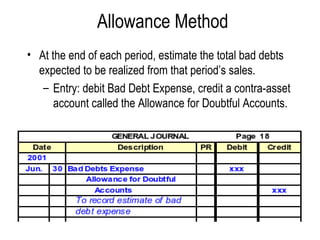
Allowance Method At the end of each period, estimate the total bad debts expected to be realized from that period’s sales. Entry: debit Bad Debt Expense, credit a contra-asset account called the Allowance for Doubtful Accounts.
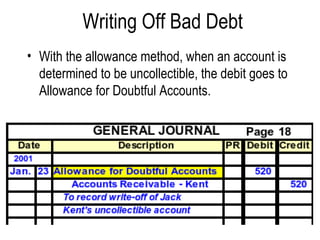
Writing Off Bad Debt With the allowance method, when an account is determined to be uncollectible, the debit goes to Allowance for Doubtful Accounts.
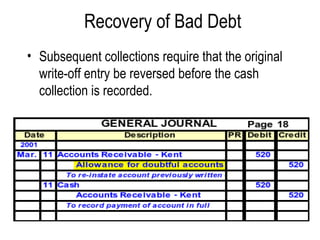
Recovery of Bad Debt Subsequent collections require that the original write-off entry be reversed before the cash collection is recorded.
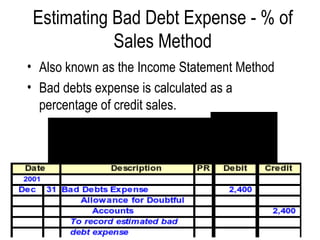
Estimating Bad Debt Expense - % of Sales Method Also known as the Income Statement Method  B ad debts expense is calculated as a percentage of credit sales.
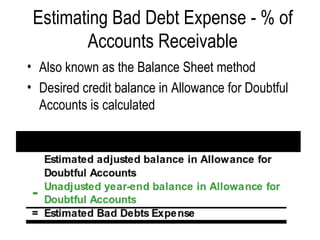
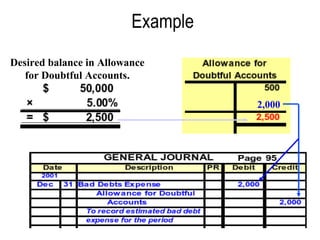
Estimating Bad Debt Expense - % of Accounts Receivable Also known as the Balance Sheet method Desired credit balance in Allowance for Doubtful Accounts is calculated
Example Desired balance in Allowance for Doubtful Accounts. 2,000
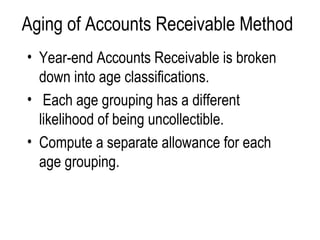
Aging of Accounts Receivable Method Year-end Accounts Receivable is broken down into age classifications. Each age grouping has a different likelihood of being uncollectible. Compute a separate allowance for each age grouping.
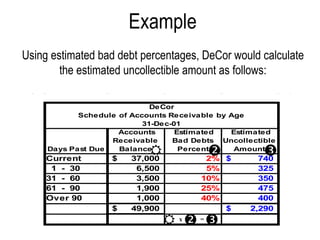
Example Using estimated bad debt percentages, DeCor would calculate the estimated uncollectible amount as follows: x =
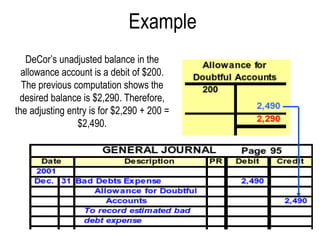
Example DeCor’s unadjusted balance in the allowance account is a debit of $200. The previous computation shows the desired balance is $2,290. Therefore, the adjusting entry is for $2,290 + 200 = $2,490.
Direct Write-Off Method Accounts for bad debts from an uncollectible account receivable at the time it is determined to be uncollectible.  Entry to write-off an uncollectible: debit Bad Debt Expense, credit Accounts Receivable. This method violates matching principle—frequently results in expense being charged in period different from revenue. Materiality principle permits use of this method when bad debts expenses are very small in relation to other financial statement items such as sales and net income.
Notes Receivable A note is a written promise to pay a specific amount at a specific future date. Promissory notes are notes payable to the maker of the note and notes receivable to the payee of the note. Notes receivable are generally preferred by creditors over accounts receivable.
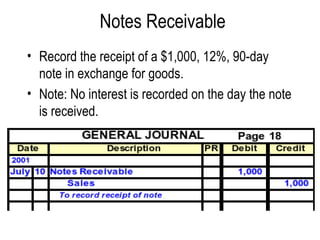
Notes Receivable Record the receipt of a $1,000, 12%, 90-day note in exchange for goods. Note: No interest is recorded on the day the note is received.
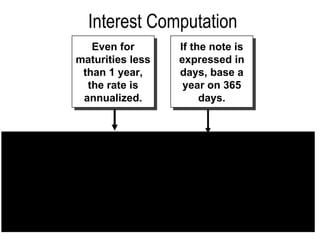
Interest Computation If the note is expressed in days, base a year on 365 days. Even for maturities less than 1 year, the rate is annualized.
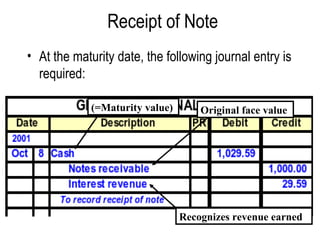
Receipt of Note At the maturity date, the following journal entry is required: (=Maturity value) Recognizes revenue earned Original face value
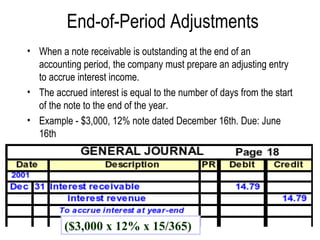
End-of-Period Adjustments When a note receivable is outstanding at the end of an accounting period, the company must prepare an adjusting entry to accrue interest income. The accrued interest is equal to the number of days from the start of the note to the end of the year. Example - $3,000, 12% note dated December 16th. Due: June 16th  ($3,000 x 12% x 15/365)
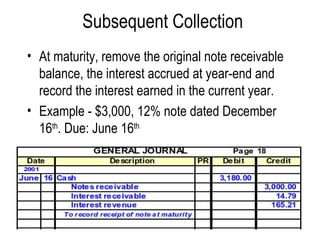
Subsequent Collection At maturity, remove the original note receivable balance, the interest accrued at year-end and record the interest earned in the current year.  Example - $3,000, 12% note dated December 16 th . Due: June 16 th
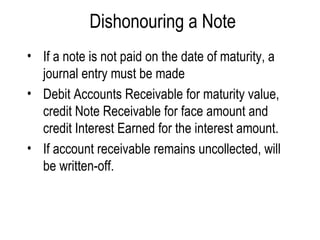
Dishonouring a Note If a note is not paid on the date of maturity, a journal entry must be made Debit Accounts Receivable for maturity value, credit Note Receivable for face amount and credit Interest Earned for the interest amount.  If account receivable remains uncollected, will be written-off.
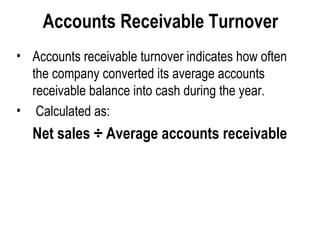
Accounts Receivable Turnover   Accounts receivable turnover indicates how often the company converted its average accounts receivable balance into cash during the year. Calculated as: Net sales ÷ Average accounts receivable
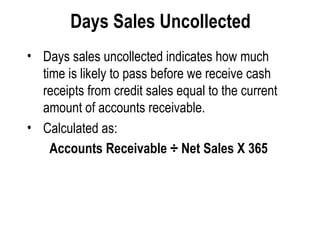
Days Sales Uncollected   Days sales uncollected indicates how much time is likely to pass before we receive cash receipts from credit sales equal to the current amount of accounts receivable.  Calculated as:  Accounts Receivable ÷ Net Sales X 365

Receivables

  • 1.
  • 2.
    Accounts Receivable Amountsdue from customers for credit sales. Credit sales require: Maintaining a separate account receivable for each customer. Accounting for bad debts that result from credit sales.
  • 3.
    Credit Card SalesCustomers’ credit is evaluated by the credit card issuer Sales increase by providing purchase options to the customer The risks of extending credit are transferred to the credit card issuer Cash collections are speeded up.
  • 4.
    Bank Credit CardSales With bank credit cards, the seller deposits the credit card sales receipt in the bank just like it deposits a customer’s cheque. The bank increases the balance in the company’s chequing account. The company usually pays a fee of 2% to 5% for the service.
  • 5.
    Example On August15th, TechCom made a bank credit card sale of $100 to a customer. The bank credits TechCom’s chequing account upon receipt of the credit card slip and charges a processing fee of 4%.
  • 6.
    Valuing Accounts ReceivableThere are two methods used to account for receivables that customers do not pay. Allowance method—at the end of each accounting period, bad debts expense is estimated and recorded. Method satisfies matching principle—expense is charged in period of related sale. Accounts Receivable are reported at their estimated realizable value (A/Rec less the allowance account). Entry to write-off an uncollectible: debit Allowance for Doubtful Accounts, credit Accounts Receivable. Writing off an uncollectible does not change the estimated realizable value of Accounts Receivable.
  • 7.
    Allowance Method Atthe end of each period, estimate the total bad debts expected to be realized from that period’s sales. Entry: debit Bad Debt Expense, credit a contra-asset account called the Allowance for Doubtful Accounts.
  • 8.
    Writing Off BadDebt With the allowance method, when an account is determined to be uncollectible, the debit goes to Allowance for Doubtful Accounts.
  • 9.
    Recovery of BadDebt Subsequent collections require that the original write-off entry be reversed before the cash collection is recorded.
  • 10.
    Estimating Bad DebtExpense - % of Sales Method Also known as the Income Statement Method B ad debts expense is calculated as a percentage of credit sales.
  • 11.
    Estimating Bad DebtExpense - % of Accounts Receivable Also known as the Balance Sheet method Desired credit balance in Allowance for Doubtful Accounts is calculated
  • 12.
    Example Desired balancein Allowance for Doubtful Accounts. 2,000
  • 13.
    Aging of AccountsReceivable Method Year-end Accounts Receivable is broken down into age classifications. Each age grouping has a different likelihood of being uncollectible. Compute a separate allowance for each age grouping.
  • 14.
    Example Using estimatedbad debt percentages, DeCor would calculate the estimated uncollectible amount as follows: x =
  • 15.
    Example DeCor’s unadjustedbalance in the allowance account is a debit of $200. The previous computation shows the desired balance is $2,290. Therefore, the adjusting entry is for $2,290 + 200 = $2,490.
  • 16.
    Direct Write-Off MethodAccounts for bad debts from an uncollectible account receivable at the time it is determined to be uncollectible. Entry to write-off an uncollectible: debit Bad Debt Expense, credit Accounts Receivable. This method violates matching principle—frequently results in expense being charged in period different from revenue. Materiality principle permits use of this method when bad debts expenses are very small in relation to other financial statement items such as sales and net income.
  • 17.
    Notes Receivable Anote is a written promise to pay a specific amount at a specific future date. Promissory notes are notes payable to the maker of the note and notes receivable to the payee of the note. Notes receivable are generally preferred by creditors over accounts receivable.
  • 18.
    Notes Receivable Recordthe receipt of a $1,000, 12%, 90-day note in exchange for goods. Note: No interest is recorded on the day the note is received.
  • 19.
    Interest Computation Ifthe note is expressed in days, base a year on 365 days. Even for maturities less than 1 year, the rate is annualized.
  • 20.
    Receipt of NoteAt the maturity date, the following journal entry is required: (=Maturity value) Recognizes revenue earned Original face value
  • 21.
    End-of-Period Adjustments Whena note receivable is outstanding at the end of an accounting period, the company must prepare an adjusting entry to accrue interest income. The accrued interest is equal to the number of days from the start of the note to the end of the year. Example - $3,000, 12% note dated December 16th. Due: June 16th ($3,000 x 12% x 15/365)
  • 22.
    Subsequent Collection Atmaturity, remove the original note receivable balance, the interest accrued at year-end and record the interest earned in the current year. Example - $3,000, 12% note dated December 16 th . Due: June 16 th
  • 23.
    Dishonouring a NoteIf a note is not paid on the date of maturity, a journal entry must be made Debit Accounts Receivable for maturity value, credit Note Receivable for face amount and credit Interest Earned for the interest amount. If account receivable remains uncollected, will be written-off.
  • 24.
    Accounts Receivable Turnover Accounts receivable turnover indicates how often the company converted its average accounts receivable balance into cash during the year. Calculated as: Net sales ÷ Average accounts receivable
  • 25.
    Days Sales Uncollected Days sales uncollected indicates how much time is likely to pass before we receive cash receipts from credit sales equal to the current amount of accounts receivable. Calculated as: Accounts Receivable ÷ Net Sales X 365