Carbohydrate 1
Md. Saiful Islam
BPharm, MPharm (PCP)
North South University
Join Facebook : Pharmacy Universe
Carbohydrate:
• Carbohydrates are the single most abundant class of organic
molecules found in nature. The name carbohydrate arises from the
basic molecular formula (CH2O)n, which can be rewritten as (C . H2O)n
to show that these substances are hydrates of carbon, where n = 3 or
more. Some also contain nitrogen, phosphorus, or sulfur.
Carbohydrates constitute a versatile class of molecules.
• Carbohydrates are principal energy giving biomolecules for us. Energy
from the sun captured by green plants, algae, and some bacteria during
photosynthesis is stored in the form of carbohydrates.
• Each year, photosynthesis converts more than 100 billion metric tons of
CO2 and H2O into cellulose and other plant products.
• In turn, carbohydrates are the metabolic precursors of virtually all other
biomolecules. Breakdown of carbohydrates provides the energy that
sustains animal life. In addition, carbohydrates are covalently linked
with a variety of other molecules.
• Carbohydrates linked to lipid molecules to form glycolipids, are
common components of biological membranes.
• Proteins that have covalently linked carbohydrates are called
glycoproteins.
• These two classes (glycolipids and glycoproteins) of
biomolecules, together called glycoconjugates, are important
components of cell walls and extracellular structures in plants,
animals, and bacteria.
• In addition to the structural roles such molecules play, they also
serve in a variety of processes involving recognition between cell
types or recognition of cellular structures by other molecules.
Recognition events are important in normal cell growth,
fertilization, transformation of cells, and other processes.
All of these functions are made possible by the
characteristic chemical features of carbohydrates:
(1) the existence of at least one and often two or more
asymmetric centers,
2) the ability to exist either in linear or ring structures,
(3) the capacity to form polymeric structures via glycosidic
bonds, and
(4) The potential to form multiple hydrogen bonds with water
or other molecules in their environment.
Carbohydrate Nomenclature
Classification:
Monosaccharides (and their derivatives),
Oligosaccharides, and Polysaccharides.
The monosaccharides are also called simple sugars and have the formula
(CH2O)n. Monosaccharides cannot be broken down into smaller sugars
under mild conditions.
Oligosaccharides derive their name from the Greek word oligo, meaning
“few,” and consist of from two to ten simple sugar molecules. Among
oligosaccharides disaccharides are common in nature. Four- to six-sugar-
unit oligosaccharides are usually bound covalently to other molecules,
including glycoproteins.
Polysaccharides are polymers of the simple sugars and their derivatives.
They may be either linear or branched polymers and may contain hundreds
or even thousands of monosaccharide units. Their molecular weights
range up to 1 million or more.
Monosaccharides
Monosaccharides consist typically of three to seven carbon atoms and are
described either as aldoses or ketoses, depending on whether the
molecule contains an aldehyde function or a ketone group.
The simplest aldose is glyceraldehyde, and the simplest ketose is
dihydroxyacetone.
These two simple sugars are termed trioses because they each contain
three carbon atoms.
Stereochemistry
Aldoses with at least three carbons
and ketoses with at least four
carbons contain chiral centers. The
nomenclature for such molecules
must specify the configuration about
each asymmetric center.
Stereochemistry describes the three dimensional arrangement of atoms
(groups) in space
Stereoisomers: molecules with the same connectivity but different
arrangement (three dimensional) of atoms (groups) in space
Asymmetric Center: A molecule
containing a carbon with four different
groups results in a chiral molecule,
and the carbon is referred to as a
chiral, or asymmetric center.
D-Aldoses
D-Ketoses
Enantiomers: According to convention, the D- and L-forms of a
monosaccharide are mirror images of each other. Stereoisomers that
are mirror images of each other are called enantiomers, or sometimes
enantiomeric pairs.
Epimers:Two sugars that differ in configuration at only one
chiral center are described as epimers. For example, D-
glucose and D-mannose are epimers,
Hemiacetal
When alcohol group binds with
aldehyde group, it is called
hemiacetal.
Hemiketal
When alcohol group binds with
ketone group, it is called hemiketal.
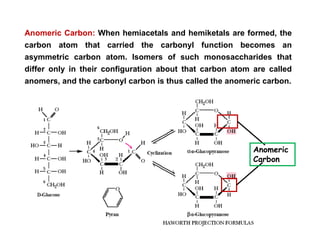
Anomeric Carbon: When hemiacetals and hemiketals are formed, the
carbon atom that carried the carbonyl function becomes an
asymmetric carbon atom. Isomers of such monosaccharides that
differ only in their configuration about that carbon atom are called
anomers, and the carbonyl carbon is thus called the anomeric carbon.
Anomeric
Carbon
Disaccharides
Polysaccharides:
Starch
The most common storage polysaccharide in plants is starch, which exists in
two forms: amylose and amylopectin, Most forms of starch in nature are 10 to
30% -amylose and 70 to 90% amylopectin. Amylose is composed of linear
chains of D-glucose in (1-4) linkage. Amylopectin is a highly branched
structure, the branches in amylopectin are (1-6) linkages. Branches can
involve any of the hydroxyl groups on the monosaccharide components. The
branches repeat after every 12 to 30 residues. The chains are of varying length,
having molecular weights from several thousand to half a million.
Functions of Polysaccharides:
The functions of polysaccharides as storage materials, structural
components or protective substances.
Thus, starch, glycogen, and other storage polysaccharides, as
readily metabolizable food, provide energy reserves for cells.
Recent research indicates, that oligosaccharides and
polysaccharides with varied structures may also be involved in
much more sophisticated tasks in cells, including a variety of
cellular recognition and intercellular communication events,
Roles of oligosaccharides in recognition
and adhesion at the cell surface.
(a) Oligosaccharides like glycoproteins or
glycolipids on the outer surface of plasma
membranes, interact with extracellular
milieu. (b) Viruses that infect animal cells,
such as the influenza virus, bind to cell
surface glycoproteins as the first step in
infection. (c) Bacterial toxins, such as the
cholera bind to a surface glycolipid before
entering a cell. (d) Some bacteria, such as
H. pylori, adhere to and then colonize or
infect animal cells. (e) Selectins (lectins) in
the plasma membrane of certain cells
mediate cell-cell interactions, such as those
of T lymphocytes with the endothelial cells
of the capillary wall at an infection site. (f)
The mannose 6-phosphate receptor/lectin
of the trans Golgi complex binds to the
oligosaccharide of lysosomal enzymes,
targeting them for transfer into the
lysosome.
Glycogen: The major form of storage polysaccharide in animals
is glycogen. Glycogen is found mainly in the liver (where it may
amount to as much as 10% of liver mass) and skeletal muscle
(where it accounts for 1 to 2% of muscle mass). Liver glycogen
consists of granules containing highly branched molecules, with
(1-6) branches occurring every 8 to 12 glucose units. Like
amylopectin, glycogen yields a red-violet color with iodine.
Glycogen can be hydrolyzed by both - and -amylases, yielding
glucose and maltose, respectively, as products and can also be
hydrolyzed by glycogen phosphorylase, an enzyme present in
liver and muscle tissue, to release glucose-1-phosphate.
The structural polysaccharides have properties that are
dramatically different from those of the storage polysaccharides,
even though the compositions of these two classes are similar. The
structural polysaccharide cellulose is the most abundant natural
polymer in the world. Cell walls of all plants are cellulose and helps
to maintain cellular strength.
Cellulose: Structural Polysaccharides
It is a linear homopolymer of D-glucose units, linked by
β (1-4)-glycosidic bonds,
Cellulose is a linear homopolymer of D-glucose units, just as in
amylose. The structural difference, which completely alters the
properties of the polymer, is that in cellulose the glucose units are
linked by (1-4)-glycosidic bonds, whereas in -amylose the linkage
is (1-4).
Cellulase, the enzyme which needs to digest cellulose is absent
in human body that’s why we can not digest cellulose.
Chitin
A polysaccharide that is similar to cellulose, both in its biological function
and its primary, secondary, and tertiary structure, is chitin. Chitin is
present in the cell walls of fungi and is the fundamental material in the
exoskeletons of crustaceans, insects, and spiders. It is the second most
abundant carbohydrate in nature.
The structure of chitin is identical to cellulose, except that the -OH group
on each Carbon at position 2 is replaced by --NHCOCH3, so that the
repeating units are N-acetyl-D-glucosamines in (1-4) linkage. Reducing
ends can occurs as parallel, anti-parallel and mix forms,

Carbohydrate 1

  • 1.
    Carbohydrate 1 Md. SaifulIslam BPharm, MPharm (PCP) North South University Join Facebook : Pharmacy Universe
  • 2.
    Carbohydrate: • Carbohydrates arethe single most abundant class of organic molecules found in nature. The name carbohydrate arises from the basic molecular formula (CH2O)n, which can be rewritten as (C . H2O)n to show that these substances are hydrates of carbon, where n = 3 or more. Some also contain nitrogen, phosphorus, or sulfur. Carbohydrates constitute a versatile class of molecules. • Carbohydrates are principal energy giving biomolecules for us. Energy from the sun captured by green plants, algae, and some bacteria during photosynthesis is stored in the form of carbohydrates. • Each year, photosynthesis converts more than 100 billion metric tons of CO2 and H2O into cellulose and other plant products. • In turn, carbohydrates are the metabolic precursors of virtually all other biomolecules. Breakdown of carbohydrates provides the energy that sustains animal life. In addition, carbohydrates are covalently linked with a variety of other molecules.
  • 3.
    • Carbohydrates linkedto lipid molecules to form glycolipids, are common components of biological membranes. • Proteins that have covalently linked carbohydrates are called glycoproteins. • These two classes (glycolipids and glycoproteins) of biomolecules, together called glycoconjugates, are important components of cell walls and extracellular structures in plants, animals, and bacteria. • In addition to the structural roles such molecules play, they also serve in a variety of processes involving recognition between cell types or recognition of cellular structures by other molecules. Recognition events are important in normal cell growth, fertilization, transformation of cells, and other processes.
  • 4.
    All of thesefunctions are made possible by the characteristic chemical features of carbohydrates: (1) the existence of at least one and often two or more asymmetric centers, 2) the ability to exist either in linear or ring structures, (3) the capacity to form polymeric structures via glycosidic bonds, and (4) The potential to form multiple hydrogen bonds with water or other molecules in their environment.
  • 5.
    Carbohydrate Nomenclature Classification: Monosaccharides (andtheir derivatives), Oligosaccharides, and Polysaccharides. The monosaccharides are also called simple sugars and have the formula (CH2O)n. Monosaccharides cannot be broken down into smaller sugars under mild conditions. Oligosaccharides derive their name from the Greek word oligo, meaning “few,” and consist of from two to ten simple sugar molecules. Among oligosaccharides disaccharides are common in nature. Four- to six-sugar- unit oligosaccharides are usually bound covalently to other molecules, including glycoproteins. Polysaccharides are polymers of the simple sugars and their derivatives. They may be either linear or branched polymers and may contain hundreds or even thousands of monosaccharide units. Their molecular weights range up to 1 million or more.
  • 6.
    Monosaccharides Monosaccharides consist typicallyof three to seven carbon atoms and are described either as aldoses or ketoses, depending on whether the molecule contains an aldehyde function or a ketone group. The simplest aldose is glyceraldehyde, and the simplest ketose is dihydroxyacetone. These two simple sugars are termed trioses because they each contain three carbon atoms.
  • 7.
    Stereochemistry Aldoses with atleast three carbons and ketoses with at least four carbons contain chiral centers. The nomenclature for such molecules must specify the configuration about each asymmetric center. Stereochemistry describes the three dimensional arrangement of atoms (groups) in space Stereoisomers: molecules with the same connectivity but different arrangement (three dimensional) of atoms (groups) in space Asymmetric Center: A molecule containing a carbon with four different groups results in a chiral molecule, and the carbon is referred to as a chiral, or asymmetric center.
  • 8.
  • 9.
  • 10.
    Enantiomers: According toconvention, the D- and L-forms of a monosaccharide are mirror images of each other. Stereoisomers that are mirror images of each other are called enantiomers, or sometimes enantiomeric pairs.
  • 11.
    Epimers:Two sugars thatdiffer in configuration at only one chiral center are described as epimers. For example, D- glucose and D-mannose are epimers,
  • 12.
    Hemiacetal When alcohol groupbinds with aldehyde group, it is called hemiacetal.
  • 14.
    Hemiketal When alcohol groupbinds with ketone group, it is called hemiketal.
  • 15.
    Anomeric Carbon: Whenhemiacetals and hemiketals are formed, the carbon atom that carried the carbonyl function becomes an asymmetric carbon atom. Isomers of such monosaccharides that differ only in their configuration about that carbon atom are called anomers, and the carbonyl carbon is thus called the anomeric carbon. Anomeric Carbon
  • 16.
  • 17.
    Polysaccharides: Starch The most commonstorage polysaccharide in plants is starch, which exists in two forms: amylose and amylopectin, Most forms of starch in nature are 10 to 30% -amylose and 70 to 90% amylopectin. Amylose is composed of linear chains of D-glucose in (1-4) linkage. Amylopectin is a highly branched structure, the branches in amylopectin are (1-6) linkages. Branches can involve any of the hydroxyl groups on the monosaccharide components. The branches repeat after every 12 to 30 residues. The chains are of varying length, having molecular weights from several thousand to half a million.
  • 18.
    Functions of Polysaccharides: Thefunctions of polysaccharides as storage materials, structural components or protective substances. Thus, starch, glycogen, and other storage polysaccharides, as readily metabolizable food, provide energy reserves for cells. Recent research indicates, that oligosaccharides and polysaccharides with varied structures may also be involved in much more sophisticated tasks in cells, including a variety of cellular recognition and intercellular communication events,
  • 19.
    Roles of oligosaccharidesin recognition and adhesion at the cell surface. (a) Oligosaccharides like glycoproteins or glycolipids on the outer surface of plasma membranes, interact with extracellular milieu. (b) Viruses that infect animal cells, such as the influenza virus, bind to cell surface glycoproteins as the first step in infection. (c) Bacterial toxins, such as the cholera bind to a surface glycolipid before entering a cell. (d) Some bacteria, such as H. pylori, adhere to and then colonize or infect animal cells. (e) Selectins (lectins) in the plasma membrane of certain cells mediate cell-cell interactions, such as those of T lymphocytes with the endothelial cells of the capillary wall at an infection site. (f) The mannose 6-phosphate receptor/lectin of the trans Golgi complex binds to the oligosaccharide of lysosomal enzymes, targeting them for transfer into the lysosome.
  • 21.
    Glycogen: The majorform of storage polysaccharide in animals is glycogen. Glycogen is found mainly in the liver (where it may amount to as much as 10% of liver mass) and skeletal muscle (where it accounts for 1 to 2% of muscle mass). Liver glycogen consists of granules containing highly branched molecules, with (1-6) branches occurring every 8 to 12 glucose units. Like amylopectin, glycogen yields a red-violet color with iodine. Glycogen can be hydrolyzed by both - and -amylases, yielding glucose and maltose, respectively, as products and can also be hydrolyzed by glycogen phosphorylase, an enzyme present in liver and muscle tissue, to release glucose-1-phosphate.
  • 22.
    The structural polysaccharideshave properties that are dramatically different from those of the storage polysaccharides, even though the compositions of these two classes are similar. The structural polysaccharide cellulose is the most abundant natural polymer in the world. Cell walls of all plants are cellulose and helps to maintain cellular strength. Cellulose: Structural Polysaccharides It is a linear homopolymer of D-glucose units, linked by β (1-4)-glycosidic bonds,
  • 23.
    Cellulose is alinear homopolymer of D-glucose units, just as in amylose. The structural difference, which completely alters the properties of the polymer, is that in cellulose the glucose units are linked by (1-4)-glycosidic bonds, whereas in -amylose the linkage is (1-4). Cellulase, the enzyme which needs to digest cellulose is absent in human body that’s why we can not digest cellulose.
  • 24.
    Chitin A polysaccharide thatis similar to cellulose, both in its biological function and its primary, secondary, and tertiary structure, is chitin. Chitin is present in the cell walls of fungi and is the fundamental material in the exoskeletons of crustaceans, insects, and spiders. It is the second most abundant carbohydrate in nature. The structure of chitin is identical to cellulose, except that the -OH group on each Carbon at position 2 is replaced by --NHCOCH3, so that the repeating units are N-acetyl-D-glucosamines in (1-4) linkage. Reducing ends can occurs as parallel, anti-parallel and mix forms,