Carbohydrates
Polyhydroxy compounds (poly-alcohols) that contain a
carbonyl (C=O) group
Elemental composition Cx(H2O)y
About 80% of human caloric intake
>90% dry matter of plants
Functional properties
– Sweetness
– Chemical reactivity
– Polymer functionality
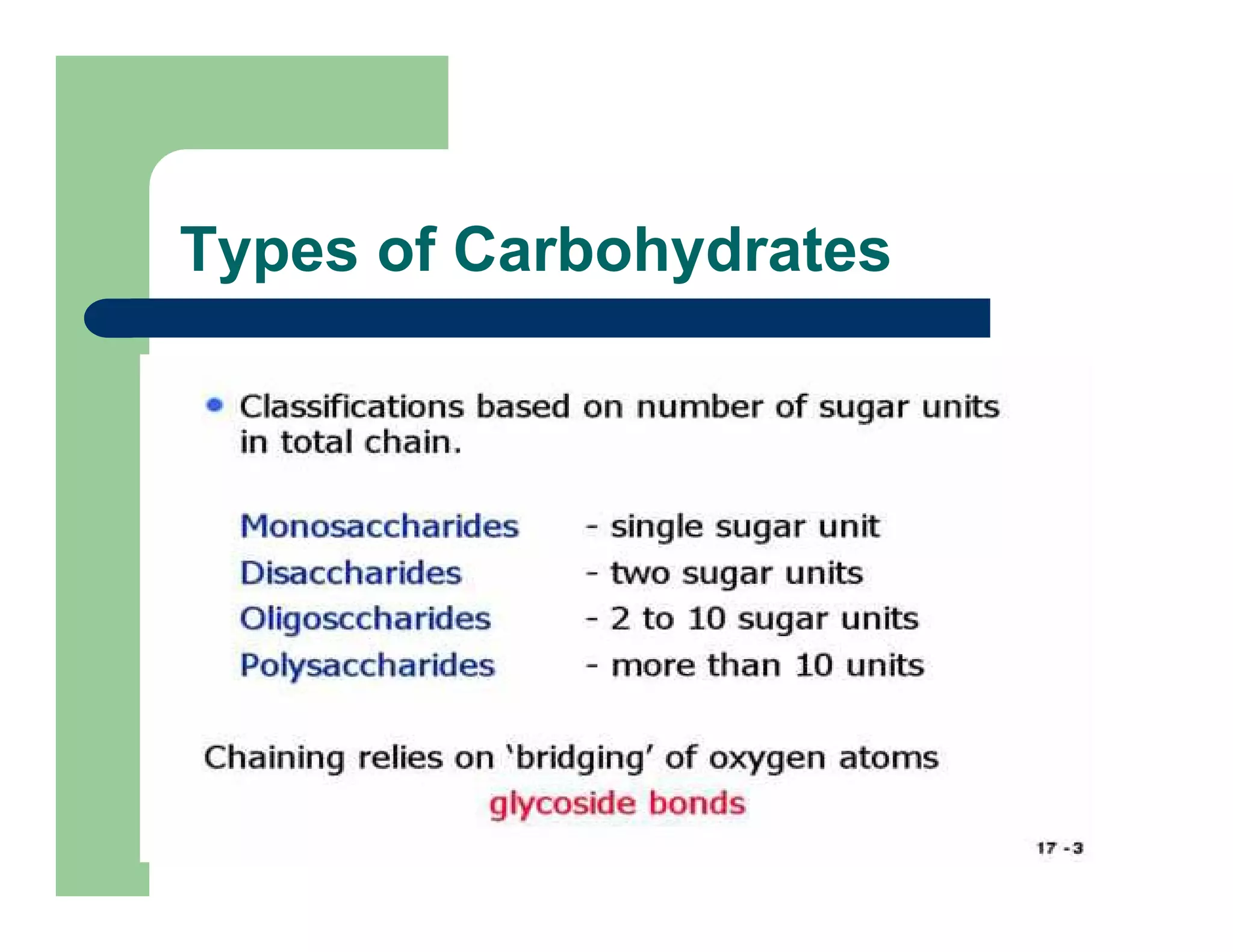
Types of Carbohydrates
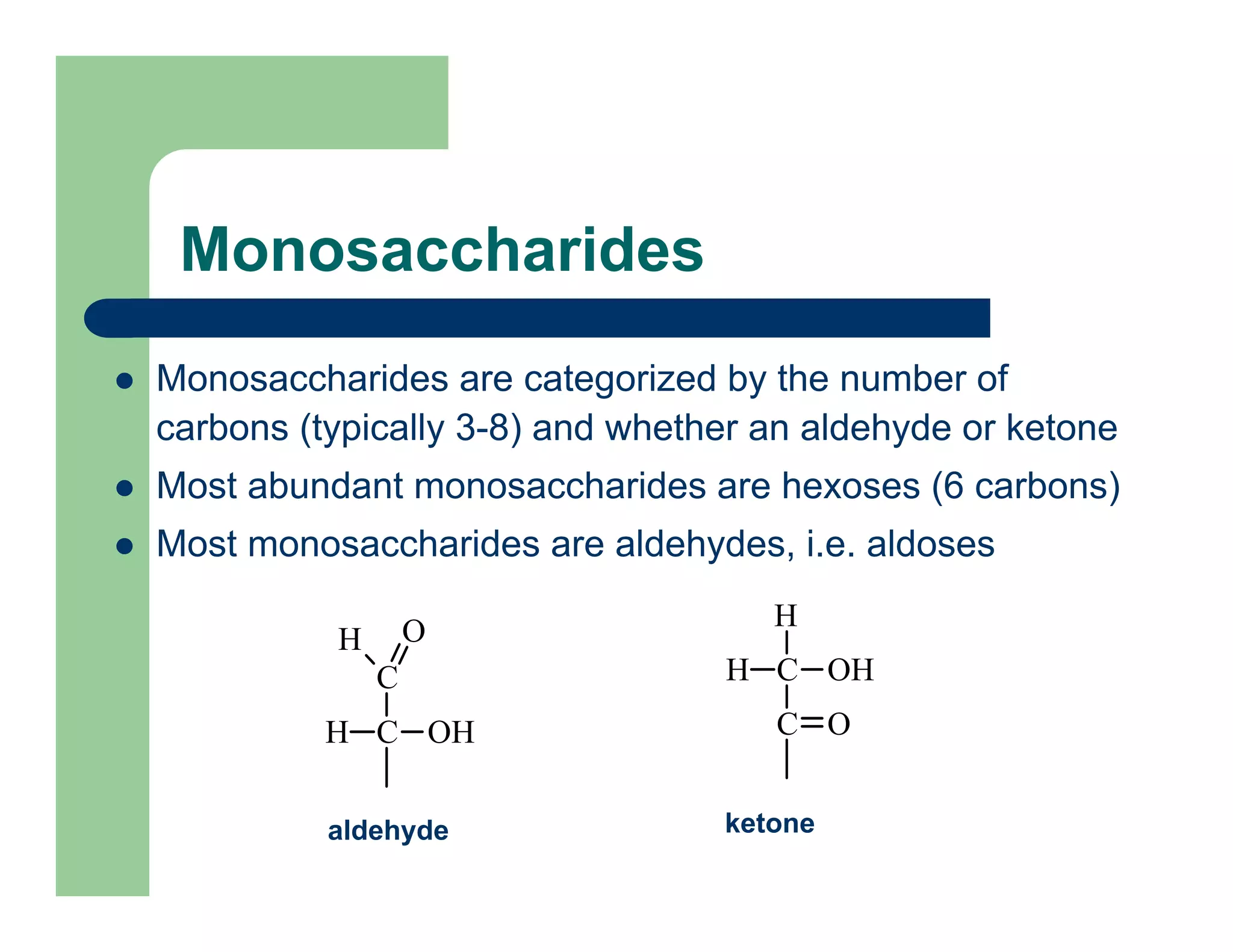
Monosaccharides
Monosaccharides are categorized by the number of
carbons (typically 3-8) and whether an aldehyde or ketone
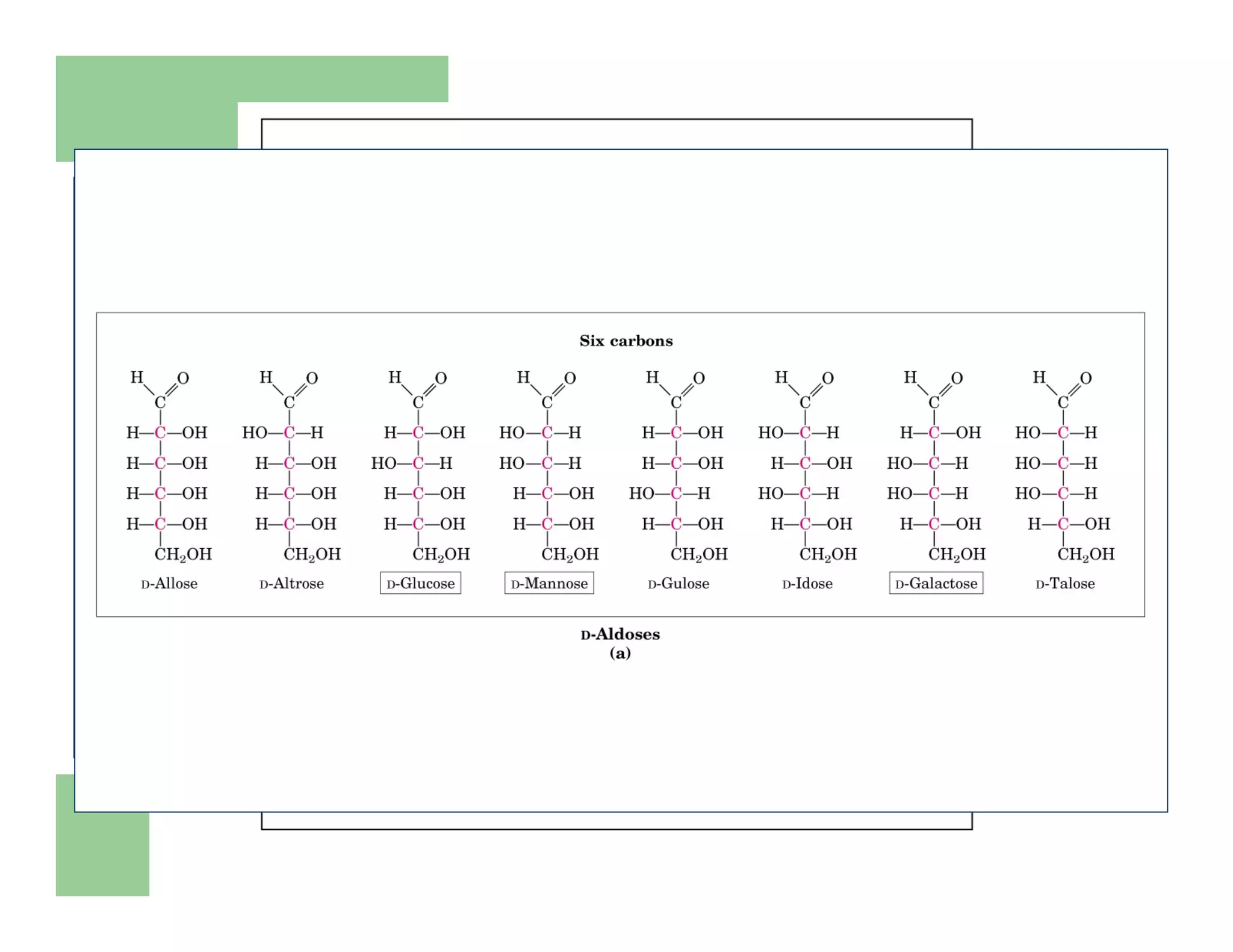
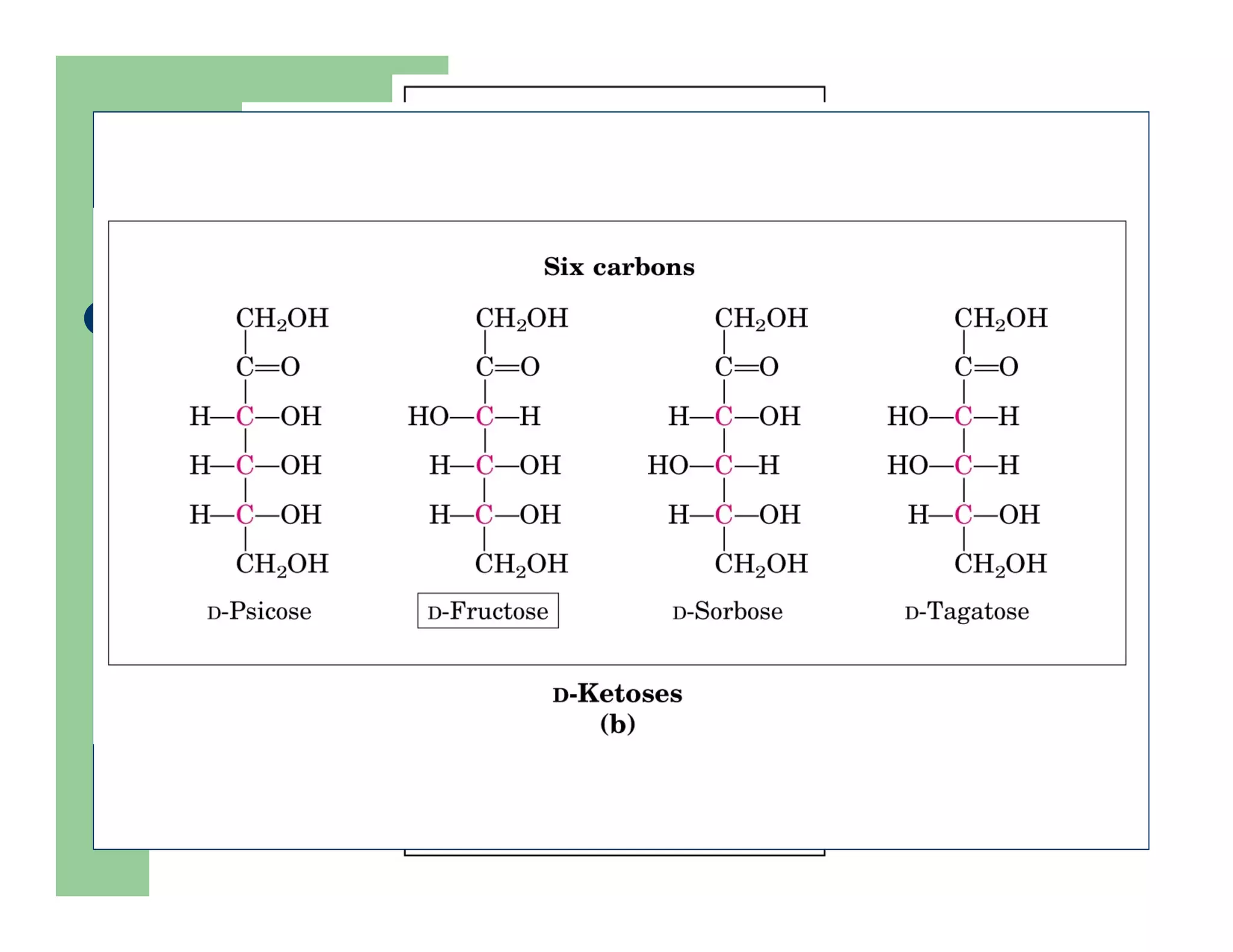
Most abundant monosaccharides are hexoses (6 carbons)
Most monosaccharides are aldehydes, i.e. aldoses
C
C
OH
H OH
C
C O
H
H OH
aldehyde ketone
Fisher projections
OHH
OHH
OHH
HHO
C
C
C
C
C
C H 2OH
H
O
OHH
OHH
O
HHO
C
C
C
C
C H OH2
C H OH21
2
3
4
5
6
D-glucose
(an aldohexose)
D-fructose
(an ketohexose)
1
2
3
4
5
6
Cyclic Forms
Lowest energy state
H
C
C
C
O
C
C
OH
HO
OH
HO
H
HH
CH2OH
H
12
3
4 5
6
β-D-glucopyranose (glucose)
—an aldose
a hexose
an aldohexose
—C1 chair conformation
β-D-fructopyranose (fructose)
—a ketose
a hexulose
a ketohexose
—1C chair conformation
C C
O
C
CH
H
C
OH
H
OHH
OH
OH
CH2OH
1
2
3
45
6
H
Ring Nomenclature
pyranose is a six-membered ring (a very stable
form due to optimal bond angles)
furanose is a five-membered ring
Chirality
Geometric property of a rigid object (or spatial
arrangement of atoms) of being non-super-imposable
on its mirror image
OHH
OHH
OHH
HHO
C
C
C
C
C
C
its mirror image
is an "optical
isomer"H2OH
H
O
4 chiral centers
e.g. at C2 carbon: This
structure has a non-
superimposable mirror image
CHO
(CHOH)3CH2OH
OHH
C2
Isomers
Isomers are molecules that have the same chemical
formula but different structures
Stereoisomer differs in the 3-D orientation of atoms
Diastereomers are isomers with > 1 chiral center.
– Pairs of isomers that have opposite configurations at one or
more of the chiral centers but that are not mirror images of
each other.
Epimers are a special type of diastereomer.
– Stereoisomers with more than one chiral center which differ in
chirality at only one chiral center.
– A chemical reaction which causes a change in chirality at one
one of many chiral center is called an epimerisation.
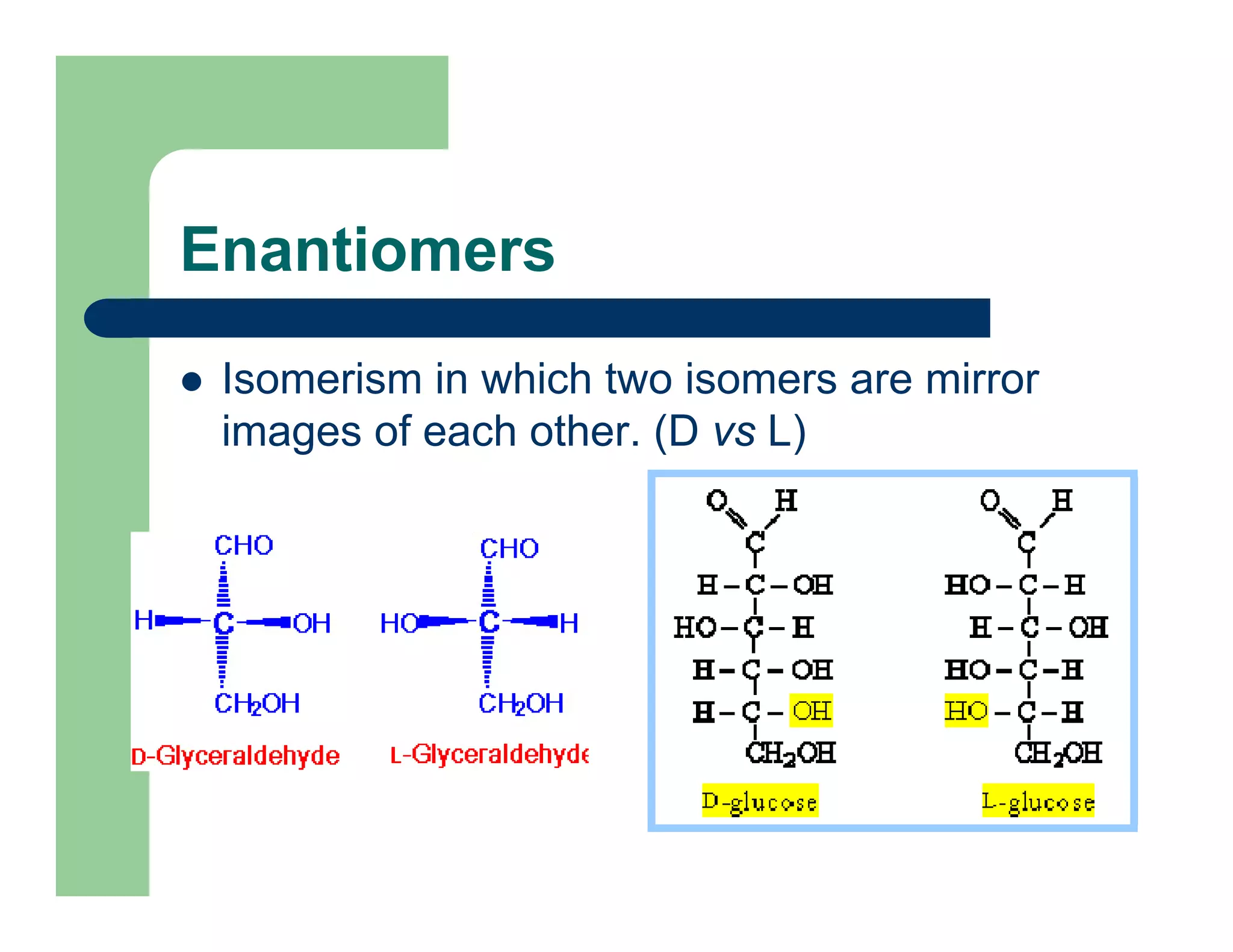
Enantiomers
Isomerism in which two isomers are mirror
images of each other. (D vs L)
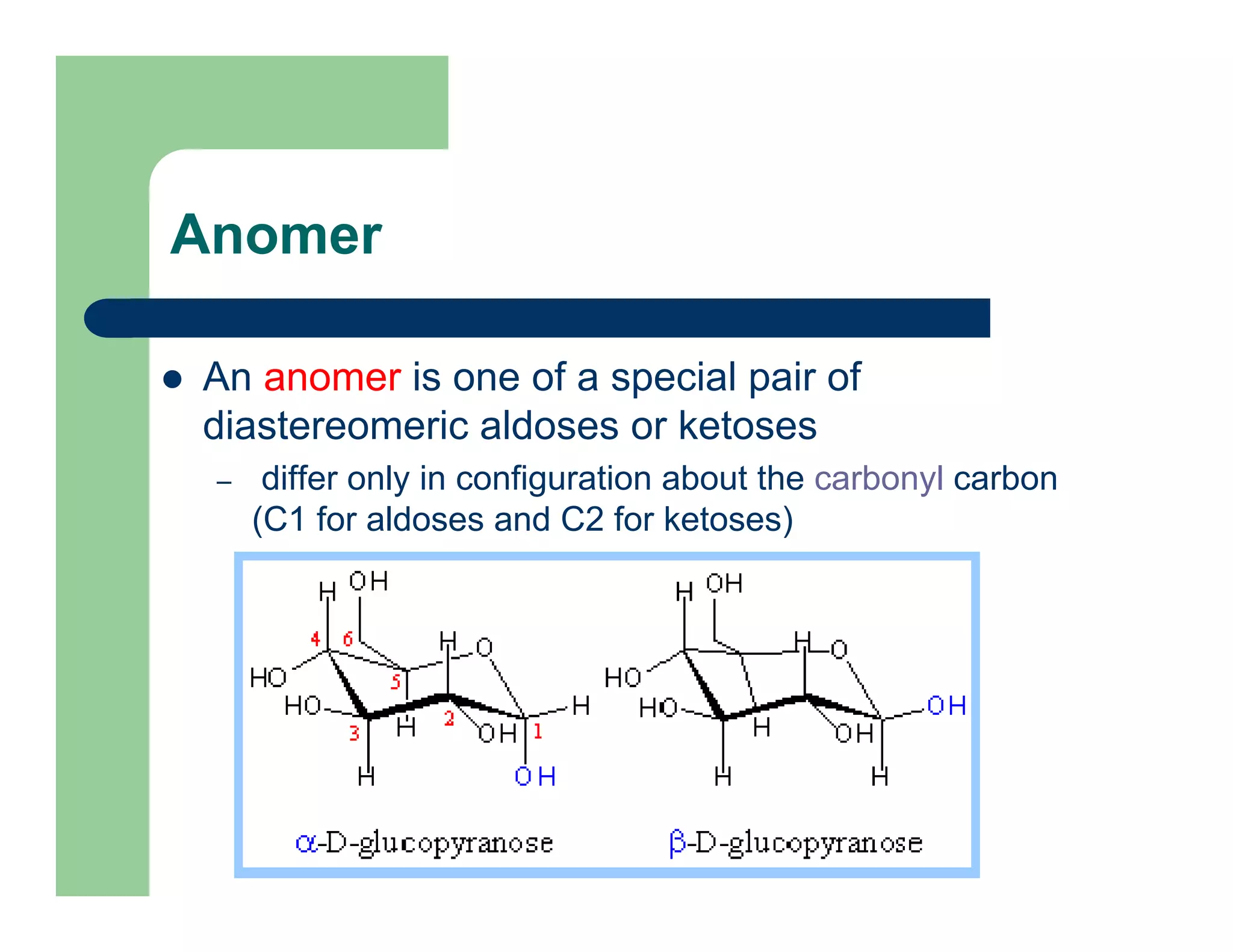
Anomer
An anomer is one of a special pair of
diastereomeric aldoses or ketoses
– differ only in configuration about the carbonyl carbon
(C1 for aldoses and C2 for ketoses)
Carbonyl Group
Carbonyl groups subject to nucleophilic attack,
since carbonyl carbon is electron deficient:
– -OH groups on the same molecule act as
nucleophile, add to carbonyl carbon to recreate ring
form
OH
H
O
O
H
O
H
O
H
OH
O
O
5
5
5
5 1
1
1
1
α anomer β anomer
Carbonyl carbon freely rotates
→O can attack either side
Specification of Conformation, chirality
and anomeric form of sugars
Determination of chair conformation
– Locate the anomeric carbon atom and determine if numbering
sequence is clockwise (n= +ve) or counterclockwise (n= -ve).
– Observe if the puckered ring oxygen atom lies “above” (p= +ve)
the plane of the ring or below (p= -ve).
– Multiply n*p. If the product is +ve then C1, -ve then 1C
Determination of chiral family
– Locate the reference carbon atom contained within the ring and
determine whether the bulky substituent (OH or CH2OH) is
equatorial (r= +ve) or axial (r= -ve).
– Multiply n*p*r. If product is +ve the chiral family is D, when it is
–ve the chiral family is L
Determination of Anomeric form:
– Determine if the hydroxyl substituent on the anomeric carbon atom is
equatorial (a= +ve) or axial (a= -ve).
– Multi[ly (n*p) by (n*p*r) by a. When the product is positive, the anomer
is β; when the product is negative the anomer is α
Specification of Conformation, chirality
and anomeric form of sugars
Mutarotation
The α- and β- anomers of carbohydrates are typically stable solids.
In solution, a single molecule can interchange between
– straight and ring form
– different ring sizes
– α and β anomeric isomers
Process is
– dynamic equilibrium
– due to reversibility of reaction
All isomers can potentially exist in solution
– energy/stability of different forms vary
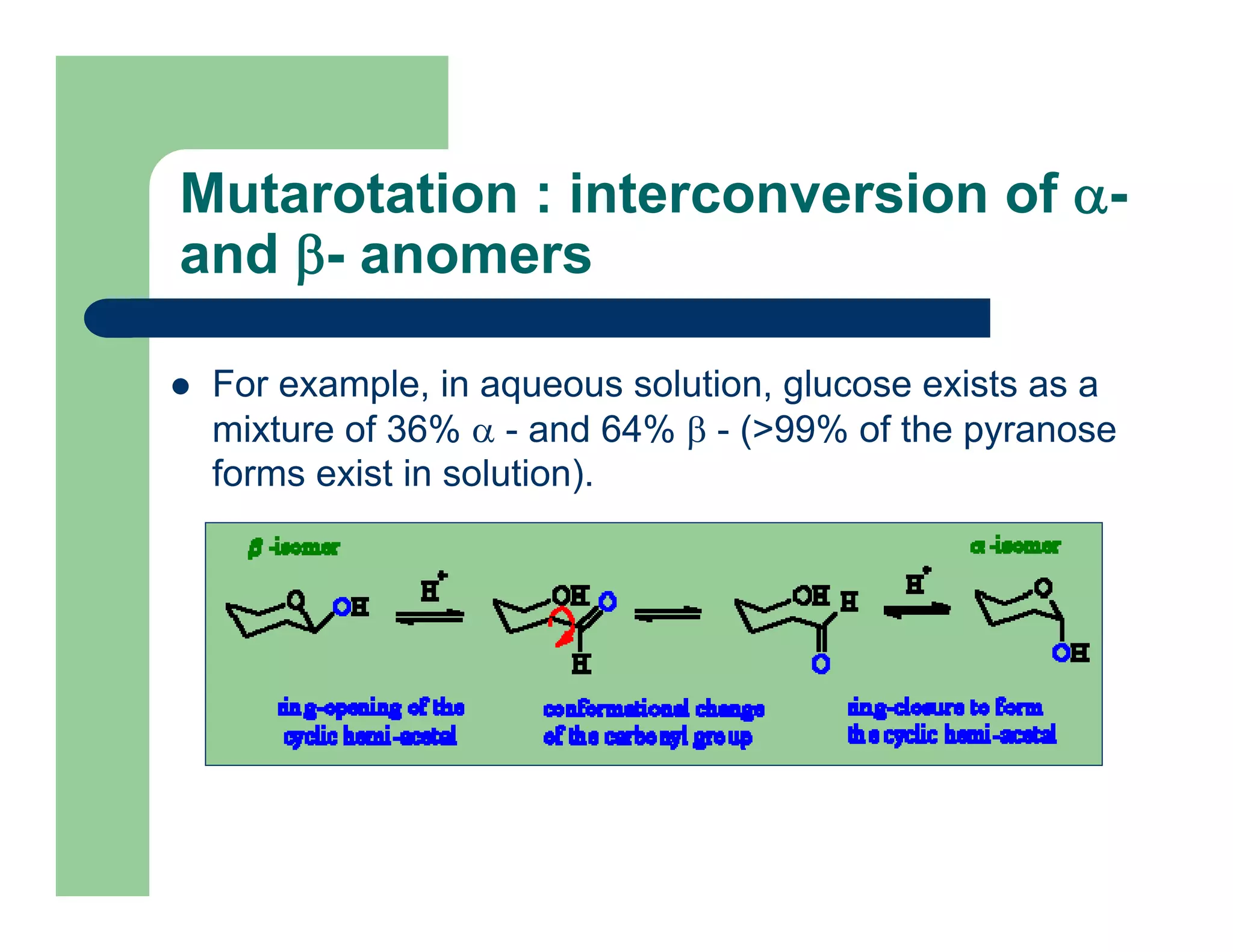
Mutarotation : interconversion of α-
and β- anomers
For example, in aqueous solution, glucose exists as a
mixture of 36% α - and 64% β - (>99% of the pyranose
forms exist in solution).
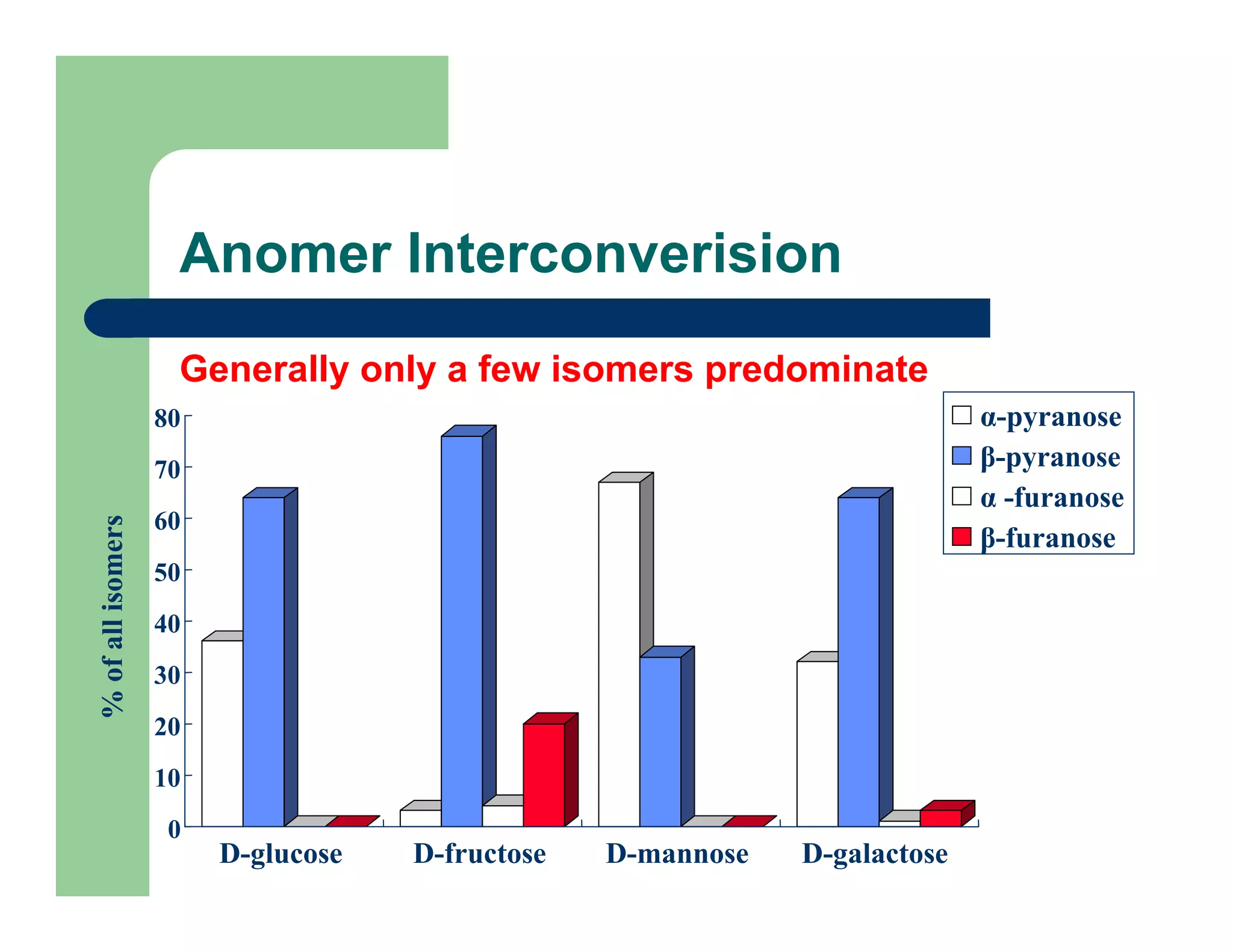
Anomer Interconverision
0
10
20
30
40
50
60
70
80
%ofallisomers
D-glucose D-fructose D-mannose D-galactose
α-pyranose
β-pyranose
α -furanose
β-furanose
Generally only a few isomers predominate
TIME
+57.2o
+112o
+19o
pure α-D-(+)-glucopyranose1
pure β-D-(+)-glucopyranose2
[α]D
66% β
34% α
(min)
OH
HO OH
O
O
HO
HO
OH
OH
O
HO
OH OH
OH
H
C
OH
OHH
OHH
CH2OH
OH
HO OH
O
OH
OH
H OH
OHH
OHH
CH2OH
HO OH
O H
Mutarotation of ribose
hydrate (0.09%)
keto-form (0.04%)
α-pyranose (20.2%)
α-furanose (7.4%)
β-pyranose (59.1%) β-furanose (13.2%)
Stability of
Hemiacetals/Hemiketals
As general rule the most stable ring
conformation is that in which all or most of
the bulky groups are equatorial to the axis of
the ring
Reactions
Isomerization
glucose fructose mannose
Oxidation
R-CHO R-COOH
R-CH2OH R-COOH
Reduction
sugar sugar alcohols
Acetal formation
sugar glycoside
Browning reactions
O
C
C
C
C
C
C
HO
H
OH
H2OH
OH
OH
H
H
H
H
carbonyl group is key
Isomerization
Isomerization is possible because of the
“acidity” of the α hydrogen
O
C
C
C
C
C
C
HO
H
OH
H2OH
OH
OH
H
H
H
Hα hydrogen
(on C next
to carbonyl)
O
C
C
C
C
C
C
HO
OH
H2OH
OH
OH
H
H
H
H
O
C
C
C
C
C
C
HO
OH
H2OH
OH
OH
H
H
H
H
base
keto form enol form
Isomerization
O
C
C
C
C
C
C
HO
OH
OH
H2OH
OH
H
H
H
H
H
O
C
C
C
C
C
C
HO
HO
OH
H2OH
OH
H
H
H
H
H C
C
C
C
C
C
HO
O
OH
H2OH
OHH
H
H
H2OH
D-glucose D-mannose D-fructose
Oxidation/Reduction
Oxidation
Increase oxygen or decrease hydrogen
Increase oxidation state
Remove electrons
Reduction
Decrease oxygen or increase hydrogen
Decrease oxidation state
Add electrons
Oxidation
Carbonyl group can be oxidized to form
carboxylic acid
Forms “-onic acid” (e.g. gluconic acid)
Can not form hemiacetal
Very hydrophillic
– Ca gluconate
Can react to form intramolecular esters:
– lactones
Oxidation
Also possible to oxidize alcohols to carboxylic
acids
– “-uronic acids”
Galacturonic acids
Pectin
Reactivity
– Aldehydes are more reactive than ketones
In presence of base ketones will isomerize
Allows ketones to oxidize
Reducing sugars
Reducing sugars are carbohydrates that can
reduce oxidizing agents
Sugars which form open chain structures
with free carbonyl group
Reduction of metal ions
– Fehling test: CuSO4 in alkaline solution
DNSA assay
• Colorimetric analysis: the sugars present reduce
3,5-dinitrosalicylic acid, DNSA, to 3-amino-5-
nitrosalicylic acid
Reduction
Carbonyl group can be reduced to form alcohol
– hydrogenation reaction
Forms sugar alcohol (“-itol”)
– glucose glucitol (aka sorbitol)
– mannose mannitol
– xylose xylitol
Sweet, same calories as sugar, non-cariogenic
Very hydrophillic
Good humectants
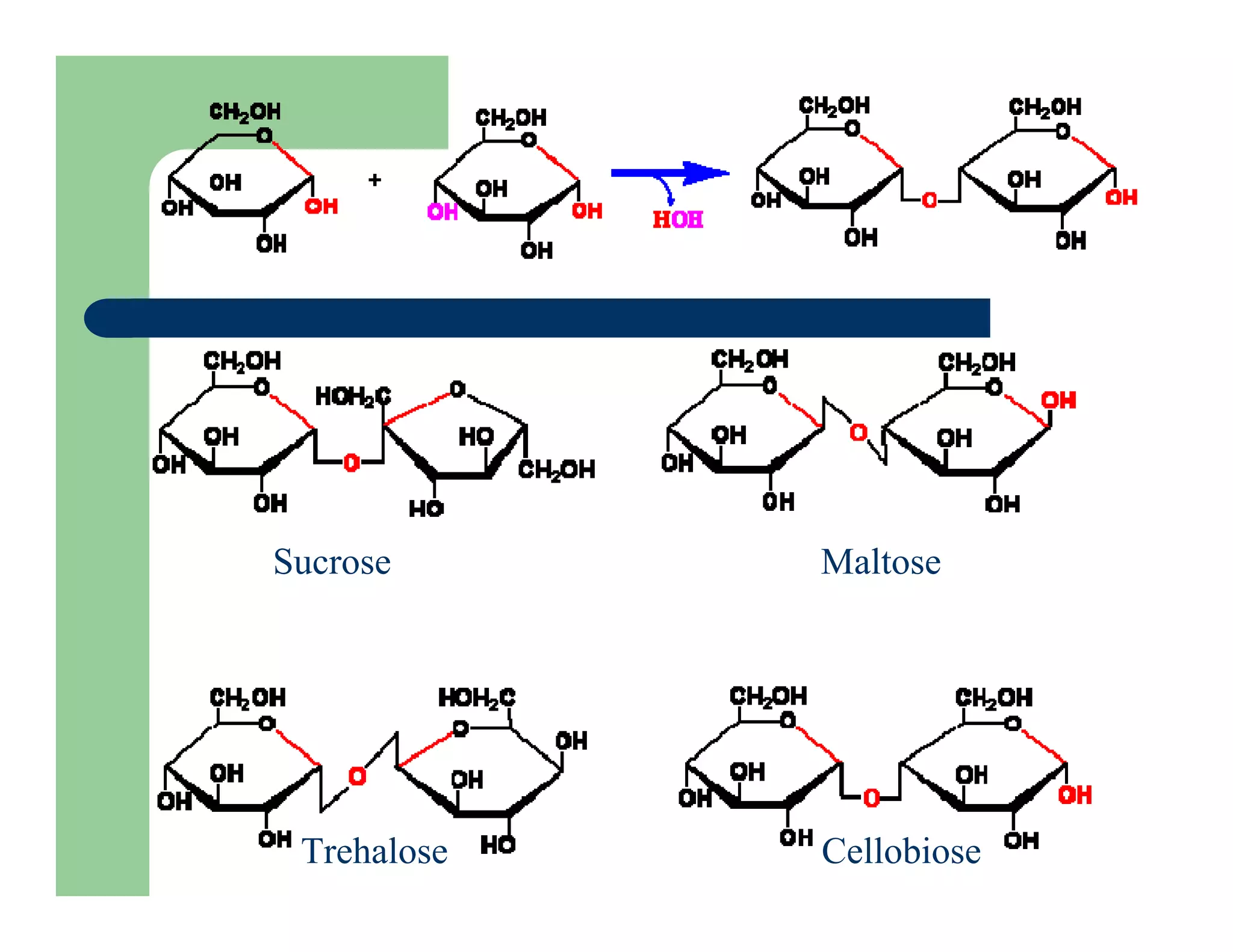
Acetal Formation
In acid solution, sugars can react with alcohols
to form acetals known as glycosides
Reaction is a nucleophilic addition of two
alcohols to aldehydes
CH2OH
+ ROH
OH
+ H2O
H+
O
CH2OH
OR
O
1. Protonation of OH
group
2. water removal to
form carbocation
3. alcohol addition and
release of proton
Acetal Formation
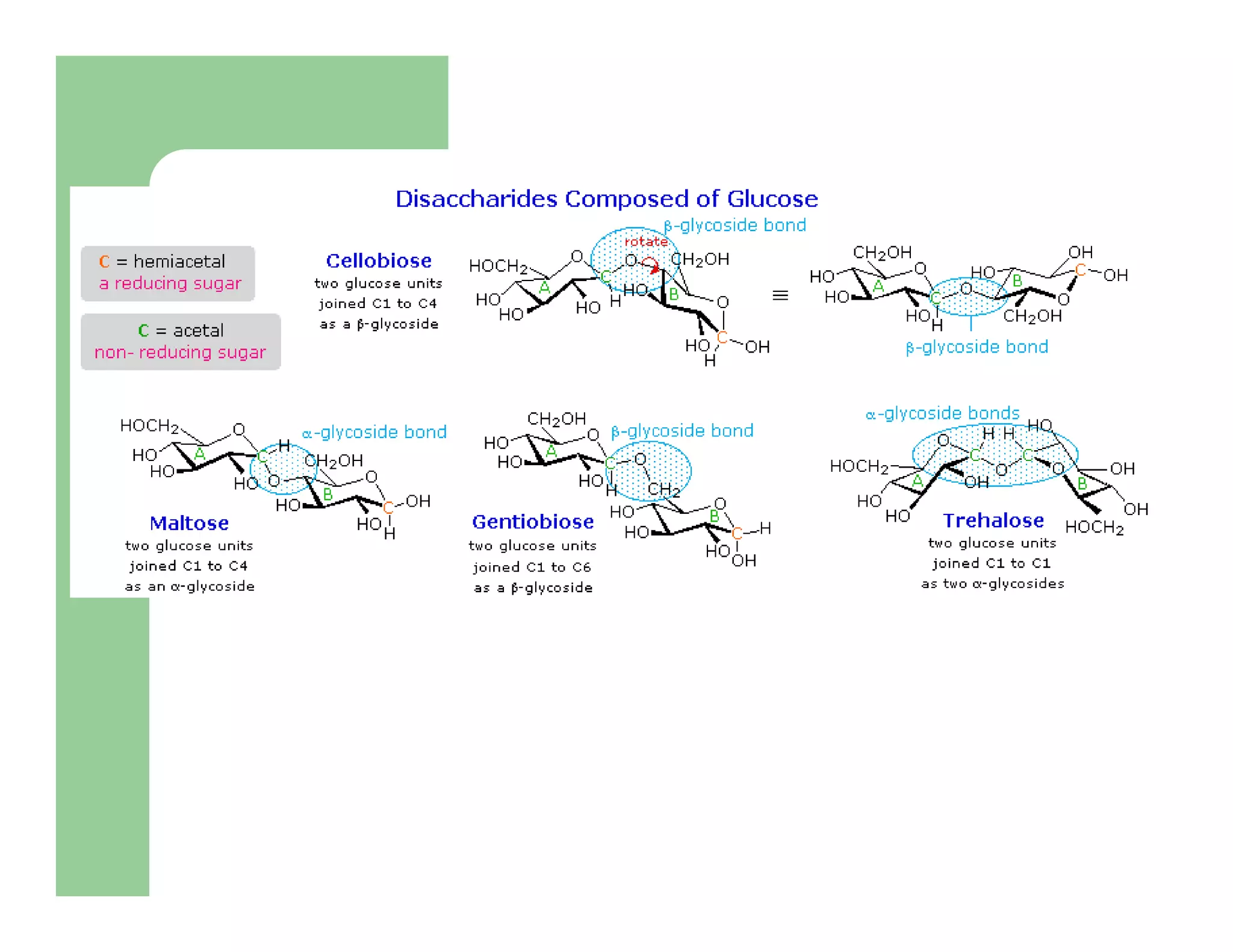
Sucrose Maltose
Trehalose Cellobiose
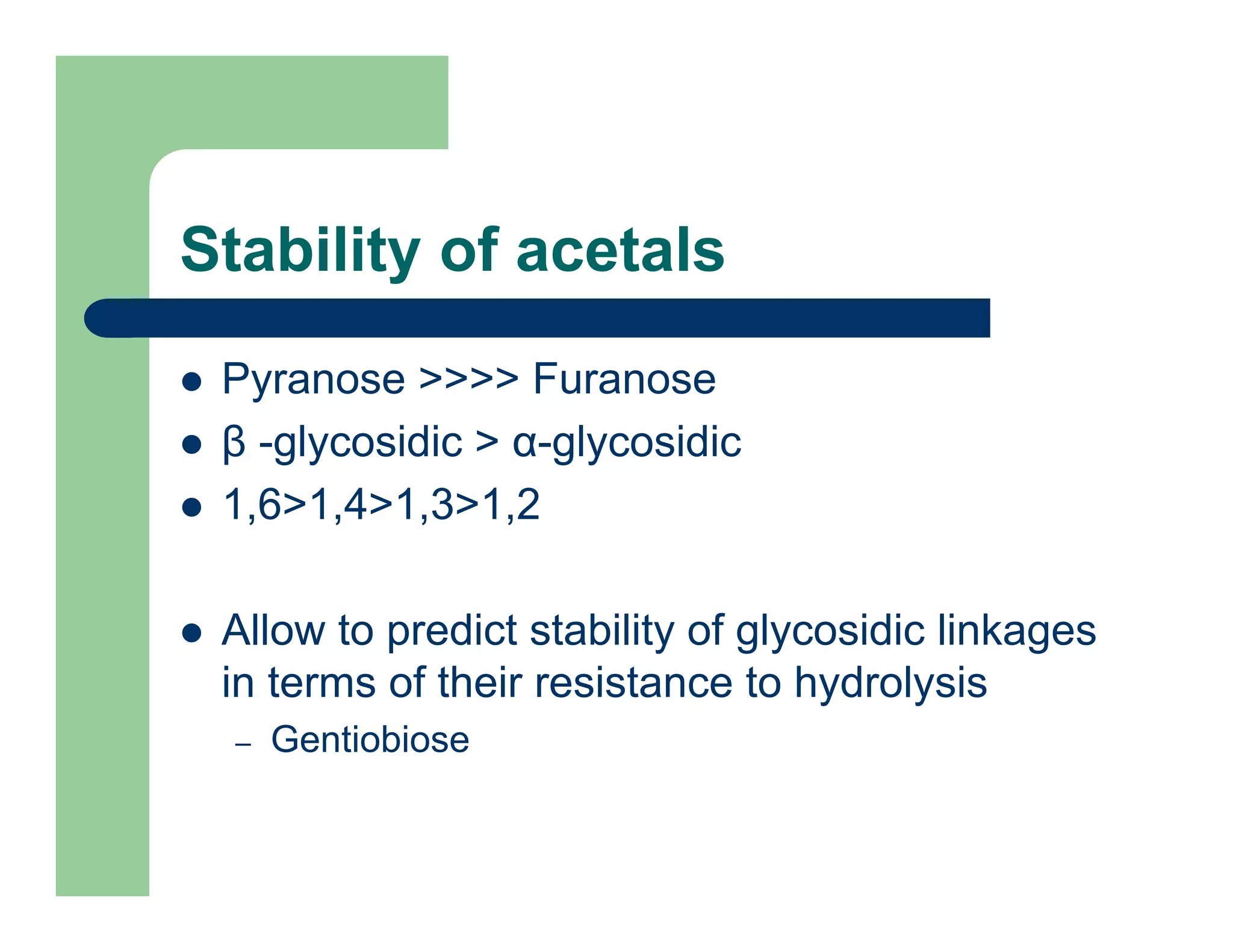
Stability of acetals
Pyranose >>>> Furanose
β -glycosidic > α-glycosidic
1,6>1,4>1,3>1,2
Allow to predict stability of glycosidic linkages
in terms of their resistance to hydrolysis
– Gentiobiose
Acid catalyzed Rxns
Acid hydrolysis of hemiactals and hemiketals
(mutarotation)
Anhydro sugars
– 1C conformation
Reversion sugars
– Formation of oligosaccharides under conditions of high sugar
concentration, dilute acid……. Maple syrup, fruit juice
concentrates
– Detection of invert sugar in juices/honey
Enolization and Dehydration
– Formation of 3-deoxyosones and HMF/furfural
Hydrolysis of hemiactals and hemiketals
(mutarotation)
– Base catalyzed loss of H from anomeric –OH
Acetals and Ketals are stable
– Sugar esters will be hydrolyzed in alkali
Enolization
– Favored by alkali
Reduction of metal ions
– Alkali prevents hydrolysis of non-reducing sugar
Base catalyzed Rxns

Carbohydrates Biochemistry

  • 1.
    Carbohydrates Polyhydroxy compounds (poly-alcohols)that contain a carbonyl (C=O) group Elemental composition Cx(H2O)y About 80% of human caloric intake >90% dry matter of plants Functional properties – Sweetness – Chemical reactivity – Polymer functionality
  • 2.
  • 3.
    Monosaccharides Monosaccharides are categorizedby the number of carbons (typically 3-8) and whether an aldehyde or ketone Most abundant monosaccharides are hexoses (6 carbons) Most monosaccharides are aldehydes, i.e. aldoses C C OH H OH C C O H H OH aldehyde ketone
  • 4.
    Fisher projections OHH OHH OHH HHO C C C C C C H2OH H O OHH OHH O HHO C C C C C H OH2 C H OH21 2 3 4 5 6 D-glucose (an aldohexose) D-fructose (an ketohexose) 1 2 3 4 5 6
  • 7.
    Cyclic Forms Lowest energystate H C C C O C C OH HO OH HO H HH CH2OH H 12 3 4 5 6 β-D-glucopyranose (glucose) —an aldose a hexose an aldohexose —C1 chair conformation β-D-fructopyranose (fructose) —a ketose a hexulose a ketohexose —1C chair conformation C C O C CH H C OH H OHH OH OH CH2OH 1 2 3 45 6 H
  • 8.
    Ring Nomenclature pyranose isa six-membered ring (a very stable form due to optimal bond angles) furanose is a five-membered ring
  • 9.
    Chirality Geometric property ofa rigid object (or spatial arrangement of atoms) of being non-super-imposable on its mirror image OHH OHH OHH HHO C C C C C C its mirror image is an "optical isomer"H2OH H O 4 chiral centers e.g. at C2 carbon: This structure has a non- superimposable mirror image CHO (CHOH)3CH2OH OHH C2
  • 10.
    Isomers Isomers are moleculesthat have the same chemical formula but different structures Stereoisomer differs in the 3-D orientation of atoms Diastereomers are isomers with > 1 chiral center. – Pairs of isomers that have opposite configurations at one or more of the chiral centers but that are not mirror images of each other. Epimers are a special type of diastereomer. – Stereoisomers with more than one chiral center which differ in chirality at only one chiral center. – A chemical reaction which causes a change in chirality at one one of many chiral center is called an epimerisation.
  • 11.
    Enantiomers Isomerism in whichtwo isomers are mirror images of each other. (D vs L)
  • 13.
    Anomer An anomer isone of a special pair of diastereomeric aldoses or ketoses – differ only in configuration about the carbonyl carbon (C1 for aldoses and C2 for ketoses)
  • 14.
    Carbonyl Group Carbonyl groupssubject to nucleophilic attack, since carbonyl carbon is electron deficient: – -OH groups on the same molecule act as nucleophile, add to carbonyl carbon to recreate ring form
  • 15.
    OH H O O H O H O H OH O O 5 5 5 5 1 1 1 1 α anomerβ anomer Carbonyl carbon freely rotates →O can attack either side
  • 16.
    Specification of Conformation,chirality and anomeric form of sugars Determination of chair conformation – Locate the anomeric carbon atom and determine if numbering sequence is clockwise (n= +ve) or counterclockwise (n= -ve). – Observe if the puckered ring oxygen atom lies “above” (p= +ve) the plane of the ring or below (p= -ve). – Multiply n*p. If the product is +ve then C1, -ve then 1C Determination of chiral family – Locate the reference carbon atom contained within the ring and determine whether the bulky substituent (OH or CH2OH) is equatorial (r= +ve) or axial (r= -ve). – Multiply n*p*r. If product is +ve the chiral family is D, when it is –ve the chiral family is L
  • 17.
    Determination of Anomericform: – Determine if the hydroxyl substituent on the anomeric carbon atom is equatorial (a= +ve) or axial (a= -ve). – Multi[ly (n*p) by (n*p*r) by a. When the product is positive, the anomer is β; when the product is negative the anomer is α Specification of Conformation, chirality and anomeric form of sugars
  • 18.
    Mutarotation The α- andβ- anomers of carbohydrates are typically stable solids. In solution, a single molecule can interchange between – straight and ring form – different ring sizes – α and β anomeric isomers Process is – dynamic equilibrium – due to reversibility of reaction All isomers can potentially exist in solution – energy/stability of different forms vary
  • 19.
    Mutarotation : interconversionof α- and β- anomers For example, in aqueous solution, glucose exists as a mixture of 36% α - and 64% β - (>99% of the pyranose forms exist in solution).
  • 20.
    Anomer Interconverision 0 10 20 30 40 50 60 70 80 %ofallisomers D-glucose D-fructoseD-mannose D-galactose α-pyranose β-pyranose α -furanose β-furanose Generally only a few isomers predominate
  • 21.
  • 23.
    OH HO OH O O HO HO OH OH O HO OH OH OH H C OH OHH OHH CH2OH OH HOOH O OH OH H OH OHH OHH CH2OH HO OH O H Mutarotation of ribose hydrate (0.09%) keto-form (0.04%) α-pyranose (20.2%) α-furanose (7.4%) β-pyranose (59.1%) β-furanose (13.2%)
  • 24.
    Stability of Hemiacetals/Hemiketals As generalrule the most stable ring conformation is that in which all or most of the bulky groups are equatorial to the axis of the ring
  • 25.
    Reactions Isomerization glucose fructose mannose Oxidation R-CHOR-COOH R-CH2OH R-COOH Reduction sugar sugar alcohols Acetal formation sugar glycoside Browning reactions O C C C C C C HO H OH H2OH OH OH H H H H carbonyl group is key
  • 26.
    Isomerization Isomerization is possiblebecause of the “acidity” of the α hydrogen O C C C C C C HO H OH H2OH OH OH H H H Hα hydrogen (on C next to carbonyl) O C C C C C C HO OH H2OH OH OH H H H H O C C C C C C HO OH H2OH OH OH H H H H base keto form enol form
  • 27.
  • 28.
    Oxidation/Reduction Oxidation Increase oxygen ordecrease hydrogen Increase oxidation state Remove electrons Reduction Decrease oxygen or increase hydrogen Decrease oxidation state Add electrons
  • 29.
    Oxidation Carbonyl group canbe oxidized to form carboxylic acid Forms “-onic acid” (e.g. gluconic acid) Can not form hemiacetal Very hydrophillic – Ca gluconate Can react to form intramolecular esters: – lactones
  • 30.
    Oxidation Also possible tooxidize alcohols to carboxylic acids – “-uronic acids” Galacturonic acids Pectin Reactivity – Aldehydes are more reactive than ketones In presence of base ketones will isomerize Allows ketones to oxidize
  • 31.
    Reducing sugars Reducing sugarsare carbohydrates that can reduce oxidizing agents Sugars which form open chain structures with free carbonyl group Reduction of metal ions – Fehling test: CuSO4 in alkaline solution
  • 32.
    DNSA assay • Colorimetricanalysis: the sugars present reduce 3,5-dinitrosalicylic acid, DNSA, to 3-amino-5- nitrosalicylic acid
  • 33.
    Reduction Carbonyl group canbe reduced to form alcohol – hydrogenation reaction Forms sugar alcohol (“-itol”) – glucose glucitol (aka sorbitol) – mannose mannitol – xylose xylitol Sweet, same calories as sugar, non-cariogenic Very hydrophillic Good humectants
  • 34.
    Acetal Formation In acidsolution, sugars can react with alcohols to form acetals known as glycosides Reaction is a nucleophilic addition of two alcohols to aldehydes CH2OH + ROH OH + H2O H+ O CH2OH OR O
  • 35.
    1. Protonation ofOH group 2. water removal to form carbocation 3. alcohol addition and release of proton Acetal Formation
  • 36.
  • 39.
    Stability of acetals Pyranose>>>> Furanose β -glycosidic > α-glycosidic 1,6>1,4>1,3>1,2 Allow to predict stability of glycosidic linkages in terms of their resistance to hydrolysis – Gentiobiose
  • 40.
    Acid catalyzed Rxns Acidhydrolysis of hemiactals and hemiketals (mutarotation) Anhydro sugars – 1C conformation Reversion sugars – Formation of oligosaccharides under conditions of high sugar concentration, dilute acid……. Maple syrup, fruit juice concentrates – Detection of invert sugar in juices/honey Enolization and Dehydration – Formation of 3-deoxyosones and HMF/furfural
  • 41.
    Hydrolysis of hemiactalsand hemiketals (mutarotation) – Base catalyzed loss of H from anomeric –OH Acetals and Ketals are stable – Sugar esters will be hydrolyzed in alkali Enolization – Favored by alkali Reduction of metal ions – Alkali prevents hydrolysis of non-reducing sugar Base catalyzed Rxns