Mewar University
Gangrar, Chittorgarh
Shanti Nath
Assistant professor
Department of Paramedical Science
Carbohydrates
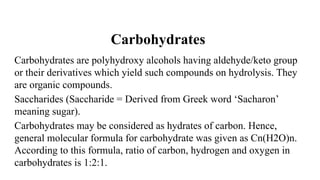
Carbohydrates are polyhydroxy alcohols having aldehyde/keto group
or their derivatives which yield such compounds on hydrolysis. They
are organic compounds.
Saccharides (Saccharide = Derived from Greek word ‘Sacharon’
meaning sugar).
Carbohydrates may be considered as hydrates of carbon. Hence,
general molecular formula for carbohydrate was given as Cn(H2O)n.
According to this formula, ratio of carbon, hydrogen and oxygen in
carbohydrates is 1:2:1.
Function of Carbohydrates
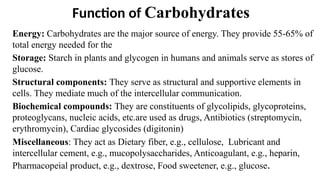
Energy: Carbohydrates are the major source of energy. They provide 55-65% of
total energy needed for the
Storage: Starch in plants and glycogen in humans and animals serve as stores of
glucose.
Structural components: They serve as structural and supportive elements in
cells. They mediate much of the intercellular communication.
Biochemical compounds: They are constituents of glycolipids, glycoproteins,
proteoglycans, nucleic acids, etc.are used as drugs, Antibiotics (streptomycin,
erythromycin), Cardiac glycosides (digitonin)
Miscellaneous: They act as Dietary fiber, e.g., cellulose, Lubricant and
intercellular cement, e.g., mucopolysaccharides, Anticoagulant, e.g., heparin,
Pharmacopeial product, e.g., dextrose, Food sweetener, e.g., glucose.
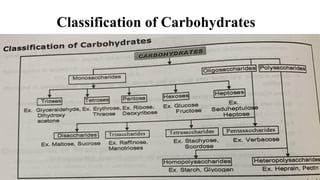
Classification of Carbohydrates
Monosaccharides
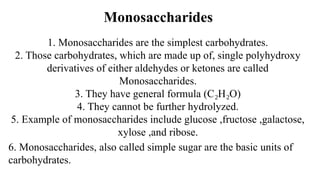
1. Monosaccharides are the simplest carbohydrates.
2. Those carbohydrates, which are made up of, single polyhydroxy
derivatives of either aldehydes or ketones are called
Monosaccharides.
3. They have general formula (C H O)
₂ ₂
4. They cannot be further hydrolyzed.
5. Example of monosaccharides include glucose ,fructose ,galactose,
xylose ,and ribose.
6. Monosaccharides, also called simple sugar are the basic units of
carbohydrates.
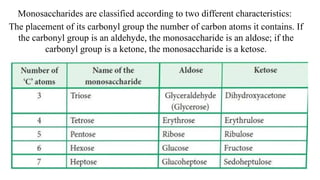
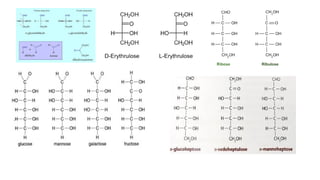
Monosaccharides are classified according to two different characteristics:
The placement of its carbonyl group the number of carbon atoms it contains. If
the carbonyl group is an aldehyde, the monosaccharide is an aldose; if the
carbonyl group is a ketone, the monosaccharide is a ketose.
Oligosaccharides
Greek word - oligo = few; sacchar sugar] oligosaccharides are composed of 2-
10 simple sugars (monosaccharides).
Depending upon the presence of monosaccharide units, these are further
divided as:Dísaccharides:
These sugars consist of two monosaccharide units joined together with
glycosidic bond.
Example: sucrose, maltose, lactose,
Sucrose
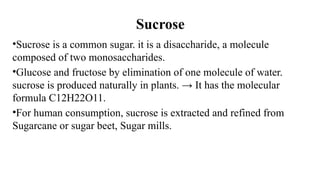
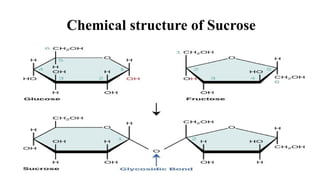
•Sucrose is a common sugar. it is a disaccharide, a molecule
composed of two monosaccharides.
•Glucose and fructose by elimination of one molecule of water.
sucrose is produced naturally in plants. → It has the molecular
formula C12H22O11.
•For human consumption, sucrose is extracted and refined from
Sugarcane or sugar beet, Sugar mills.
Chemical structure of Sucrose
Maltose
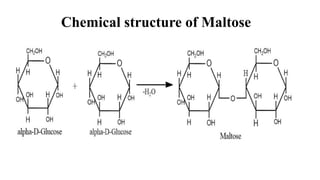
Maltose, also know al maltobiose or malt sugar is a disaccharide
formed from two units of glucose Joined with and (174) bond by
elimination of one malecule water.
Chemical formula: C12H12O11.
The maltose found in sweet potato.
Chemical structure of Maltose
Lactose
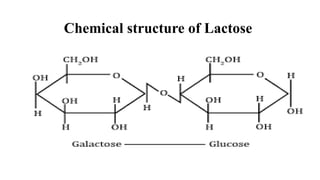
Lactose-Lactose is a disaccharide.
It is a Sugar Composed of galactose and glucose subunits by
elimination of one molecule of water.
It’s molecular formula C12H22O11
Lactose makes up around 2-8% of milk.
A type of sugar found in milk and used in some body food.
• Lactase is a protein enzyme that is produced in the Small intestine.
Chemical structure of Lactose
Trisaccharides
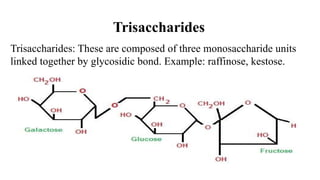
Trisaccharides: These are composed of three monosaccharide units
linked together by glycosidic bond. Example: raffinose, kestose.
Tetrasaccharides
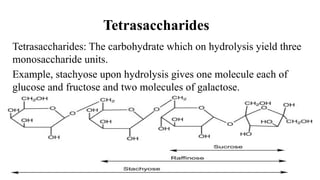
Tetrasaccharides: The carbohydrate which on hydrolysis yield three
monosaccharide units.
Example, stachyose upon hydrolysis gives one molecule each of
glucose and fructose and two molecules of galactose.
Polysaccharides
[Greek poly many; sacchar-sugar] Polysaccharides consist of long chains of
same or different monosaccharide units linked together by glycosidic bond.
They may be tasteless, amorphous and insoluble in water.
Their structures may be linear to highly branch.
They are further classified as:
(a) Homopolysaccharides: Polysaccharides composed of the same
monosaccharide units are called homopolysaccharide.
Examples: starch, glycogen, cellulose.
(b) Heteropolysaccharides: Polysaccharides composed of different
monosaccharide units are called heteropolysaccharide. Example: heparin.
Starch
It is a polysaccharide composed of large number of glucose units
linked together by glycosidic bond.
It is insoluble in water.
Starch is mainly obtained from vegetable sources, cereals such as
wheat, corn and rice.
It is the reserve food material for plants.
Starch is the mixture of two polymers namely amylose and
amylopectin.
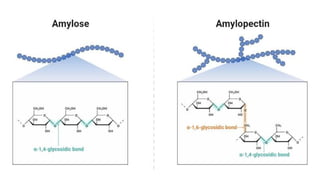
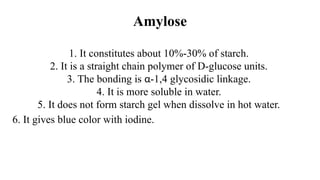
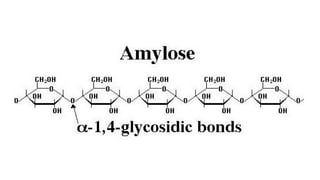
Amylose
1. It constitutes about 10%-30% of starch.
2. It is a straight chain polymer of D-glucose units.
3. The bonding is α-1,4 glycosidic linkage.
4. It is more soluble in water.
5. It does not form starch gel when dissolve in hot water.
6. It gives blue color with iodine.
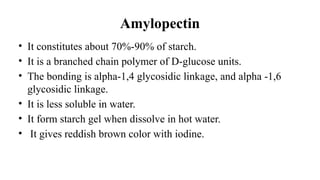
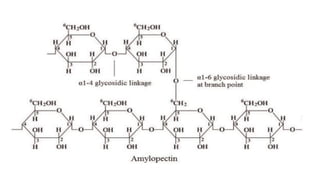
Amylopectin
• It constitutes about 70%-90% of starch.
• It is a branched chain polymer of D-glucose units.
• The bonding is alpha-1,4 glycosidic linkage, and alpha -1,6
glycosidic linkage.
• It is less soluble in water.
• It form starch gel when dissolve in hot water.
• It gives reddish brown color with iodine.
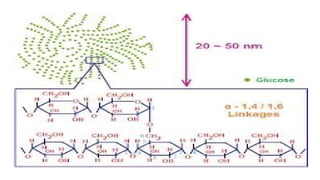
Glycogen
Glycogen is the storage material for animal cells and provides energy
to them. Its structure is similar to that of the amylopectin; therefore it
is called animal starch.
Glycogen is more highly branched than amylopectin.
The polymer is composed of glucose units connected by α-1,4-
glycosidic bonds and the branching of the polymer is due to α-1,6-
glycosidic bonds. These branches occur once for every ten 1,4-
linkages.
Glycogen is primarily produced in the liver and muscle cells. It is
soluble in water. It gives pink red to brown color with iodine.
Cellulose
discover-Anselme payen 1838.
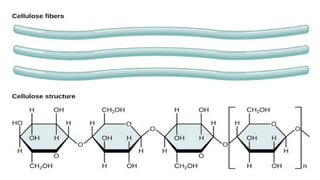
Cellulose is an unbranched homopolymer of long chain of D-
glucose units joined together by alpha-1,4- glycosidic linkage.
It is composed of Carbon (49.3%), Oxygen (44.4%) and Hydrogen
(6.17%). The molecular formula of cellulose is (CHO).
It is the most abundant naturally occurring organic substance on the
earth. The cellulose content of cotton fiber is about 90%.
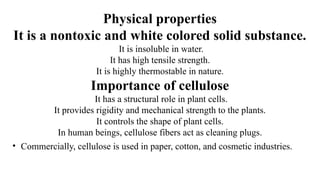
Physical properties
It is a nontoxic and white colored solid substance.
It is insoluble in water.
It has high tensile strength.
It is highly thermostable in nature.
Importance of cellulose
It has a structural role in plant cells.
It provides rigidity and mechanical strength to the plants.
It controls the shape of plant cells.
In human beings, cellulose fibers act as cleaning plugs.
• Commercially, cellulose is used in paper, cotton, and cosmetic industries.
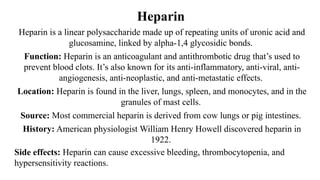
Heparin
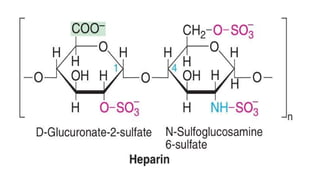
Heparin is a linear polysaccharide made up of repeating units of uronic acid and
glucosamine, linked by alpha-1,4 glycosidic bonds.
Function: Heparin is an anticoagulant and antithrombotic drug that’s used to
prevent blood clots. It’s also known for its anti-inflammatory, anti-viral, anti-
angiogenesis, anti-neoplastic, and anti-metastatic effects.
Location: Heparin is found in the liver, lungs, spleen, and monocytes, and in the
granules of mast cells.
Source: Most commercial heparin is derived from cow lungs or pig intestines.
History: American physiologist William Henry Howell discovered heparin in
1922.
Side effects: Heparin can cause excessive bleeding, thrombocytopenia, and
hypersensitivity reactions.
Carbohydrates Introduction, Functions and Classification.pptx

Carbohydrates Introduction, Functions and Classification.pptx

  • 1.
    Mewar University Gangrar, Chittorgarh ShantiNath Assistant professor Department of Paramedical Science
  • 2.
    Carbohydrates Carbohydrates are polyhydroxyalcohols having aldehyde/keto group or their derivatives which yield such compounds on hydrolysis. They are organic compounds. Saccharides (Saccharide = Derived from Greek word ‘Sacharon’ meaning sugar). Carbohydrates may be considered as hydrates of carbon. Hence, general molecular formula for carbohydrate was given as Cn(H2O)n. According to this formula, ratio of carbon, hydrogen and oxygen in carbohydrates is 1:2:1.
  • 3.
    Function of Carbohydrates Energy:Carbohydrates are the major source of energy. They provide 55-65% of total energy needed for the Storage: Starch in plants and glycogen in humans and animals serve as stores of glucose. Structural components: They serve as structural and supportive elements in cells. They mediate much of the intercellular communication. Biochemical compounds: They are constituents of glycolipids, glycoproteins, proteoglycans, nucleic acids, etc.are used as drugs, Antibiotics (streptomycin, erythromycin), Cardiac glycosides (digitonin) Miscellaneous: They act as Dietary fiber, e.g., cellulose, Lubricant and intercellular cement, e.g., mucopolysaccharides, Anticoagulant, e.g., heparin, Pharmacopeial product, e.g., dextrose, Food sweetener, e.g., glucose.
  • 4.
  • 5.
    Monosaccharides 1. Monosaccharides arethe simplest carbohydrates. 2. Those carbohydrates, which are made up of, single polyhydroxy derivatives of either aldehydes or ketones are called Monosaccharides. 3. They have general formula (C H O) ₂ ₂ 4. They cannot be further hydrolyzed. 5. Example of monosaccharides include glucose ,fructose ,galactose, xylose ,and ribose. 6. Monosaccharides, also called simple sugar are the basic units of carbohydrates.
  • 6.
    Monosaccharides are classifiedaccording to two different characteristics: The placement of its carbonyl group the number of carbon atoms it contains. If the carbonyl group is an aldehyde, the monosaccharide is an aldose; if the carbonyl group is a ketone, the monosaccharide is a ketose.
  • 8.
    Oligosaccharides Greek word -oligo = few; sacchar sugar] oligosaccharides are composed of 2- 10 simple sugars (monosaccharides). Depending upon the presence of monosaccharide units, these are further divided as:Dísaccharides: These sugars consist of two monosaccharide units joined together with glycosidic bond. Example: sucrose, maltose, lactose,
  • 9.
    Sucrose •Sucrose is acommon sugar. it is a disaccharide, a molecule composed of two monosaccharides. •Glucose and fructose by elimination of one molecule of water. sucrose is produced naturally in plants. → It has the molecular formula C12H22O11. •For human consumption, sucrose is extracted and refined from Sugarcane or sugar beet, Sugar mills.
  • 10.
  • 11.
    Maltose Maltose, also knowal maltobiose or malt sugar is a disaccharide formed from two units of glucose Joined with and (174) bond by elimination of one malecule water. Chemical formula: C12H12O11. The maltose found in sweet potato.
  • 12.
  • 13.
    Lactose Lactose-Lactose is adisaccharide. It is a Sugar Composed of galactose and glucose subunits by elimination of one molecule of water. It’s molecular formula C12H22O11 Lactose makes up around 2-8% of milk. A type of sugar found in milk and used in some body food. • Lactase is a protein enzyme that is produced in the Small intestine.
  • 14.
  • 15.
    Trisaccharides Trisaccharides: These arecomposed of three monosaccharide units linked together by glycosidic bond. Example: raffinose, kestose.
  • 16.
    Tetrasaccharides Tetrasaccharides: The carbohydratewhich on hydrolysis yield three monosaccharide units. Example, stachyose upon hydrolysis gives one molecule each of glucose and fructose and two molecules of galactose.
  • 17.
    Polysaccharides [Greek poly many;sacchar-sugar] Polysaccharides consist of long chains of same or different monosaccharide units linked together by glycosidic bond. They may be tasteless, amorphous and insoluble in water. Their structures may be linear to highly branch. They are further classified as: (a) Homopolysaccharides: Polysaccharides composed of the same monosaccharide units are called homopolysaccharide. Examples: starch, glycogen, cellulose. (b) Heteropolysaccharides: Polysaccharides composed of different monosaccharide units are called heteropolysaccharide. Example: heparin.
  • 18.
    Starch It is apolysaccharide composed of large number of glucose units linked together by glycosidic bond. It is insoluble in water. Starch is mainly obtained from vegetable sources, cereals such as wheat, corn and rice. It is the reserve food material for plants. Starch is the mixture of two polymers namely amylose and amylopectin.
  • 20.
    Amylose 1. It constitutesabout 10%-30% of starch. 2. It is a straight chain polymer of D-glucose units. 3. The bonding is α-1,4 glycosidic linkage. 4. It is more soluble in water. 5. It does not form starch gel when dissolve in hot water. 6. It gives blue color with iodine.
  • 22.
    Amylopectin • It constitutesabout 70%-90% of starch. • It is a branched chain polymer of D-glucose units. • The bonding is alpha-1,4 glycosidic linkage, and alpha -1,6 glycosidic linkage. • It is less soluble in water. • It form starch gel when dissolve in hot water. • It gives reddish brown color with iodine.
  • 24.
    Glycogen Glycogen is thestorage material for animal cells and provides energy to them. Its structure is similar to that of the amylopectin; therefore it is called animal starch. Glycogen is more highly branched than amylopectin. The polymer is composed of glucose units connected by α-1,4- glycosidic bonds and the branching of the polymer is due to α-1,6- glycosidic bonds. These branches occur once for every ten 1,4- linkages. Glycogen is primarily produced in the liver and muscle cells. It is soluble in water. It gives pink red to brown color with iodine.
  • 26.
    Cellulose discover-Anselme payen 1838. Celluloseis an unbranched homopolymer of long chain of D- glucose units joined together by alpha-1,4- glycosidic linkage. It is composed of Carbon (49.3%), Oxygen (44.4%) and Hydrogen (6.17%). The molecular formula of cellulose is (CHO). It is the most abundant naturally occurring organic substance on the earth. The cellulose content of cotton fiber is about 90%.
  • 27.
    Physical properties It isa nontoxic and white colored solid substance. It is insoluble in water. It has high tensile strength. It is highly thermostable in nature. Importance of cellulose It has a structural role in plant cells. It provides rigidity and mechanical strength to the plants. It controls the shape of plant cells. In human beings, cellulose fibers act as cleaning plugs. • Commercially, cellulose is used in paper, cotton, and cosmetic industries.
  • 29.
    Heparin Heparin is alinear polysaccharide made up of repeating units of uronic acid and glucosamine, linked by alpha-1,4 glycosidic bonds. Function: Heparin is an anticoagulant and antithrombotic drug that’s used to prevent blood clots. It’s also known for its anti-inflammatory, anti-viral, anti- angiogenesis, anti-neoplastic, and anti-metastatic effects. Location: Heparin is found in the liver, lungs, spleen, and monocytes, and in the granules of mast cells. Source: Most commercial heparin is derived from cow lungs or pig intestines. History: American physiologist William Henry Howell discovered heparin in 1922. Side effects: Heparin can cause excessive bleeding, thrombocytopenia, and hypersensitivity reactions.