Lecture 7
Fatty acids
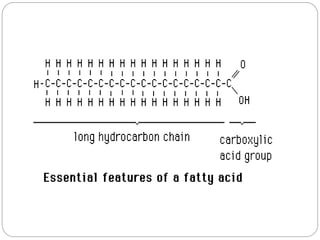
 Fatty acids are carboxylic acids with hydrocarbon
side chain
 The are the simplest form of lipids
Occurrence
 Majorly occur in esterified form as major
constituents of various lipids
 They are also present as free (unesterified) fatty
acids
 Fatty acids of animal origin are much more
simpler in structure in contrast to those of plant
origin
Even and odd carbon fatty acids
 Most of the F.A that occur in natural lipids are of
even carbons. This is due to the fact that
biosynthesis of F.A mainly occurs with the
sequential addition of 2 carbon units
 For example: Palmitic acid (16c) and stearic acid
(18c) are the most common
 Among the odd chain F.A, Propionic acid (13c)
and Valeric acid (5c) are well known
Saturated and unsaturated F.A
 Saturated fatty acids do not contain double bonds
 Unsaturated fatty acids contain one or more
double bonds
 Both almost equally occur in the natural lipids
 Fatty acids with one double bond are mono
unsaturated and those with 2 or more double
bonds are collectively known as polyunsaturated
fatty acids
Nomenclature
 The systematic naming of fatty acid is based on
the hydrocarbon from which it is derived
 Saturated fatty acid ends with the suuix –anoic
(e.g. octanoic acid)
 Unsaturated fatty acids ends with the suffex –
enoic (e.g. octadecanoic acid)
Numbering of carbon atoms
 It starts from the carboxyl carbon which is taken
as number 1
 The carbon adjacent to this are 2, 3, 4 and so on
or alternatively α, β, γ and so on.
 The terminal carbon containing methyl group is
known as omega (ω) carbon
 Starting from the methyl end the carbon atoms in a
fatty acid are numbered as omega 1, 2, 3 etc
Length of the hydrocarbon chain of
fatty acids
 Depending on the length of carbon chians, fatty
acids are categorized into three groups
 Short chain with less than 6 carbon
 Medium chain with 8 to 14 carbons
 Long chain with 16 to 24 carbons
Shorthand representation of F. A
 Instead of writing the full structures, biochemists
employ shorthand notations (by numbers) to
represent fatty acids
 The general rule is that the total number of
carbon atoms are written first, followed by the
number of double bonds and finally the (first
carbon) position of double bonds starting from the
carboxyl end
Palmitic acid
 16:0
Oleic acid
 18: 1; 9
Arachidonic acid
 20: 4; 5, 8, 11, 14
Other convention of representing
double bonds
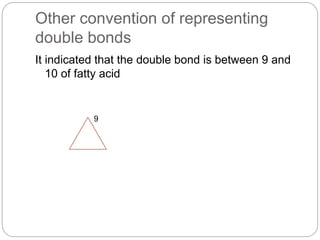
It indicated that the double bond is between 9 and
10 of fatty acid
9
ω 9
 It represents the double bond position (9 and 10)
from the ω end
 Naturally occurring unsaturated fatty acids belong to
ω 9, 6 and 3 series

Fatty acids

  • 1.
  • 2.
     Fatty acidsare carboxylic acids with hydrocarbon side chain  The are the simplest form of lipids
  • 4.
    Occurrence  Majorly occurin esterified form as major constituents of various lipids  They are also present as free (unesterified) fatty acids  Fatty acids of animal origin are much more simpler in structure in contrast to those of plant origin
  • 5.
    Even and oddcarbon fatty acids  Most of the F.A that occur in natural lipids are of even carbons. This is due to the fact that biosynthesis of F.A mainly occurs with the sequential addition of 2 carbon units  For example: Palmitic acid (16c) and stearic acid (18c) are the most common  Among the odd chain F.A, Propionic acid (13c) and Valeric acid (5c) are well known
  • 6.
    Saturated and unsaturatedF.A  Saturated fatty acids do not contain double bonds  Unsaturated fatty acids contain one or more double bonds  Both almost equally occur in the natural lipids  Fatty acids with one double bond are mono unsaturated and those with 2 or more double bonds are collectively known as polyunsaturated fatty acids
  • 8.
    Nomenclature  The systematicnaming of fatty acid is based on the hydrocarbon from which it is derived  Saturated fatty acid ends with the suuix –anoic (e.g. octanoic acid)  Unsaturated fatty acids ends with the suffex – enoic (e.g. octadecanoic acid)
  • 10.
    Numbering of carbonatoms  It starts from the carboxyl carbon which is taken as number 1  The carbon adjacent to this are 2, 3, 4 and so on or alternatively α, β, γ and so on.  The terminal carbon containing methyl group is known as omega (ω) carbon  Starting from the methyl end the carbon atoms in a fatty acid are numbered as omega 1, 2, 3 etc
  • 12.
    Length of thehydrocarbon chain of fatty acids  Depending on the length of carbon chians, fatty acids are categorized into three groups  Short chain with less than 6 carbon  Medium chain with 8 to 14 carbons  Long chain with 16 to 24 carbons
  • 13.
    Shorthand representation ofF. A  Instead of writing the full structures, biochemists employ shorthand notations (by numbers) to represent fatty acids  The general rule is that the total number of carbon atoms are written first, followed by the number of double bonds and finally the (first carbon) position of double bonds starting from the carboxyl end
  • 14.
  • 15.
  • 16.
    Arachidonic acid  20:4; 5, 8, 11, 14
  • 17.
    Other convention ofrepresenting double bonds It indicated that the double bond is between 9 and 10 of fatty acid 9
  • 18.
    ω 9  Itrepresents the double bond position (9 and 10) from the ω end  Naturally occurring unsaturated fatty acids belong to ω 9, 6 and 3 series