Monosaccharides (Simple sugars)
 • They may exist in a linear molecule or in ring forms.
 • They are classified according to the number of carbon
   atoms in their molecule.
    5 carbons are called pentoses ex. Ribose
    6 carbons are called hexoses ex. Glucose
 • Many forms exists as isomers. Isomers are molecules
   which have the same empirical formula (recipe) but
   have different structures (shapes) due to arrangement
   of the atoms in the molecule. This also gives them
   different properties. Glucose and fructose both have
   the empirical formula C6H12O6, but they have different
   structural formulas or shapes.
 • MONOSACCHARIDES             ARE     THE      BUILDING
   BLOCKS FOR ALL OTHER CARBOHYDRATES!
Monosaccharides

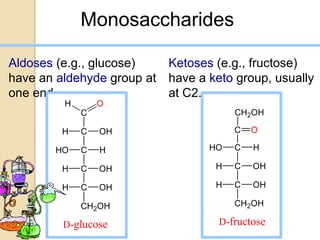
Aldoses (e.g., glucose)   Ketoses (e.g., fructose)
have an aldehyde group at have a keto group, usually
one end.                  at C2.
         H       O
             C                         CH2OH

         H   C   OH                    C   O

        HO   C   H                HO   C   H

         H   C   OH                H   C   OH

         H   C   OH                H   C   OH

             CH2OH                     CH2OH

         D-glucose                 D-fructose
Trioses
a three-carbon simple sugar.
formed during the metabolic breakdown of hexoses     in
muscle metabolism.

Tetroses
are four-carbon sugars.
One tetrose, erythrose, is a intermediate in the hexose
monophosphate shunt for the oxidation of glucose.

Pentoses
are five-carbon sugar molecules.

Ribose and deoxyribose
Ribose forms part of ribonucleic acid (RNA), and
deoxyribose forms part of deoxyribonucleic acid (DNA).
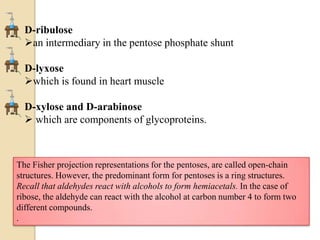
D-ribulose
  an intermediary in the pentose phosphate shunt

  D-lyxose
  which is found in heart muscle

  D-xylose and D-arabinose
   which are components of glycoproteins.


The Fisher projection representations for the pentoses, are called open-chain
structures. However, the predominant form for pentoses is a ring structures.
Recall that aldehydes react with alcohols to form hemiacetals. In the case of
ribose, the aldehyde can react with the alcohol at carbon number 4 to form two
different compounds.
.
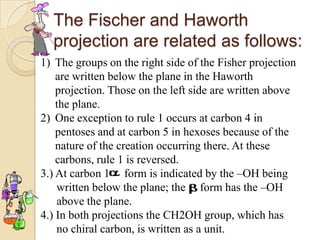
The Fischer and Haworth
  projection are related as follows:
1) The groups on the right side of the Fisher projection
    are written below the plane in the Haworth
    projection. Those on the left side are written above
    the plane.
2) One exception to rule 1 occurs at carbon 4 in
    pentoses and at carbon 5 in hexoses because of the
    nature of the creation occurring there. At these
    carbons, rule 1 is reversed.
3.) At carbon 1 form is indicated by the –OH being
    written below the plane; the form has the –OH
    above the plane.
4.) In both projections the CH2OH group, which has
    no chiral carbon, is written as a unit.
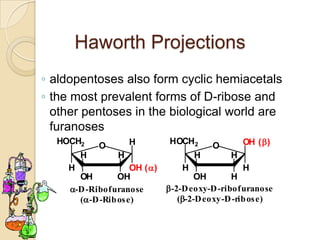
Haworth Projections
◦ aldopentoses also form cyclic hemiacetals
◦ the most prevalent forms of D-ribose and
  other pentoses in the biological world are
  furanoses
  HOCH2             H        HOCH2              OH ()
            O                           O
        H       H                  H        H
    H                OH ()      H              H
       OH        OH                OH        H
     -D -Ribofuranose      -2-D eoxy-D -ribofuranose
       (-D -Rib os e)         (-2-D eoxy-D -rib os e)
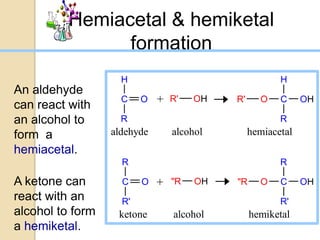
Hemiacetal & hemiketal
                formation
                    H                                  H
An aldehyde
can react with
                    C    O   +   R'   OH   R'     O    C     OH

an alcohol to       R                                  R
form a            aldehyde       alcohol        hemiacetal
hemiacetal.
                    R                                  R

A ketone can        C    O   +   "R   OH   "R     O    C     OH
react with an       R'                                 R'
alcohol to form    ketone        alcohol        hemiketal
a hemiketal.
HEXOSES
The six-carbon sugars.

The most common of all the carbohyrates.

 The most important as far as the human body is concerned
  are glucose, galactose and fructose.

The have the same molecular formula             but have
diff. structural formulas; they are isomers.
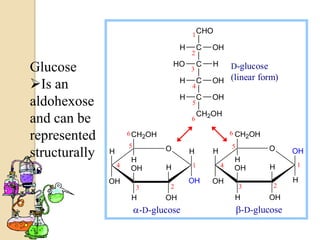
1
                                               CHO

                                       H       C   OH
                                           2
                                      HO       C   H
Glucose                                    3               D-glucose
                                                   OH (linear form)
Is an                                 H
                                           4
                                               C

                                       H       C   OH
aldohexose                                 5
                                               CH2OH
and can be                                 6

represented            6 CH2OH                             6 CH2OH
                       5          O                        5           O
structurally   H
                       H
                                           H       H
                                                            H
                                                                             OH
                   4                       1           4                     1
as                     OH         H                         OH         H
               OH                          OH      OH                        H
                           3       2                           3       2
                        H         OH                        H          OH
                           -D-glucose                         -D-glucose
is known commonly as dextrose, or
grape sugar.
It is a white crystalline solid that is
 soluble in water and insoluble in most
 organic liquids.
It is found, along with fructose, in
 many fruit juices.
It can be prepared by the hydrolysis of
 sucrose, a disaccharide, or by the
 hydrolysis of starch, polysaccharides.
It is normally found in the bloodstream and
 in the tissue fluids.
“Metabolism of Carbohydrates,” glucose
 requires no digestion and can be given
 intravenously to patients who are unable to
 take food by mouth.
is found in the urine of patients suffering
 from diabetes mellitus and is an indication
 of this disease
GALACTOSE
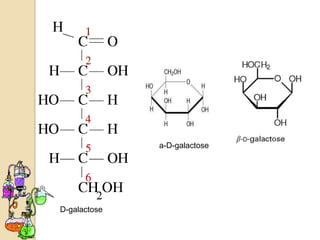
 An isomer of glucose, is also an aldohexose.
Glucose and galactose differ from each other
only in the configuration of the H and OH
about a single carbon atom.
Two sugars that differ only in the
configuration about a single carbon atom are
called epimers.
D-Galactose is converted to D-glucose in the
liver by a specific enzyme called an epimerse.
is present in some glycoproteins and
glycolipids.
Galactosemia
severe inherited disease, results in the
inability of infants to metabolize galactose
because of a difiency of either the enzyme
galactose 1-phosphate uridyl transferase or
the enzyme galactokinase.
 The galactose concentration increases in
the blood the urine (galactosuria).
a-D-galactose


D-galactose
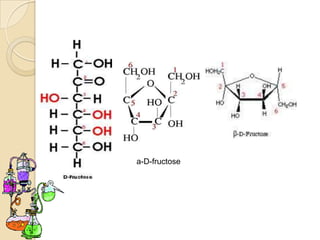
FRUCTOSE
can be represented as a straight-chain or as a ring
compound.
The ring structure is predominant. Note that the
ring structure represents a hemiketal.
often called levulose, or fruit sugar and it occurs
naturally in fruit juices and honey.
 It can be prepared by the hydrolysis of sucrose, a
disaccharide, and also by the hydrolysis of insulin,
polysaccharides found in Jerusalem artichokes.
the most soluble and also the sweetest of all sugars,
being 75 percent sweeter than glucose.
Fructosemia,
fructose intolerance, is an inherited
disease due to a deficiency of a
deficiency of the enzyme fructose 1-
phosphate aldolase. An infant suffering
from     this    disease    experiences
hypoglycemia, vomiting, and severe
malnutrition. Such a condition is treated
by placing the infant on a low-fructose
diet.
a-D-fructose
Reactions of the Hexoses
Hexoses, which are either aldoses or ketoses, show reducing properties.
This reducing property is the basis of the test sugar in the urine and in
the blood.

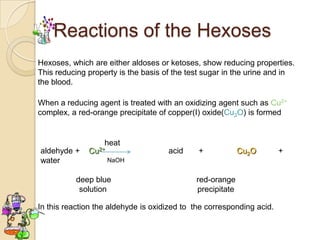
When a reducing agent is treated with an oxidizing agent such as Cu2+
complex, a red-orange precipitate of copper(I) oxide(Cu2O) is formed


                   heat
aldehyde +    Cu2+                   acid     +            Cu2O        +
water                NaOH


           deep blue                         red-orange
            solution                         precipitate

In this reaction the aldehyde is oxidized to the corresponding acid.
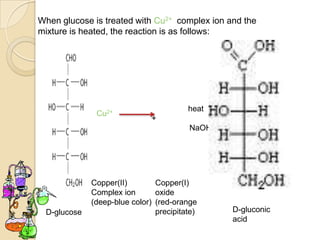
When glucose is treated with Cu2+ complex ion and the
mixture is heated, the reaction is as follows:


                                        heat
              Cu2+
                              +                Cu2O     +
                                        NaOH


             Copper(II)        Copper(I)
             Complex ion       oxide
             (deep-blue color) (red-orange
 D-glucose                     precipitate)    D-gluconic
                                               acid
Benedict's Reagent
 O                                   O

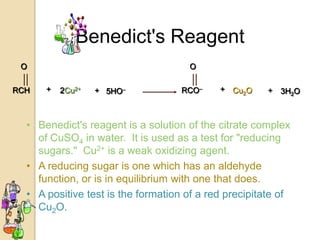
RCH   +   2Cu2+   + 5HO–            RCO–    + Cu2O     +   3H2O


  • Benedict's reagent is a solution of the citrate complex
    of CuSO4 in water. It is used as a test for "reducing
    sugars." Cu2+ is a weak oxidizing agent.
  • A reducing sugar is one which has an aldehyde
    function, or is in equilibrium with one that does.
  • A positive test is the formation of a red precipitate of
    Cu2O.
Examples of
         Reducing Sugars
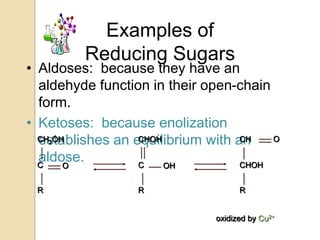
• Aldoses: because they have an
  aldehyde function in their open-chain
  form.
• Ketoses: because enolization
  establishes an equilibrium with an
  CH OH
     2            CHOH             CH   O

  aldose.
  C    O          C    OH          CHOH


 R                R                 R


                              oxidized by Cu2+
Oxidation
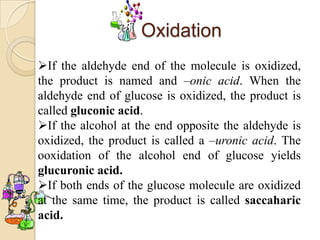
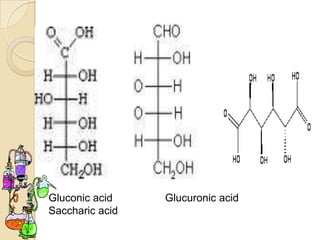
If the aldehyde end of the molecule is oxidized,
the product is named and –onic acid. When the
aldehyde end of glucose is oxidized, the product is
called gluconic acid.
If the alcohol at the end opposite the aldehyde is
oxidized, the product is called a –uronic acid. The
ooxidation of the alcohol end of glucose yields
glucuronic acid.
If both ends of the glucose molecule are oxidized
at the same time, the product is called saccaharic
acid.
Gluconic acid    Glucuronic acid
Saccharic acid
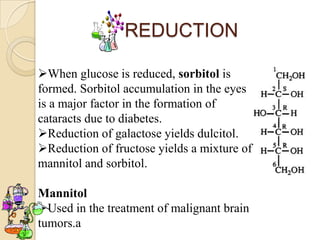
REDUCTION

When glucose is reduced, sorbitol is
formed. Sorbitol accumulation in the eyes
is a major factor in the formation of
cataracts due to diabetes.
Reduction of galactose yields dulcitol.
Reduction of fructose yields a mixture of
mannitol and sorbitol.

Mannitol
Used in the treatment of malignant brain
tumors.a
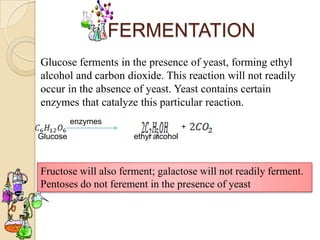
FERMENTATION
Glucose ferments in the presence of yeast, forming ethyl
alcohol and carbon dioxide. This reaction will not readily
occur in the absence of yeast. Yeast contains certain
enzymes that catalyze this particular reaction.
          enzymes
                                      +
Glucose               ethyl alcohol


Fructose will also ferment; galactose will not readily ferment.
Pentoses do not ferement in the presence of yeast
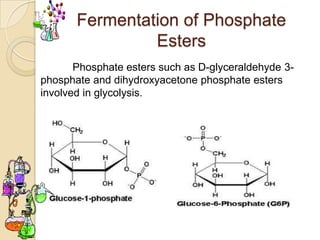
Fermentation of Phosphate
                Esters
       Phosphate esters such as D-glyceraldehyde 3-
phosphate and dihydroxyacetone phosphate esters
involved in glycolysis.
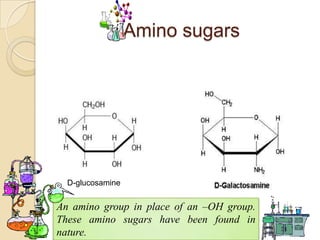
Amino sugars


  D-glucosamine


An amino group in place of an –OH group.
These amino sugars have been found in
nature.

Monosaccharides(2)

  • 1.
    Monosaccharides (Simple sugars) • They may exist in a linear molecule or in ring forms. • They are classified according to the number of carbon atoms in their molecule. 5 carbons are called pentoses ex. Ribose 6 carbons are called hexoses ex. Glucose • Many forms exists as isomers. Isomers are molecules which have the same empirical formula (recipe) but have different structures (shapes) due to arrangement of the atoms in the molecule. This also gives them different properties. Glucose and fructose both have the empirical formula C6H12O6, but they have different structural formulas or shapes. • MONOSACCHARIDES ARE THE BUILDING BLOCKS FOR ALL OTHER CARBOHYDRATES!
  • 2.
    Monosaccharides Aldoses (e.g., glucose) Ketoses (e.g., fructose) have an aldehyde group at have a keto group, usually one end. at C2. H O C CH2OH H C OH C O HO C H HO C H H C OH H C OH H C OH H C OH CH2OH CH2OH D-glucose D-fructose
  • 3.
    Trioses a three-carbon simplesugar. formed during the metabolic breakdown of hexoses in muscle metabolism. Tetroses are four-carbon sugars. One tetrose, erythrose, is a intermediate in the hexose monophosphate shunt for the oxidation of glucose. Pentoses are five-carbon sugar molecules. Ribose and deoxyribose Ribose forms part of ribonucleic acid (RNA), and deoxyribose forms part of deoxyribonucleic acid (DNA).
  • 4.
    D-ribulose anintermediary in the pentose phosphate shunt D-lyxose which is found in heart muscle D-xylose and D-arabinose  which are components of glycoproteins. The Fisher projection representations for the pentoses, are called open-chain structures. However, the predominant form for pentoses is a ring structures. Recall that aldehydes react with alcohols to form hemiacetals. In the case of ribose, the aldehyde can react with the alcohol at carbon number 4 to form two different compounds. .
  • 5.
    The Fischer andHaworth projection are related as follows: 1) The groups on the right side of the Fisher projection are written below the plane in the Haworth projection. Those on the left side are written above the plane. 2) One exception to rule 1 occurs at carbon 4 in pentoses and at carbon 5 in hexoses because of the nature of the creation occurring there. At these carbons, rule 1 is reversed. 3.) At carbon 1 form is indicated by the –OH being written below the plane; the form has the –OH above the plane. 4.) In both projections the CH2OH group, which has no chiral carbon, is written as a unit.
  • 6.
    Haworth Projections ◦ aldopentosesalso form cyclic hemiacetals ◦ the most prevalent forms of D-ribose and other pentoses in the biological world are furanoses HOCH2 H HOCH2 OH () O O H H H H H OH () H H OH OH OH H -D -Ribofuranose -2-D eoxy-D -ribofuranose (-D -Rib os e) (-2-D eoxy-D -rib os e)
  • 7.
    Hemiacetal & hemiketal formation H H An aldehyde can react with C O + R' OH R' O C OH an alcohol to R R form a aldehyde alcohol hemiacetal hemiacetal. R R A ketone can C O + "R OH "R O C OH react with an R' R' alcohol to form ketone alcohol hemiketal a hemiketal.
  • 8.
    HEXOSES The six-carbon sugars. Themost common of all the carbohyrates.  The most important as far as the human body is concerned are glucose, galactose and fructose. The have the same molecular formula but have diff. structural formulas; they are isomers.
  • 9.
    1 CHO H C OH 2 HO C H Glucose 3 D-glucose OH (linear form) Is an H 4 C H C OH aldohexose 5 CH2OH and can be 6 represented 6 CH2OH 6 CH2OH 5 O 5 O structurally H H H H H OH 4 1 4 1 as OH H OH H OH OH OH H 3 2 3 2 H OH H OH -D-glucose -D-glucose
  • 10.
    is known commonlyas dextrose, or grape sugar. It is a white crystalline solid that is soluble in water and insoluble in most organic liquids. It is found, along with fructose, in many fruit juices. It can be prepared by the hydrolysis of sucrose, a disaccharide, or by the hydrolysis of starch, polysaccharides.
  • 11.
    It is normallyfound in the bloodstream and in the tissue fluids. “Metabolism of Carbohydrates,” glucose requires no digestion and can be given intravenously to patients who are unable to take food by mouth. is found in the urine of patients suffering from diabetes mellitus and is an indication of this disease
  • 12.
    GALACTOSE  An isomerof glucose, is also an aldohexose. Glucose and galactose differ from each other only in the configuration of the H and OH about a single carbon atom. Two sugars that differ only in the configuration about a single carbon atom are called epimers. D-Galactose is converted to D-glucose in the liver by a specific enzyme called an epimerse. is present in some glycoproteins and glycolipids.
  • 13.
    Galactosemia severe inherited disease,results in the inability of infants to metabolize galactose because of a difiency of either the enzyme galactose 1-phosphate uridyl transferase or the enzyme galactokinase.  The galactose concentration increases in the blood the urine (galactosuria).
  • 14.
  • 15.
    FRUCTOSE can be representedas a straight-chain or as a ring compound. The ring structure is predominant. Note that the ring structure represents a hemiketal. often called levulose, or fruit sugar and it occurs naturally in fruit juices and honey.  It can be prepared by the hydrolysis of sucrose, a disaccharide, and also by the hydrolysis of insulin, polysaccharides found in Jerusalem artichokes. the most soluble and also the sweetest of all sugars, being 75 percent sweeter than glucose.
  • 16.
    Fructosemia, fructose intolerance, isan inherited disease due to a deficiency of a deficiency of the enzyme fructose 1- phosphate aldolase. An infant suffering from this disease experiences hypoglycemia, vomiting, and severe malnutrition. Such a condition is treated by placing the infant on a low-fructose diet.
  • 17.
  • 18.
    Reactions of theHexoses Hexoses, which are either aldoses or ketoses, show reducing properties. This reducing property is the basis of the test sugar in the urine and in the blood. When a reducing agent is treated with an oxidizing agent such as Cu2+ complex, a red-orange precipitate of copper(I) oxide(Cu2O) is formed heat aldehyde + Cu2+ acid + Cu2O + water NaOH deep blue red-orange solution precipitate In this reaction the aldehyde is oxidized to the corresponding acid.
  • 19.
    When glucose istreated with Cu2+ complex ion and the mixture is heated, the reaction is as follows: heat Cu2+ + Cu2O + NaOH Copper(II) Copper(I) Complex ion oxide (deep-blue color) (red-orange D-glucose precipitate) D-gluconic acid
  • 20.
    Benedict's Reagent O O RCH + 2Cu2+ + 5HO– RCO– + Cu2O + 3H2O • Benedict's reagent is a solution of the citrate complex of CuSO4 in water. It is used as a test for "reducing sugars." Cu2+ is a weak oxidizing agent. • A reducing sugar is one which has an aldehyde function, or is in equilibrium with one that does. • A positive test is the formation of a red precipitate of Cu2O.
  • 21.
    Examples of Reducing Sugars • Aldoses: because they have an aldehyde function in their open-chain form. • Ketoses: because enolization establishes an equilibrium with an CH OH 2 CHOH CH O aldose. C O C OH CHOH R R R oxidized by Cu2+
  • 22.
    Oxidation If the aldehydeend of the molecule is oxidized, the product is named and –onic acid. When the aldehyde end of glucose is oxidized, the product is called gluconic acid. If the alcohol at the end opposite the aldehyde is oxidized, the product is called a –uronic acid. The ooxidation of the alcohol end of glucose yields glucuronic acid. If both ends of the glucose molecule are oxidized at the same time, the product is called saccaharic acid.
  • 23.
    Gluconic acid Glucuronic acid Saccharic acid
  • 24.
    REDUCTION When glucose isreduced, sorbitol is formed. Sorbitol accumulation in the eyes is a major factor in the formation of cataracts due to diabetes. Reduction of galactose yields dulcitol. Reduction of fructose yields a mixture of mannitol and sorbitol. Mannitol Used in the treatment of malignant brain tumors.a
  • 25.
    FERMENTATION Glucose ferments inthe presence of yeast, forming ethyl alcohol and carbon dioxide. This reaction will not readily occur in the absence of yeast. Yeast contains certain enzymes that catalyze this particular reaction. enzymes + Glucose ethyl alcohol Fructose will also ferment; galactose will not readily ferment. Pentoses do not ferement in the presence of yeast
  • 26.
    Fermentation of Phosphate Esters Phosphate esters such as D-glyceraldehyde 3- phosphate and dihydroxyacetone phosphate esters involved in glycolysis.
  • 27.
    Amino sugars D-glucosamine An amino group in place of an –OH group. These amino sugars have been found in nature.