1
Carbohydrates
By: ProfessorAsgharAli
2
Carbohydrates
Carbohydrates are broadly defined as polyhydroxy
asaldehydes or ketones and their derivatives or
substances that yields one of these compounds
 Composed of carbon, hydrogen, and oxygen
 Functional groups present include hydroxyl groups
 -ose indicates sugar
Carbohydrates are the most abundant of all the organic compounds in nature.
 In plants, energy from the Sun is used to convert carbon dioxide and water into
the carbohydrate glucose.
 Many of the glucose molecules are made into long-chain polymers of starch
that store energy.
 About 65% of the foods in our diet consist of carbohydrates.
 Each day we utilize carbohydrates in foods such as bread, pasta, potatoes, and
rice.
 Other carbohydrates called disaccharides include sucrose (table sugar) and
lactose in milk.
 During digestion and cellular metabolism, carbohydrates are converted into
glucose,
 which is oxidized further in our cells to provide our bodies with energy and to
provide the cells with carbon atoms for building molecules of protein, lipids, and
nucleic acids.
 In plants, a polymer of glucose called cellulose builds the structural framework.
Cellulose has other important uses, too.
 The wood in our furniture, the pages in your notebook, and the cotton in our
clothing are made of cellulose.
Compiled and Edited by Dr.Syed
Ismail,MAU, Parbhani
4
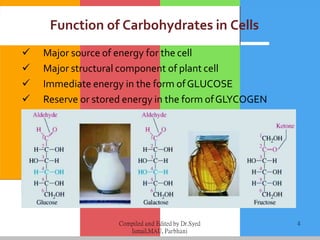
Function of Carbohydrates in Cells
 Major source of energy for the cell
 Major structural component of plant cell
 Immediate energy in the form ofGLUCOSE
 Reserve or stored energy in the form ofGLYCOGEN
Compiled and Edited byDr.Syed
Ismail,MAU, Parbhani
5
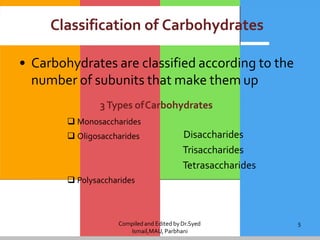
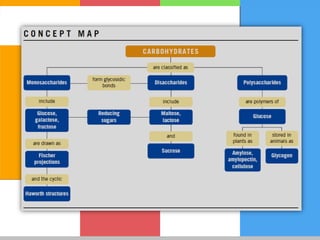
Classification of Carbohydrates
• Carbohydrates are classified according to the
number of subunits that make them up
3Types ofCarbohydrates
 Monosaccharides
 Oligosaccharides Disaccharides
Trisaccharides
Tetrasaccharides
 Polysaccharides
6
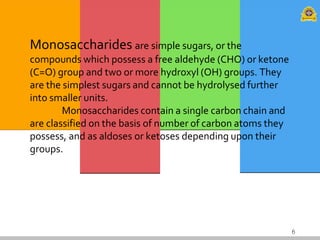
Monosaccharides are simple sugars, or the
compounds which possess a free aldehyde (CHO) or ketone
(C=O) group and two or more hydroxyl (OH) groups. They
are the simplest sugars and cannot be hydrolysed further
into smaller units.
Monosaccharides contain a single carbon chain and
are classified on the basis of number of carbon atoms they
possess, and as aldoses or ketoses depending upon their
groups.
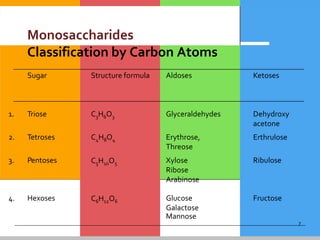
Monosaccharides
Classification by Carbon Atoms
Sugar Structure formula Aldoses Ketoses
1. Triose C3H6O3 Glyceraldehydes
2. Tetroses C4H8O4
Dehydroxy
acetone
Erthrulose
3. Pentoses C5H10O5
Erythrose,
Threose
Xylose
Ribose
Arabinose
Ribulose
4. Hexoses C6H12O6
Mannose
7
Glucose Fructose
Galactose
Compiled and Edited byDr.Syed
Ismail,MAU, Parbhani
8
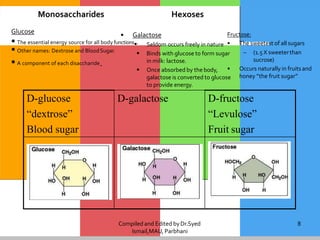
D-glucose
“dextrose”
Blood sugar
D-galactose D-fructose
“Levulose”
Fruit sugar
Fructose:
• The sweetest of all sugars
– (1.5 X sweeterthan
sucrose)
• Occurs naturally in fruits and
honey “the fruit sugar”
Glucose
 Other names: Dextrose and BloodSugar.
 A component of each disaccharide.
Monosaccharides Hexoses
• Galactose
 The essential energy source for all body functions. Seldom occurs freely in nature
 Binds with glucose to form sugar
in milk: lactose.
 Once absorbed by the body,
galactose is converted to glucose
to provide energy.
Compiled and Edited by Dr.Syed Ismail,MAU, Parbhani
9
Steriochemistry
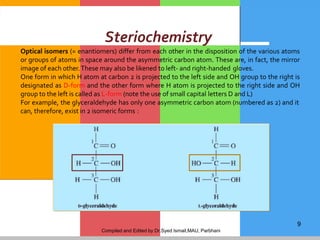
Optical isomers (= enantiomers) differ from each other in the disposition of the various atoms
or groups of atoms in space around the asymmetric carbon atom. These are, in fact, the mirror
image of each other.These may also be likened to left- and right-handed gloves.
One form in which H atom at carbon 2 is projected to the left side and OH group to the right is
designated as D-form and the other form where H atom is projected to the right side and OH
group to the left is called as L-form (note the use of small capital letters D and L)
For example, the glyceraldehyde has only one asymmetric carbon atom (numbered as 2) and it
can, therefore, exist in 2 isomeric forms :
Oligosaccharides
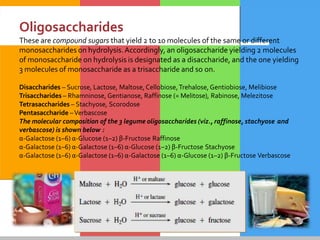
These are compound sugars that yield 2 to 10 molecules of the same or different
monosaccharides on hydrolysis.Accordingly, an oligosaccharide yielding 2 molecules
of monosaccharide on hydrolysis is designated as a disaccharide, and the one yielding
3 molecules of monosaccharide as a trisaccharide and so on.
Disaccharides – Sucrose, Lactose, Maltose, Cellobiose,Trehalose,Gentiobiose, Melibiose
Trisaccharides – Rhamninose, Gentianose, Raffinose (= Melitose), Rabinose, Melezitose
Tetrasaccharides – Stachyose, Scorodose
Pentasaccharide –Verbascose
The molecular composition of the 3 legume oligosaccharides (viz., raffinose, stachyose and
verbascose) is shown below :
α-Galactose (1–6) α-Glucose (1–2) β-Fructose Raffinose
α-Galactose (1–6) α-Galactose (1–6) α-Glucose (1–2) β-Fructose Stachyose
α-Galactose (1–6) α-Galactose (1–6) α-Galactose (1–6) α-Glucose (1–2) β-Fructose Verbascose
15
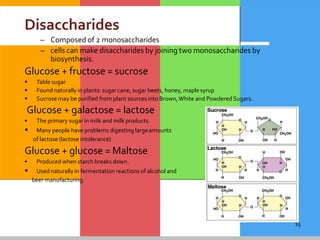
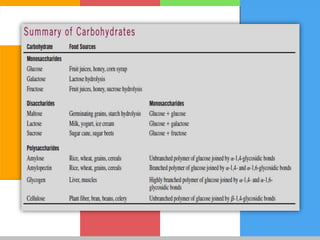
Disaccharides
– Composed of 2 monosaccharides
– cells can make disaccharides by joining two monosaccharides by
biosynthesis.
Glucose + fructose = sucrose
 Table sugar
 Found naturally in plants: sugar cane, sugar beets, honey, maple syrup
 Sucrose may be purified from plant sources into Brown,White and Powdered Sugars.
Glucose + galactose = lactose
• The primary sugar in milk and milk products.
• Many people have problems digesting largeamounts
of lactose (lactose intolerance)
Glucose + glucose = Maltose
• Produced when starch breaks down.
• Used naturally in fermentation reactions of alcohol and
beer manufacturing.
16
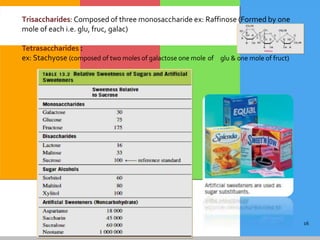
Trisaccharides: Composed of three monosaccharide ex: Raffinose (Formed by one
mole of each i.e. glu, fruc, galac)
Tetrasaccharides :
ex: Stachyose (composed of two moles of galactose one mole of glu & one mole of fruct)
Compiled and Edited byDr.Syed
Ismail,MAU,Parbhani
17
Polysaccharides
Containing 10 or more monosaccharide units attached together
• Examples
1. Starch- digestible
2. Glycogen- digestible
3. Fiber- indigestible
Long chains of glucose units form these polysaccharides
• Cellulose gives structure to plants, fiber to our diet
• Glycogen is an energy storage sugar produced by animals
• Liver cells synthesize glycogen after a meal to maintain
blood glucose levels
A great majority of carbohydrates of nature
occur as polysaccharides
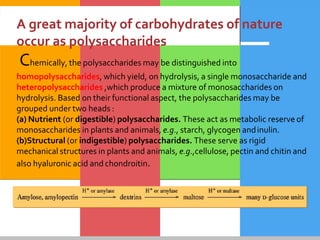
Chemically, the polysaccharides may be distinguished into
homopolysaccharides, which yield, on hydrolysis, a single monosaccharide and
heteropolysaccharides ,which produce a mixture of monosaccharides on
hydrolysis. Based on their functional aspect, the polysaccharides may be
grouped under two heads :
(a) Nutrient (or digestible) polysaccharides. These act as metabolic reserve of
monosaccharides in plants and animals, e.g., starch, glycogen andinulin.
(b)Structural (or indigestible) polysaccharides. These serve as rigid
mechanical structures in plants and animals, e.g.,cellulose, pectin and chitin and
also hyaluronic acid and chondroitin.
19
Types of Polysaccharides
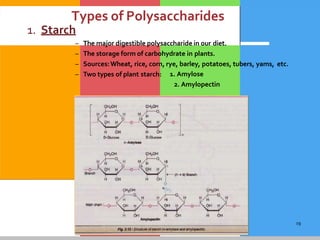
1. Starch
– The major digestible polysaccharide in our diet.
– The storage form of carbohydrate in plants.
– Sources:Wheat, rice, corn, rye, barley, potatoes, tubers, yams, etc.
– Two types of plant starch: 1. Amylose
2. Amylopectin
20
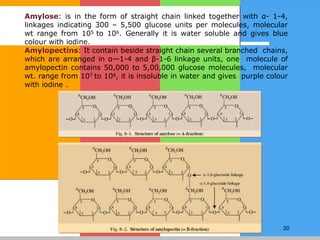
Amylose: is in the form of straight chain linked together with α- 1-4,
linkages indicating 300 – 5,500 glucose units per molecules, molecular
wt range from 105 to 106. Generally it is water soluble and gives blue
colour with iodine.
Amylopectins: It contain beside straight chain several branched chains,
which are arranged in α—1-4 and β-1-6 linkage units, one molecule of
amylopectin contains 50,000 to 5,00,000 glucose molecules, molecular
wt. range from 107 to 108, it is insoluble in water and gives purple colour
with iodine .
Compiled and Edited by Dr.Syed Ismail,
MAU,Parbhani
21
Types of Polysaccharides
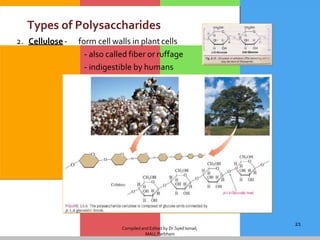
2. Cellulose- form cell walls in plantcells
- also called fiber or ruffage
- indigestible by humans
22
Types of Polysaccharides
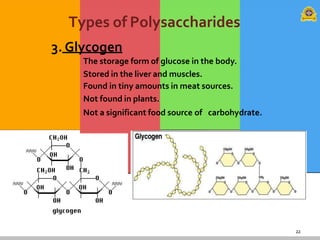
3. Glycogen
The storage form of glucose in the body.
Stored in the liver and muscles.
Found in tiny amounts in meat sources.
Not found in plants.
Not a significant food source of carbohydrate.
Chitin
Chitin is a large, structural polysaccharides made from
chains of modified glucose. Chitin is found in the
exoskeletons of insects, the cell walls of fungi, and certain
hard structures in invertebrates and fish. In terms of
abundance, chitin is second to only cellulose. In the
biosphere, over 1 billion tons of chitin are synthesized each
year by organisms. This extremely versatile molecule can
form solid structures on its own as in insect wings, or can
combine with other components like calcium carbonate to
make even stronger substances like the shell of a clam.
Like cellulose, no vertebrate animals can
digest chitin on their own. Animals that eat a
diet of insects often have
symbiotic bacteria and protozoa which can
break down the fibrous chitin into the glucose
molecules that compose it. However, because
chitin is a biodegradable molecule that
dissolves over time, it is used in a number of
industrial applications, such as surgical thread
and binders for dyes and glues.
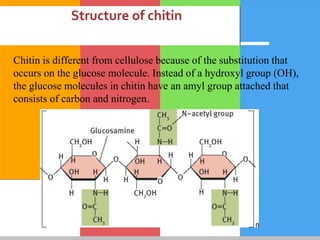
Structure of chitin
Chitin is different from cellulose because of the substitution that
occurs on the glucose molecule. Instead of a hydroxyl group (OH),
the glucose molecules in chitin have an amyl group attached that
consists of carbon and nitrogen.
Function of Chitin
Chitin, like cellulose and keratin, is a structural polymer. Made from
smaller monomers, or monosaccharides, structural polymers form
strong fibers. When secreted inside or outside of cells in an organized
way, the fibers form weak bonds between each other. This adds strength
to the entire structure. Chitin and cellulose are both made from glucose
monomers, while keratin is a fibrous protein. The various structural
polymers arose early in the evolution of life, because they are seen only
in certain groups. Cellulose is exclusive to plants, keratin to animals,
and chitin to the arthropods, mollusks and fungi. Chitin and cellulose
both evolved early-on in the history of life, while keratin arose in
certain animals long after plants and fungi had branched off from the
other eukaryotes.
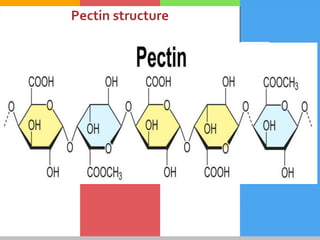
Pectin
Pectin is a structural acidic heteropolysaccharide contained
in the primary and middle lamella and cell
walls of terrestrial plants. Its main component
is galacturonic acid, a sugar acid derived from galactose. It
was first isolated and described in 1825 by Henri
Braconnot. It is produced commercially as a white to light
brown powder, mainly extracted from citrus fruits, and is
used in food as a gelling agent, particularly in jams and
jellies. It is also used in dessert fillings, medicines, sweets,
as a stabilizer in fruit juices and milk drinks, and as a source
of dietary fiber
Pectin structure
Hemicellulose
The building block of hemicellulose is xyloglucan
Backbone of xyloglucan consists of a chain of beta
glucose subunits to which side chains of xylose are
attached
Xyloglucans play role in stabilizing primary wall
by hydrogen bonding to cellulose microfibrils
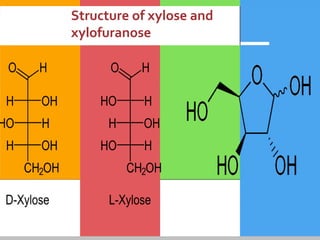
Structure of xylose and
xylofuranose

Carbohydrates

  • 1.
  • 2.
    2 Carbohydrates Carbohydrates are broadlydefined as polyhydroxy asaldehydes or ketones and their derivatives or substances that yields one of these compounds  Composed of carbon, hydrogen, and oxygen  Functional groups present include hydroxyl groups  -ose indicates sugar
  • 3.
    Carbohydrates are themost abundant of all the organic compounds in nature.  In plants, energy from the Sun is used to convert carbon dioxide and water into the carbohydrate glucose.  Many of the glucose molecules are made into long-chain polymers of starch that store energy.  About 65% of the foods in our diet consist of carbohydrates.  Each day we utilize carbohydrates in foods such as bread, pasta, potatoes, and rice.  Other carbohydrates called disaccharides include sucrose (table sugar) and lactose in milk.  During digestion and cellular metabolism, carbohydrates are converted into glucose,  which is oxidized further in our cells to provide our bodies with energy and to provide the cells with carbon atoms for building molecules of protein, lipids, and nucleic acids.  In plants, a polymer of glucose called cellulose builds the structural framework. Cellulose has other important uses, too.  The wood in our furniture, the pages in your notebook, and the cotton in our clothing are made of cellulose.
  • 4.
    Compiled and Editedby Dr.Syed Ismail,MAU, Parbhani 4 Function of Carbohydrates in Cells  Major source of energy for the cell  Major structural component of plant cell  Immediate energy in the form ofGLUCOSE  Reserve or stored energy in the form ofGLYCOGEN
  • 5.
    Compiled and EditedbyDr.Syed Ismail,MAU, Parbhani 5 Classification of Carbohydrates • Carbohydrates are classified according to the number of subunits that make them up 3Types ofCarbohydrates  Monosaccharides  Oligosaccharides Disaccharides Trisaccharides Tetrasaccharides  Polysaccharides
  • 6.
    6 Monosaccharides are simplesugars, or the compounds which possess a free aldehyde (CHO) or ketone (C=O) group and two or more hydroxyl (OH) groups. They are the simplest sugars and cannot be hydrolysed further into smaller units. Monosaccharides contain a single carbon chain and are classified on the basis of number of carbon atoms they possess, and as aldoses or ketoses depending upon their groups.
  • 7.
    Monosaccharides Classification by CarbonAtoms Sugar Structure formula Aldoses Ketoses 1. Triose C3H6O3 Glyceraldehydes 2. Tetroses C4H8O4 Dehydroxy acetone Erthrulose 3. Pentoses C5H10O5 Erythrose, Threose Xylose Ribose Arabinose Ribulose 4. Hexoses C6H12O6 Mannose 7 Glucose Fructose Galactose
  • 8.
    Compiled and EditedbyDr.Syed Ismail,MAU, Parbhani 8 D-glucose “dextrose” Blood sugar D-galactose D-fructose “Levulose” Fruit sugar Fructose: • The sweetest of all sugars – (1.5 X sweeterthan sucrose) • Occurs naturally in fruits and honey “the fruit sugar” Glucose  Other names: Dextrose and BloodSugar.  A component of each disaccharide. Monosaccharides Hexoses • Galactose  The essential energy source for all body functions. Seldom occurs freely in nature  Binds with glucose to form sugar in milk: lactose.  Once absorbed by the body, galactose is converted to glucose to provide energy.
  • 9.
    Compiled and Editedby Dr.Syed Ismail,MAU, Parbhani 9 Steriochemistry Optical isomers (= enantiomers) differ from each other in the disposition of the various atoms or groups of atoms in space around the asymmetric carbon atom. These are, in fact, the mirror image of each other.These may also be likened to left- and right-handed gloves. One form in which H atom at carbon 2 is projected to the left side and OH group to the right is designated as D-form and the other form where H atom is projected to the right side and OH group to the left is called as L-form (note the use of small capital letters D and L) For example, the glyceraldehyde has only one asymmetric carbon atom (numbered as 2) and it can, therefore, exist in 2 isomeric forms :
  • 10.
    Oligosaccharides These are compoundsugars that yield 2 to 10 molecules of the same or different monosaccharides on hydrolysis.Accordingly, an oligosaccharide yielding 2 molecules of monosaccharide on hydrolysis is designated as a disaccharide, and the one yielding 3 molecules of monosaccharide as a trisaccharide and so on. Disaccharides – Sucrose, Lactose, Maltose, Cellobiose,Trehalose,Gentiobiose, Melibiose Trisaccharides – Rhamninose, Gentianose, Raffinose (= Melitose), Rabinose, Melezitose Tetrasaccharides – Stachyose, Scorodose Pentasaccharide –Verbascose The molecular composition of the 3 legume oligosaccharides (viz., raffinose, stachyose and verbascose) is shown below : α-Galactose (1–6) α-Glucose (1–2) β-Fructose Raffinose α-Galactose (1–6) α-Galactose (1–6) α-Glucose (1–2) β-Fructose Stachyose α-Galactose (1–6) α-Galactose (1–6) α-Galactose (1–6) α-Glucose (1–2) β-Fructose Verbascose
  • 11.
    15 Disaccharides – Composed of2 monosaccharides – cells can make disaccharides by joining two monosaccharides by biosynthesis. Glucose + fructose = sucrose  Table sugar  Found naturally in plants: sugar cane, sugar beets, honey, maple syrup  Sucrose may be purified from plant sources into Brown,White and Powdered Sugars. Glucose + galactose = lactose • The primary sugar in milk and milk products. • Many people have problems digesting largeamounts of lactose (lactose intolerance) Glucose + glucose = Maltose • Produced when starch breaks down. • Used naturally in fermentation reactions of alcohol and beer manufacturing.
  • 12.
    16 Trisaccharides: Composed ofthree monosaccharide ex: Raffinose (Formed by one mole of each i.e. glu, fruc, galac) Tetrasaccharides : ex: Stachyose (composed of two moles of galactose one mole of glu & one mole of fruct)
  • 13.
    Compiled and EditedbyDr.Syed Ismail,MAU,Parbhani 17 Polysaccharides Containing 10 or more monosaccharide units attached together • Examples 1. Starch- digestible 2. Glycogen- digestible 3. Fiber- indigestible Long chains of glucose units form these polysaccharides • Cellulose gives structure to plants, fiber to our diet • Glycogen is an energy storage sugar produced by animals • Liver cells synthesize glycogen after a meal to maintain blood glucose levels
  • 14.
    A great majorityof carbohydrates of nature occur as polysaccharides Chemically, the polysaccharides may be distinguished into homopolysaccharides, which yield, on hydrolysis, a single monosaccharide and heteropolysaccharides ,which produce a mixture of monosaccharides on hydrolysis. Based on their functional aspect, the polysaccharides may be grouped under two heads : (a) Nutrient (or digestible) polysaccharides. These act as metabolic reserve of monosaccharides in plants and animals, e.g., starch, glycogen andinulin. (b)Structural (or indigestible) polysaccharides. These serve as rigid mechanical structures in plants and animals, e.g.,cellulose, pectin and chitin and also hyaluronic acid and chondroitin.
  • 15.
    19 Types of Polysaccharides 1.Starch – The major digestible polysaccharide in our diet. – The storage form of carbohydrate in plants. – Sources:Wheat, rice, corn, rye, barley, potatoes, tubers, yams, etc. – Two types of plant starch: 1. Amylose 2. Amylopectin
  • 16.
    20 Amylose: is inthe form of straight chain linked together with α- 1-4, linkages indicating 300 – 5,500 glucose units per molecules, molecular wt range from 105 to 106. Generally it is water soluble and gives blue colour with iodine. Amylopectins: It contain beside straight chain several branched chains, which are arranged in α—1-4 and β-1-6 linkage units, one molecule of amylopectin contains 50,000 to 5,00,000 glucose molecules, molecular wt. range from 107 to 108, it is insoluble in water and gives purple colour with iodine .
  • 17.
    Compiled and Editedby Dr.Syed Ismail, MAU,Parbhani 21 Types of Polysaccharides 2. Cellulose- form cell walls in plantcells - also called fiber or ruffage - indigestible by humans
  • 18.
    22 Types of Polysaccharides 3.Glycogen The storage form of glucose in the body. Stored in the liver and muscles. Found in tiny amounts in meat sources. Not found in plants. Not a significant food source of carbohydrate.
  • 21.
    Chitin Chitin is alarge, structural polysaccharides made from chains of modified glucose. Chitin is found in the exoskeletons of insects, the cell walls of fungi, and certain hard structures in invertebrates and fish. In terms of abundance, chitin is second to only cellulose. In the biosphere, over 1 billion tons of chitin are synthesized each year by organisms. This extremely versatile molecule can form solid structures on its own as in insect wings, or can combine with other components like calcium carbonate to make even stronger substances like the shell of a clam.
  • 22.
    Like cellulose, novertebrate animals can digest chitin on their own. Animals that eat a diet of insects often have symbiotic bacteria and protozoa which can break down the fibrous chitin into the glucose molecules that compose it. However, because chitin is a biodegradable molecule that dissolves over time, it is used in a number of industrial applications, such as surgical thread and binders for dyes and glues.
  • 23.
    Structure of chitin Chitinis different from cellulose because of the substitution that occurs on the glucose molecule. Instead of a hydroxyl group (OH), the glucose molecules in chitin have an amyl group attached that consists of carbon and nitrogen.
  • 24.
    Function of Chitin Chitin,like cellulose and keratin, is a structural polymer. Made from smaller monomers, or monosaccharides, structural polymers form strong fibers. When secreted inside or outside of cells in an organized way, the fibers form weak bonds between each other. This adds strength to the entire structure. Chitin and cellulose are both made from glucose monomers, while keratin is a fibrous protein. The various structural polymers arose early in the evolution of life, because they are seen only in certain groups. Cellulose is exclusive to plants, keratin to animals, and chitin to the arthropods, mollusks and fungi. Chitin and cellulose both evolved early-on in the history of life, while keratin arose in certain animals long after plants and fungi had branched off from the other eukaryotes.
  • 25.
    Pectin Pectin is astructural acidic heteropolysaccharide contained in the primary and middle lamella and cell walls of terrestrial plants. Its main component is galacturonic acid, a sugar acid derived from galactose. It was first isolated and described in 1825 by Henri Braconnot. It is produced commercially as a white to light brown powder, mainly extracted from citrus fruits, and is used in food as a gelling agent, particularly in jams and jellies. It is also used in dessert fillings, medicines, sweets, as a stabilizer in fruit juices and milk drinks, and as a source of dietary fiber
  • 26.
  • 27.
    Hemicellulose The building blockof hemicellulose is xyloglucan Backbone of xyloglucan consists of a chain of beta glucose subunits to which side chains of xylose are attached Xyloglucans play role in stabilizing primary wall by hydrogen bonding to cellulose microfibrils
  • 28.
    Structure of xyloseand xylofuranose