CARBOHYDRATES
Dipesh Tamrakar
MSc Clinical Biochemistry
Overview
 Introduction,
 Biochemical and medical importance
 Classification,
 Structure,
 Stereoisomerism,
 Physical and chemical properties
Introduction
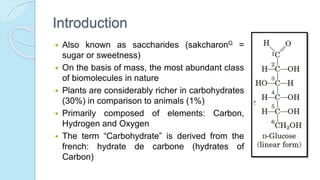
 Also known as saccharides (sakcharonG =
sugar or sweetness)
 On the basis of mass, the most abundant class
of biomolecules in nature
 Plants are considerably richer in carbohydrates
(30%) in comparison to animals (1%)
 Primarily composed of elements: Carbon,
Hydrogen and Oxygen
 The term “Carbohydrate” is derived from the
french: hydrate de carbone (hydrates of
Carbon)
Definition
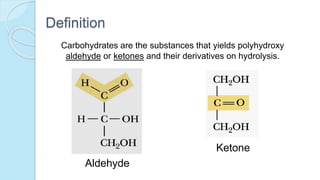
Carbohydrates are the substances that yields polyhydroxy
aldehyde or ketones and their derivatives on hydrolysis.
Aldehyde
Ketone
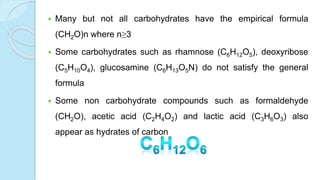
 Many but not all carbohydrates have the empirical formula
(CH2O)n where n≥3
 Some carbohydrates such as rhamnose (C6H12O5), deoxyribose
(C5H10O4), glucosamine (C6H13O5N) do not satisfy the general
formula
 Some non carbohydrate compounds such as formaldehyde
(CH2O), acetic acid (C2H4O2) and lactic acid (C3H6O3) also
appear as hydrates of carbon
Biomedical importance
 sources of energy & storage form (glycogen, starch)
 Precursors for many organic compounds: fats and proteins
 Glycosides : Streptomycin antibiotic
 Amino sugars: Erythromycin, carbomycin antibiotics
 form structural tissues in plants and in microorganisms (cellulose,
lignin, murein)
 participate in biological transport, cell-cell recognition, activation of
growth factors, modulation of the immune system
 Components of cell membrane and cell receptors
 Components of nucleic acids and blood group substances
 Used as anticoagulant : heparin
 Used as joint lubricant : hyaluronic acid
 Estimation of carbohydrate derivatives; glucose, fructose, tumor
markers (CA 125, CA 19.9, CA 15.3) are often used in disease
diagnosis, monitoring and prognosis
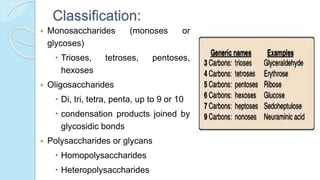
Classification:
 Monosaccharides (monoses or
glycoses)
 Trioses, tetroses, pentoses,
hexoses
 Oligosaccharides
 Di, tri, tetra, penta, up to 9 or 10
 condensation products joined by
glycosidic bonds
 Polysaccharides or glycans
 Homopolysaccharides
 Heteropolysaccharides
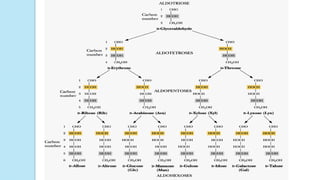
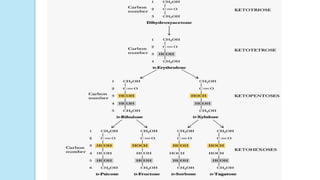
MONOSACCHARIDES
 Simplest group of carbohydrate
 Carbohydrates that have a free carbonyl group have the suffix "-
ose." [Note: Ketoses (with some exceptions, for example, fructose)
have an additional two letters in their suffix; “-ulose” for example,
xylulose.]
 Monosaccharides can be linked by glycosidic bonds to create larger
structures
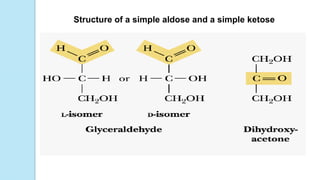
 Further classified based on the number of carbons and functional
group
Structure of a simple aldose and a simple ketose
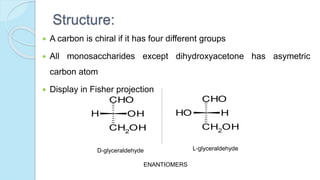
Structure:
 A carbon is chiral if it has four different groups
 All monosaccharides except dihydroxyacetone has asymetric
carbon atom
 Display in Fisher projection
CH2OH
H OH
CHO
CH2OH
OH H
CHO
D-glyceraldehyde L-glyceraldehyde
ENANTIOMERS
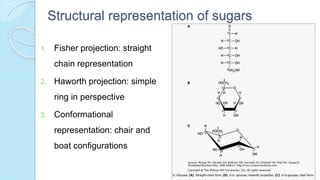
Structural representation of sugars
1. Fisher projection: straight
chain representation
2. Haworth projection: simple
ring in perspective
3. Conformational
representation: chair and
boat configurations
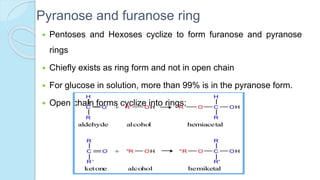
Pyranose and furanose ring
 Pentoses and Hexoses cyclize to form furanose and pyranose
rings
 Chiefly exists as ring form and not in open chain
 For glucose in solution, more than 99% is in the pyranose form.
 Open chain forms cyclize into rings:
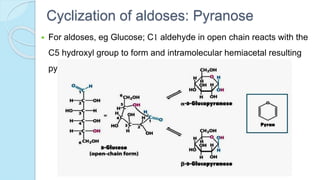
Cyclization of aldoses: Pyranose
 For aldoses, eg Glucose; C1 aldehyde in open chain reacts with the
C5 hydroxyl group to form and intramolecular hemiacetal resulting
pyranose
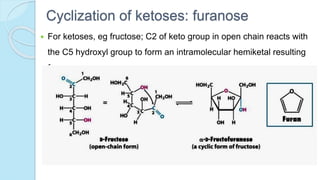
Cyclization of ketoses: furanose
 For ketoses, eg fructose; C2 of keto group in open chain reacts with
the C5 hydroxyl group to form an intramolecular hemiketal resulting
furanose
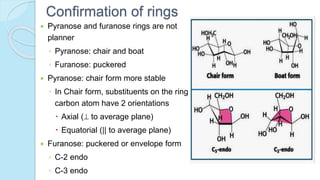
Confirmation of rings
 Pyranose and furanose rings are not
planner
◦ Pyranose: chair and boat
◦ Furanose: puckered
 Pyranose: chair form more stable
◦ In Chair form, substituents on the ring
carbon atom have 2 orientations
 Axial ( to average plane)
 Equatorial (|| to average plane)
 Furanose: puckered or envelope form
◦ C-2 endo
◦ C-3 endo
Isomerism
 Greek : isos = equal ; meros = part
 Originally applied by Jones J. Berzelius in 1827 to different
compounds with the same molecular formula and the phenomenon
was called Isomerism
 2 types of isomers:
1. Structural isomers: same molecular formula but different structure
(carbon chain or functional group)
2. Stereoisomers: same molecular formula and structure but differ
only in spatial configuration
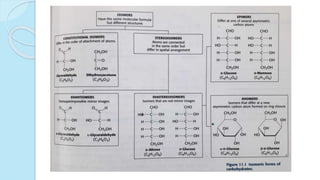
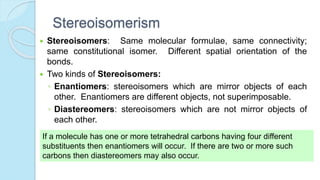
Stereoisomerism
 Stereoisomers: Same molecular formulae, same connectivity;
same constitutional isomer. Different spatial orientation of the
bonds.
 Two kinds of Stereoisomers:
◦ Enantiomers: stereoisomers which are mirror objects of each
other. Enantiomers are different objects, not superimposable.
◦ Diastereomers: stereoisomers which are not mirror objects of
each other.
If a molecule has one or more tetrahedral carbons having four different
substituents then enantiomers will occur. If there are two or more such
carbons then diastereomers may also occur.
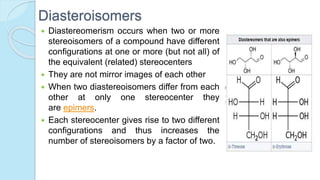
Diasteroisomers
 Diastereomerism occurs when two or more
stereoisomers of a compound have different
configurations at one or more (but not all) of
the equivalent (related) stereocenters
 They are not mirror images of each other
 When two diastereoisomers differ from each
other at only one stereocenter they
are epimers.
 Each stereocenter gives rise to two different
configurations and thus increases the
number of stereoisomers by a factor of two.
Stereoisomers
 2 types: Geometric and Optical
1. Geometric or cis-trans (Latin; cis = same, trans = across) arises
from peculiar geometry of compounds having double bond within
the carbon chain
These structures have different chemical and physiologic properties,
fumaric acid is physiologically active.
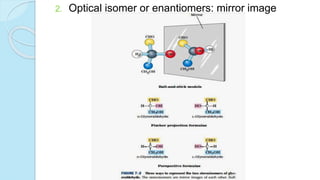
2. Optical isomer or enantiomers: mirror image
 The designation of a sugar isomer as the D form or the L form is
determined by its spatial relationship to the parent compound of the
carbohydrates
 The orientation of the -H and -OH groups around the carbon atom
adjacent to the terminal primary alcohol carbon (carbon 5 in glucose)
determines whether the sugar belongs to the D or L series.
 When the -OH group on this carbon is on the right, the sugar is the D
isomer; when it is on the left, it is the L isomer.
 Most of the monosaccharides occurring in mammals are D sugars, and
the enzymes responsible for their metabolism are specific for this
configuration.
Optical Activity
 A property exhibited by any compound whose mirror images are
non-superimposable
 Asymmetric compounds rotate plane polarized light
 When a beam of polarized light is passed through a solution of
optical isomer, it will be rotated either to the right or left
◦ Dextrorotatory (+): compounds that rotate the plane of polarized
light to right (dexterL = right)
◦ Levorotatory (-): compounds that rotate the plane of polarized
light to left (laevusL = left)
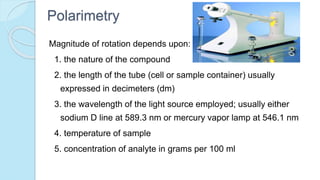
◦ Measurement uses an instrument called a polarimeter (Lippich type)
Polarimetry
Magnitude of rotation depends upon:
1. the nature of the compound
2. the length of the tube (cell or sample container) usually
expressed in decimeters (dm)
3. the wavelength of the light source employed; usually either
sodium D line at 589.3 nm or mercury vapor lamp at 546.1 nm
4. temperature of sample
5. concentration of analyte in grams per 100 ml
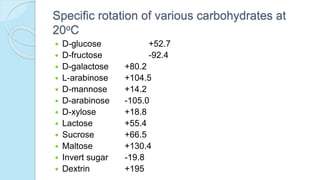
Specific rotation of various carbohydrates at
20oC
 D-glucose +52.7
 D-fructose -92.4
 D-galactose +80.2
 L-arabinose +104.5
 D-mannose +14.2
 D-arabinose -105.0
 D-xylose +18.8
 Lactose +55.4
 Sucrose +66.5
 Maltose +130.4
 Invert sugar -19.8
 Dextrin +195
Racemic mixture
 When equal amounts of D and L isomers are present, the
resulting mixture becomes optically inactive
 Such mixtures are known as Racemic mixture or DL mixture or
Conglomerate
 Optical inactivity is due to cancellation of charges by equality in
dextro and levorotatory activities.
 This process of conversion into the recemic modification is known
as racemisation
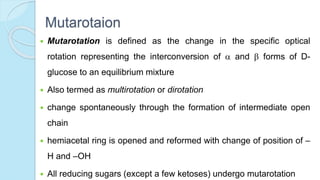
Mutarotaion
 Mutarotation is defined as the change in the specific optical
rotation representing the interconversion of  and  forms of D-
glucose to an equilibrium mixture
 Also termed as multirotation or dirotation
 change spontaneously through the formation of intermediate open
chain
 hemiacetal ring is opened and reformed with change of position of –
H and –OH
 All reducing sugars (except a few ketoses) undergo mutarotation
The equilibrium mixture contains 63% beta anomer, 36% alpha
anomer of glucose and 1% open chain (glucofuranose forms)
In aqueous solution, the beta form is more predominant due to its
stable configuration
Specific optical rotation []20
D
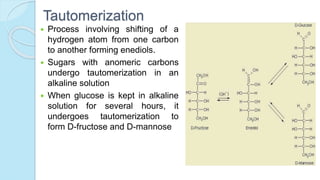
Tautomerization
 Process involving shifting of a
hydrogen atom from one carbon
to another forming enediols.
 Sugars with anomeric carbons
undergo tautomerization in an
alkaline solution
 When glucose is kept in alkaline
solution for several hours, it
undergoes tautomerization to
form D-fructose and D-mannose
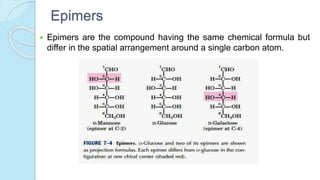
Epimers
 Epimers are the compound having the same chemical formula but
differ in the spatial arrangement around a single carbon atom.
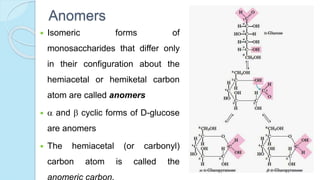
Anomers
 Isomeric forms of
monosaccharides that differ only
in their configuration about the
hemiacetal or hemiketal carbon
atom are called anomers
  and  cyclic forms of D-glucose
are anomers
 The hemiacetal (or carbonyl)
carbon atom is called the
anomeric carbon.
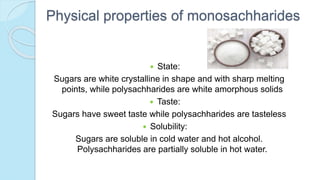
Physical properties of monosachharides
 State:
Sugars are white crystalline in shape and with sharp melting
points, while polysachharides are white amorphous solids
 Taste:
Sugars have sweet taste while polysachharides are tasteless
 Solubility:
Sugars are soluble in cold water and hot alcohol.
Polysachharides are partially soluble in hot water.
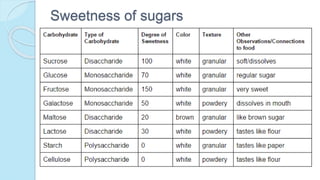
Sweetness of sugars
Chemical properties of monosaccharide
 Iodo compounds
◦ Aldose sugar when heated with conc Hydriodic acid (HI) losses
all of its O2 and converted into an iodo compound (glucose to
iodohexane)
 Acetylation
◦ Acetylation with acetylchloride indicates the presence of –OH in
the sugar (5OH group of glucose results in a pentaacetate)
 Heat
◦ Gluconic acid on heating produces lactones (cyclic structure
resembling pyranose and furanoses)
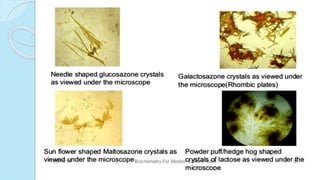
Osazone formation
 Crystalline derivatives of sugars which are valuable in the
identification of sugars
 Phenylhydrazine in acetic acid, when boiled with reducing sugars,
forms osazones
 a crystalline compound with a sharp melting point will be obtained
 D-fructose and D-mannose give the same needle shaped osazone
crystals as D-glucose
 seldom used for identification; we now use HPLC or mass
spectrometry
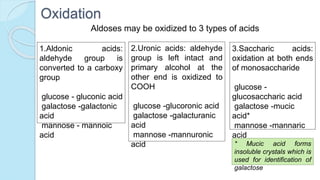
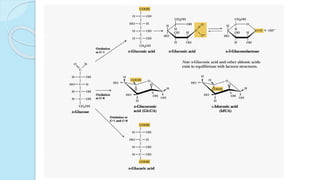
Oxidation
Aldoses may be oxidized to 3 types of acids
1.Aldonic acids:
aldehyde group is
converted to a carboxy
group
glucose - gluconic acid
galactose -galactonic
acid
mannose - mannoic
acid
2.Uronic acids: aldehyde
group is left intact and
primary alcohol at the
other end is oxidized to
COOH
glucose -glucoronic acid
galactose -galacturanic
acid
mannose -mannuronic
acid
3.Saccharic acids:
oxidation at both ends
of monosaccharide
glucose -
glucosaccharic acid
galactose -mucic
acid*
mannose -mannaric
acid
* Mucic acid forms
insoluble crystals which is
used for identification of
galactose
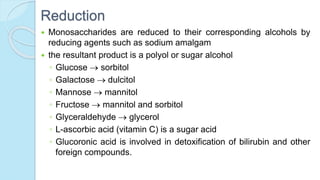
Reduction
 Monosaccharides are reduced to their corresponding alcohols by
reducing agents such as sodium amalgam
 the resultant product is a polyol or sugar alcohol
◦ Glucose  sorbitol
◦ Galactose  dulcitol
◦ Mannose  mannitol
◦ Fructose  mannitol and sorbitol
◦ Glyceraldehyde  glycerol
◦ L-ascorbic acid (vitamin C) is a sugar acid
◦ Glucoronic acid is involved in detoxification of bilirubin and other
foreign compounds.
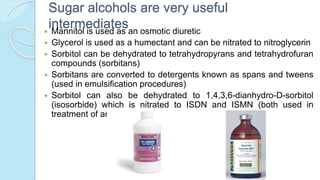
Sugar alcohols are very useful
intermediates Mannitol is used as an osmotic diuretic
 Glycerol is used as a humectant and can be nitrated to nitroglycerin
 Sorbitol can be dehydrated to tetrahydropyrans and tetrahydrofuran
compounds (sorbitans)
 Sorbitans are converted to detergents known as spans and tweens
(used in emulsification procedures)
 Sorbitol can also be dehydrated to 1,4,3,6-dianhydro-D-sorbitol
(isosorbide) which is nitrated to ISDN and ISMN (both used in
treatment of angina)
With strong mineral acids (furfural
derivatives)
 Monosaccharides are normally stable to dilute acids but are
dehydrated by strong acids (elimination of 3H2O)
 Change in OH groups towards and H away from aldehyde end of
the chain
 Hexoses give 5-hydroxymethyl furfurals and pentoses give furfurals
when heated with conc acids
 Reaction products with acids will condense with certain organic
phenols to form colorful compounds (eg; Molisch test and Bial’s
orcinol test)
With dilute alkalies
 Sugars are weak acids and can form salts at high pH eg; 1,2-enediol
salt
 Enediols are highly reactive sugars and are powerful reducing
agents
 sugars which give this reaction are known as reducing sugars
 This allows the interconversion of D-mannose, D-fructose and D-
glucose
 The reaction is known as the Lobry de Bruyn-Alberta von
Eckenstein reaction
 enediols obtained by the action of base are quite susceptible to
oxidation when heated in the presence of an oxidizing agent
 copper sulfate is frequently used as the oxidizing agent and a red
precipitate of Cu2O is obtained
 Strong alkalis cause CARAMELISATION(decomposition )of sugars
Tests for reducing sugar
 Fehling’s solution : 25% KOH or 35% NaOH and 7% CuSO4
 Barfoed’s reagent 7% Cupric acetate and 1% Acetic acid
(differentiate mono from disaccharide; mono more active
reducing agent)
 Benedict’s solution: Na2CO3 ,CuSO4 and Sodium Citrate
 Clinitest tablets are used to detect urinary glucose in diabetics
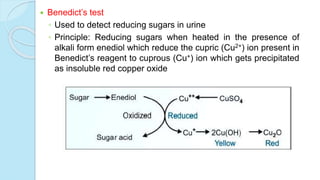
 Benedict’s test
◦ Used to detect reducing sugars in urine
◦ Principle: Reducing sugars when heated in the presence of
alkali form enediol which reduce the cupric (Cu2+) ion present in
Benedict’s reagent to cuprous (Cu+) ion which gets precipitated
as insoluble red copper oxide
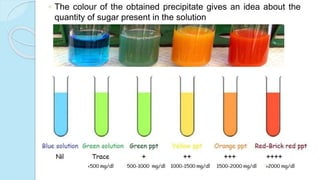
◦ The colour of the obtained precipitate gives an idea about the
quantity of sugar present in the solution
Reaction with alcohol
 The glycosidic OH group of mutarotating sugars react with
alcohols to form  and  glycosides or acetals
 Glucose forms glucosides and fructose forms fructosides
 They are formed by the reaction of the hydroxy group of the
anomeric carbon(hemiacetyl or hemiketal)with the hydroxyl
group of any other molecule with the elimination of water.
 A glycosidic bone is formed
Glycosides
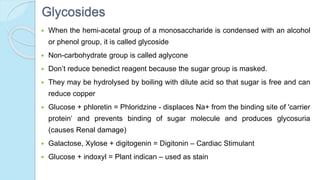
 When the hemi-acetal group of a monosaccharide is condensed with an alcohol
or phenol group, it is called glycoside
 Non-carbohydrate group is called aglycone
 Don’t reduce benedict reagent because the sugar group is masked.
 They may be hydrolysed by boiling with dilute acid so that sugar is free and can
reduce copper
 Glucose + phloretin = Phloridzine - displaces Na+ from the binding site of 'carrier
protein‘ and prevents binding of sugar molecule and produces glycosuria
(causes Renal damage)
 Galactose, Xylose + digitogenin = Digitonin – Cardiac Stimulant
 Glucose + indoxyl = Plant indican – used as stain
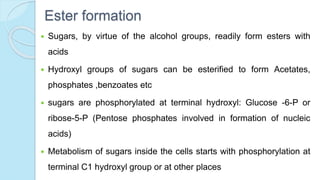
Ester formation
 Sugars, by virtue of the alcohol groups, readily form esters with
acids
 Hydroxyl groups of sugars can be esterified to form Acetates,
phosphates ,benzoates etc
 sugars are phosphorylated at terminal hydroxyl: Glucose -6-P or
ribose-5-P (Pentose phosphates involved in formation of nucleic
acids)
 Metabolism of sugars inside the cells starts with phosphorylation at
terminal C1 hydroxyl group or at other places
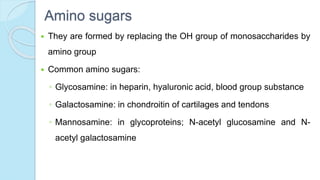
Amino sugars
 They are formed by replacing the OH group of monosaccharides by
amino group
 Common amino sugars:
◦ Glycosamine: in heparin, hyaluronic acid, blood group substance
◦ Galactosamine: in chondroitin of cartilages and tendons
◦ Mannosamine: in glycoproteins; N-acetyl glucosamine and N-
acetyl galactosamine
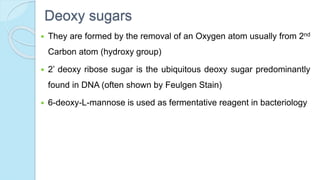
Deoxy sugars
 They are formed by the removal of an Oxygen atom usually from 2nd
Carbon atom (hydroxy group)
 2’ deoxy ribose sugar is the ubiquitous deoxy sugar predominantly
found in DNA (often shown by Feulgen Stain)
 6-deoxy-L-mannose is used as fermentative reagent in bacteriology
56

Carbohydrates

  • 1.
  • 2.
    Overview  Introduction,  Biochemicaland medical importance  Classification,  Structure,  Stereoisomerism,  Physical and chemical properties
  • 3.
    Introduction  Also knownas saccharides (sakcharonG = sugar or sweetness)  On the basis of mass, the most abundant class of biomolecules in nature  Plants are considerably richer in carbohydrates (30%) in comparison to animals (1%)  Primarily composed of elements: Carbon, Hydrogen and Oxygen  The term “Carbohydrate” is derived from the french: hydrate de carbone (hydrates of Carbon)
  • 4.
    Definition Carbohydrates are thesubstances that yields polyhydroxy aldehyde or ketones and their derivatives on hydrolysis. Aldehyde Ketone
  • 5.
     Many butnot all carbohydrates have the empirical formula (CH2O)n where n≥3  Some carbohydrates such as rhamnose (C6H12O5), deoxyribose (C5H10O4), glucosamine (C6H13O5N) do not satisfy the general formula  Some non carbohydrate compounds such as formaldehyde (CH2O), acetic acid (C2H4O2) and lactic acid (C3H6O3) also appear as hydrates of carbon
  • 6.
    Biomedical importance  sourcesof energy & storage form (glycogen, starch)  Precursors for many organic compounds: fats and proteins  Glycosides : Streptomycin antibiotic  Amino sugars: Erythromycin, carbomycin antibiotics  form structural tissues in plants and in microorganisms (cellulose, lignin, murein)  participate in biological transport, cell-cell recognition, activation of growth factors, modulation of the immune system
  • 7.
     Components ofcell membrane and cell receptors  Components of nucleic acids and blood group substances  Used as anticoagulant : heparin  Used as joint lubricant : hyaluronic acid  Estimation of carbohydrate derivatives; glucose, fructose, tumor markers (CA 125, CA 19.9, CA 15.3) are often used in disease diagnosis, monitoring and prognosis
  • 8.
    Classification:  Monosaccharides (monosesor glycoses)  Trioses, tetroses, pentoses, hexoses  Oligosaccharides  Di, tri, tetra, penta, up to 9 or 10  condensation products joined by glycosidic bonds  Polysaccharides or glycans  Homopolysaccharides  Heteropolysaccharides
  • 9.
    MONOSACCHARIDES  Simplest groupof carbohydrate  Carbohydrates that have a free carbonyl group have the suffix "- ose." [Note: Ketoses (with some exceptions, for example, fructose) have an additional two letters in their suffix; “-ulose” for example, xylulose.]  Monosaccharides can be linked by glycosidic bonds to create larger structures  Further classified based on the number of carbons and functional group
  • 14.
    Structure of asimple aldose and a simple ketose
  • 15.
    Structure:  A carbonis chiral if it has four different groups  All monosaccharides except dihydroxyacetone has asymetric carbon atom  Display in Fisher projection CH2OH H OH CHO CH2OH OH H CHO D-glyceraldehyde L-glyceraldehyde ENANTIOMERS
  • 16.
    Structural representation ofsugars 1. Fisher projection: straight chain representation 2. Haworth projection: simple ring in perspective 3. Conformational representation: chair and boat configurations
  • 17.
    Pyranose and furanosering  Pentoses and Hexoses cyclize to form furanose and pyranose rings  Chiefly exists as ring form and not in open chain  For glucose in solution, more than 99% is in the pyranose form.  Open chain forms cyclize into rings:
  • 18.
    Cyclization of aldoses:Pyranose  For aldoses, eg Glucose; C1 aldehyde in open chain reacts with the C5 hydroxyl group to form and intramolecular hemiacetal resulting pyranose
  • 19.
    Cyclization of ketoses:furanose  For ketoses, eg fructose; C2 of keto group in open chain reacts with the C5 hydroxyl group to form an intramolecular hemiketal resulting furanose
  • 20.
    Confirmation of rings Pyranose and furanose rings are not planner ◦ Pyranose: chair and boat ◦ Furanose: puckered  Pyranose: chair form more stable ◦ In Chair form, substituents on the ring carbon atom have 2 orientations  Axial ( to average plane)  Equatorial (|| to average plane)  Furanose: puckered or envelope form ◦ C-2 endo ◦ C-3 endo
  • 21.
    Isomerism  Greek :isos = equal ; meros = part  Originally applied by Jones J. Berzelius in 1827 to different compounds with the same molecular formula and the phenomenon was called Isomerism  2 types of isomers: 1. Structural isomers: same molecular formula but different structure (carbon chain or functional group) 2. Stereoisomers: same molecular formula and structure but differ only in spatial configuration
  • 23.
    Stereoisomerism  Stereoisomers: Samemolecular formulae, same connectivity; same constitutional isomer. Different spatial orientation of the bonds.  Two kinds of Stereoisomers: ◦ Enantiomers: stereoisomers which are mirror objects of each other. Enantiomers are different objects, not superimposable. ◦ Diastereomers: stereoisomers which are not mirror objects of each other. If a molecule has one or more tetrahedral carbons having four different substituents then enantiomers will occur. If there are two or more such carbons then diastereomers may also occur.
  • 24.
    Diasteroisomers  Diastereomerism occurswhen two or more stereoisomers of a compound have different configurations at one or more (but not all) of the equivalent (related) stereocenters  They are not mirror images of each other  When two diastereoisomers differ from each other at only one stereocenter they are epimers.  Each stereocenter gives rise to two different configurations and thus increases the number of stereoisomers by a factor of two.
  • 25.
    Stereoisomers  2 types:Geometric and Optical 1. Geometric or cis-trans (Latin; cis = same, trans = across) arises from peculiar geometry of compounds having double bond within the carbon chain These structures have different chemical and physiologic properties, fumaric acid is physiologically active.
  • 26.
    2. Optical isomeror enantiomers: mirror image
  • 27.
     The designationof a sugar isomer as the D form or the L form is determined by its spatial relationship to the parent compound of the carbohydrates  The orientation of the -H and -OH groups around the carbon atom adjacent to the terminal primary alcohol carbon (carbon 5 in glucose) determines whether the sugar belongs to the D or L series.  When the -OH group on this carbon is on the right, the sugar is the D isomer; when it is on the left, it is the L isomer.  Most of the monosaccharides occurring in mammals are D sugars, and the enzymes responsible for their metabolism are specific for this configuration.
  • 28.
    Optical Activity  Aproperty exhibited by any compound whose mirror images are non-superimposable  Asymmetric compounds rotate plane polarized light  When a beam of polarized light is passed through a solution of optical isomer, it will be rotated either to the right or left ◦ Dextrorotatory (+): compounds that rotate the plane of polarized light to right (dexterL = right) ◦ Levorotatory (-): compounds that rotate the plane of polarized light to left (laevusL = left) ◦ Measurement uses an instrument called a polarimeter (Lippich type)
  • 29.
    Polarimetry Magnitude of rotationdepends upon: 1. the nature of the compound 2. the length of the tube (cell or sample container) usually expressed in decimeters (dm) 3. the wavelength of the light source employed; usually either sodium D line at 589.3 nm or mercury vapor lamp at 546.1 nm 4. temperature of sample 5. concentration of analyte in grams per 100 ml
  • 30.
    Specific rotation ofvarious carbohydrates at 20oC  D-glucose +52.7  D-fructose -92.4  D-galactose +80.2  L-arabinose +104.5  D-mannose +14.2  D-arabinose -105.0  D-xylose +18.8  Lactose +55.4  Sucrose +66.5  Maltose +130.4  Invert sugar -19.8  Dextrin +195
  • 31.
    Racemic mixture  Whenequal amounts of D and L isomers are present, the resulting mixture becomes optically inactive  Such mixtures are known as Racemic mixture or DL mixture or Conglomerate  Optical inactivity is due to cancellation of charges by equality in dextro and levorotatory activities.  This process of conversion into the recemic modification is known as racemisation
  • 32.
    Mutarotaion  Mutarotation isdefined as the change in the specific optical rotation representing the interconversion of  and  forms of D- glucose to an equilibrium mixture  Also termed as multirotation or dirotation  change spontaneously through the formation of intermediate open chain  hemiacetal ring is opened and reformed with change of position of – H and –OH  All reducing sugars (except a few ketoses) undergo mutarotation
  • 33.
    The equilibrium mixturecontains 63% beta anomer, 36% alpha anomer of glucose and 1% open chain (glucofuranose forms) In aqueous solution, the beta form is more predominant due to its stable configuration Specific optical rotation []20 D
  • 34.
    Tautomerization  Process involvingshifting of a hydrogen atom from one carbon to another forming enediols.  Sugars with anomeric carbons undergo tautomerization in an alkaline solution  When glucose is kept in alkaline solution for several hours, it undergoes tautomerization to form D-fructose and D-mannose
  • 35.
    Epimers  Epimers arethe compound having the same chemical formula but differ in the spatial arrangement around a single carbon atom.
  • 36.
    Anomers  Isomeric formsof monosaccharides that differ only in their configuration about the hemiacetal or hemiketal carbon atom are called anomers   and  cyclic forms of D-glucose are anomers  The hemiacetal (or carbonyl) carbon atom is called the anomeric carbon.
  • 37.
    Physical properties ofmonosachharides  State: Sugars are white crystalline in shape and with sharp melting points, while polysachharides are white amorphous solids  Taste: Sugars have sweet taste while polysachharides are tasteless  Solubility: Sugars are soluble in cold water and hot alcohol. Polysachharides are partially soluble in hot water.
  • 38.
  • 39.
    Chemical properties ofmonosaccharide  Iodo compounds ◦ Aldose sugar when heated with conc Hydriodic acid (HI) losses all of its O2 and converted into an iodo compound (glucose to iodohexane)  Acetylation ◦ Acetylation with acetylchloride indicates the presence of –OH in the sugar (5OH group of glucose results in a pentaacetate)  Heat ◦ Gluconic acid on heating produces lactones (cyclic structure resembling pyranose and furanoses)
  • 40.
    Osazone formation  Crystallinederivatives of sugars which are valuable in the identification of sugars  Phenylhydrazine in acetic acid, when boiled with reducing sugars, forms osazones  a crystalline compound with a sharp melting point will be obtained  D-fructose and D-mannose give the same needle shaped osazone crystals as D-glucose  seldom used for identification; we now use HPLC or mass spectrometry
  • 42.
    Oxidation Aldoses may beoxidized to 3 types of acids 1.Aldonic acids: aldehyde group is converted to a carboxy group glucose - gluconic acid galactose -galactonic acid mannose - mannoic acid 2.Uronic acids: aldehyde group is left intact and primary alcohol at the other end is oxidized to COOH glucose -glucoronic acid galactose -galacturanic acid mannose -mannuronic acid 3.Saccharic acids: oxidation at both ends of monosaccharide glucose - glucosaccharic acid galactose -mucic acid* mannose -mannaric acid * Mucic acid forms insoluble crystals which is used for identification of galactose
  • 44.
    Reduction  Monosaccharides arereduced to their corresponding alcohols by reducing agents such as sodium amalgam  the resultant product is a polyol or sugar alcohol ◦ Glucose  sorbitol ◦ Galactose  dulcitol ◦ Mannose  mannitol ◦ Fructose  mannitol and sorbitol ◦ Glyceraldehyde  glycerol ◦ L-ascorbic acid (vitamin C) is a sugar acid ◦ Glucoronic acid is involved in detoxification of bilirubin and other foreign compounds.
  • 45.
    Sugar alcohols arevery useful intermediates Mannitol is used as an osmotic diuretic  Glycerol is used as a humectant and can be nitrated to nitroglycerin  Sorbitol can be dehydrated to tetrahydropyrans and tetrahydrofuran compounds (sorbitans)  Sorbitans are converted to detergents known as spans and tweens (used in emulsification procedures)  Sorbitol can also be dehydrated to 1,4,3,6-dianhydro-D-sorbitol (isosorbide) which is nitrated to ISDN and ISMN (both used in treatment of angina)
  • 46.
    With strong mineralacids (furfural derivatives)  Monosaccharides are normally stable to dilute acids but are dehydrated by strong acids (elimination of 3H2O)  Change in OH groups towards and H away from aldehyde end of the chain  Hexoses give 5-hydroxymethyl furfurals and pentoses give furfurals when heated with conc acids  Reaction products with acids will condense with certain organic phenols to form colorful compounds (eg; Molisch test and Bial’s orcinol test)
  • 47.
    With dilute alkalies Sugars are weak acids and can form salts at high pH eg; 1,2-enediol salt  Enediols are highly reactive sugars and are powerful reducing agents  sugars which give this reaction are known as reducing sugars  This allows the interconversion of D-mannose, D-fructose and D- glucose  The reaction is known as the Lobry de Bruyn-Alberta von Eckenstein reaction  enediols obtained by the action of base are quite susceptible to oxidation when heated in the presence of an oxidizing agent  copper sulfate is frequently used as the oxidizing agent and a red precipitate of Cu2O is obtained  Strong alkalis cause CARAMELISATION(decomposition )of sugars
  • 48.
    Tests for reducingsugar  Fehling’s solution : 25% KOH or 35% NaOH and 7% CuSO4  Barfoed’s reagent 7% Cupric acetate and 1% Acetic acid (differentiate mono from disaccharide; mono more active reducing agent)  Benedict’s solution: Na2CO3 ,CuSO4 and Sodium Citrate  Clinitest tablets are used to detect urinary glucose in diabetics
  • 49.
     Benedict’s test ◦Used to detect reducing sugars in urine ◦ Principle: Reducing sugars when heated in the presence of alkali form enediol which reduce the cupric (Cu2+) ion present in Benedict’s reagent to cuprous (Cu+) ion which gets precipitated as insoluble red copper oxide
  • 50.
    ◦ The colourof the obtained precipitate gives an idea about the quantity of sugar present in the solution
  • 51.
    Reaction with alcohol The glycosidic OH group of mutarotating sugars react with alcohols to form  and  glycosides or acetals  Glucose forms glucosides and fructose forms fructosides  They are formed by the reaction of the hydroxy group of the anomeric carbon(hemiacetyl or hemiketal)with the hydroxyl group of any other molecule with the elimination of water.  A glycosidic bone is formed
  • 52.
    Glycosides  When thehemi-acetal group of a monosaccharide is condensed with an alcohol or phenol group, it is called glycoside  Non-carbohydrate group is called aglycone  Don’t reduce benedict reagent because the sugar group is masked.  They may be hydrolysed by boiling with dilute acid so that sugar is free and can reduce copper  Glucose + phloretin = Phloridzine - displaces Na+ from the binding site of 'carrier protein‘ and prevents binding of sugar molecule and produces glycosuria (causes Renal damage)  Galactose, Xylose + digitogenin = Digitonin – Cardiac Stimulant  Glucose + indoxyl = Plant indican – used as stain
  • 53.
    Ester formation  Sugars,by virtue of the alcohol groups, readily form esters with acids  Hydroxyl groups of sugars can be esterified to form Acetates, phosphates ,benzoates etc  sugars are phosphorylated at terminal hydroxyl: Glucose -6-P or ribose-5-P (Pentose phosphates involved in formation of nucleic acids)  Metabolism of sugars inside the cells starts with phosphorylation at terminal C1 hydroxyl group or at other places
  • 54.
    Amino sugars  Theyare formed by replacing the OH group of monosaccharides by amino group  Common amino sugars: ◦ Glycosamine: in heparin, hyaluronic acid, blood group substance ◦ Galactosamine: in chondroitin of cartilages and tendons ◦ Mannosamine: in glycoproteins; N-acetyl glucosamine and N- acetyl galactosamine
  • 55.
    Deoxy sugars  Theyare formed by the removal of an Oxygen atom usually from 2nd Carbon atom (hydroxy group)  2’ deoxy ribose sugar is the ubiquitous deoxy sugar predominantly found in DNA (often shown by Feulgen Stain)  6-deoxy-L-mannose is used as fermentative reagent in bacteriology
  • 56.