“Sugar-ClassificationandReaction”
By
KAUSHAL KUMAR SAHU
Assistant Professor (Ad Hoc)
Department of Biotechnology
Govt. Digvijay Autonomous P. G. College
Raj-Nandgaon ( C. G. )
SYNOPSIS
Introduction
Classification of carbohydrate
Monosaccharide
The Common Monosaccharide Have Cyclic Structure
 Organism Contain a Variety of Hexose Derivatives
 Monosaccharide Are Reducing Agents
Disaccharide
Polysaccharide
Type of polysaccharide
 Some Homopolysaccharides Are Stored Forms of Fuel
 Some Homopolysaccharides Serve Structural Roles
 Homopolysaccharied Folding
Reaction of Sugar
Conclusion
Reference
INTRODUCTION
Carbohydrate are most abundant biomolecules on
earth.
Carbohydrates are Polyhydroxy aldehydes or
ketones, or substance that yield such compound on
hydrolysis.
Many, but not all, carbohydrates have the
empirical formula (CH2O)ń, some also contain
nitrogen, phosphorous, or sulfur.
C
A
R
B
O
H
Y
D
R
A
T
E
Classification
• There are three major size cases of Carbohydrate:
 Monosaccharide
 Oligosaccharide
 Polysaccharide
• “Saccharide” is derived from the Greek Sakcharon
meaning “sugar”.

C
A
R
B
O
H
Y
D
R
A
T
e
Monosaccharide
Monosaccharide’s, or simple sugar, consist of a
single polyhydroxy aldehyde or ketone unit.
Monosaccharide of more than four carbons tend to
have cyclic structure.
Many of the carbon atoms to which hydroxyl
groups are attached are chiral centers, which give
rise to the many sugar stereoisomers found in
nature.
C
A
R
B
O
H
Y
D
R
A
T
e
Monosaccharide has colorless, crystalline solids that
are freely soluble in water but insoluble in non polar
solvents.
Most have a sweet taste.
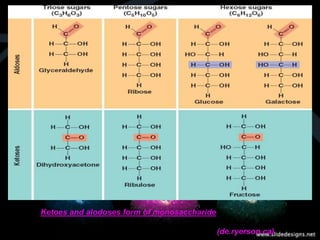
If the carbonyl group is at an end of the carbon
chain (that is, in an aldehyde group) the
monosaccharidies an aldose; if the carbonyl group is
at any other position (in a ketone group) the
monosaccharide is a ketose.
M
O
N
O
S
A
C
C
H
A
R
I
D
E
Ketoes and alodoses form of monosaccharide
(de.ryerson.ca)
TheCommonMonosaccharideHaveCyclicStructure
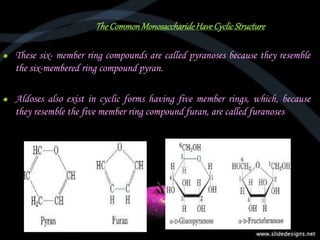
These six- member ring compounds are called pyranoses because they resemble
the six-membered ring compound pyran.
Aldoses also exist in cyclic forms having five member rings, which, because
they resemble the five member ring compound furan, are called furanoses
HaworthPerspectiveFormula
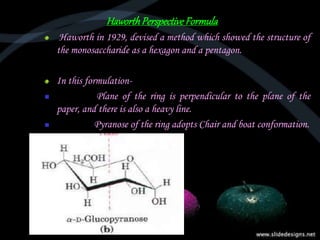
Haworth in 1929, devised a method which showed the structure of
the monosaccharide as a hexagon and a pentagon.
In this formulation-
 Plane of the ring is perpendicular to the plane of the
paper, and there is also a heavy line.
 Pyranose of the ring adopts Chair and boat conformation.
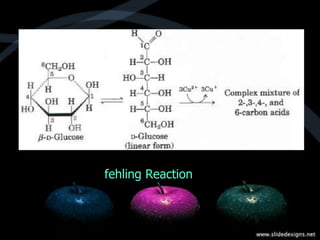
MonosaccharideAreReducingAgents-
Monosaccharide’s can be oxidized by relatively mild oxidizing agents such
as cupric (Cu*) ion.
The carbonyl carbon is oxidized to a carboxyl group.
Glucose and other sugars capable of reducing cupric ion are called
reducing sugars.
This is the basis of Fehling's reaction, a qualitative test for the presence of
reducing sugar.
For many years this test was used to detect and measure elevated glucose
levels in blood and urine in the diagnosis of diabetes mellitus.
F
fehling Reaction
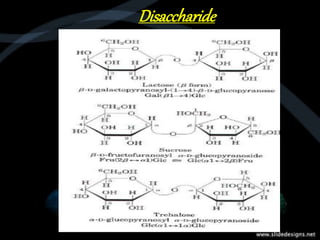
Disaccharide
Disaccharides Consist of two monosaccharide
joined covalently by an O-glycosidic bond, which is
formed when a hydroxyl group of one sugar reacts
with the anomeric carbon of the other.
In describing disaccharide or polysaccharide the
end of a chain with a free anomeric carbon (one
not involved in a glycosidic bond) is commonly
called the reducing end.
C
A
R
B
O
H
Y
D
R
A
T
e
It is formed by plants but not by animals.
Sucrose is a non reducing sugar
Sucrose (table sugar) is a disaccharide of glucose and
fructose.
Disaccharide
Polysaccharide
Most carbohydrates found in nature occur as
polysaccharides, polymers of medium to high
molecular weight.
Polysaccharides also called glycans, differ from
each other in the identity of their recurring
monosaccharide units, in the length of their
chains, in the types of bonds Linking the units,
and in the degree of branching.
Ca
rb
O
H
yd
ra
t
e
Typeofpolysaccharide-
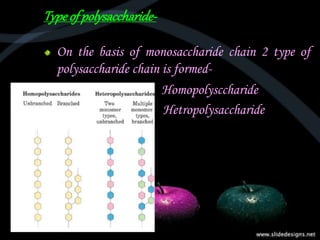
On the basis of monosaccharide chain 2 type of
polysaccharide chain is formed-
 Homopolysccharide
Hetropolysaccharide
SomeHomopolysaccharidesAreStoredFormsof Fuel-
Starch
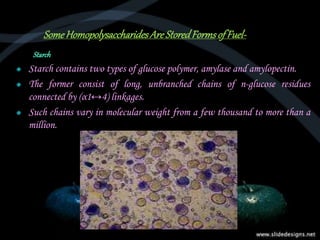
Starch contains two types of glucose polymer, amylase and amylopectin.
The former consist of long, unbranched chains of n-glucose residues
connected by (α1↔4) linkages.
Such chains vary in molecular weight from a few thousand to more than a
million.
Glycogen
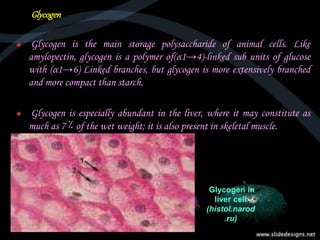
Glycogen is the main storage polysaccharide of animal cells. Like
amylopectin, glycogen is a polymer of(α1→4)-linked sub units of glucose
with (α1→6) Linked branches, but glycogen is more extensively branched
and more compact than starch.
Glycogen is especially abundant in the liver, where it may constitute as
much as 7 ٪ of the wet weight; it is also present in skeletal muscle.
Glycogen in
liver cell
(histol.narod
.ru)
SomeHomopolysaccharidesServeStructuralRoles-
 Cellulose
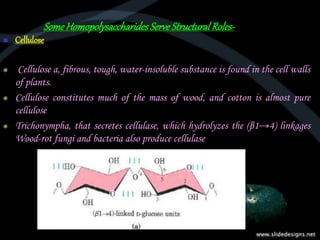
Cellulose a, fibrous, tough, water-insoluble substance is found in the cell walls
of plants.
Cellulose constitutes much of the mass of wood, and cotton is almost pure
cellulose
Trichonympha, that secretes cellulase, which hydrolyzes the (β1→4) linkages
Wood-rot fungi and bacteria also produce cellulase
 Chitin
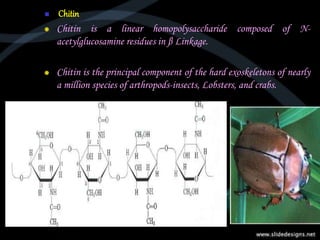
Chitin is a linear homopolysaccharide composed of N-
acetylglucosamine residues in β Linkage.
Chitin is the principal component of the hard exoskeletons of nearly
a million species of arthropods-insects, Lobsters, and crabs.
HomopolysacchariedFolding
The most stable three-dimensional structure for the (α1→4)-linked
chains of starch and glycogen is a tightly coiled helix , stabilized by
inter chain hydrogen bond.
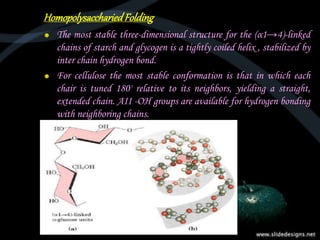
For cellulose the most stable conformation is that in which each
chair is tuned 180' relative to its neighbors, yielding a straight,
extended chain. AII -OH groups are available for hydrogen bonding
with neighboring chains.
Bacterial and Algal Cellwall contain Structural Hteropolysaccharides-
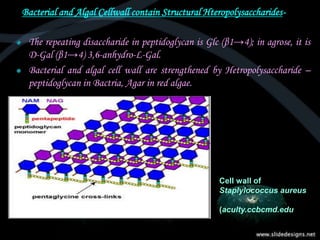
The repeating disaccharide in peptidoglycan is Glc (β1→4); in agrose, it is
D-Gal (β1→4) 3,6-anhydro-L-Gal.
Bacterial and algal cell wall are strengthened by Hetropolysaccharide –
peptidoglycan in Bactria, Agar in red algae.
Cell wall of
Staplylococcus aureus
(aculty.ccbcmd.edu
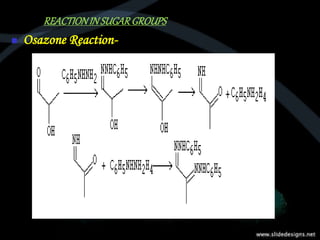
REACTIONINSUGARGROUPS
 Osazone Reaction-
Conclusion
Reference

 Biomolecule by Nelson & Cox (5th ed)
 Biochemistry by lubert (5th ed.)
 Internet
 www.wikipedia.com
 www.chemistry.msu.edu
 www.medicalnewstoday.com


sugar classification and reaction

  • 1.
    “Sugar-ClassificationandReaction” By KAUSHAL KUMAR SAHU AssistantProfessor (Ad Hoc) Department of Biotechnology Govt. Digvijay Autonomous P. G. College Raj-Nandgaon ( C. G. )
  • 2.
    SYNOPSIS Introduction Classification of carbohydrate Monosaccharide TheCommon Monosaccharide Have Cyclic Structure  Organism Contain a Variety of Hexose Derivatives  Monosaccharide Are Reducing Agents
  • 3.
    Disaccharide Polysaccharide Type of polysaccharide Some Homopolysaccharides Are Stored Forms of Fuel  Some Homopolysaccharides Serve Structural Roles  Homopolysaccharied Folding Reaction of Sugar Conclusion Reference
  • 4.
    INTRODUCTION Carbohydrate are mostabundant biomolecules on earth. Carbohydrates are Polyhydroxy aldehydes or ketones, or substance that yield such compound on hydrolysis. Many, but not all, carbohydrates have the empirical formula (CH2O)ń, some also contain nitrogen, phosphorous, or sulfur. C A R B O H Y D R A T E
  • 5.
    Classification • There arethree major size cases of Carbohydrate:  Monosaccharide  Oligosaccharide  Polysaccharide • “Saccharide” is derived from the Greek Sakcharon meaning “sugar”.  C A R B O H Y D R A T e
  • 6.
    Monosaccharide Monosaccharide’s, or simplesugar, consist of a single polyhydroxy aldehyde or ketone unit. Monosaccharide of more than four carbons tend to have cyclic structure. Many of the carbon atoms to which hydroxyl groups are attached are chiral centers, which give rise to the many sugar stereoisomers found in nature. C A R B O H Y D R A T e
  • 7.
    Monosaccharide has colorless,crystalline solids that are freely soluble in water but insoluble in non polar solvents. Most have a sweet taste. If the carbonyl group is at an end of the carbon chain (that is, in an aldehyde group) the monosaccharidies an aldose; if the carbonyl group is at any other position (in a ketone group) the monosaccharide is a ketose. M O N O S A C C H A R I D E
  • 8.
    Ketoes and alodosesform of monosaccharide (de.ryerson.ca)
  • 9.
    TheCommonMonosaccharideHaveCyclicStructure These six- memberring compounds are called pyranoses because they resemble the six-membered ring compound pyran. Aldoses also exist in cyclic forms having five member rings, which, because they resemble the five member ring compound furan, are called furanoses
  • 10.
    HaworthPerspectiveFormula Haworth in 1929,devised a method which showed the structure of the monosaccharide as a hexagon and a pentagon. In this formulation-  Plane of the ring is perpendicular to the plane of the paper, and there is also a heavy line.  Pyranose of the ring adopts Chair and boat conformation.
  • 11.
    MonosaccharideAreReducingAgents- Monosaccharide’s can beoxidized by relatively mild oxidizing agents such as cupric (Cu*) ion. The carbonyl carbon is oxidized to a carboxyl group. Glucose and other sugars capable of reducing cupric ion are called reducing sugars. This is the basis of Fehling's reaction, a qualitative test for the presence of reducing sugar. For many years this test was used to detect and measure elevated glucose levels in blood and urine in the diagnosis of diabetes mellitus.
  • 12.
  • 13.
    Disaccharide Disaccharides Consist oftwo monosaccharide joined covalently by an O-glycosidic bond, which is formed when a hydroxyl group of one sugar reacts with the anomeric carbon of the other. In describing disaccharide or polysaccharide the end of a chain with a free anomeric carbon (one not involved in a glycosidic bond) is commonly called the reducing end. C A R B O H Y D R A T e
  • 14.
    It is formedby plants but not by animals. Sucrose is a non reducing sugar Sucrose (table sugar) is a disaccharide of glucose and fructose.
  • 15.
  • 16.
    Polysaccharide Most carbohydrates foundin nature occur as polysaccharides, polymers of medium to high molecular weight. Polysaccharides also called glycans, differ from each other in the identity of their recurring monosaccharide units, in the length of their chains, in the types of bonds Linking the units, and in the degree of branching. Ca rb O H yd ra t e
  • 17.
    Typeofpolysaccharide- On the basisof monosaccharide chain 2 type of polysaccharide chain is formed-  Homopolysccharide Hetropolysaccharide
  • 18.
    SomeHomopolysaccharidesAreStoredFormsof Fuel- Starch Starch containstwo types of glucose polymer, amylase and amylopectin. The former consist of long, unbranched chains of n-glucose residues connected by (α1↔4) linkages. Such chains vary in molecular weight from a few thousand to more than a million.
  • 19.
    Glycogen Glycogen is themain storage polysaccharide of animal cells. Like amylopectin, glycogen is a polymer of(α1→4)-linked sub units of glucose with (α1→6) Linked branches, but glycogen is more extensively branched and more compact than starch. Glycogen is especially abundant in the liver, where it may constitute as much as 7 ٪ of the wet weight; it is also present in skeletal muscle. Glycogen in liver cell (histol.narod .ru)
  • 20.
    SomeHomopolysaccharidesServeStructuralRoles-  Cellulose Cellulose a,fibrous, tough, water-insoluble substance is found in the cell walls of plants. Cellulose constitutes much of the mass of wood, and cotton is almost pure cellulose Trichonympha, that secretes cellulase, which hydrolyzes the (β1→4) linkages Wood-rot fungi and bacteria also produce cellulase
  • 21.
     Chitin Chitin isa linear homopolysaccharide composed of N- acetylglucosamine residues in β Linkage. Chitin is the principal component of the hard exoskeletons of nearly a million species of arthropods-insects, Lobsters, and crabs.
  • 22.
    HomopolysacchariedFolding The most stablethree-dimensional structure for the (α1→4)-linked chains of starch and glycogen is a tightly coiled helix , stabilized by inter chain hydrogen bond. For cellulose the most stable conformation is that in which each chair is tuned 180' relative to its neighbors, yielding a straight, extended chain. AII -OH groups are available for hydrogen bonding with neighboring chains.
  • 23.
    Bacterial and AlgalCellwall contain Structural Hteropolysaccharides- The repeating disaccharide in peptidoglycan is Glc (β1→4); in agrose, it is D-Gal (β1→4) 3,6-anhydro-L-Gal. Bacterial and algal cell wall are strengthened by Hetropolysaccharide – peptidoglycan in Bactria, Agar in red algae. Cell wall of Staplylococcus aureus (aculty.ccbcmd.edu
  • 24.
  • 25.
  • 26.
    Reference   Biomolecule byNelson & Cox (5th ed)  Biochemistry by lubert (5th ed.)  Internet  www.wikipedia.com  www.chemistry.msu.edu  www.medicalnewstoday.com 