Calibration Techniques 
1. Calibration Curve Method 
2. Standard Additions Method 
3. Internal Standard Method
Calibration Curve Method 
1. Most convenient when a large 
number of similar samples are to be 
analyzed. 
2. Most common technique. 
3. Facilitates calculation of Figures of 
Merit.
Calibration Curve Procedure 
1. Prepare a series of standard solutions 
(analyte solutions with known 
concentrations). 
2. Plot [analyte] vs. Analytical Signal. 
3. Use signal for unknown to find [analyte].
Example: Pb in Blood by GFAAS 
[Pb] Signal 
(ppb) (mAbs) 
0.50 3.76 
1.50 9.16 
2.50 15.03 
3.50 20.42 
4.50 25.33 
5.50 31.87 
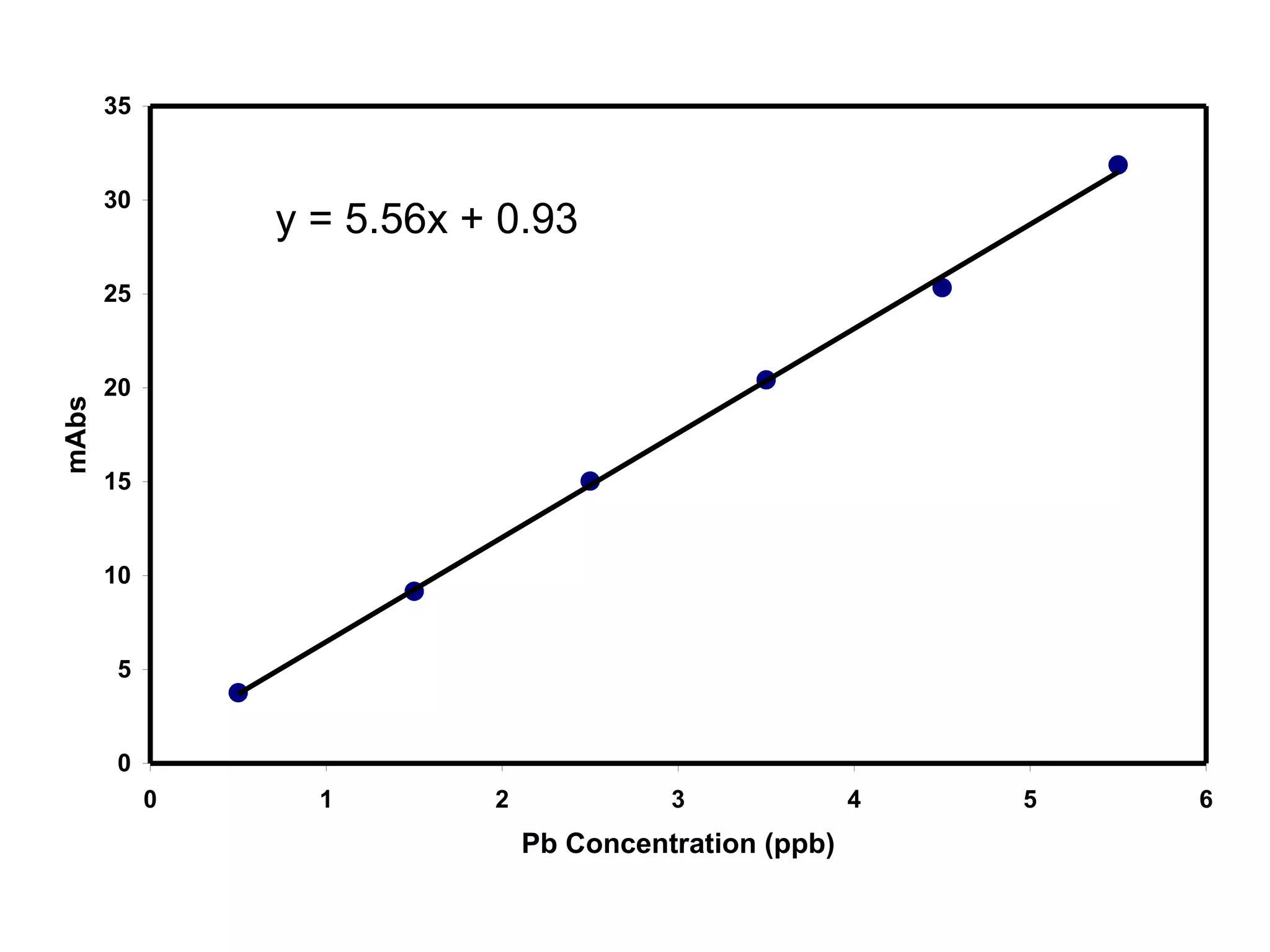
Results of linear regression: 
S = mC + b 
m = 5.56 mAbs/ppb 
b = 0.93 mAbs
35 
30 
25 
20 
15 
10 
5 
0 
0 1 2 3 4 5 6 
Pb Concentration (ppb) 
mAbs 
y = 5.56x + 0.93
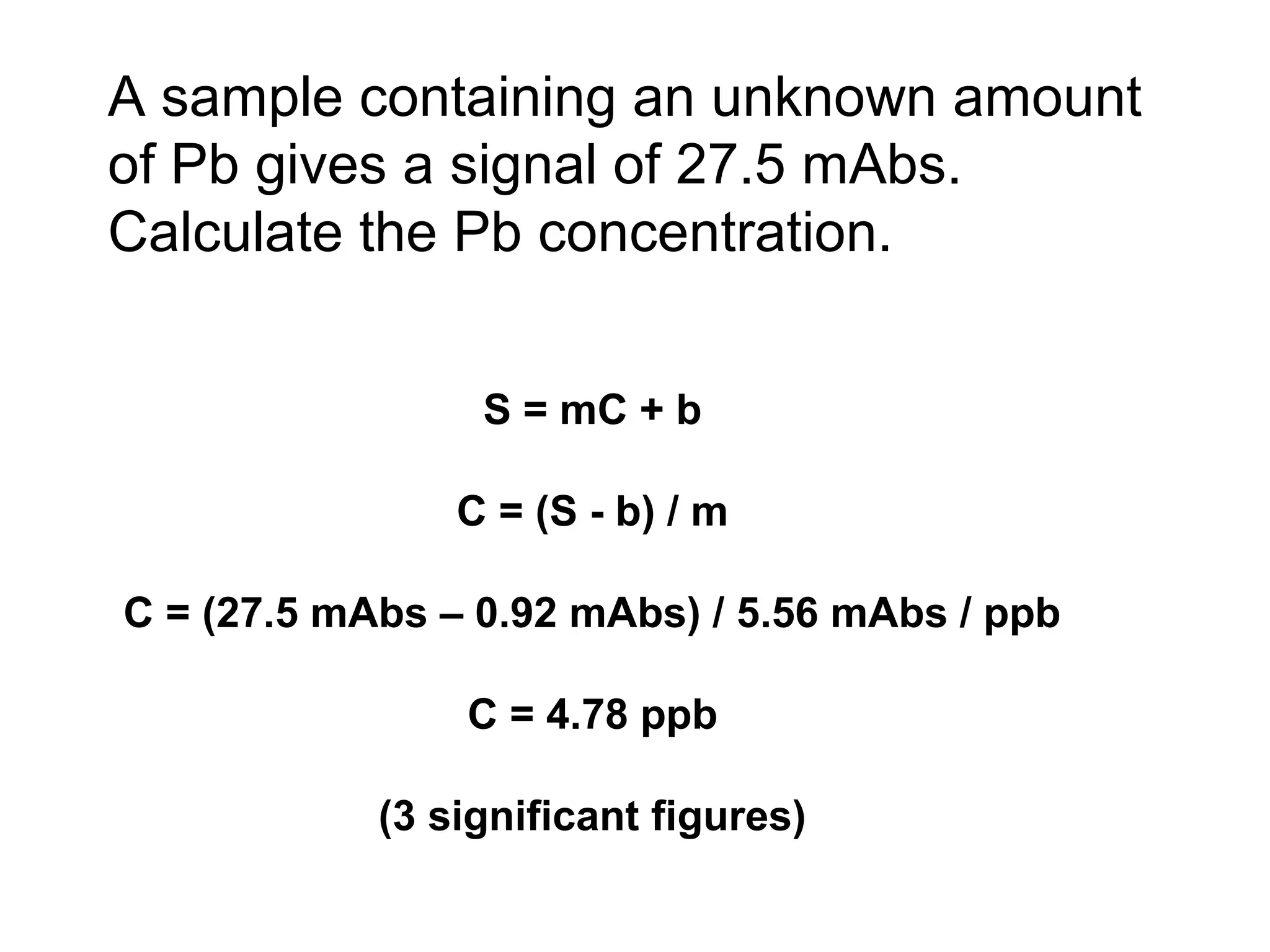
A sample containing an unknown amount 
of Pb gives a signal of 27.5 mAbs. 
Calculate the Pb concentration. 
S = mC + b 
C = (S - b) / m 
C = (27.5 mAbs – 0.92 mAbs) / 5.56 mAbs / ppb 
C = 4.78 ppb 
(3 significant figures)
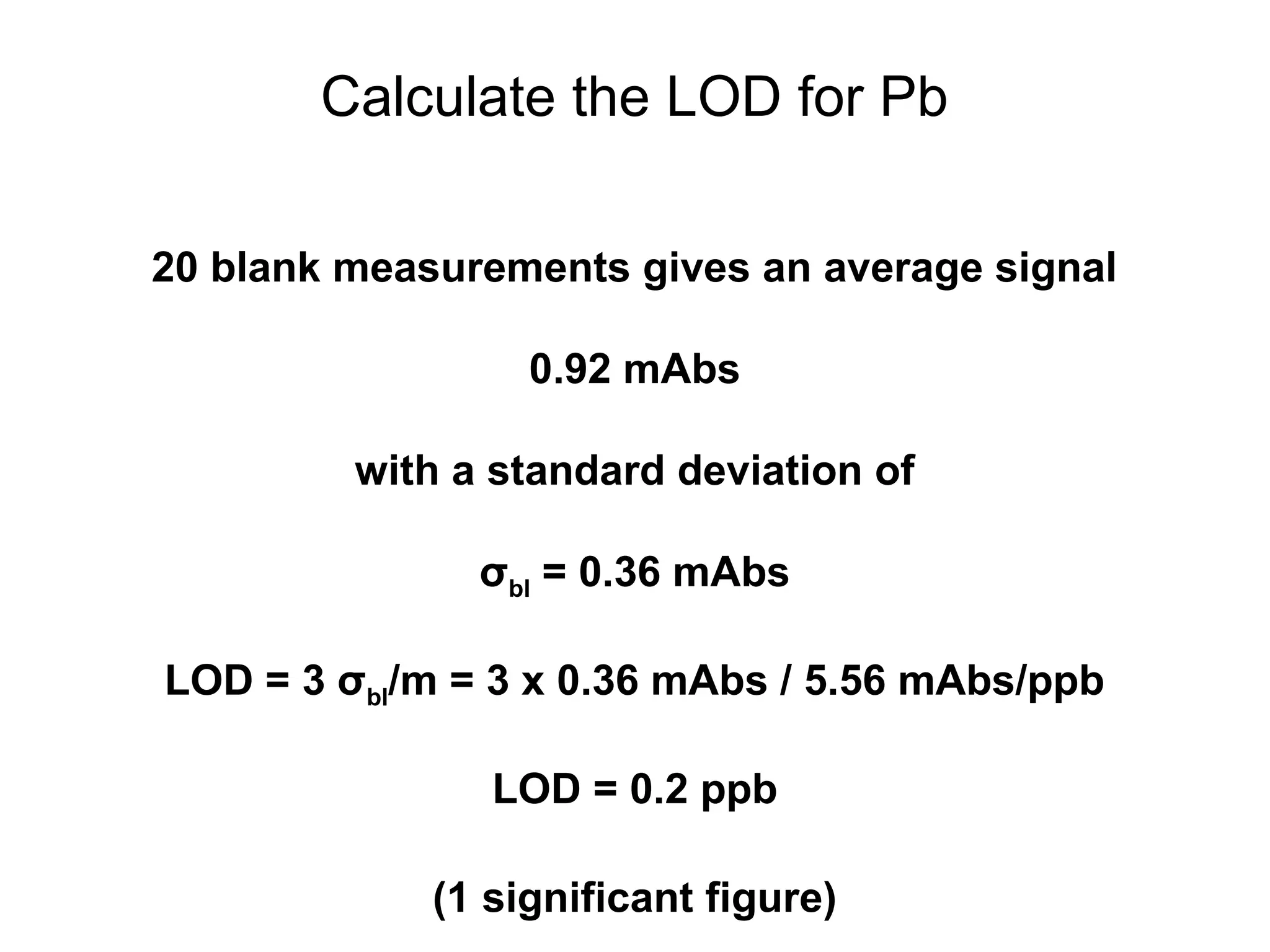
Calculate the LOD for Pb 
20 blank measurements gives an average signal 
0.92 mAbs 
with a standard deviation of 
σbl = 0.36 mAbs 
LOD = 3 σbl/m = 3 x 0.36 mAbs / 5.56 mAbs/ppb 
LOD = 0.2 ppb 
(1 significant figure)
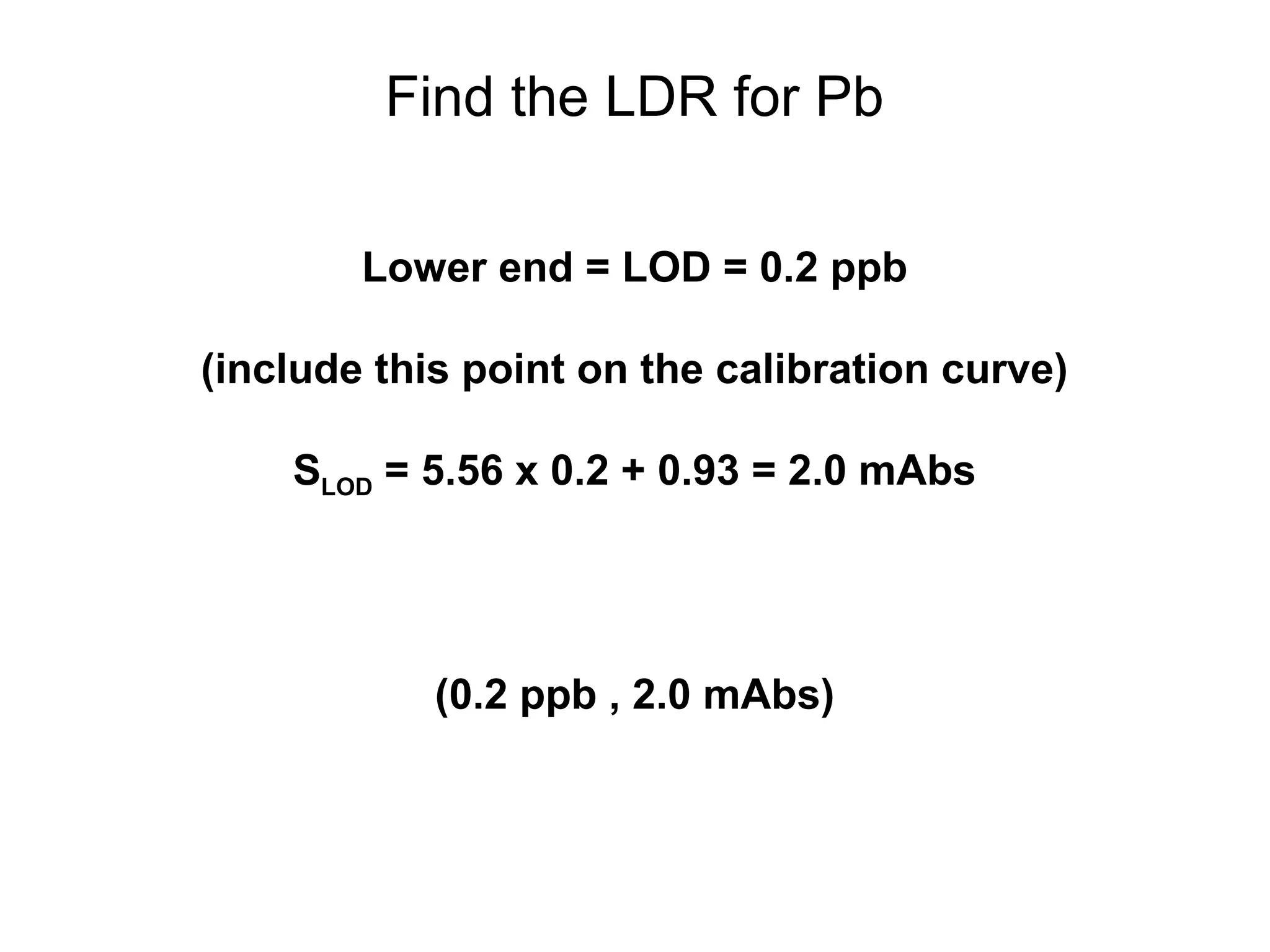
Find the LDR for Pb 
Lower end = LOD = 0.2 ppb 
(include this point on the calibration curve) 
SLOD = 5.56 x 0.2 + 0.93 = 2.0 mAbs 
(0.2 ppb , 2.0 mAbs)
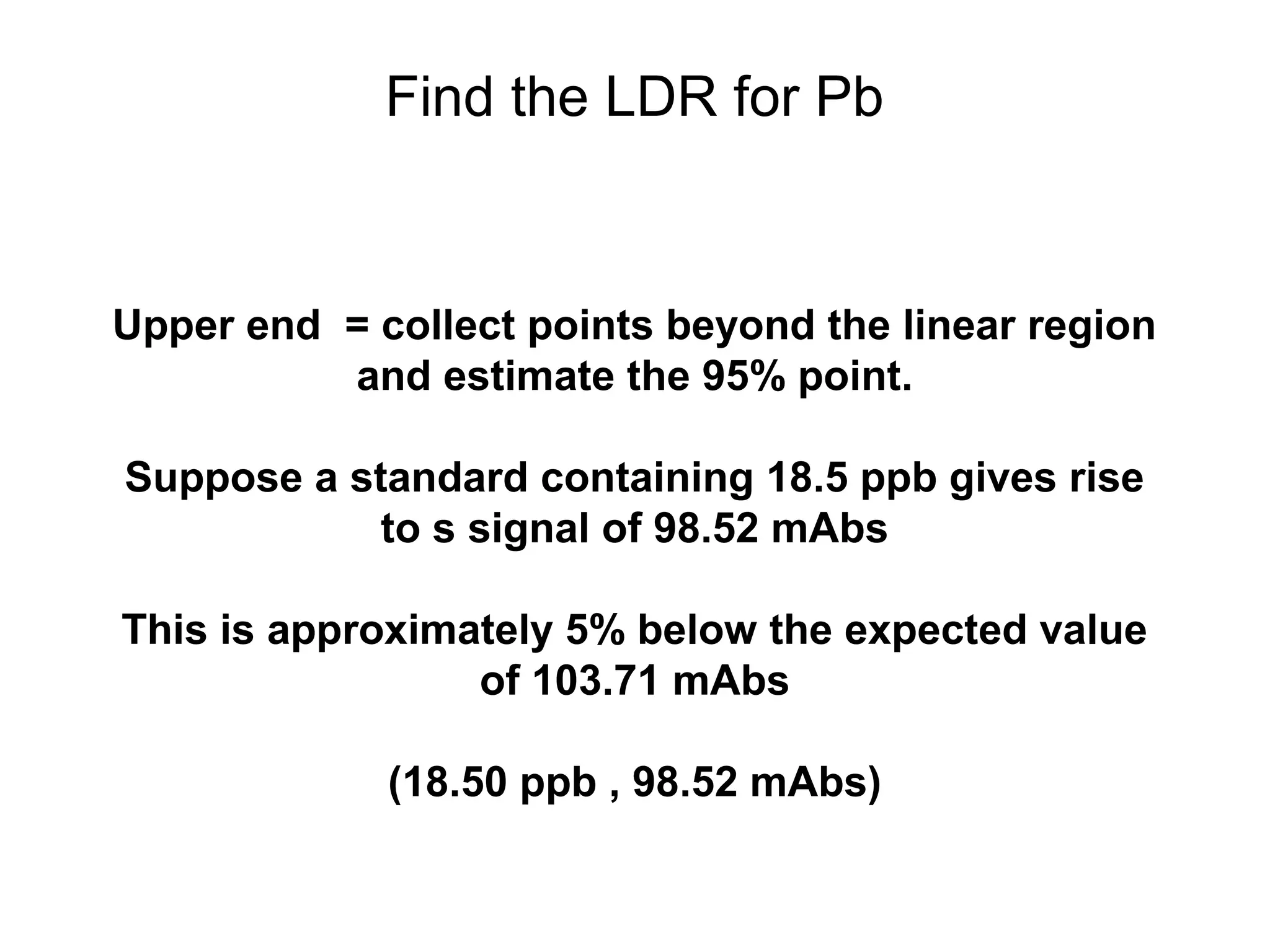
Find the LDR for Pb 
Upper end = collect points beyond the linear region 
and estimate the 95% point. 
Suppose a standard containing 18.5 ppb gives rise 
to s signal of 98.52 mAbs 
This is approximately 5% below the expected value 
of 103.71 mAbs 
(18.50 ppb , 98.52 mAbs)
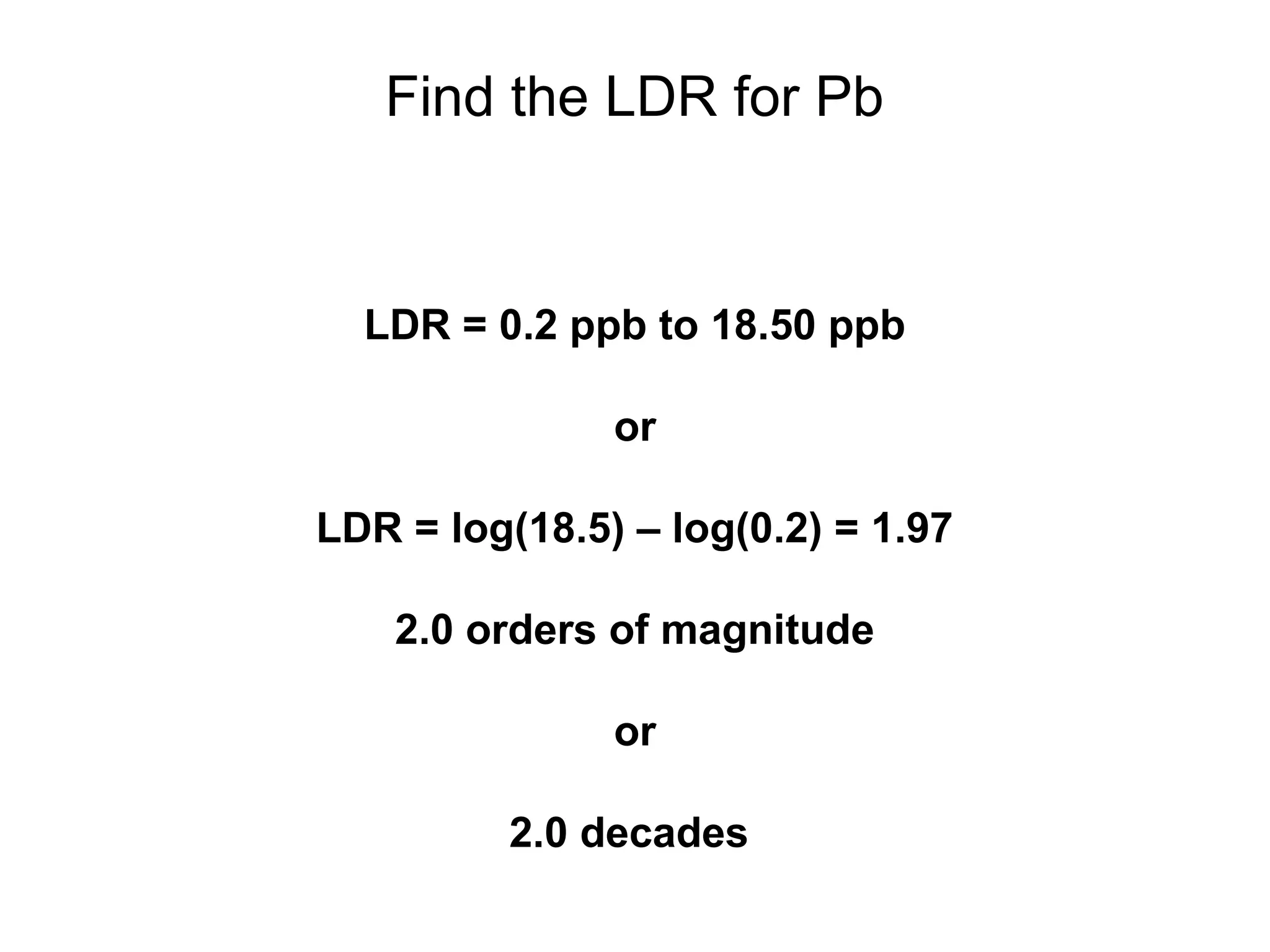
Find the LDR for Pb 
LDR = 0.2 ppb to 18.50 ppb 
or 
LDR = log(18.5) – log(0.2) = 1.97 
2.0 orders of magnitude 
or 
2.0 decades
Find the Linearity 
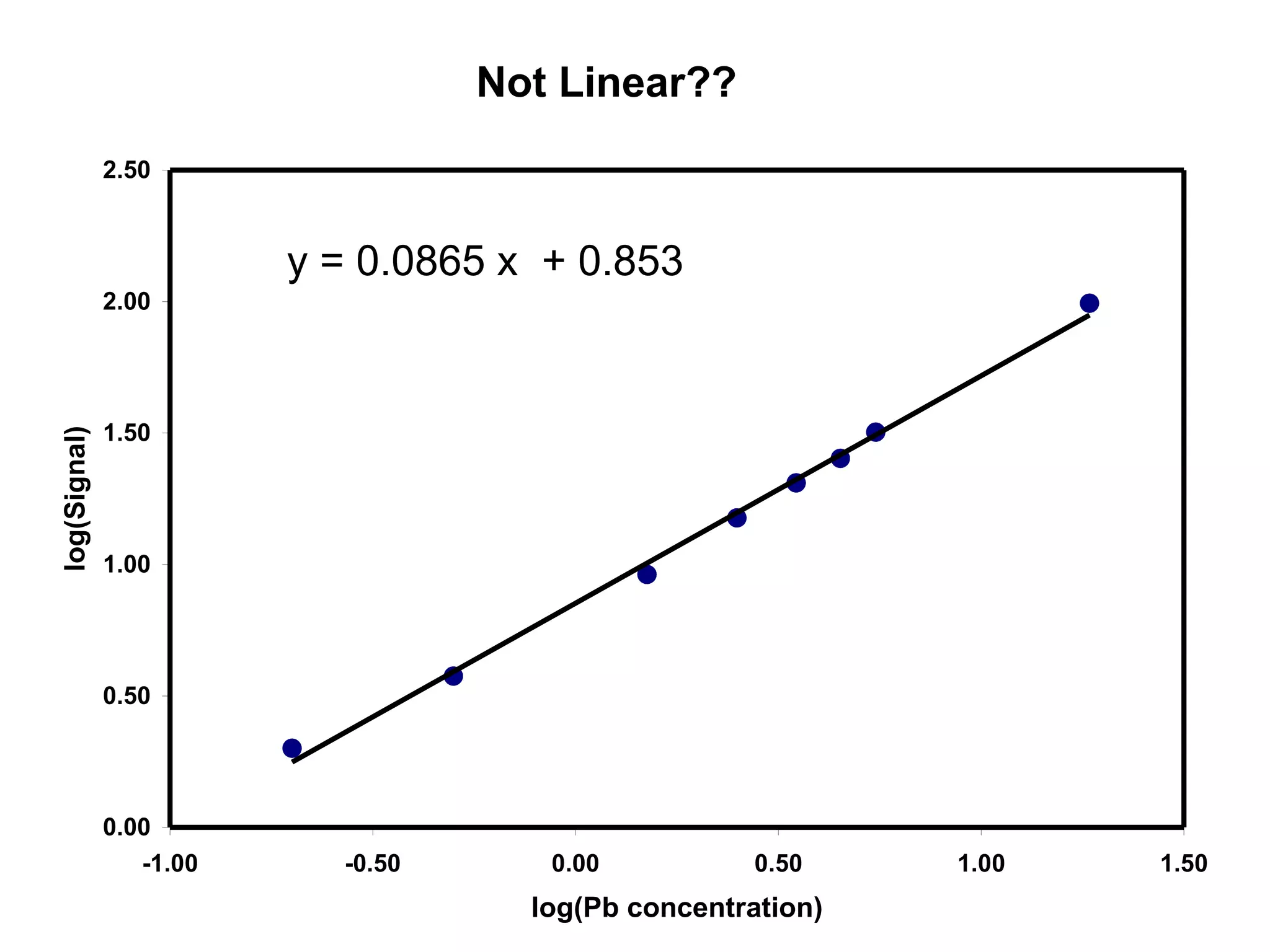
Calculate the slope of the log-log plot 
log[Pb] log(S) 
-0.70 0.30 
-0.30 0.58 
0.18 0.96 
0.40 1.18 
0.54 1.31 
0.65 1.40 
0.74 1.50 
1.27 1.99
2.50 
2.00 
1.50 
1.00 
0.50 
0.00 
Not Linear?? 
-1.00 -0.50 0.00 0.50 1.00 1.50 
log(Pb concentration) 
log(Signal) 
y = 0.0865 x + 0.853
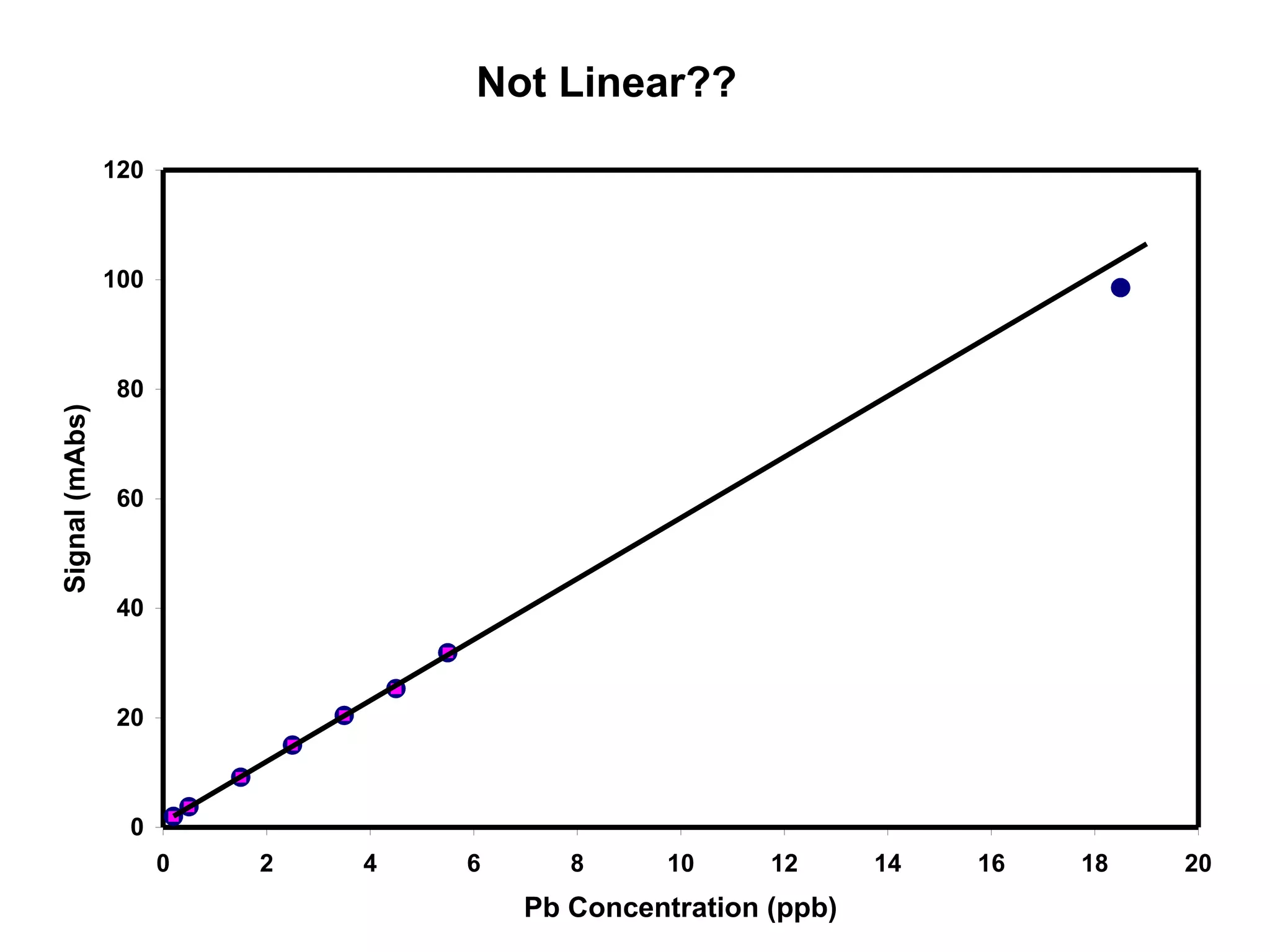
Not Linear?? 
120 
100 
80 
60 
40 
20 
0 
0 2 4 6 8 10 12 14 16 18 20 
Pb Concentration (ppb) 
Signal (mAbs)
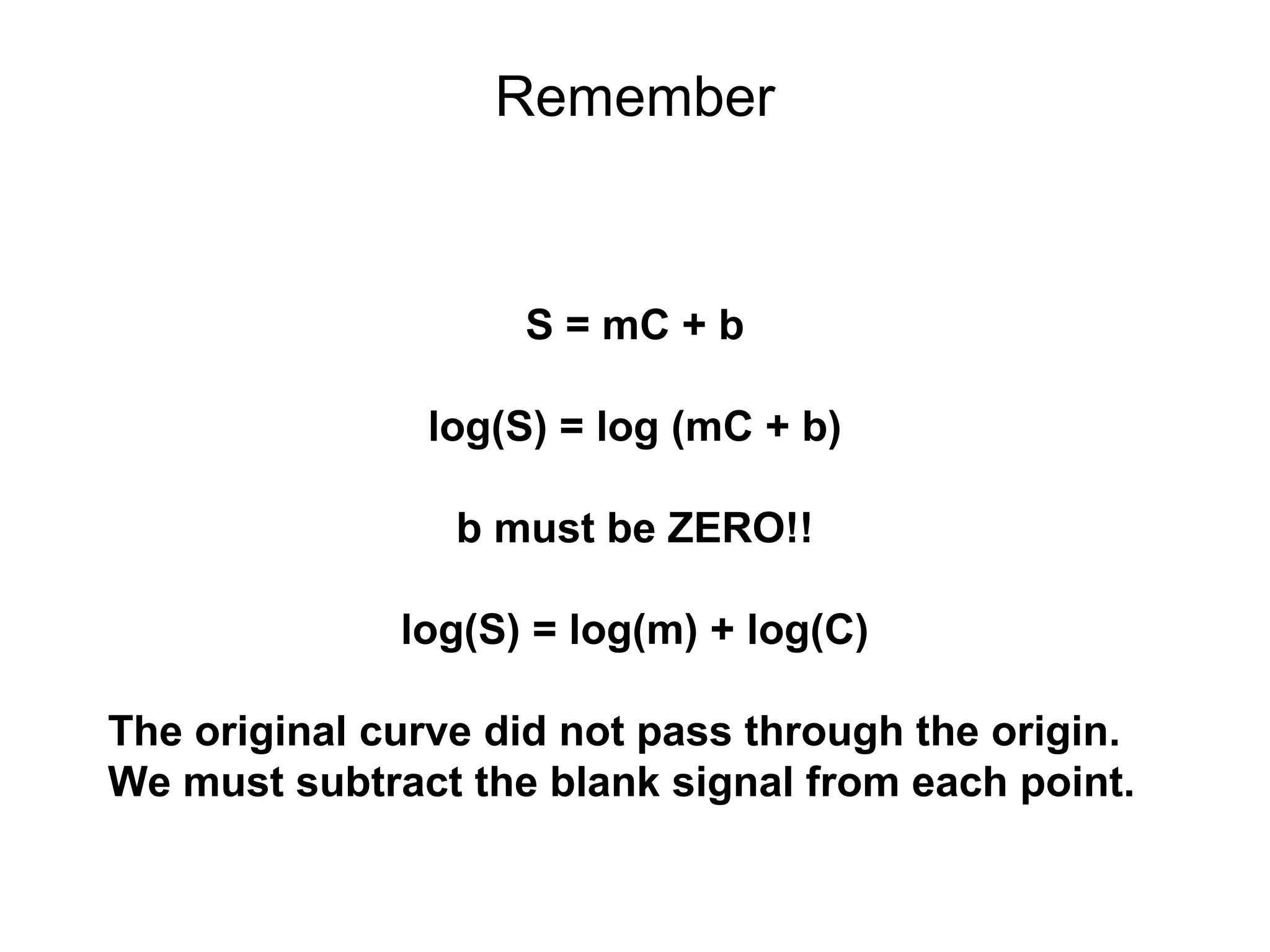
Remember 
S = mC + b 
log(S) = log (mC + b) 
b must be ZERO!! 
log(S) = log(m) + log(C) 
The original curve did not pass through the origin. 
We must subtract the blank signal from each point.
Corrected Data 
[Pb] Signal 
(ppb) (mAbs) 
0.20 1.07 
0.50 2.83 
1.50 8.23 
2.50 14.10 
3.50 19.49 
4.50 24.40 
5.50 30.94 
18.50 97.59 
log[Pb] log(S) 
-0.70 0.03 
-0.30 0.45 
0.18 0.92 
0.40 1.15 
0.54 1.29 
0.65 1.39 
0.74 1.49 
1.27 1.99
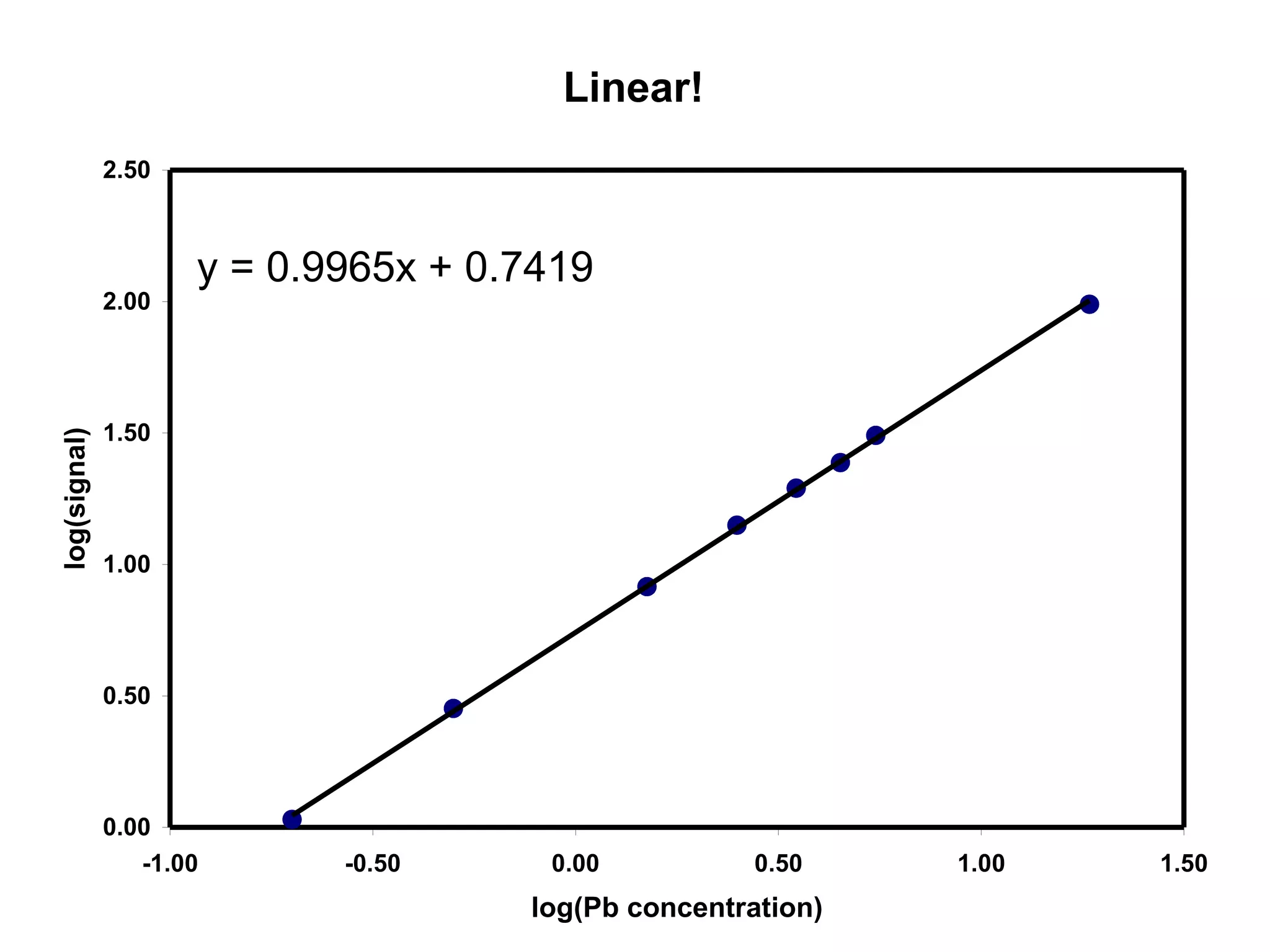
Linear! 
y = 0.9965x + 0.7419 
2.50 
2.00 
1.50 
1.00 
0.50 
0.00 
-1.00 -0.50 0.00 0.50 1.00 1.50 
log(Pb concentration) 
log(signal)
Standard Addition Method 
1. Most convenient when a small 
number of samples are to be 
analyzed. 
2. Useful when the analyte is present in 
a complicated matrix and no ideal 
blank is available.
Standard Addition Procedure 
1. Add one or more increments of a standard 
solution to sample aliquots of the same size. 
Each mixture is then diluted to the same 
volume. 
2. Prepare a plot of Analytical Signal versus: 
a) volume of standard solution added, or 
b) concentration of analyte added.
Standard Addition Procedure 
3. The x-intercept of the standard addition plot 
corresponds to the amount of analyte that 
must have been present in the sample (after 
accounting for dilution). 
4. The standard addition method assumes: 
a) the curve is linear over the concentration range 
b) the y-intercept of a calibration curve would be 0
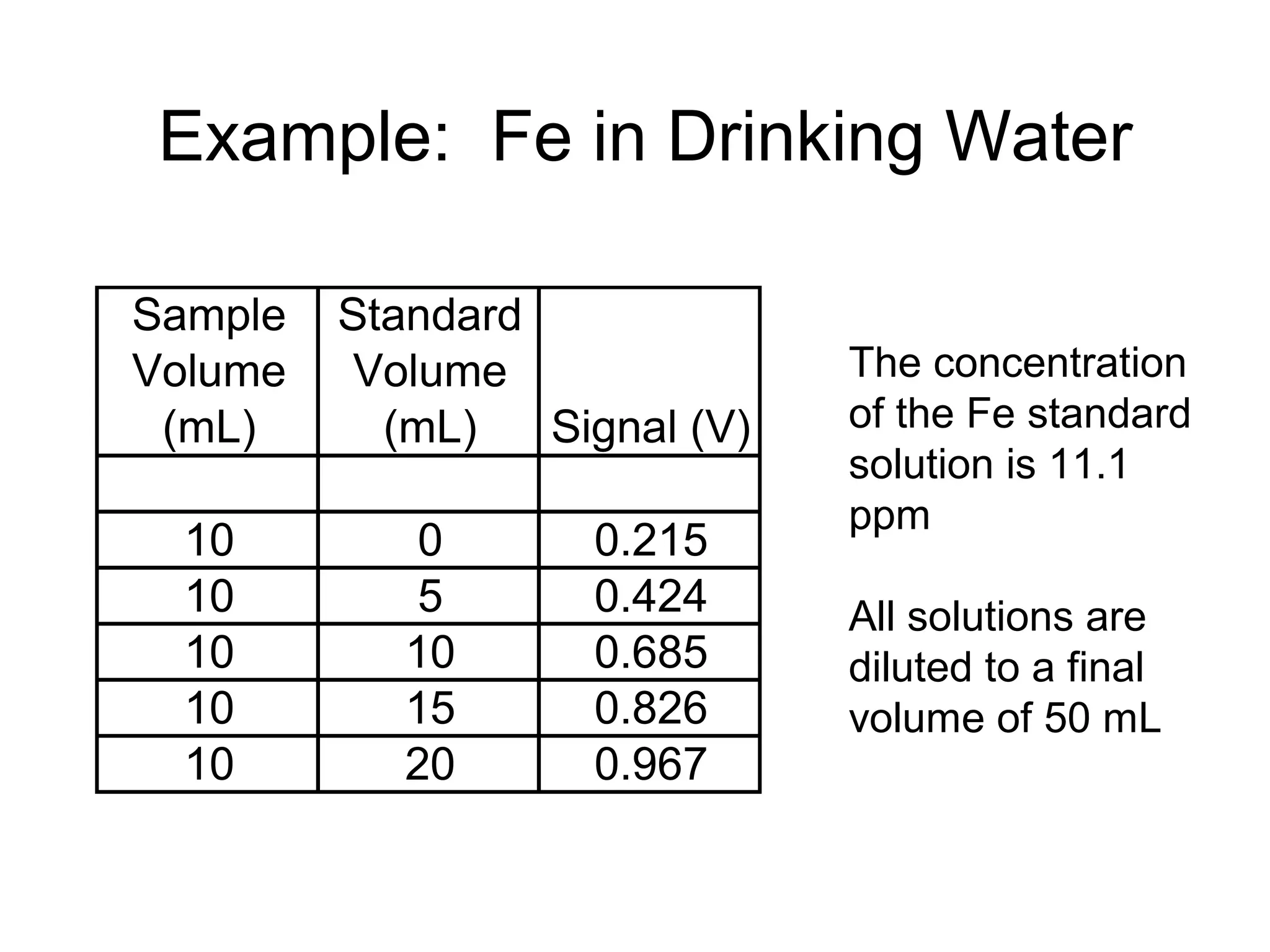
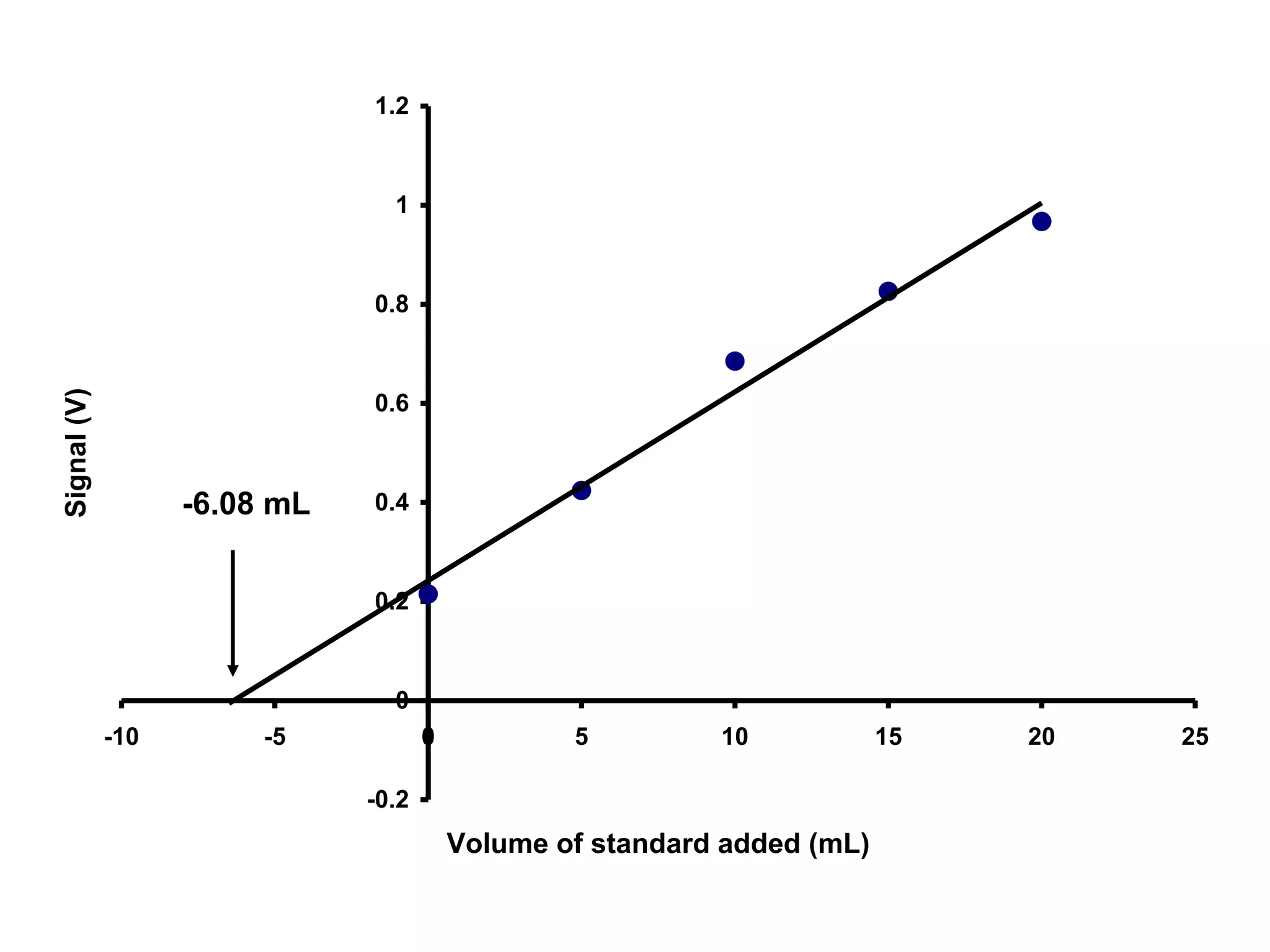
Example: Fe in Drinking Water 
Sample 
Volume 
(mL) 
Standard 
Volume 
(mL) Signal (V) 
10 0 0.215 
10 5 0.424 
10 10 0.685 
10 15 0.826 
10 20 0.967 
The concentration 
of the Fe standard 
solution is 11.1 
ppm 
All solutions are 
diluted to a final 
volume of 50 mL
1.2 
1 
0.8 
0.6 
0.4 
0.2 
0 
-10 -5 0 5 10 15 20 25 
-0.2 
Volume of standard added (mL) 
Signal (V) 
-6.08 mL
[Fe] = ? 
x-intercept = -6.08 mL 
Therefore, 10 mL of sample diluted to 50 mL would 
give a signal equivalent to 6.08 mL of standard 
diluted to 50 mL. 
Vsam x [Fe]sam = Vstd x [Fe]std 
10.0 mL x [Fe] = 6.08 mL x 11.1 ppm 
[Fe] = 6.75 ppm
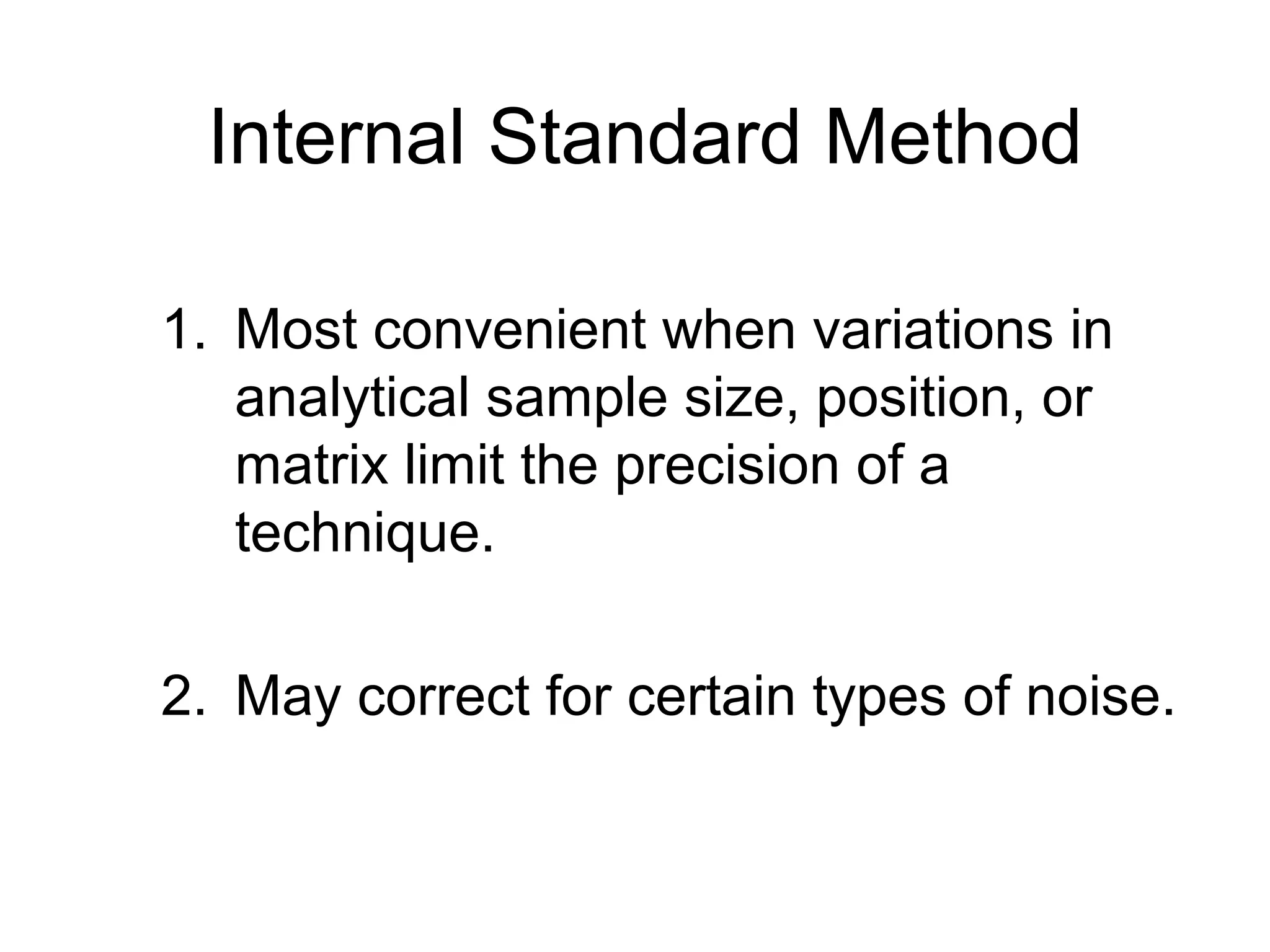
Internal Standard Method 
1. Most convenient when variations in 
analytical sample size, position, or 
matrix limit the precision of a 
technique. 
2. May correct for certain types of noise.
Internal Standard Procedure 
1. Prepare a set of standard solutions for 
analyte (A) as with the calibration curve 
method, but add a constant amount of a 
second species (B) to each solution. 
2. Prepare a plot of SA/SB versus [A].
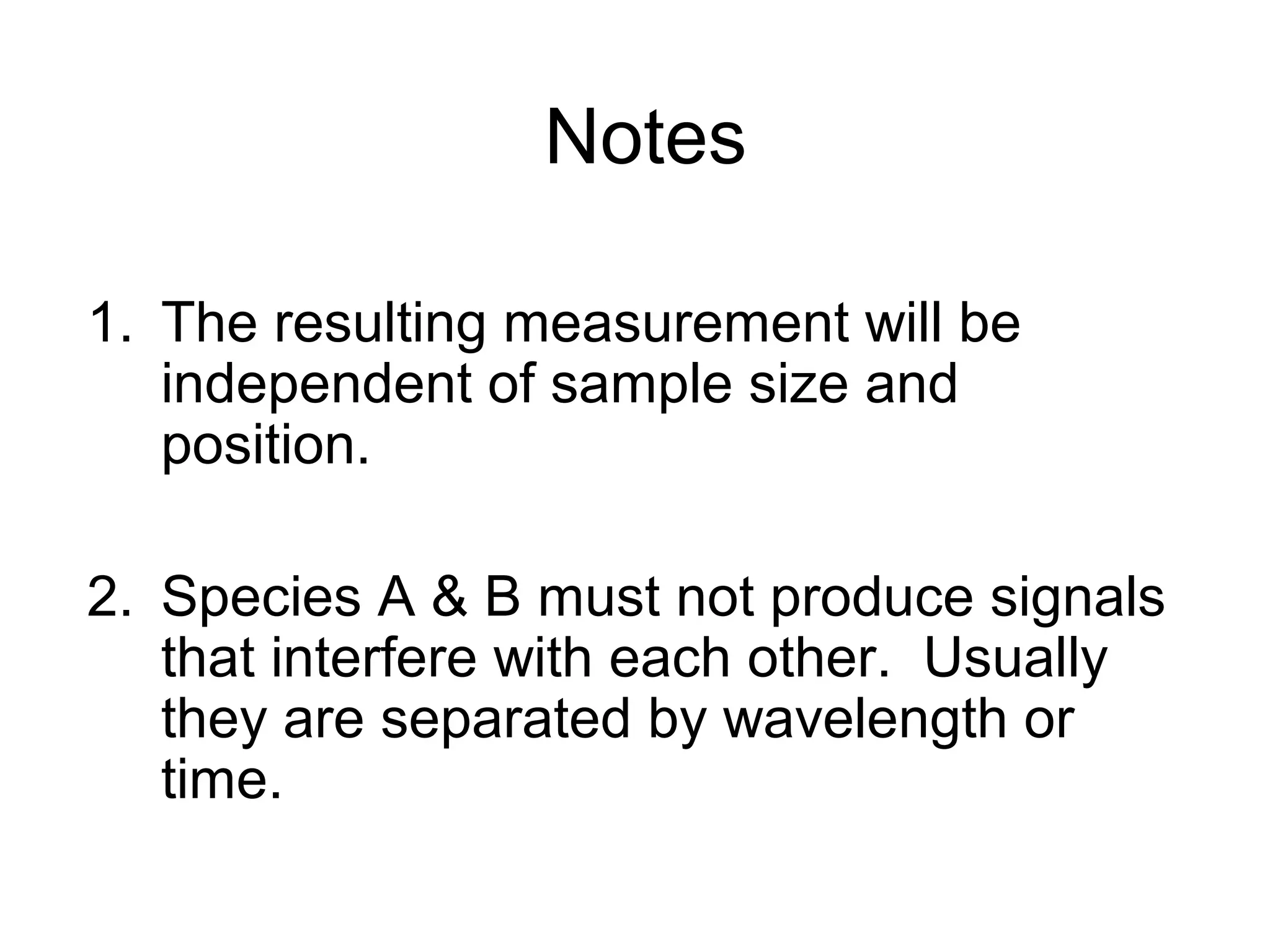
Notes 
1. The resulting measurement will be 
independent of sample size and 
position. 
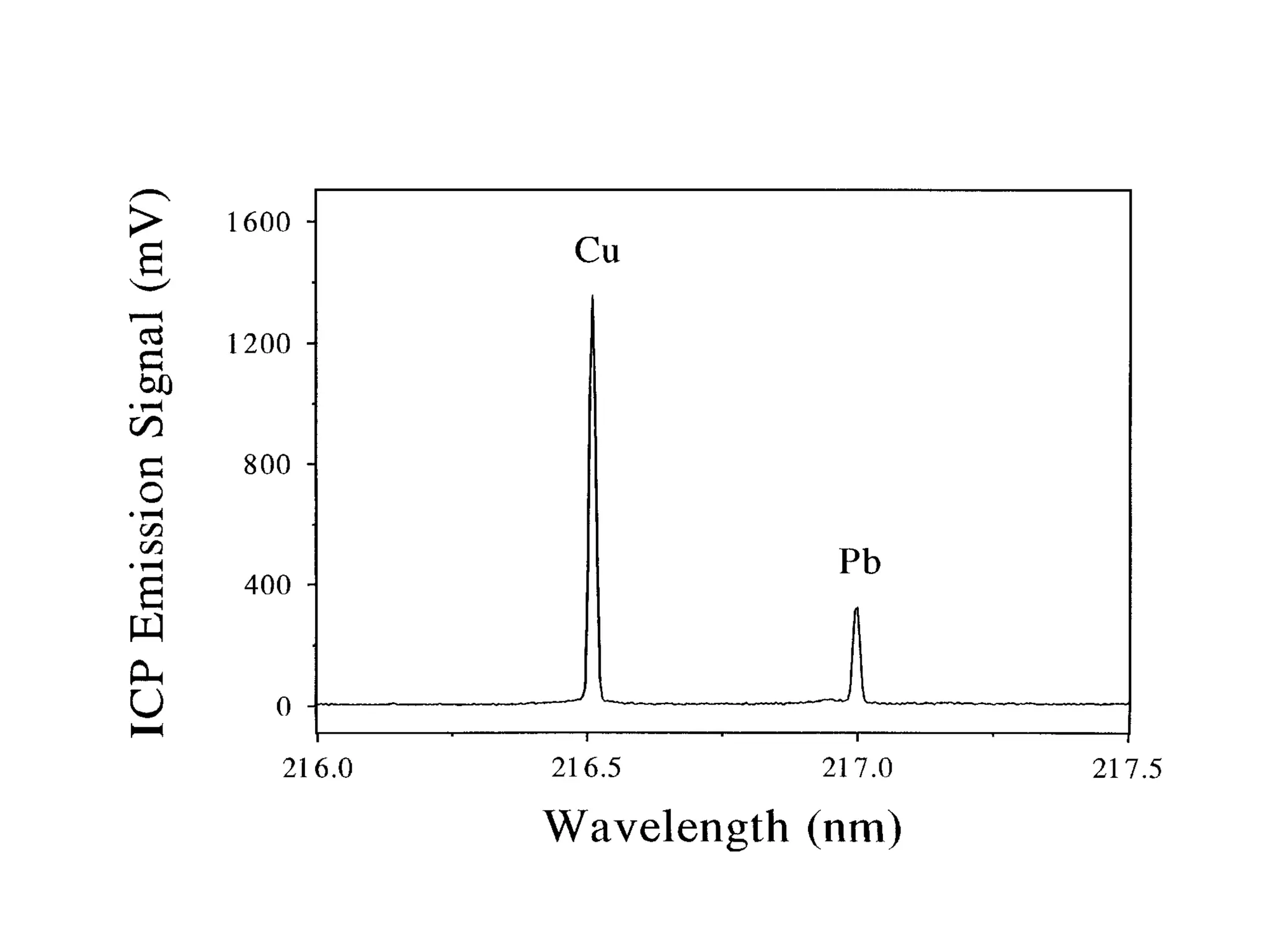
2. Species A & B must not produce signals 
that interfere with each other. Usually 
they are separated by wavelength or 
time.
Example: Pb by ICP Emission 
Each Pb solution contains 
100 ppm Cu. 
Signal 
[Pb] 
(ppm) Pb Cu Pb/Cu 
20 112 1347 0.083 
40 243 1527 0.159 
60 326 1383 0.236 
80 355 1135 0.313 
100 558 1440 0.388
No Internal Standard Correction 
600 
500 
400 
300 
200 
100 
0 
0 20 40 60 80 100 120 
[Pb] (ppm) 
Pb Emission Signal
0.450 
0.400 
0.350 
0.300 
0.250 
0.200 
0.150 
0.100 
0.050 
0.000 
0 20 40 60 80 100 120 
[Pb] (ppm) 
Pb Emission Signal 
Internal Standard Correction
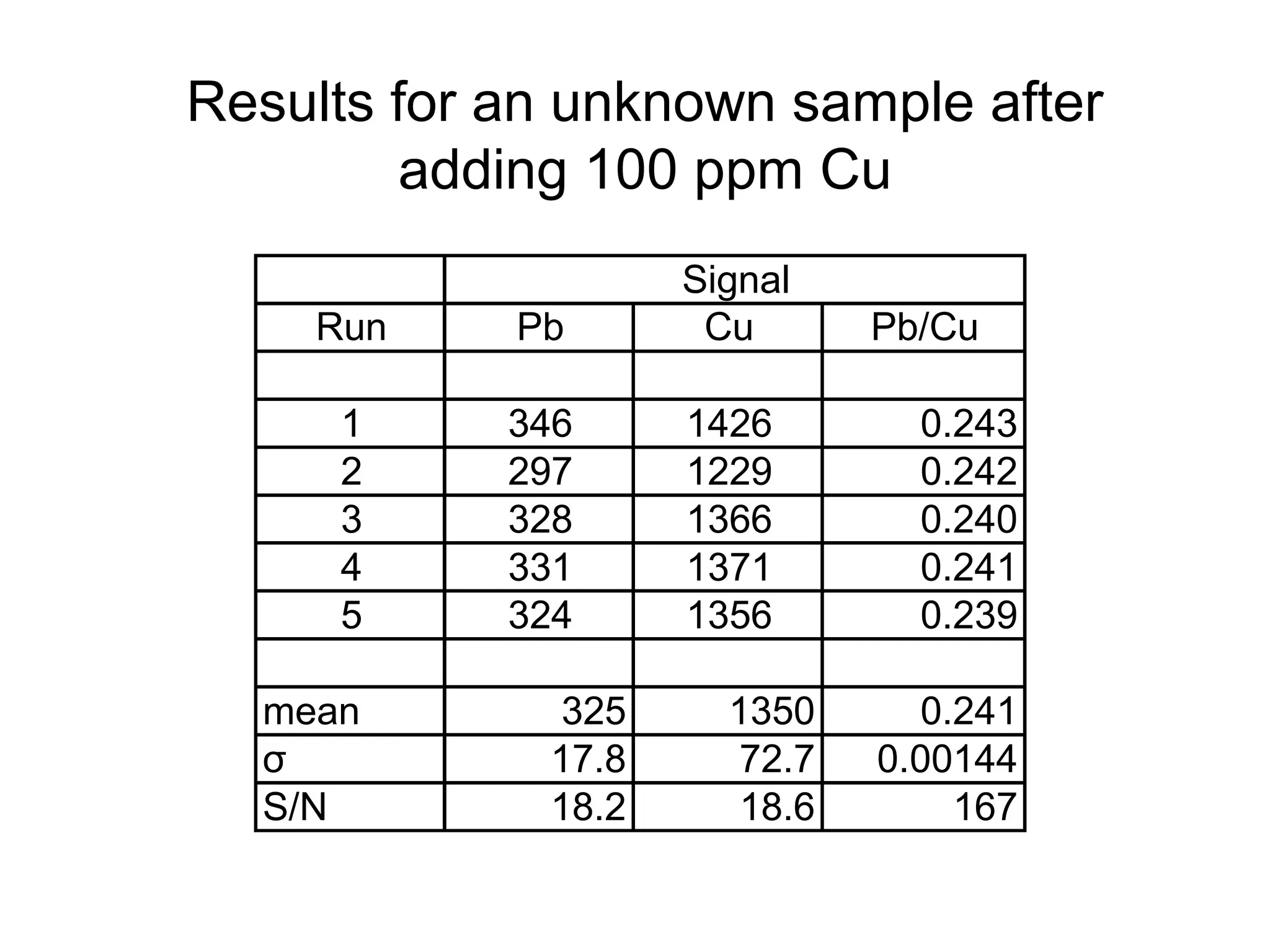
Results for an unknown sample after 
adding 100 ppm Cu 
Signal 
Run Pb Cu Pb/Cu 
1 346 1426 0.243 
2 297 1229 0.242 
3 328 1366 0.240 
4 331 1371 0.241 
5 324 1356 0.239 
mean 325 1350 0.241 
σ 17.8 72.7 0.00144 
S/N 18.2 18.6 167
Calibration
Calibration

Calibration

  • 1.
    Calibration Techniques 1.Calibration Curve Method 2. Standard Additions Method 3. Internal Standard Method
  • 2.
    Calibration Curve Method 1. Most convenient when a large number of similar samples are to be analyzed. 2. Most common technique. 3. Facilitates calculation of Figures of Merit.
  • 3.
    Calibration Curve Procedure 1. Prepare a series of standard solutions (analyte solutions with known concentrations). 2. Plot [analyte] vs. Analytical Signal. 3. Use signal for unknown to find [analyte].
  • 4.
    Example: Pb inBlood by GFAAS [Pb] Signal (ppb) (mAbs) 0.50 3.76 1.50 9.16 2.50 15.03 3.50 20.42 4.50 25.33 5.50 31.87 Results of linear regression: S = mC + b m = 5.56 mAbs/ppb b = 0.93 mAbs
  • 5.
    35 30 25 20 15 10 5 0 0 1 2 3 4 5 6 Pb Concentration (ppb) mAbs y = 5.56x + 0.93
  • 6.
    A sample containingan unknown amount of Pb gives a signal of 27.5 mAbs. Calculate the Pb concentration. S = mC + b C = (S - b) / m C = (27.5 mAbs – 0.92 mAbs) / 5.56 mAbs / ppb C = 4.78 ppb (3 significant figures)
  • 7.
    Calculate the LODfor Pb 20 blank measurements gives an average signal 0.92 mAbs with a standard deviation of σbl = 0.36 mAbs LOD = 3 σbl/m = 3 x 0.36 mAbs / 5.56 mAbs/ppb LOD = 0.2 ppb (1 significant figure)
  • 8.
    Find the LDRfor Pb Lower end = LOD = 0.2 ppb (include this point on the calibration curve) SLOD = 5.56 x 0.2 + 0.93 = 2.0 mAbs (0.2 ppb , 2.0 mAbs)
  • 9.
    Find the LDRfor Pb Upper end = collect points beyond the linear region and estimate the 95% point. Suppose a standard containing 18.5 ppb gives rise to s signal of 98.52 mAbs This is approximately 5% below the expected value of 103.71 mAbs (18.50 ppb , 98.52 mAbs)
  • 10.
    Find the LDRfor Pb LDR = 0.2 ppb to 18.50 ppb or LDR = log(18.5) – log(0.2) = 1.97 2.0 orders of magnitude or 2.0 decades
  • 11.
    Find the Linearity Calculate the slope of the log-log plot log[Pb] log(S) -0.70 0.30 -0.30 0.58 0.18 0.96 0.40 1.18 0.54 1.31 0.65 1.40 0.74 1.50 1.27 1.99
  • 12.
    2.50 2.00 1.50 1.00 0.50 0.00 Not Linear?? -1.00 -0.50 0.00 0.50 1.00 1.50 log(Pb concentration) log(Signal) y = 0.0865 x + 0.853
  • 13.
    Not Linear?? 120 100 80 60 40 20 0 0 2 4 6 8 10 12 14 16 18 20 Pb Concentration (ppb) Signal (mAbs)
  • 14.
    Remember S =mC + b log(S) = log (mC + b) b must be ZERO!! log(S) = log(m) + log(C) The original curve did not pass through the origin. We must subtract the blank signal from each point.
  • 15.
    Corrected Data [Pb]Signal (ppb) (mAbs) 0.20 1.07 0.50 2.83 1.50 8.23 2.50 14.10 3.50 19.49 4.50 24.40 5.50 30.94 18.50 97.59 log[Pb] log(S) -0.70 0.03 -0.30 0.45 0.18 0.92 0.40 1.15 0.54 1.29 0.65 1.39 0.74 1.49 1.27 1.99
  • 16.
    Linear! y =0.9965x + 0.7419 2.50 2.00 1.50 1.00 0.50 0.00 -1.00 -0.50 0.00 0.50 1.00 1.50 log(Pb concentration) log(signal)
  • 17.
    Standard Addition Method 1. Most convenient when a small number of samples are to be analyzed. 2. Useful when the analyte is present in a complicated matrix and no ideal blank is available.
  • 18.
    Standard Addition Procedure 1. Add one or more increments of a standard solution to sample aliquots of the same size. Each mixture is then diluted to the same volume. 2. Prepare a plot of Analytical Signal versus: a) volume of standard solution added, or b) concentration of analyte added.
  • 19.
    Standard Addition Procedure 3. The x-intercept of the standard addition plot corresponds to the amount of analyte that must have been present in the sample (after accounting for dilution). 4. The standard addition method assumes: a) the curve is linear over the concentration range b) the y-intercept of a calibration curve would be 0
  • 20.
    Example: Fe inDrinking Water Sample Volume (mL) Standard Volume (mL) Signal (V) 10 0 0.215 10 5 0.424 10 10 0.685 10 15 0.826 10 20 0.967 The concentration of the Fe standard solution is 11.1 ppm All solutions are diluted to a final volume of 50 mL
  • 21.
    1.2 1 0.8 0.6 0.4 0.2 0 -10 -5 0 5 10 15 20 25 -0.2 Volume of standard added (mL) Signal (V) -6.08 mL
  • 22.
    [Fe] = ? x-intercept = -6.08 mL Therefore, 10 mL of sample diluted to 50 mL would give a signal equivalent to 6.08 mL of standard diluted to 50 mL. Vsam x [Fe]sam = Vstd x [Fe]std 10.0 mL x [Fe] = 6.08 mL x 11.1 ppm [Fe] = 6.75 ppm
  • 23.
    Internal Standard Method 1. Most convenient when variations in analytical sample size, position, or matrix limit the precision of a technique. 2. May correct for certain types of noise.
  • 24.
    Internal Standard Procedure 1. Prepare a set of standard solutions for analyte (A) as with the calibration curve method, but add a constant amount of a second species (B) to each solution. 2. Prepare a plot of SA/SB versus [A].
  • 25.
    Notes 1. Theresulting measurement will be independent of sample size and position. 2. Species A & B must not produce signals that interfere with each other. Usually they are separated by wavelength or time.
  • 26.
    Example: Pb byICP Emission Each Pb solution contains 100 ppm Cu. Signal [Pb] (ppm) Pb Cu Pb/Cu 20 112 1347 0.083 40 243 1527 0.159 60 326 1383 0.236 80 355 1135 0.313 100 558 1440 0.388
  • 28.
    No Internal StandardCorrection 600 500 400 300 200 100 0 0 20 40 60 80 100 120 [Pb] (ppm) Pb Emission Signal
  • 29.
    0.450 0.400 0.350 0.300 0.250 0.200 0.150 0.100 0.050 0.000 0 20 40 60 80 100 120 [Pb] (ppm) Pb Emission Signal Internal Standard Correction
  • 30.
    Results for anunknown sample after adding 100 ppm Cu Signal Run Pb Cu Pb/Cu 1 346 1426 0.243 2 297 1229 0.242 3 328 1366 0.240 4 331 1371 0.241 5 324 1356 0.239 mean 325 1350 0.241 σ 17.8 72.7 0.00144 S/N 18.2 18.6 167