


Standardization and Calibration
Prepared by-
Dr. Mallikarjunaswamy C
Assistant Professor
Postgraduate Department of Chemistry
JSS College of Arts, Commerce and Science
Ooty Road, Mysuru-570025
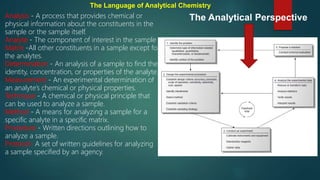
The Language of Analytical Chemistry
Analysis - A process that provides chemical or
physical information about the constituents in the
sample or the sample itself.
Analyte - The component of interest in the sample
Matrix -All other constituents in a sample except for
the analytes.
Determination - An analysis of a sample to find the
identity, concentration, or properties of the analyte.
Measurement - An experimental determination of
an analyte’s chemical or physical properties.
Technique - A chemical or physical principle that
can be used to analyze a sample.
Method - A means for analyzing a sample for a
specific analyte in a specific matrix.
Procedure - Written directions outlining how to
analyze a sample.
Protocol- A set of written guidelines for analyzing
a sample specified by an agency.
The Analytical Perspective
What is calibration?
• Calibration determines the relationship between the analytical response and the
analyte concentration.
Usually this is accomplished by the use of chemical standards.
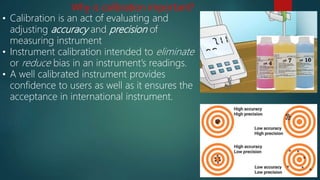
Why is calibration important?
• Calibration is an act of evaluating and
adjusting accuracy and precision of
measuring instrument
• Instrument calibration intended to eliminate
or reduce bias in an instrument’s readings.
• A well calibrated instrument provides
confidence to users as well as it ensures the
acceptance in international instrument.
STANDARDIZATION
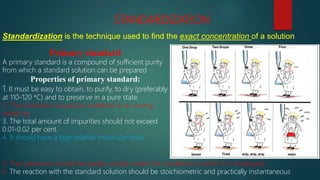
Standardization is the technique used to find the exact concentration of a solution
Primary standard
A primary standard is a compound of sufficient purity
from which a standard solution can be prepared
Properties of primary standard:
1. It must be easy to obtain, to purify, to dry (preferably
at 110-120 °C) and to preserve in a pure state.
2. The substance should be unaltered in air during
weighing
3. The total amount of impurities should not exceed
0.01-0.02 per cent.
4. It should have a high relative molecular mass
5. The substance should be readily soluble under the conditions in which it is employed
6. The reaction with the standard solution should be stoichiometric and practically instantaneous
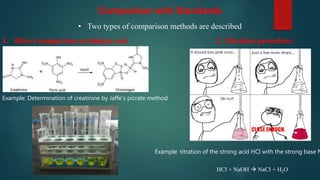
Comparison with Standards
• Two types of comparison methods are described
1. Direct comparison technique and
Example: Determination of creatinine by Jaffe’s picrate method
2. Titration procedure.
HCI + NaOH  NaCI + H2O
Example: titration of the strong acid HCI with the strong base N
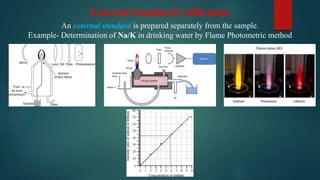
External Standard Calibration
An external standard is prepared separately from the sample.
Example- Determination of Na/K in drinking water by Flame Photometric method
External Standards
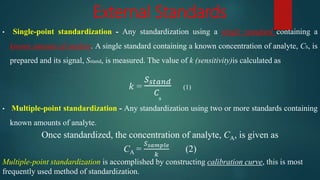
• Single-point standardization - Any standardization using a single standard containing a
known amount of analyte. A single standard containing a known concentration of analyte, CS, is
prepared and its signal, Sstand, is measured. The value of k (sensitivity)is calculated as
𝑘 =
𝑆𝑠𝑡𝑎𝑛𝑑
𝐶
s
(1)
• Multiple-point standardization - Any standardization using two or more standards containing
known amounts of analyte.
Once standardized, the concentration of analyte, CA, is given as
CA =
𝑆𝑠𝑎𝑚𝑝𝑙𝑒
𝑘
(2)
Multiple-point standardization is accomplished by constructing calibration curve, this is most
frequently used method of standardization.
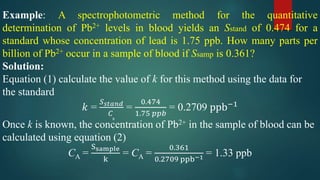
Example: A spectrophotometric method for the quantitative
determination of Pb2+ levels in blood yields an Sstand of 0.474 for a
standard whose concentration of lead is 1.75 ppb. How many parts per
billion of Pb2+ occur in a sample of blood if Ssamp is 0.361?
Solution:
Equation (1) calculate the value of k for this method using the data for
the standard
𝑘 =
𝑆𝑠𝑡𝑎𝑛𝑑
𝐶
s
=
0.474
1.75 𝑝𝑝𝑏
= 0.2709 ppb−1
Once k is known, the concentration of Pb2+ in the sample of blood can be
calculated using equation (2)
CA =
Ssample
k
= CA =
0.361
0.2709 ppb−1 = 1.33 ppb
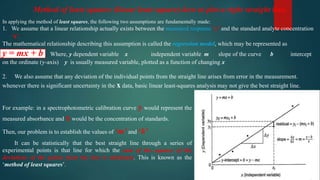
Method of least squares (linear least square)-how to plot a right straight line.
In applying the method of least squares, the following two assumptions are fundamentally made:
1. We assume that a linear relationship actually exists between the measured response ‘y’ and the standard analyte concentration
‘x’.
The mathematical relationship describing this assumption is called the regression model, which may be represented as
y = mx + b Where, y dependent variable x independent variable m slope of the curve b intercept
on the ordinate (y-axis) y is usually measured variable, plotted as a function of changing x
2. We also assume that any deviation of the individual points from the straight line arises from error in the measurement.
whenever there is significant uncertainty in the x data, basic linear least-squares analysis may not give the best straight line.
For example: in a spectrophotometric calibration curve y would represent the
measured absorbance and x would be the concentration of standards.
Then, our problem is to establish the values of ‘m’ and ‘b’
It can be statistically that the best straight line through a series of
experimental points is that line for which the sum of the squares of the
deviations of the points from the line is minimum. This is known as the
‘method of least squares’.
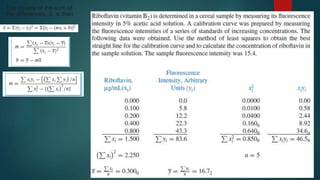
The square of the sum of
the differences, S, is then
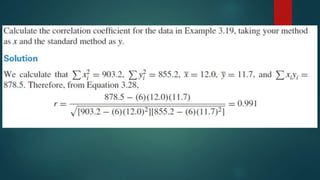
Correlation Coefficient and Coefficient of Determination
• The correlation coefficient is used as a measure of the correlation between two
variables.(X and Y)
• When variables x and y are correlated rather than being functionally related (i.e.,
are not directly dependent upon one another), we do not speak of the “best” y
value corresponding to a given x value, but only of the most “probable” value.
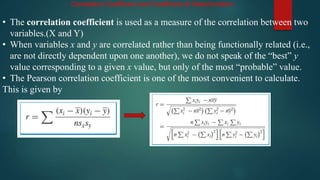
• The Pearson correlation coefficient is one of the most convenient to calculate.
This is given by
• standard is added directly to the aliquots of analyzed sample
• This method is used where sample matrix also contributes to the analytical signal – MATRIX EFFECT
• Standard addition is frequently used in chemical instrumental analysis such as AAS and GC.
STANDARD ADDITIONS METHOD
Procedure-
• A typical procedure involves preparing
several solutions containing the same
amount of unknown, but different amounts
of standard.
• For example, five 25 mL volumetric flasks
are each filled with 10 mL of the
unknown.
• Then the standard is added in differing
amounts, such as 0, 1, 2, 3, and 4 mL.
• The flasks are then diluted to the mark and
mixed well.
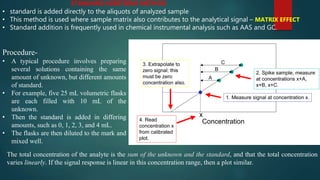
The total concentration of the analyte is the sum of the unknown and the standard, and that the total concentration
varies linearly. If the signal response is linear in this concentration range, then a plot similar.
(Bear in mind that the chemical species X and S are the same) Signal is directly proportional to analyte concentration, so
initial concentration of analyte [X]i gives a signal intensity IX
Then a known concentration of standard, S, is added to an aliquot of the sample
and a signal ISX
Let’s call the diluted concentration of analyte [X]f, where “f” stands for “final.”
We designate the concentration of standard in the final solution as [S]f.
Standard addition equation:
For an initial volume Vo of unknown and added volume VS of
standard with concentration [S]i, the total volume is V Vo VS and
the concentrations in Equation
If all standard additions are made to a constant final volume, plot the signal ISX versus the concentration of diluted
standard, [S]f . In this case, the x-intercept is the final concentration of unknown, [X]f, after dilution to the final sample
volume. The initial concentration of unknown, [X]i, is calculated from the dilution that was applied to make the final
sample
References-
• Fundamentals of Analytical Chemistry- Douglas A.
Skoog, F. James Holler, Stanley R. Crouch
• Analytical Chemistry 7e by Gary D. Christian
• Vogel’s Textbook of Quantitative Chemical Analysis
by Arthur Israel Vogel
• Principles of Instrumental Analysis 7th edition Skoog
by Douglas A. Skoog, F. James Holler, Stanley R. Crouch
Thank you

Standardization and calibration -dr.mallik

  • 1.
    Standardization and Calibration Preparedby- Dr. Mallikarjunaswamy C Assistant Professor Postgraduate Department of Chemistry JSS College of Arts, Commerce and Science Ooty Road, Mysuru-570025
  • 2.
    The Language ofAnalytical Chemistry Analysis - A process that provides chemical or physical information about the constituents in the sample or the sample itself. Analyte - The component of interest in the sample Matrix -All other constituents in a sample except for the analytes. Determination - An analysis of a sample to find the identity, concentration, or properties of the analyte. Measurement - An experimental determination of an analyte’s chemical or physical properties. Technique - A chemical or physical principle that can be used to analyze a sample. Method - A means for analyzing a sample for a specific analyte in a specific matrix. Procedure - Written directions outlining how to analyze a sample. Protocol- A set of written guidelines for analyzing a sample specified by an agency. The Analytical Perspective
  • 3.
    What is calibration? •Calibration determines the relationship between the analytical response and the analyte concentration. Usually this is accomplished by the use of chemical standards.
  • 4.
    Why is calibrationimportant? • Calibration is an act of evaluating and adjusting accuracy and precision of measuring instrument • Instrument calibration intended to eliminate or reduce bias in an instrument’s readings. • A well calibrated instrument provides confidence to users as well as it ensures the acceptance in international instrument.
  • 5.
    STANDARDIZATION Standardization is thetechnique used to find the exact concentration of a solution Primary standard A primary standard is a compound of sufficient purity from which a standard solution can be prepared Properties of primary standard: 1. It must be easy to obtain, to purify, to dry (preferably at 110-120 °C) and to preserve in a pure state. 2. The substance should be unaltered in air during weighing 3. The total amount of impurities should not exceed 0.01-0.02 per cent. 4. It should have a high relative molecular mass 5. The substance should be readily soluble under the conditions in which it is employed 6. The reaction with the standard solution should be stoichiometric and practically instantaneous
  • 6.
    Comparison with Standards •Two types of comparison methods are described 1. Direct comparison technique and Example: Determination of creatinine by Jaffe’s picrate method 2. Titration procedure. HCI + NaOH  NaCI + H2O Example: titration of the strong acid HCI with the strong base N
  • 7.
    External Standard Calibration Anexternal standard is prepared separately from the sample. Example- Determination of Na/K in drinking water by Flame Photometric method
  • 8.
    External Standards • Single-pointstandardization - Any standardization using a single standard containing a known amount of analyte. A single standard containing a known concentration of analyte, CS, is prepared and its signal, Sstand, is measured. The value of k (sensitivity)is calculated as 𝑘 = 𝑆𝑠𝑡𝑎𝑛𝑑 𝐶 s (1) • Multiple-point standardization - Any standardization using two or more standards containing known amounts of analyte. Once standardized, the concentration of analyte, CA, is given as CA = 𝑆𝑠𝑎𝑚𝑝𝑙𝑒 𝑘 (2) Multiple-point standardization is accomplished by constructing calibration curve, this is most frequently used method of standardization.
  • 9.
    Example: A spectrophotometricmethod for the quantitative determination of Pb2+ levels in blood yields an Sstand of 0.474 for a standard whose concentration of lead is 1.75 ppb. How many parts per billion of Pb2+ occur in a sample of blood if Ssamp is 0.361? Solution: Equation (1) calculate the value of k for this method using the data for the standard 𝑘 = 𝑆𝑠𝑡𝑎𝑛𝑑 𝐶 s = 0.474 1.75 𝑝𝑝𝑏 = 0.2709 ppb−1 Once k is known, the concentration of Pb2+ in the sample of blood can be calculated using equation (2) CA = Ssample k = CA = 0.361 0.2709 ppb−1 = 1.33 ppb
  • 10.
    Method of leastsquares (linear least square)-how to plot a right straight line. In applying the method of least squares, the following two assumptions are fundamentally made: 1. We assume that a linear relationship actually exists between the measured response ‘y’ and the standard analyte concentration ‘x’. The mathematical relationship describing this assumption is called the regression model, which may be represented as y = mx + b Where, y dependent variable x independent variable m slope of the curve b intercept on the ordinate (y-axis) y is usually measured variable, plotted as a function of changing x 2. We also assume that any deviation of the individual points from the straight line arises from error in the measurement. whenever there is significant uncertainty in the x data, basic linear least-squares analysis may not give the best straight line. For example: in a spectrophotometric calibration curve y would represent the measured absorbance and x would be the concentration of standards. Then, our problem is to establish the values of ‘m’ and ‘b’ It can be statistically that the best straight line through a series of experimental points is that line for which the sum of the squares of the deviations of the points from the line is minimum. This is known as the ‘method of least squares’.
  • 11.
    The square ofthe sum of the differences, S, is then
  • 13.
    Correlation Coefficient andCoefficient of Determination • The correlation coefficient is used as a measure of the correlation between two variables.(X and Y) • When variables x and y are correlated rather than being functionally related (i.e., are not directly dependent upon one another), we do not speak of the “best” y value corresponding to a given x value, but only of the most “probable” value. • The Pearson correlation coefficient is one of the most convenient to calculate. This is given by
  • 15.
    • standard isadded directly to the aliquots of analyzed sample • This method is used where sample matrix also contributes to the analytical signal – MATRIX EFFECT • Standard addition is frequently used in chemical instrumental analysis such as AAS and GC. STANDARD ADDITIONS METHOD Procedure- • A typical procedure involves preparing several solutions containing the same amount of unknown, but different amounts of standard. • For example, five 25 mL volumetric flasks are each filled with 10 mL of the unknown. • Then the standard is added in differing amounts, such as 0, 1, 2, 3, and 4 mL. • The flasks are then diluted to the mark and mixed well. The total concentration of the analyte is the sum of the unknown and the standard, and that the total concentration varies linearly. If the signal response is linear in this concentration range, then a plot similar.
  • 16.
    (Bear in mindthat the chemical species X and S are the same) Signal is directly proportional to analyte concentration, so initial concentration of analyte [X]i gives a signal intensity IX Then a known concentration of standard, S, is added to an aliquot of the sample and a signal ISX Let’s call the diluted concentration of analyte [X]f, where “f” stands for “final.” We designate the concentration of standard in the final solution as [S]f. Standard addition equation: For an initial volume Vo of unknown and added volume VS of standard with concentration [S]i, the total volume is V Vo VS and the concentrations in Equation
  • 17.
    If all standardadditions are made to a constant final volume, plot the signal ISX versus the concentration of diluted standard, [S]f . In this case, the x-intercept is the final concentration of unknown, [X]f, after dilution to the final sample volume. The initial concentration of unknown, [X]i, is calculated from the dilution that was applied to make the final sample
  • 18.
    References- • Fundamentals ofAnalytical Chemistry- Douglas A. Skoog, F. James Holler, Stanley R. Crouch • Analytical Chemistry 7e by Gary D. Christian • Vogel’s Textbook of Quantitative Chemical Analysis by Arthur Israel Vogel • Principles of Instrumental Analysis 7th edition Skoog by Douglas A. Skoog, F. James Holler, Stanley R. Crouch
  • 19.