Hyphenated Techniques
Analytical Chemistry
• Analytical chemistry is the study of the separation, identification, and quantification of matter for the
purpose of chemical characterization of matter.
• Analytical chemistry answers the two important questions...
1. What is it..??
2. How much is it..??
• Qualitative analysis gives an indication of the identity of the chemical species in the sample.
• Quantitative analysis determines the amount of certain components in the substance.
1. Conventional/ Classical methods
2. Instrumental methods
• The separation of components is often performed prior to analysis.
• The separation of materials is accomplished using-
– Chromatography,
– Electrophoresis,
– Field flow fractionation methods.
• To select an appropriate method of analysis,
following factors must be taken into account-
a. Nature of information which is sought
b. Size of sample available
c. Proportion of the constituents to be determined
d. Purpose for which analytical data is required
Qualitative Analysis
• A qualitative analysis determines the presence or
absence of a particular compound, but not the
mass or concentration.
• By definition, qualitative analyses do not measure
quantity.
– Color Tests
– Microcrystal Tests
– Flame Tests
– pH Tests
Hyphenated Techniques
• A Hyphenated technique is combination or coupling of two different analytical
techniques with the help of proper interface.
• Hirschfield (1980) introduced the term "hyphenation" to refer to the on-line
combination of a separation technique and one or more spectroscopic detection
techniques.
• Chromatography - Produces pure or nearly pure fractions of chemical
components in a mixture. Spectroscopy – Produces selective information for
identification using standards or library spectra.
• The hyphenated technique is developed from the coupling of a separation
technique and an online spectroscopic detection technology.
• The number of existing techniques has been combined to expand the utility.
• The direct conjugation of chromatographic technique with spectroscopic
examination of separated fraction constitutes several powerful analytical
techniques.
Hyphenation
• The hyphenation does not always have to be between two
techniques; the coupling of separation or detection techniques
• Recently, more than two techniques coupled together to form a
more powerful integrated system have revolutionized the trace
element analysis industry.
• Also called double hybrid e.g. LC-PDA-MS; LC-MS-MS; LC-NMR-MS
instruments have become available and have been applied to
pharmaceutical problem solving.
• Online coupling with solid phase extraction (SPE), solid phase micro
extraction or large volume injection can be incorporated to build in
a more powerful integrated system e.g. SPE-LC-MS.
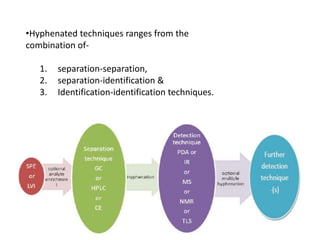
•Hyphenated techniques ranges from the
combination of-
1. separation-separation,
2. separation-identification &
3. Identification-identification techniques.
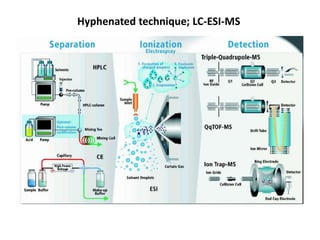
Hyphenated technique; LC-ESI-MS
Advantages of Hyphenated
Techniques
1. Fast and accurate analysis
2. Higher degree of automation
3. Higher sample throughput
4. Better reproducibility
5. Reduction of contamination due to its closed System
6. Separation and quantification achieved at same time.
List of Hyphenated Techniques
1. GC-MS
2. LC-MS
3. LC-NMR
4. EC-MS
5. CE-MS
6. GC-IR
7. LC-MS-MS
8. LC-ESI-MALDI-TOF
9. GC-MS-MS
10. GC-NMR
11. GC-AES
12. ICP-MS
13. ICP-AAS
14. ICP-OES
Hyphenated GC
• Simple detector (such as thermal-conductivity detection (TCD), flame-
ionization detection (FID) and electron-capture detector (ECD), etc.) for a GC
system.
• Based on different detection mechanism, information-rich detectors can be
mainly classified as-
1. detection based on molecular mass spectrometry,
2. detection based on molecular spectroscopy such as Fourier-Transform infrared
(FTIR) and nuclear magnetic resonance (NMR) spectroscopy, and
3. detection based on atomic spectroscopy (elemental analysis) by coupling with
such as inductively-coupled plasma (ICP)-MS, atomic absorption spectroscopy
(AAS) and atomic emission spectroscopy (AES), respectively.
• In addition to these hyphenations mentioned above and which are mounted
after a gas chromatograph, it can also include automated online sample
preparation systems before a GC system such as-
1. Static headspace (HS),
2. Dynamic headspace,
3. Large volume injection (LVI) and
4. Solid-Phase Micro Extraction (SPME).
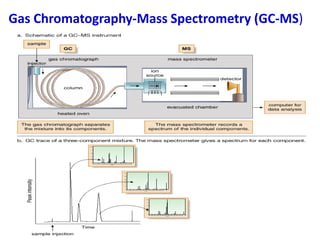
GC-MS
• A GC-MS instrument is composed of following two
major building blocks:
i. a gas chromatograph and
ii. a mass spectrometer.
• GC-MS separates chemical mixtures into individual
components (using a gas chromatograph) and
identifies / quantifies the components at a molecular
level (using a MS detector).
• It is one of the most accurate and efficient tools for
analyzing volatile organic samples.
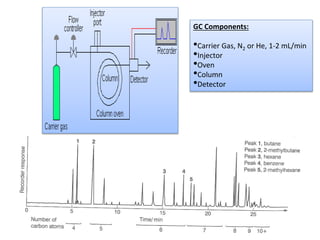
GC Components:
•Carrier Gas, N2 or He, 1-2 mL/min
•Injector
•Oven
•Column
•Detector
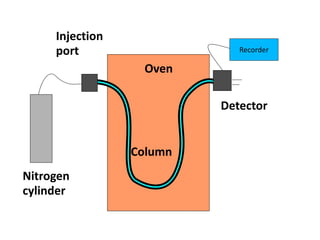
Oven
Detector
Injection
port
Nitrogen
cylinder
Column
Recorder
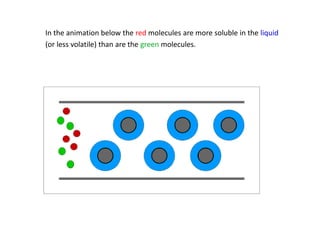
In the animation below the red molecules are more soluble in the liquid
(or less volatile) than are the green molecules.
Gas Chromatography-Mass Spectrometry (GC-MS)
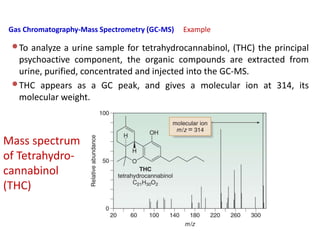
Gas Chromatography-Mass Spectrometry (GC-MS) Example
•To analyze a urine sample for tetrahydrocannabinol, (THC) the principal
psychoactive component, the organic compounds are extracted from
urine, purified, concentrated and injected into the GC-MS.
•THC appears as a GC peak, and gives a molecular ion at 314, its
molecular weight.
Mass spectrum
of Tetrahydro-
cannabinol
(THC)
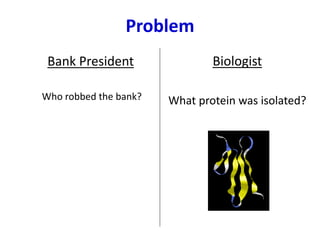
Problem
Bank President
Who robbed the bank?
Biologist
What protein was isolated?
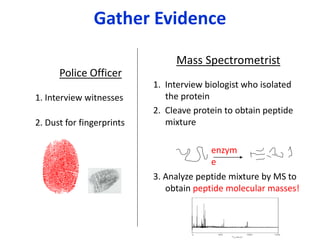
Gather Evidence
Police Officer
1. Interview witnesses
2. Dust for fingerprints
Mass Spectrometrist
1. Interview biologist who isolated
the protein
2. Cleave protein to obtain peptide
mixture
3. Analyze peptide mixture by MS to
obtain peptide molecular masses!
enzym
e
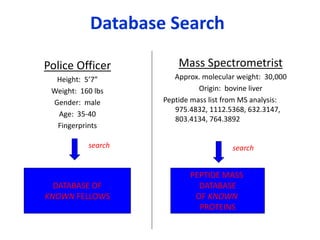
Database Search
Police Officer
Height: 5’7”
Weight: 160 lbs
Gender: male
Age: 35-40
Fingerprints
Mass Spectrometrist
Approx. molecular weight: 30,000
Origin: bovine liver
Peptide mass list from MS analysis:
975.4832, 1112.5368, 632.3147,
803.4134, 764.3892
DATABASE OF
KNOWN FELLOWS
PEPTIDE MASS
DATABASE
OF KNOWN
PROTEINS
search search
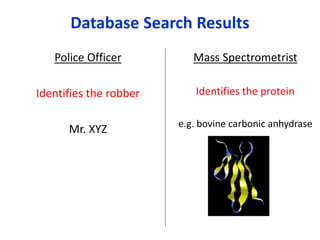
Database Search Results
Police Officer
Identifies the robber
Mr. XYZ
Mass Spectrometrist
Identifies the protein
e.g. bovine carbonic anhydrase
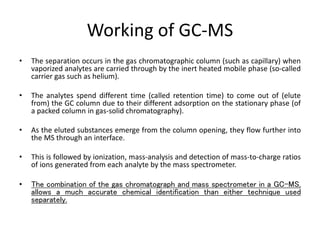
Working of GC-MS
• The separation occurs in the gas chromatographic column (such as capillary) when
vaporized analytes are carried through by the inert heated mobile phase (so-called
carrier gas such as helium).
• The analytes spend different time (called retention time) to come out of (elute
from) the GC column due to their different adsorption on the stationary phase (of
a packed column in gas-solid chromatography).
• As the eluted substances emerge from the column opening, they flow further into
the MS through an interface.
• This is followed by ionization, mass-analysis and detection of mass-to-charge ratios
of ions generated from each analyte by the mass spectrometer.
• The combination of the gas chromatograph and mass spectrometer in a GC-MS,
allows a much accurate chemical identification than either technique used
separately.
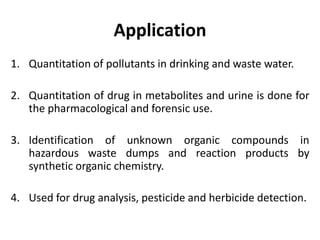
Application
1. Quantitation of pollutants in drinking and waste water.
2. Quantitation of drug in metabolites and urine is done for
the pharmacological and forensic use.
3. Identification of unknown organic compounds in
hazardous waste dumps and reaction products by
synthetic organic chemistry.
4. Used for drug analysis, pesticide and herbicide detection.
LC-MS
• Liquid chromatography-mass spectrometry is the technique which performs separation by liquid
chromatography and mass analysis with the help of the mass spectrometry.
• Electrospray needle is used as bridge to connect the liquid chromatography with that of the mass.
• LC-MS is mainly separated into the three parts-
1. Chromatography
– In liquid chromatography separation is performed which is detected with the help of Photo
diode Array.
– These separated components then transferred to the interface.
2. Interface
– In interface the liquid is volatilized and transferred to the MS.
3. Spectrometry
– With the help of various ionization techniques the compound is ionized and then it is
analyzed by mass analyzer.
– Various mass analyzers are used viz. Quadrupoles, quadrupole ion traps, time-to-flight (TOF),
time-to-flight reflection (TOFR), and ion cyclotron resonance (ICR) mass analyzers.
Applications
1. LC-MS used to detect compounds from polyaromatic
(non-polar) to peptide and proteins.
2. LC-MS used for compounds identification and purity.
3. Used for determination of pesticides, herbicides &
organic pollutant for environmental monitoring.
4. Proteome analysis is done by this technique.
GC-IR
• GC-IR technique is hyphenation of gas chromatography and Infrared
spectroscopy.
• This technique is very sensitive, very expensive, sample recovery is also
possible because IR is non-destructive technique.
• In this technique the GC does the separation part where as IR perform
the function of identification.
• Effluent from GC is directly forwarded into the heated pipe of IR at
atmospheric pressure.
• Infrared red spectroscopy identifies the compound by identifying the
functional groups.
Applications
1. Pharmaceutical, Industrial
2. DNA Analysis of blood samples, other fluids.
GC-AES/ GC-OES
• This technique is combination of gas chromatography with atomic emission
spectroscopy.
• Atomic emission spectroscopy is one of the elemental analysis techniques.
• GC performs the separation of the components and with the help of AES the
elemental identification of the components is performed.
• Elemental composition of every peak separated by GC is determined.
i. GC effluent is directly introduced into the Quartz atomization furnace.
ii. Analytes are first atomized using either ICP or microwave irradiation (high
temperatures), where the atoms are transferred to electronically excited state.
iii. Then these electrons are return to the lower energy levels at that time photons are
emitted at certain wavelengths that are characteristic of the particular element.
iv. In both the techniques sample is in gas phase so the techniques are complementary
to each other.

Hyphenated techniques

  • 1.
  • 2.
    Analytical Chemistry • Analyticalchemistry is the study of the separation, identification, and quantification of matter for the purpose of chemical characterization of matter. • Analytical chemistry answers the two important questions... 1. What is it..?? 2. How much is it..?? • Qualitative analysis gives an indication of the identity of the chemical species in the sample. • Quantitative analysis determines the amount of certain components in the substance. 1. Conventional/ Classical methods 2. Instrumental methods • The separation of components is often performed prior to analysis. • The separation of materials is accomplished using- – Chromatography, – Electrophoresis, – Field flow fractionation methods.
  • 3.
    • To selectan appropriate method of analysis, following factors must be taken into account- a. Nature of information which is sought b. Size of sample available c. Proportion of the constituents to be determined d. Purpose for which analytical data is required
  • 4.
    Qualitative Analysis • Aqualitative analysis determines the presence or absence of a particular compound, but not the mass or concentration. • By definition, qualitative analyses do not measure quantity. – Color Tests – Microcrystal Tests – Flame Tests – pH Tests
  • 5.
    Hyphenated Techniques • AHyphenated technique is combination or coupling of two different analytical techniques with the help of proper interface. • Hirschfield (1980) introduced the term "hyphenation" to refer to the on-line combination of a separation technique and one or more spectroscopic detection techniques. • Chromatography - Produces pure or nearly pure fractions of chemical components in a mixture. Spectroscopy – Produces selective information for identification using standards or library spectra. • The hyphenated technique is developed from the coupling of a separation technique and an online spectroscopic detection technology. • The number of existing techniques has been combined to expand the utility. • The direct conjugation of chromatographic technique with spectroscopic examination of separated fraction constitutes several powerful analytical techniques.
  • 6.
    Hyphenation • The hyphenationdoes not always have to be between two techniques; the coupling of separation or detection techniques • Recently, more than two techniques coupled together to form a more powerful integrated system have revolutionized the trace element analysis industry. • Also called double hybrid e.g. LC-PDA-MS; LC-MS-MS; LC-NMR-MS instruments have become available and have been applied to pharmaceutical problem solving. • Online coupling with solid phase extraction (SPE), solid phase micro extraction or large volume injection can be incorporated to build in a more powerful integrated system e.g. SPE-LC-MS.
  • 7.
    •Hyphenated techniques rangesfrom the combination of- 1. separation-separation, 2. separation-identification & 3. Identification-identification techniques.
  • 8.
  • 9.
    Advantages of Hyphenated Techniques 1.Fast and accurate analysis 2. Higher degree of automation 3. Higher sample throughput 4. Better reproducibility 5. Reduction of contamination due to its closed System 6. Separation and quantification achieved at same time.
  • 10.
    List of HyphenatedTechniques 1. GC-MS 2. LC-MS 3. LC-NMR 4. EC-MS 5. CE-MS 6. GC-IR 7. LC-MS-MS 8. LC-ESI-MALDI-TOF 9. GC-MS-MS 10. GC-NMR 11. GC-AES 12. ICP-MS 13. ICP-AAS 14. ICP-OES
  • 11.
    Hyphenated GC • Simpledetector (such as thermal-conductivity detection (TCD), flame- ionization detection (FID) and electron-capture detector (ECD), etc.) for a GC system. • Based on different detection mechanism, information-rich detectors can be mainly classified as- 1. detection based on molecular mass spectrometry, 2. detection based on molecular spectroscopy such as Fourier-Transform infrared (FTIR) and nuclear magnetic resonance (NMR) spectroscopy, and 3. detection based on atomic spectroscopy (elemental analysis) by coupling with such as inductively-coupled plasma (ICP)-MS, atomic absorption spectroscopy (AAS) and atomic emission spectroscopy (AES), respectively. • In addition to these hyphenations mentioned above and which are mounted after a gas chromatograph, it can also include automated online sample preparation systems before a GC system such as- 1. Static headspace (HS), 2. Dynamic headspace, 3. Large volume injection (LVI) and 4. Solid-Phase Micro Extraction (SPME).
  • 12.
    GC-MS • A GC-MSinstrument is composed of following two major building blocks: i. a gas chromatograph and ii. a mass spectrometer. • GC-MS separates chemical mixtures into individual components (using a gas chromatograph) and identifies / quantifies the components at a molecular level (using a MS detector). • It is one of the most accurate and efficient tools for analyzing volatile organic samples.
  • 13.
    GC Components: •Carrier Gas,N2 or He, 1-2 mL/min •Injector •Oven •Column •Detector
  • 14.
  • 15.
    In the animationbelow the red molecules are more soluble in the liquid (or less volatile) than are the green molecules.
  • 16.
  • 17.
    Gas Chromatography-Mass Spectrometry(GC-MS) Example •To analyze a urine sample for tetrahydrocannabinol, (THC) the principal psychoactive component, the organic compounds are extracted from urine, purified, concentrated and injected into the GC-MS. •THC appears as a GC peak, and gives a molecular ion at 314, its molecular weight. Mass spectrum of Tetrahydro- cannabinol (THC)
  • 18.
    Problem Bank President Who robbedthe bank? Biologist What protein was isolated?
  • 19.
    Gather Evidence Police Officer 1.Interview witnesses 2. Dust for fingerprints Mass Spectrometrist 1. Interview biologist who isolated the protein 2. Cleave protein to obtain peptide mixture 3. Analyze peptide mixture by MS to obtain peptide molecular masses! enzym e
  • 20.
    Database Search Police Officer Height:5’7” Weight: 160 lbs Gender: male Age: 35-40 Fingerprints Mass Spectrometrist Approx. molecular weight: 30,000 Origin: bovine liver Peptide mass list from MS analysis: 975.4832, 1112.5368, 632.3147, 803.4134, 764.3892 DATABASE OF KNOWN FELLOWS PEPTIDE MASS DATABASE OF KNOWN PROTEINS search search
  • 21.
    Database Search Results PoliceOfficer Identifies the robber Mr. XYZ Mass Spectrometrist Identifies the protein e.g. bovine carbonic anhydrase
  • 22.
    Working of GC-MS •The separation occurs in the gas chromatographic column (such as capillary) when vaporized analytes are carried through by the inert heated mobile phase (so-called carrier gas such as helium). • The analytes spend different time (called retention time) to come out of (elute from) the GC column due to their different adsorption on the stationary phase (of a packed column in gas-solid chromatography). • As the eluted substances emerge from the column opening, they flow further into the MS through an interface. • This is followed by ionization, mass-analysis and detection of mass-to-charge ratios of ions generated from each analyte by the mass spectrometer. • The combination of the gas chromatograph and mass spectrometer in a GC-MS, allows a much accurate chemical identification than either technique used separately.
  • 23.
    Application 1. Quantitation ofpollutants in drinking and waste water. 2. Quantitation of drug in metabolites and urine is done for the pharmacological and forensic use. 3. Identification of unknown organic compounds in hazardous waste dumps and reaction products by synthetic organic chemistry. 4. Used for drug analysis, pesticide and herbicide detection.
  • 24.
    LC-MS • Liquid chromatography-massspectrometry is the technique which performs separation by liquid chromatography and mass analysis with the help of the mass spectrometry. • Electrospray needle is used as bridge to connect the liquid chromatography with that of the mass. • LC-MS is mainly separated into the three parts- 1. Chromatography – In liquid chromatography separation is performed which is detected with the help of Photo diode Array. – These separated components then transferred to the interface. 2. Interface – In interface the liquid is volatilized and transferred to the MS. 3. Spectrometry – With the help of various ionization techniques the compound is ionized and then it is analyzed by mass analyzer. – Various mass analyzers are used viz. Quadrupoles, quadrupole ion traps, time-to-flight (TOF), time-to-flight reflection (TOFR), and ion cyclotron resonance (ICR) mass analyzers.
  • 25.
    Applications 1. LC-MS usedto detect compounds from polyaromatic (non-polar) to peptide and proteins. 2. LC-MS used for compounds identification and purity. 3. Used for determination of pesticides, herbicides & organic pollutant for environmental monitoring. 4. Proteome analysis is done by this technique.
  • 26.
    GC-IR • GC-IR techniqueis hyphenation of gas chromatography and Infrared spectroscopy. • This technique is very sensitive, very expensive, sample recovery is also possible because IR is non-destructive technique. • In this technique the GC does the separation part where as IR perform the function of identification. • Effluent from GC is directly forwarded into the heated pipe of IR at atmospheric pressure. • Infrared red spectroscopy identifies the compound by identifying the functional groups.
  • 27.
    Applications 1. Pharmaceutical, Industrial 2.DNA Analysis of blood samples, other fluids.
  • 28.
    GC-AES/ GC-OES • Thistechnique is combination of gas chromatography with atomic emission spectroscopy. • Atomic emission spectroscopy is one of the elemental analysis techniques. • GC performs the separation of the components and with the help of AES the elemental identification of the components is performed. • Elemental composition of every peak separated by GC is determined. i. GC effluent is directly introduced into the Quartz atomization furnace. ii. Analytes are first atomized using either ICP or microwave irradiation (high temperatures), where the atoms are transferred to electronically excited state. iii. Then these electrons are return to the lower energy levels at that time photons are emitted at certain wavelengths that are characteristic of the particular element. iv. In both the techniques sample is in gas phase so the techniques are complementary to each other.