• Introduction
• Referencematerial and its importance
• Types of Reference material
• Calibration procedure and methods
• Importance of calibration
• Types of calibration
3.
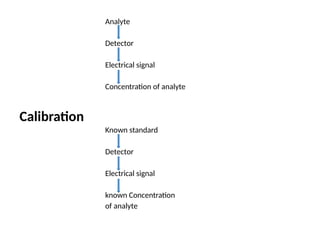
Calibration
• Calibration orstandardization is the process of
establishing the response of a detection or
measurement system to known amounts or
concentrations of an analyte under specified
conditions or the comparison of a measured
quantity with a reference value
• It is the process of establishing a relation between a
detection or measurement system and known
amounts or concentrations of an analyte under
specified conditions.
4.
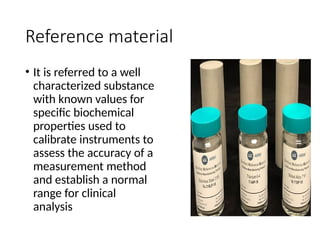
Reference material
• Itis referred to a well
characterized substance
with known values for
specific biochemical
properties used to
calibrate instruments to
assess the accuracy of a
measurement method
and establish a normal
range for clinical
analysis
5.
Importance of referencematerial
• Assessment of precision and Trueness
• Quality control
• Assigning values to calibration
• Method validation
• Estimation of measurement uncertainty
• Proficiency testing
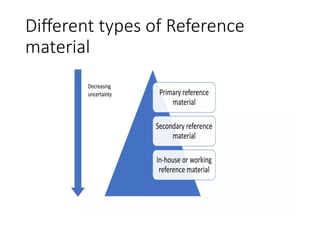
Primary reference material:
•Highly pure substance or mixture used as standard
for chemical analysis, identification test or assay
and analytical method validation
• Eg: Primary standard and certified reference
material
• Characteristics:
• High purity
• Highly stable
• Accurate and consistent traceability
8.
Secondary reference material:
•Substance or mixture whose concentration is
detrmined by comparison with primary reference
material
• Used for quality control purpose in smaller labs
• Eg: Glucose and urea standard
Characteristics:
• Less pure
• Less stable
• Less expensive
9.
In house orworking reference material:
• Prepared by laboratory itself,by pooling sera from
multiple patients
• Closely matches the matrix of patient sample
• Used as control material for qualitative test
Characteristics:
Less pure
Less stable
Less expensive
Empirical calibration
• Inempirical calibration, calibration is formulated on
the basis of the performed experiment, sensory
perception or observation.
• The measurements of analytical signals obtained
directly or indirectly for chemical, biological, or
physical standards.
• e.g. Nernst’s equation or Beer’s Lambert law
12.
Theoretical calibration
• Intheoretical calibration, the calibration is
formulated on the basis of a mathematical
description of physicochemical phenomena and
processes occurring during the analysis using a
given analytical and measurement method.
• It includes phenomenological quantities based on
• Physical or chemical measurements (electrochemical
potentials, diffusion coefficients, etc.)
• Universal quantities (molar mass, atomic number)
• Fundamental physical constants (Faraday constant,
Avogadro constant, etc.)
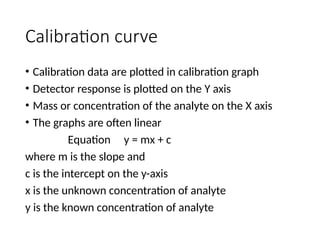
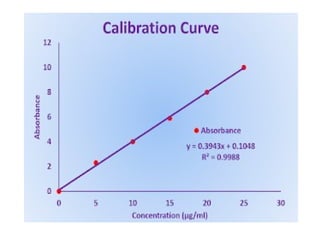
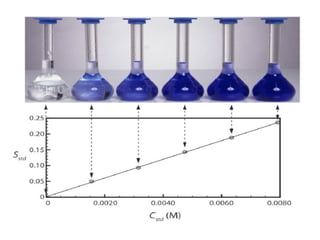
Calibration curve
• Calibrationdata are plotted in calibration graph
• Detector response is plotted on the Y axis
• Mass or concentration of the analyte on the X axis
• The graphs are often linear
Equation y = mx + c
where m is the slope and
c is the intercept on the y-axis
x is the unknown concentration of analyte
y is the known concentration of analyte
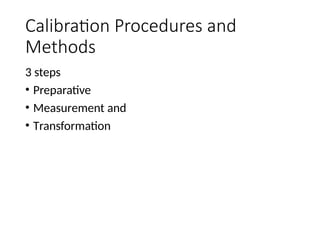
Preparative step
• Thepreparative step consists in preparing the
sample and the standard
• Sample and standard are prepared separately
• The chemical composition of the standard is similar
to that of the sample
• Standard is added to the sample prior to
measurement
18.
Measurement stage
• Inthe measurement stage, signal measurements
are made using a selected measurement method.
• If the calibration is empirical, measurements are
related to the sample and standard or sample and
sample with the addition of the standard
• In theoretical calibration, measurements are made
only for the sample and the formulated theorem
19.
Transformation step
• Inthe transformation step, the value of the signal
obtained for the sample is entered into an empirical
or theoretical theorem and thus the final analytical
result is determined
20.
Importance of calibration
•Ensures instruments and equipment provide
accurate and reliable measurements
• Maintaining quality, safety and equipment longevity
by comparing the readings against a standard of
known accuracy
• Provides documentation and evidence that the
equipment is functioning correctly and meeting the
required standards
• Identifies and correct problems with laboratory
equipments
21.
Factors affecting accuracyand
precision of instruments
• During qualitative and quantitativeanalysis, there
are changes in the analytical signal that are partially
or completely out of the analyst’s control are
known as Analytical effects
• Controlled analytical effect
• Uncontrolled analytical effect
22.
Controlled analytical effect
•Changes caused by targeted action of a analyst to
decrease or increase the concentration of an
analyte in a sample by dilution or concentration
23.
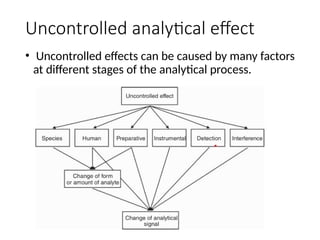
Uncontrolled analytical effect
•Uncontrolled effects can be caused by many factors
at different stages of the analytical process.
25.
Human factors
• analyst’sknowledge and skills, professional abilities
and qualifications
• Personal factors such as tiredness, nervousness,
and hurry play a large role
Preparative effect
• Change in signal result physical changes in the
sample or standard (e.g. solution viscosity)
• Changes in environmental conditions under which
the sample and standard are processed
(e.g.temperature, humidity, illumination)
26.
Instrumental effect
• Actionof instrumental components used in the
analytical process to process the sample prior to
measurement
• Eg: Power fluctuation
Detection effect
• measurement changes occurring in the detection
system
• Eg: Self-absorption of radiation emitted in the
emission spectrometry method, causing a change in
analytical signal
27.
Interference effect
• Amountof analyte can also be affected by components
both naturally present in the sample and introduced
during sample preparation
• If the effect comes from the native components of the
sample - matrix effect
• If the interferents are components added to the sample
during sample processing - blank effect
• Speciation effect
• when an analyte contained in a sample changes its
chemical form and at the same time changes its
measurement sensitivity.
• Eg. a change from atoms to analyte ions in atomic
absorption spectrometry
28.
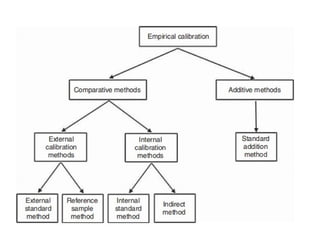
Calibration methods
Two groupsof calibration methods can be
distinguished in analytical calibration
• Comparative methods (when the sample and
standard are treated separately) and
• Additive methods (when the standard is added to
the sample)
30.
Comparitive methods
External calibration
•Method of calibrating an instrument by comparing it
with known standard
• Example: Balance calibration
Internal calibration
• Method of calibration that uses a known amount of
reference compound to compare the signal of an analyte
to the reference compound
• Example: calibration in gas and liquid chromatography
31.
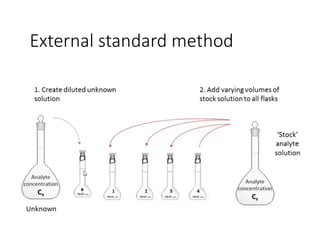
External calibration method
•External standard method
A set of solution with known concentration of the
analyte are analyzed separately from the unknown
sample
• External dilution method
A series of known diluted standard solution is are
used to determine the concentration of an analyte in
an unknown sample by comparing its measured
signal
32.
Reference sample method
theanalyte is the sample as a whole; and the
standard – another sample of known or even unknown
composition, which may be called the reference
sample
33.
External standard method
Aset of solution with known concentration of the
analyte are analyzed separately from the unknown
sample
Eg: Determining the concentration of glucose in
blood sample by preparing a series of known
glucose of varying concentrations measuring their
absorbance on a spectrophotometer
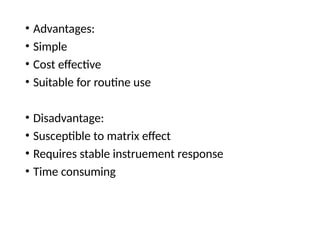
• Advantages:
• Simple
•Cost effective
• Suitable for routine use
• Disadvantage:
• Susceptible to matrix effect
• Requires stable instruement response
• Time consuming
37.
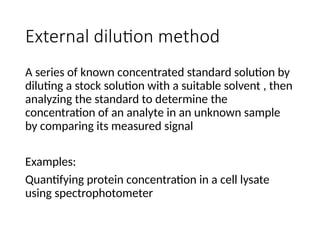
External dilution method
Aseries of known concentrated standard solution by
diluting a stock solution with a suitable solvent , then
analyzing the standard to determine the
concentration of an analyte in an unknown sample
by comparing its measured signal
Examples:
Quantifying protein concentration in a cell lysate
using spectrophotometer
38.
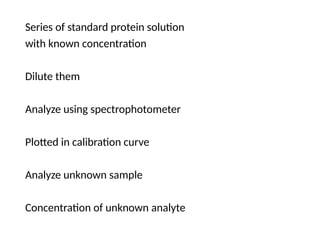
Series of standardprotein solution
with known concentration
Dilute them
Analyze using spectrophotometer
Plotted in calibration curve
Analyze unknown sample
Concentration of unknown analyte
39.
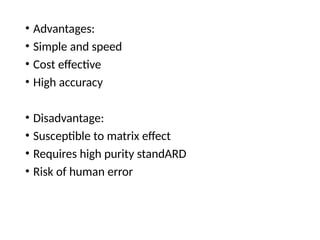
• Advantages:
• Simpleand speed
• Cost effective
• High accuracy
• Disadvantage:
• Susceptible to matrix effect
• Requires high purity standARD
• Risk of human error
40.
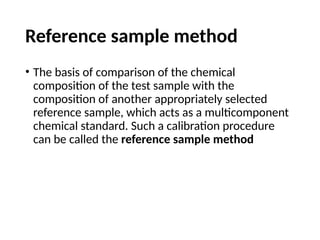
Reference sample method
•The basis of comparison of the chemical
composition of the test sample with the
composition of another appropriately selected
reference sample, which acts as a multicomponent
chemical standard. Such a calibration procedure
can be called the reference sample method
41.
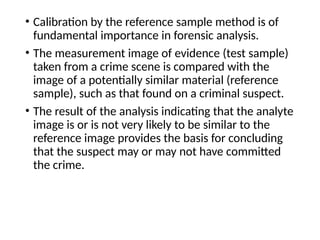
• Calibration bythe reference sample method is of
fundamental importance in forensic analysis.
• The measurement image of evidence (test sample)
taken from a crime scene is compared with the
image of a potentially similar material (reference
sample), such as that found on a criminal suspect.
• The result of the analysis indicating that the analyte
image is or is not very likely to be similar to the
reference image provides the basis for concluding
that the suspect may or may not have committed
the crime.
42.
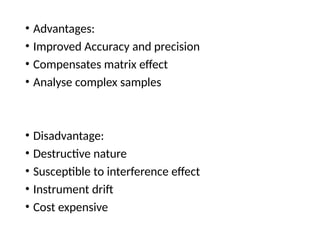
• Advantages:
• Accuracyand precision
• Measurements are standardized
• Simple
• Disadvantage:
• Susceptible to matrix effect
• Susceptible to interference effect
• Instrument drift
• Cost expensive
• Time consuming
43.
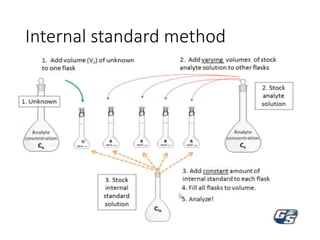
Internal Calibration Methods
Internalcalibration methods also belong to
comparative methods. They satisfy the following
conditions:
● The sample and standard are prepared separately
from each other.
● Another substance of known type and absent in the
sample can be added to the sample and to the
standard in usually equal and known amounts.
The added substance can either:
● be chemically inert with respect to the analyte or
● react with the analyte, but not with other sample
components.
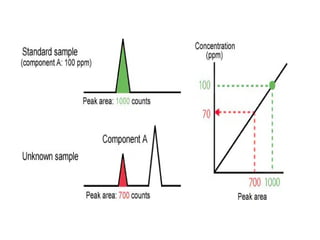
Internal standard method
•Adding a known amount of non targeted
compound (internal standard) to the sample and
calibration solution to compare the response of
chemical in a sample to the calibration solution
• In gas chromatography, an internal standard might
be a dueterated version of the analyte that is not
present in the sample
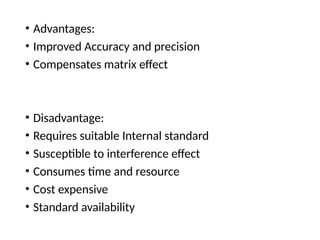
• Advantages:
• ImprovedAccuracy and precision
• Compensates matrix effect
• Disadvantage:
• Requires suitable Internal standard
• Susceptible to interference effect
• Instrument drift
• Cost expensive
• Complex process
49.
Indirect method
• Substanceof known type is added to the sample and the
external standard to react with the analyte in the
standard and Desired analyte in the sample.
• Both solutions are then measured under conditions that
are optimal for the reaction product of the reagent with
the standard analyte
• When an analyte is present in the sample, the product
obtained after reaction with this component should be
the same as the product obtained after reaction with the
analyte contained in the standard.
• The signals obtained for this product should be located at
the same positions in the measurement images of the
standard and the sample and indicate the presence of the
desired analyte in the sample
• Advantages:
• ImprovedAccuracy and precision
• Simultaneous analysis
• Disadvantage:
• Requires suitable Internal standard
• Susceptible to Error
• Cost expensive
• Complex process
52.
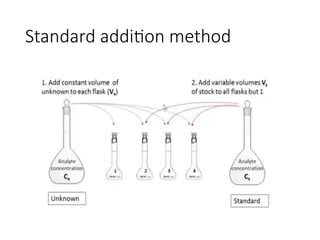
Additive calibration methods
•Adding known of the analyte to the unknown
sample to determine the analytes concentration
Types
• Standard addition method
• Isotope dilution method
53.
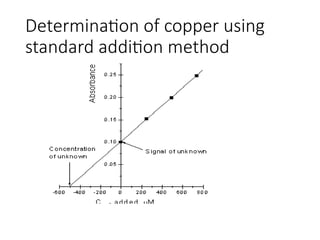
Standard addition method
•Used to determine the concentration of the analyte
in a sample by adding known amount of the analyte
to the sample and measuring the resultant signal
• Involves creating two sample - one sample without
any spikes and another one with spikes , by
comparing these two samples, the amount of
analyte in the unknown is determined.
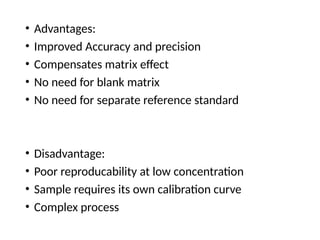
• Advantages:
• ImprovedAccuracy and precision
• Compensates matrix effect
• No need for blank matrix
• No need for separate reference standard
• Disadvantage:
• Poor reproducability at low concentration
• Sample requires its own calibration curve
• Complex process
57.
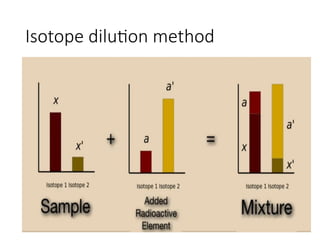
Isotope dilution method
•Adding a known amount of stable isotope to a
sample, measuring the isotope ratios and using a
calibration curve to determine the analyte
concentration
• Example: Detetmination of vitamin A total body
stores after an oral dose of vitamin A stable isotope
• Advantages:
• ImprovedAccuracy and precision
• Compensates matrix effect
• Disadvantage:
• Requires suitable Internal standard
• Susceptible to interference effect
• Consumes time and resource
• Cost expensive
• Standard availability
61.
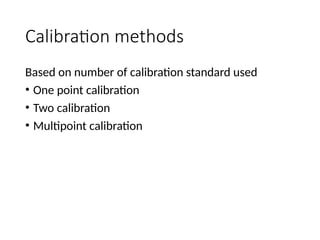
Calibration methods
Based onnumber of calibration standard used
• One point calibration
• Two calibration
• Multipoint calibration
62.
One point calibration
•A single reference point is used to adjust the device
output to match the known standard
• Suitable for Linear response
• Example: Adjusting a pressure gauge to read zero
when the pressure is actually zero
63.
Two point calibration
•Two reference points are used to establish a linear
relationship between the device’s output and the
known standard
• Suitable for Device with linear response over a
measurement range
• Example: Calibrating pH meter using two pH
solutions one at low pH and other at a high pH
64.
Multipoint calibration
• Multiplereference points are used to create a curve
that represents the device’s output across its entire
measurement range
• Suitable for devices with non linear responses
• Example: Calibrating a spectrophotometer using
multiple known concentrations of standard solution
to create a calibration curve for accurate
absorbance measurements