
Prof. Liwayway Memije-Cruz
 A chemical reaction describes what occurs in a
chemical change. It shows not only the kind but
also the relative amounts of the substances
involved in a change. The coefficients written
before the formulas in a balanced equation
represent the number of moles of each substance
involved in a reaction. Since the number of moles
is related to the mass of any substance and to the
volume of any gaseous substance, the mole
relationship can be easily changed to
mass/volume relationship.
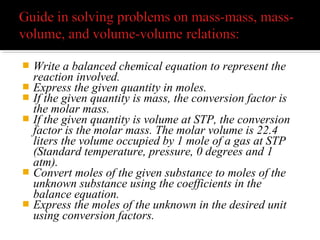
 Write a balanced chemical equation to represent the
reaction involved.
 Express the given quantity in moles.
 If the given quantity is mass, the conversion factor is
the molar mass.
 If the given quantity is volume at STP, the conversion
factor is the molar mass. The molar volume is 22.4
liters the volume occupied by 1 mole of a gas at STP
(Standard temperature, pressure, 0 degrees and 1
atm).
 Convert moles of the given substance to moles of the
unknown substance using the coefficients in the
balance equation.
 Express the moles of the unknown in the desired unit
using conversion factors.
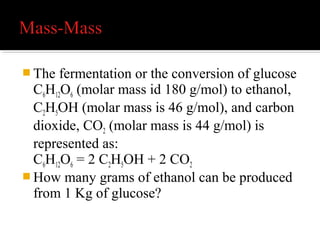
 The fermentation or the conversion of glucose
C6H12O6 (molar mass is 180 g/mol) to ethanol,
C2H5OH (molar mass is 46 g/mol), and carbon
dioxide, CO2 (molar mass is 44 g/mol) is
represented as:
C6H12O6 = 2 C2H5OH + 2 CO2
 How many grams of ethanol can be produced
from 1 Kg of glucose?
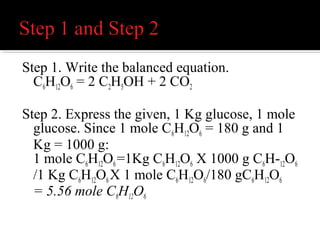
Step 1. Write the balanced equation.
C6H12O6 = 2 C2H5OH + 2 CO2
Step 2. Express the given, 1 Kg glucose, 1 mole
glucose. Since 1 mole C6H12O6 = 180 g and
1 Kg = 1000 g:
1 mole C6H12O6=1Kg C6H12O6 X 1000 g 1000 g
C6H12O6/180 gC6H12O6
= 5.56 moles C6H12O6
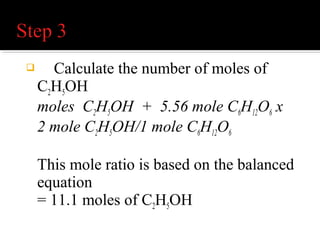
 Calculate the number of moles of
C2H5OH
moles C2H5OH + 5.56 moles C6H12O6 x
2 moles C2H5OH/1 mole C6H12O6
This mole ratio is based on the balanced
equation
= 11.12 moles of C2H5OH
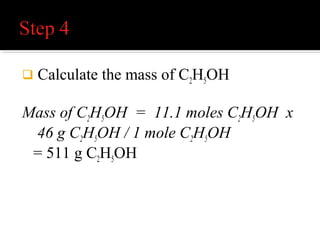
 Calculate the mass of C2H5OH
Mass of C2H5OH = 11.1 moles C2H5OH x
46 g C2H5OH / 1 mole C2H5OH
= 511 g C2H5OH
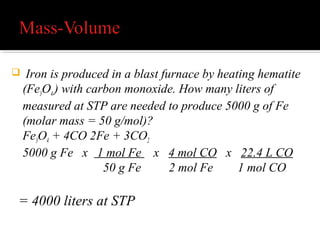
 Iron is produced in a blast furnace by heating hematite
(Fe3O4­) with carbon monoxide. How many liters of CO2
measured at STP are needed to produce 5000 g of Fe
(molar mass = 56 g/mol)?
Fe3O4 + 4CO ­> 3Fe + 4CO2
5000 g Fe x 1mol Fe x 4 mol CO2 x 22.4 L CO2
56 g Fe 3 mol Fe 1 mol CO2
= 112,000 liters at STP
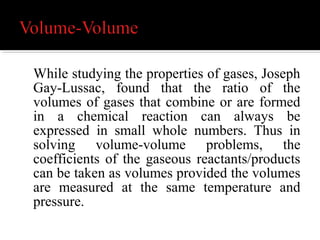
While studying the properties of gases, Joseph
Gay-Lussac, found that the ratio of the
volumes of gases that combine or are formed
in a chemical reaction can always be
expressed in small whole numbers. Thus in
solving volume-volume problems, the
coefficients of the gaseous reactants/products
can be taken as volumes provided the volumes
are measured at the same temperature and
pressure.
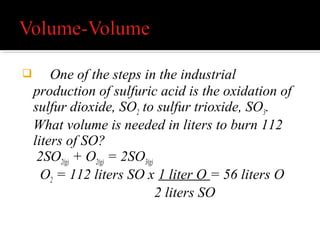
 One of the steps in the industrial
production of sulfuric acid is the oxidation of
sulfur dioxide, SO2 to sulfur trioxide, SO3.
What volume of O2 is needed in liters to burn
112 liters of SO2?
2SO2(g) + O2(g) = 2SO3(g)
SO2 = 112 liters SO2 x 1 liter O2 = 56 liters O2
2 liters SO2
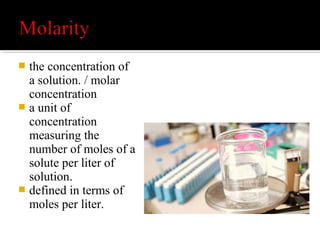
 the concentration of
a solution. / molar
concentration
 a unit of
concentration
measuring the
number of moles of a
solute per liter of
solution.
 defined in terms of
moles per liter.
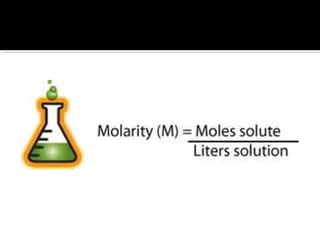
the ratio of moles to volume of
the solution
 the number of moles of a
substance per liter of solution.
 A 1.0 M solution contains 1
mole of solute per liter of
solution
Step 1
Select an example problem to
demonstrate molarity. Suppose you
dissolved 5 g of sodium chloride (NaCl)
in 500 mL of water and wanted to
determine the molarity of the final
solution.
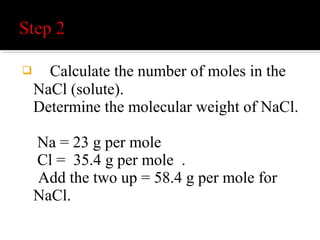
 Calculate the number of moles in the
NaCl (solute).
Determine the molecular weight of NaCl.
Na = 23 g per mole
Cl = 35.4 g per mole .
Add the two up = 58.4 g per mole for
NaCl.
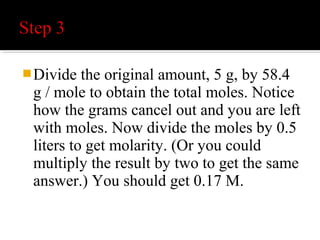
Divide the original amount, 5 g, by 58.4
g / mole to obtain the total moles. Notice
how the grams cancel out and you are left
with moles. Now divide the moles by 0.5
liters to get molarity. (Or you could
multiply the result by two to get the same
answer.) You should get 0.17 M.
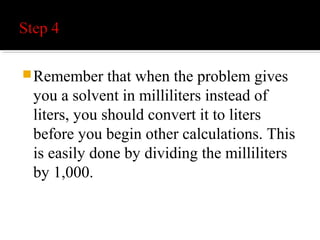
Remember that when the problem gives
you a solvent in milliliters instead of
liters, you should convert it to liters
before you begin other calculations. This
is easily done by dividing the milliliters
by 1,000.
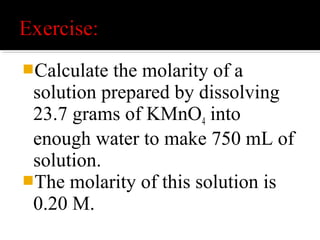
Calculate the molarity of a
solution prepared by dissolving
23.7 grams of KMnO4 into
enough water to make 750 mL of
solution.
The molarity of this solution is
0.20 M.
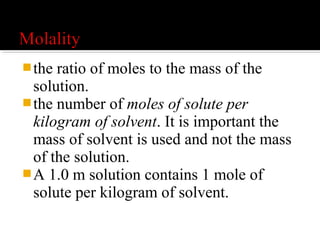
the ratio of moles to the mass of the
solution.
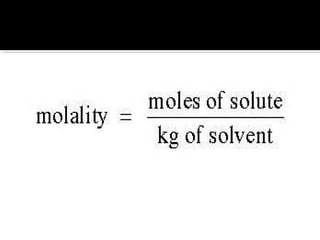
the number of moles of solute per
kilogram of solvent. It is important the
mass of solvent is used and not the mass
of the solution.
A 1.0 m solution contains 1 mole of
solute per kilogram of solvent.​
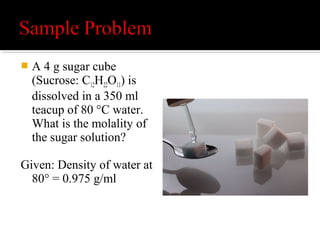
 A 4 g sugar cube
(Sucrose: C12H22O11) is
dissolved in a 350 ml
teacup of 80 °C water.
What is the molality of
the sugar solution?
Given: Density of water at
80° = 0.975 g/ml
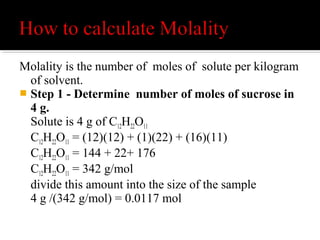
Molality is the number of moles of solute per kilogram
of solvent.
 Step 1 - Determine number of moles of sucrose in
4 g.
Solute is 4 g of C12H22O11
C12H22O11 = (12)(12) + (1)(22) + (16)(11)
C12H22O11 = 144 + 22+ 176
C12H22O11 = 342 g/mol
divide this amount into the size of the sample
4 g /(342 g/mol) = 0.0117 mol
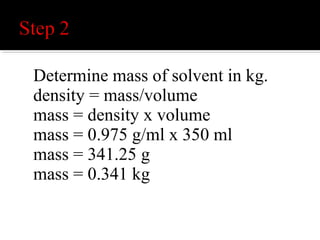
Determine mass of solvent in kg.
density = mass/volume
mass = density x volume
mass = 0.975 g/ml x 350 ml
mass = 341.25 g
mass = 0.341 kg
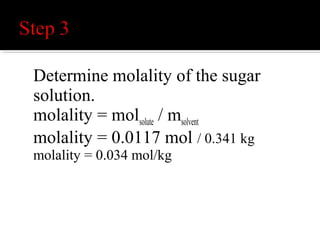
Determine molality of the sugar
solution.
molality = molsolute / msolvent
molality = 0.0117 mol / 0.341 kg
molality = 0.034 mol/kg
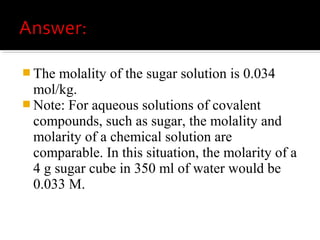
 The molality of the sugar solution is 0.034
mol/kg.
 Note: For aqueous solutions of covalent
compounds, such as sugar, the molality and
molarity of a chemical solution are
comparable. In this situation, the molarity of a
4 g sugar cube in 350 ml of water would be
0.033 M.
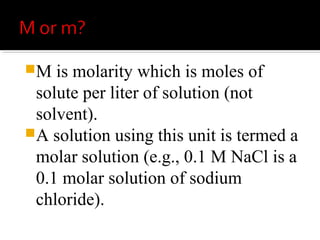
M is molarity which is moles of
solute per liter of solution (not
solvent).
A solution using this unit is termed a
molar solution (e.g., 0.1 M NaCl is a
0.1 molar solution of sodium
chloride).
m indicates molality which is
calculated using moles of solute per
kilograms of solvent.
 A solution using these units is
called a molal solution (e.g., 0,1 m
NaOH is a 0.1 molal solution of
sodium hydroxide).
 the gram equivalent
weight of a solute per
liter of solution. A
gram equivalent
weight or equivalent is
a measure of the
reactive capacity of a
given chemical
species (ion, molecule,
etc.).
 1 M sulfuric acid (H2SO4) is 2 N for acid-base
reactions because each mole of sulfuric acid
provides 2 moles of H+
ions.
 1 M sulfuric acid is 1 N for sulfate
precipitation, since 1 mole of sulfuric acid
provides 1 mole of sulfate ions.
 1. What is the molarity of 245.0 g of H2SO4 dissolved
in 1.000 L of solution?
 2. What is the molality when 0.75 mol is dissolved in
2.50 L of solvent?
 3. Suppose you had 58.44 grams of NaCl and you
dissolved it in exactly 2.00 kg of pure water (the
solvent). What would be the molality of the solution?
 4.Sea water contains roughly 28.0 g of NaCl per liter.
What is the molarity of sodium chloride in sea water?
 https://www.thoughtco.com/molarity-and-
molality-differences-606117
 http://chemistry.tutorvista.com/inorganic-
chemistry/molality.html
 https://www.thoughtco.com/calculate-
molarity-of-a-solution-606823
 https://www.thoughtco.com/molality-
example-problem-609568

Calculations Based on Balanced Equations.

  • 1.
  • 2.
     A chemicalreaction describes what occurs in a chemical change. It shows not only the kind but also the relative amounts of the substances involved in a change. The coefficients written before the formulas in a balanced equation represent the number of moles of each substance involved in a reaction. Since the number of moles is related to the mass of any substance and to the volume of any gaseous substance, the mole relationship can be easily changed to mass/volume relationship.
  • 4.
     Write abalanced chemical equation to represent the reaction involved.  Express the given quantity in moles.  If the given quantity is mass, the conversion factor is the molar mass.  If the given quantity is volume at STP, the conversion factor is the molar mass. The molar volume is 22.4 liters the volume occupied by 1 mole of a gas at STP (Standard temperature, pressure, 0 degrees and 1 atm).  Convert moles of the given substance to moles of the unknown substance using the coefficients in the balance equation.  Express the moles of the unknown in the desired unit using conversion factors.
  • 5.
     The fermentationor the conversion of glucose C6H12O6 (molar mass is 180 g/mol) to ethanol, C2H5OH (molar mass is 46 g/mol), and carbon dioxide, CO2 (molar mass is 44 g/mol) is represented as: C6H12O6 = 2 C2H5OH + 2 CO2  How many grams of ethanol can be produced from 1 Kg of glucose?
  • 6.
    Step 1. Writethe balanced equation. C6H12O6 = 2 C2H5OH + 2 CO2 Step 2. Express the given, 1 Kg glucose, 1 mole glucose. Since 1 mole C6H12O6 = 180 g and 1 Kg = 1000 g: 1 mole C6H12O6=1Kg C6H12O6 X 1000 g 1000 g C6H12O6/180 gC6H12O6 = 5.56 moles C6H12O6
  • 7.
     Calculate thenumber of moles of C2H5OH moles C2H5OH + 5.56 moles C6H12O6 x 2 moles C2H5OH/1 mole C6H12O6 This mole ratio is based on the balanced equation = 11.12 moles of C2H5OH
  • 8.
     Calculate themass of C2H5OH Mass of C2H5OH = 11.1 moles C2H5OH x 46 g C2H5OH / 1 mole C2H5OH = 511 g C2H5OH
  • 9.
     Iron isproduced in a blast furnace by heating hematite (Fe3O4­) with carbon monoxide. How many liters of CO2 measured at STP are needed to produce 5000 g of Fe (molar mass = 56 g/mol)? Fe3O4 + 4CO ­> 3Fe + 4CO2 5000 g Fe x 1mol Fe x 4 mol CO2 x 22.4 L CO2 56 g Fe 3 mol Fe 1 mol CO2 = 112,000 liters at STP
  • 10.
    While studying theproperties of gases, Joseph Gay-Lussac, found that the ratio of the volumes of gases that combine or are formed in a chemical reaction can always be expressed in small whole numbers. Thus in solving volume-volume problems, the coefficients of the gaseous reactants/products can be taken as volumes provided the volumes are measured at the same temperature and pressure.
  • 11.
     One ofthe steps in the industrial production of sulfuric acid is the oxidation of sulfur dioxide, SO2 to sulfur trioxide, SO3. What volume of O2 is needed in liters to burn 112 liters of SO2? 2SO2(g) + O2(g) = 2SO3(g) SO2 = 112 liters SO2 x 1 liter O2 = 56 liters O2 2 liters SO2
  • 12.
     the concentrationof a solution. / molar concentration  a unit of concentration measuring the number of moles of a solute per liter of solution.  defined in terms of moles per liter.
  • 14.
    the ratio ofmoles to volume of the solution  the number of moles of a substance per liter of solution.  A 1.0 M solution contains 1 mole of solute per liter of solution
  • 15.
    Step 1 Select anexample problem to demonstrate molarity. Suppose you dissolved 5 g of sodium chloride (NaCl) in 500 mL of water and wanted to determine the molarity of the final solution.
  • 16.
     Calculate thenumber of moles in the NaCl (solute). Determine the molecular weight of NaCl. Na = 23 g per mole Cl = 35.4 g per mole . Add the two up = 58.4 g per mole for NaCl.
  • 17.
    Divide the originalamount, 5 g, by 58.4 g / mole to obtain the total moles. Notice how the grams cancel out and you are left with moles. Now divide the moles by 0.5 liters to get molarity. (Or you could multiply the result by two to get the same answer.) You should get 0.17 M.
  • 18.
    Remember that whenthe problem gives you a solvent in milliliters instead of liters, you should convert it to liters before you begin other calculations. This is easily done by dividing the milliliters by 1,000.
  • 19.
    Calculate the molarityof a solution prepared by dissolving 23.7 grams of KMnO4 into enough water to make 750 mL of solution. The molarity of this solution is 0.20 M.
  • 20.
    the ratio ofmoles to the mass of the solution. the number of moles of solute per kilogram of solvent. It is important the mass of solvent is used and not the mass of the solution. A 1.0 m solution contains 1 mole of solute per kilogram of solvent.​
  • 22.
     A 4g sugar cube (Sucrose: C12H22O11) is dissolved in a 350 ml teacup of 80 °C water. What is the molality of the sugar solution? Given: Density of water at 80° = 0.975 g/ml
  • 23.
    Molality is thenumber of moles of solute per kilogram of solvent.  Step 1 - Determine number of moles of sucrose in 4 g. Solute is 4 g of C12H22O11 C12H22O11 = (12)(12) + (1)(22) + (16)(11) C12H22O11 = 144 + 22+ 176 C12H22O11 = 342 g/mol divide this amount into the size of the sample 4 g /(342 g/mol) = 0.0117 mol
  • 24.
    Determine mass ofsolvent in kg. density = mass/volume mass = density x volume mass = 0.975 g/ml x 350 ml mass = 341.25 g mass = 0.341 kg
  • 25.
    Determine molality ofthe sugar solution. molality = molsolute / msolvent molality = 0.0117 mol / 0.341 kg molality = 0.034 mol/kg
  • 26.
     The molalityof the sugar solution is 0.034 mol/kg.  Note: For aqueous solutions of covalent compounds, such as sugar, the molality and molarity of a chemical solution are comparable. In this situation, the molarity of a 4 g sugar cube in 350 ml of water would be 0.033 M.
  • 27.
    M is molaritywhich is moles of solute per liter of solution (not solvent). A solution using this unit is termed a molar solution (e.g., 0.1 M NaCl is a 0.1 molar solution of sodium chloride).
  • 28.
    m indicates molalitywhich is calculated using moles of solute per kilograms of solvent.  A solution using these units is called a molal solution (e.g., 0,1 m NaOH is a 0.1 molal solution of sodium hydroxide).
  • 29.
     the gramequivalent weight of a solute per liter of solution. A gram equivalent weight or equivalent is a measure of the reactive capacity of a given chemical species (ion, molecule, etc.).
  • 30.
     1 Msulfuric acid (H2SO4) is 2 N for acid-base reactions because each mole of sulfuric acid provides 2 moles of H+ ions.  1 M sulfuric acid is 1 N for sulfate precipitation, since 1 mole of sulfuric acid provides 1 mole of sulfate ions.
  • 31.
     1. Whatis the molarity of 245.0 g of H2SO4 dissolved in 1.000 L of solution?  2. What is the molality when 0.75 mol is dissolved in 2.50 L of solvent?  3. Suppose you had 58.44 grams of NaCl and you dissolved it in exactly 2.00 kg of pure water (the solvent). What would be the molality of the solution?  4.Sea water contains roughly 28.0 g of NaCl per liter. What is the molarity of sodium chloride in sea water?
  • 32.
     https://www.thoughtco.com/molarity-and- molality-differences-606117  http://chemistry.tutorvista.com/inorganic- chemistry/molality.html https://www.thoughtco.com/calculate- molarity-of-a-solution-606823  https://www.thoughtco.com/molality- example-problem-609568