 Stoichiometry Calculations
It includes- Numerical based on
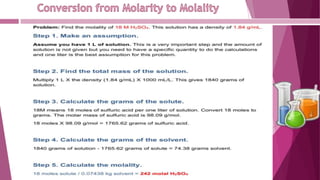
Molarity and Molality
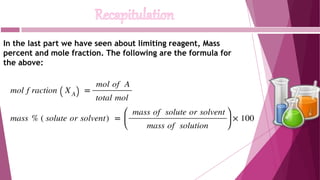
In the last part we have seen about limiting reagent, Mass
percent and mole fraction. The following are the formula for
the above:
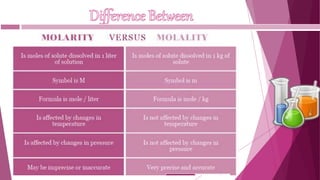
The important part of remembering the difference is:
molarity - M → moles per liter solution
molality - m → moles per kilogram solvent
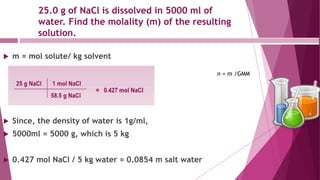
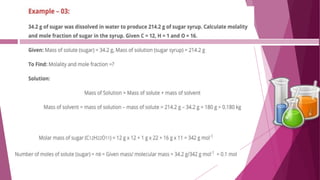
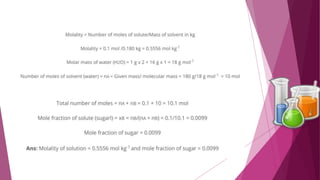
25.0 g of NaCl is dissolved in 5000 ml of
water. Find the molality (m) of the resulting
solution.
 m = mol solute/ kg solvent
 Since, the density of water is 1g/ml,
 5000ml = 5000 g, which is 5 kg
 0.427 mol NaCl / 5 kg water = 0.0854 m salt water
n = m /GMM
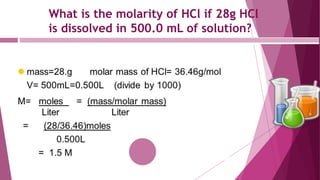
What is the molarity of HCl if 28g HCl
is dissolved in 500.0 mL of solution?
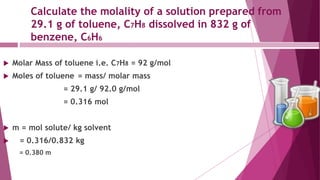
Calculate the molality of a solution prepared from
29.1 g of toluene, C7H8 dissolved in 832 g of
benzene, C6H6
 Molar Mass of toluene i.e. C7H8 = 92 g/mol
 Moles of toluene = mass/ molar mass
= 29.1 g/ 92.0 g/mol
= 0.316 mol
 m = mol solute/ kg solvent
 = 0.316/0.832 kg
= 0.380 m
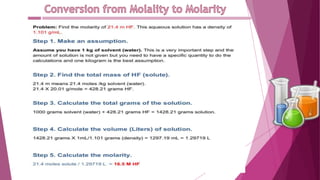
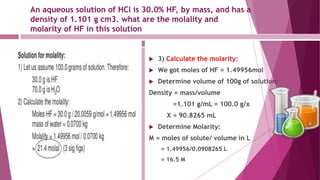
An aqueous solution of HCl is 30.0% HF, by mass, and has a
density of 1.101 g cm3. what are the molality and
molarity of HF in this solution
 3) Calculate the molarity:
 We got moles of HF = 1.49956mol
 Determine volume of 100g of solution:
Density = mass/volume
=1.101 g/mL = 100.0 g/x
X = 90.8265 mL
 Determine Molarity:
M = moles of solute/ volume in L
= 1.49956/0.0908265 L
= 16.5 M
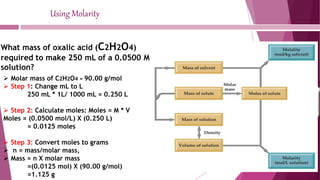
Using Molarity
What mass of oxalic acid (C2H2O4)
required to make 250 mL of a 0.0500 M
solution?
 Molar mass of C2H2O4 = 90.00 g/mol
 Step 1: Change mL to L
250 mL * 1L/ 1000 mL = 0.250 L
 Step 2: Calculate moles: Moles = M * V
Moles = (0.0500 mol/L) X (0.250 L)
= 0.0125 moles
 Step 3: Convert moles to grams
 n = mass/molar mass,
 Mass = n X molar mass
=(0.0125 mol) X (90.00 g/mol)
=1.125 g
Solution:
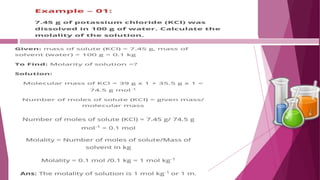
 7.45 g of potassium chloride is dissolved in 100 g of water. What will be the
molality of the solution?
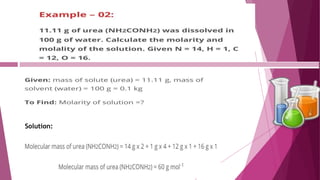
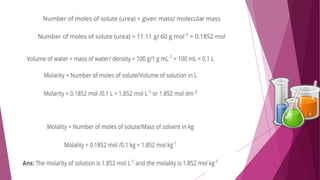
 1.11 g of urea was dissolved in 100 g of water. Calculate the molality of
solution. (N=14, H=1. C=12, O=16]
Class 11 sbcc part XI

Class 11 sbcc part XI

  • 3.
     Stoichiometry Calculations Itincludes- Numerical based on Molarity and Molality
  • 4.
    In the lastpart we have seen about limiting reagent, Mass percent and mole fraction. The following are the formula for the above:
  • 6.
    The important partof remembering the difference is: molarity - M → moles per liter solution molality - m → moles per kilogram solvent
  • 7.
    25.0 g ofNaCl is dissolved in 5000 ml of water. Find the molality (m) of the resulting solution.  m = mol solute/ kg solvent  Since, the density of water is 1g/ml,  5000ml = 5000 g, which is 5 kg  0.427 mol NaCl / 5 kg water = 0.0854 m salt water n = m /GMM
  • 8.
    What is themolarity of HCl if 28g HCl is dissolved in 500.0 mL of solution?
  • 10.
    Calculate the molalityof a solution prepared from 29.1 g of toluene, C7H8 dissolved in 832 g of benzene, C6H6  Molar Mass of toluene i.e. C7H8 = 92 g/mol  Moles of toluene = mass/ molar mass = 29.1 g/ 92.0 g/mol = 0.316 mol  m = mol solute/ kg solvent  = 0.316/0.832 kg = 0.380 m
  • 12.
    An aqueous solutionof HCl is 30.0% HF, by mass, and has a density of 1.101 g cm3. what are the molality and molarity of HF in this solution  3) Calculate the molarity:  We got moles of HF = 1.49956mol  Determine volume of 100g of solution: Density = mass/volume =1.101 g/mL = 100.0 g/x X = 90.8265 mL  Determine Molarity: M = moles of solute/ volume in L = 1.49956/0.0908265 L = 16.5 M
  • 13.
    Using Molarity What massof oxalic acid (C2H2O4) required to make 250 mL of a 0.0500 M solution?  Molar mass of C2H2O4 = 90.00 g/mol  Step 1: Change mL to L 250 mL * 1L/ 1000 mL = 0.250 L  Step 2: Calculate moles: Moles = M * V Moles = (0.0500 mol/L) X (0.250 L) = 0.0125 moles  Step 3: Convert moles to grams  n = mass/molar mass,  Mass = n X molar mass =(0.0125 mol) X (90.00 g/mol) =1.125 g
  • 16.
  • 21.
     7.45 gof potassium chloride is dissolved in 100 g of water. What will be the molality of the solution?  1.11 g of urea was dissolved in 100 g of water. Calculate the molality of solution. (N=14, H=1. C=12, O=16]