Chapter 2
Section 1
Physical or Chemical?
Chemical Reaction?
Chemical Reaction?

       A process that
         produces a
      chemical change
Chemical Equations
Chemical Equations


Substances that
exist before the
reaction begins
Chemical Equations


Substances that    Substances that
exist before the   form as a result
reaction begins     of the reaction
Describe What is Happening
Using Words

Baking Soda + Vinegar
                Gas + White Solid

Charcoal + Oxygen 
                Ash + Gas + Heat
Chemical Names


Acidic Acid + Sodium Hydrogen Carbonate 

    Sodium Acetate + Water + Carbon Dioxide
Chemical Formula’s

CH3COOH + NaHCO3 CH3COONa + H2O + CO2
 Acetic   Sodium      Sodium     Water   Carbon
 Acid     Hydrogen    Acetate            Dioxide
          Carbonate
Arrows and Subscript
It’s All a Balancing Act
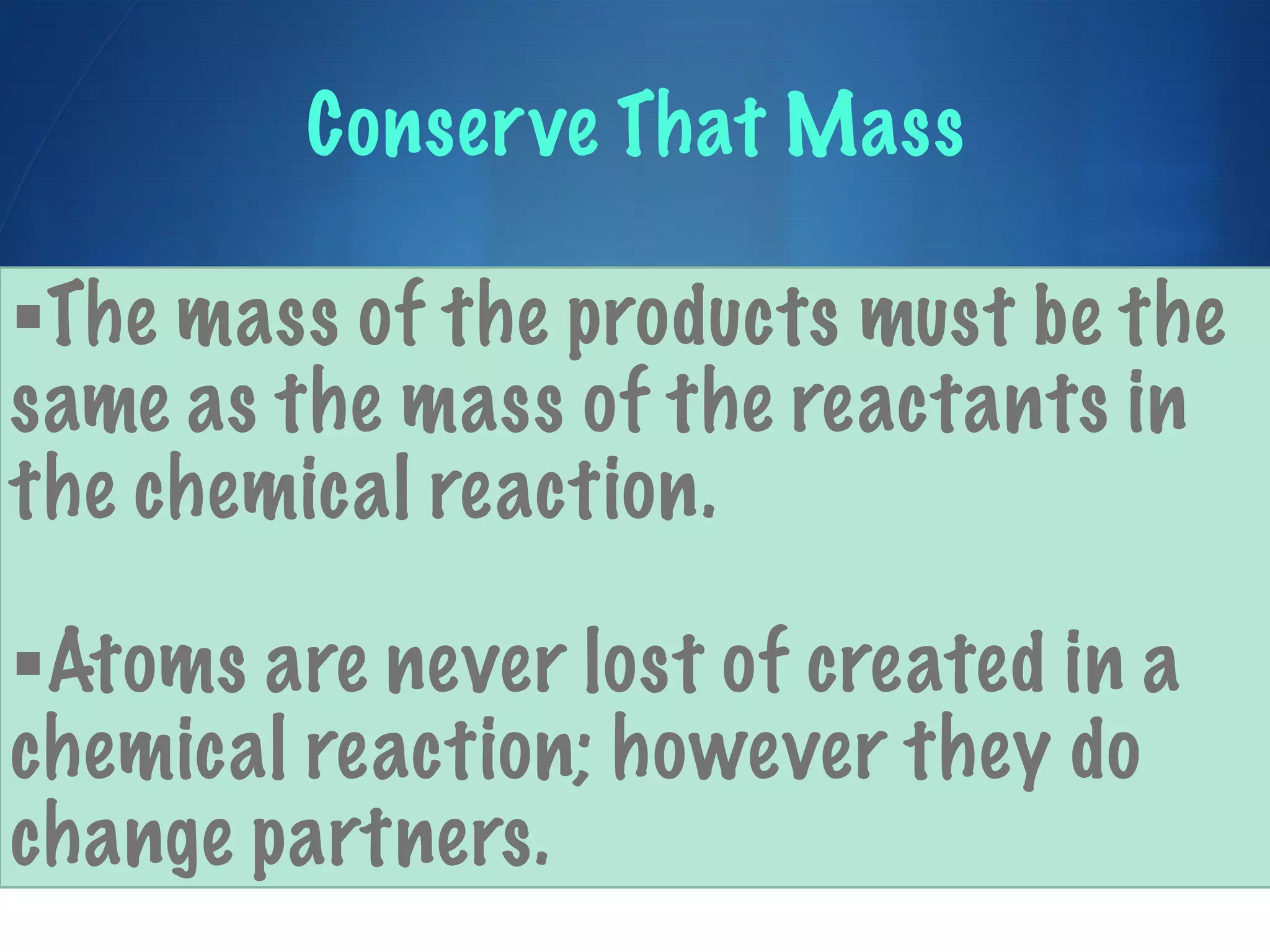
Conserve That Mass
Conserve That Mass

The mass of the products must be the
same as the mass of the reactants in
the chemical reaction.
Conserve That Mass

The mass of the products must be the
same as the mass of the reactants in
the chemical reaction.

Atoms are never lost of created in a
chemical reaction; however they do
change partners.
Conserve That Mass
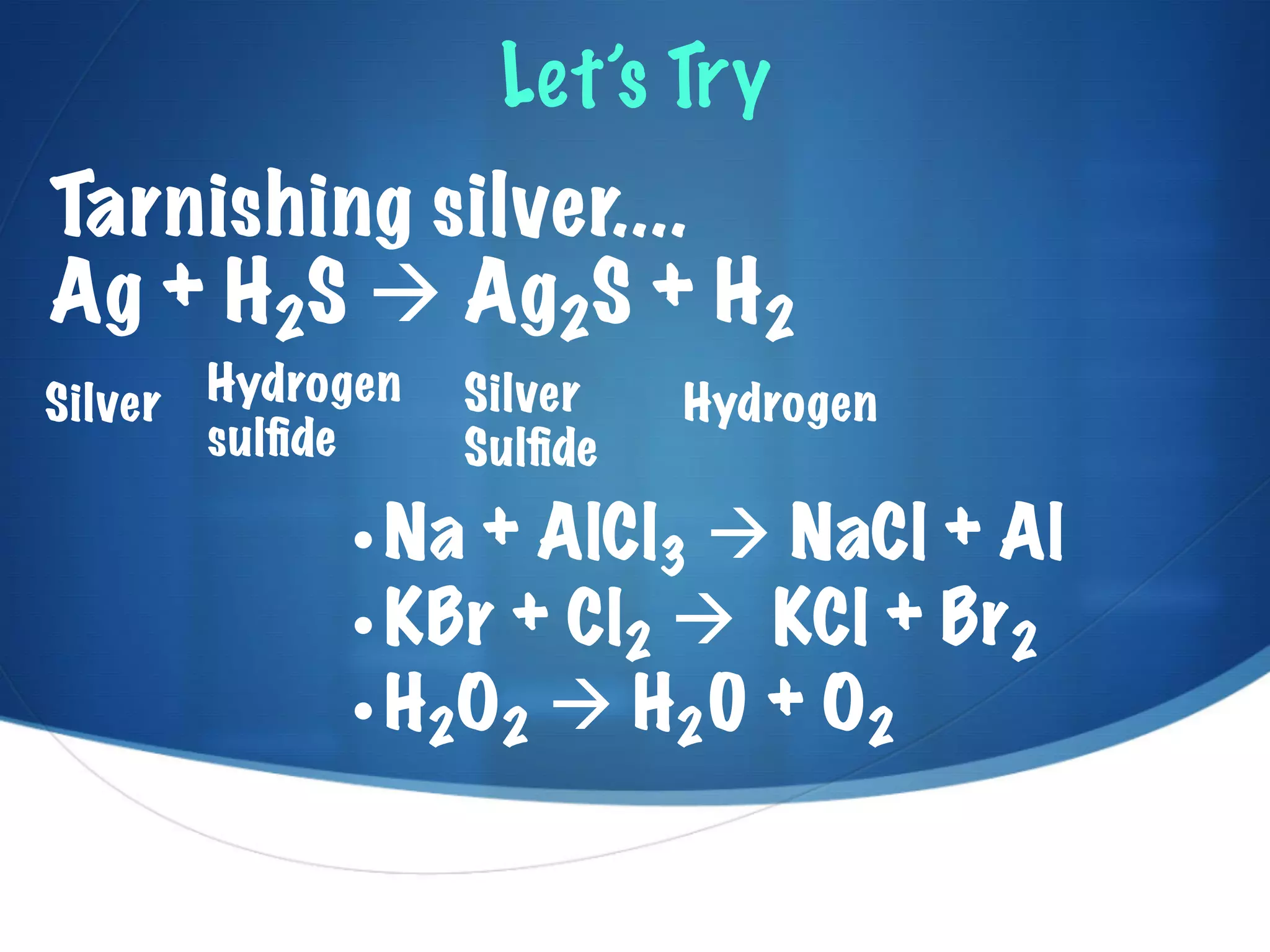
Let’s Try
Tarnishing silver....
Ag + H2S  Ag2S + H2
Silver Hydrogen   Silver   Hydrogen
       sulfide     Sulfide
Let’s Try
Tarnishing silver....
Ag + H2S  Ag2S + H2
Silver Hydrogen   Silver   Hydrogen
       sulfide     Sulfide

            • Na + AlCl3  NaCl + Al
            • KBr + Cl2  KCl + Br2
            • H2O2  H20 + O2
Energy in a Chemical Equation

Energy is often released or
 absorbed during a chemical
 reaction.
Energy Released
Energy Released

 Where does this energy come from?
Energy Released

 Where does this energy come from?
 You have to think about the chemical bonds of
  the reactants and the products, in order to
  answer this question.
Energy Released

 Where does this energy come from?
 You have to think about the chemical bonds of
  the reactants and the products, in order to
  answer this question.
 When energy is released, the products are more
  stable, and their bonds have less energy than
  those of the reactants.
Energy Released

 Where does this energy come from?
 You have to think about the chemical bonds of
  the reactants and the products, in order to
  answer this question.
 When energy is released, the products are more
  stable, and their bonds have less energy than
  those of the reactants.
 The extra energy is released in different forms:
  light, sound, thermal energy
Energy Absorbed
Energy Absorbed


 When energy is absorbed, the reactants are
  more stable, and their bonds have less energy
  than those of the products.
Energy Absorbed


 When energy is absorbed, the reactants are
  more stable, and their bonds have less energy
  than those of the products.
 The extra energy needed to form the products
  can be supplied in the form of electricity, light,
  sound, thermal energy.
Energy Released
2H2 + O2  2H2O + energy
Energy Released
2H2 + O2  2H2O + energy


2H2O + energy  2H2 + O2
Energy Released
2H2 + O2  2H2O + energy

    Energy Absorbed
2H2O + energy  2H2 + O2
When thermal energy is gained or
 lost, special terms are used….
When thermal energy is gained or
 lost, special terms are used….
When thermal energy is gained or
 lost, special terms are used….
When thermal energy is gained or
 lost, special terms are used….


   Absorb           Release
  thermal           thermal
   energy            energy
Endothermic or Exothermic
     Absorb or Release
Adding ENERGY to the equation
Finished!

2.1 Chemical Formulas and Equations