Presented by :-
Jijo George
4th MLT
COPPER
COPPER
• It is a relatively soft yet tough metal with
excellent electrical and heat conducting
properties
• Copper is widely distributed in nature both in
element form and in compounds
• It forms alloys with Zinc, Tin, nickel
• In body contains about 100 mg copper
distributed in different organs.
( muscle, Liver, Bone marrow, Brain, Kidney,
Heart and in Hair )
DIETARY REQUIREMENTS
Adults :- 2-3 mg/day
Infants and children's : 0.5 -2 mg/day
SOURCES
 Liver
 Kidney
 Meat
 Green leafy vegetables
 Egg yolk
 Cereals
 Nuts
 Milk is a poor source
FUNCTIONS
• It is necessary for iron absorption and
incorporation of iron into hemoglobin.
• It is necessary for tyrosine activity
• It is a co-factor for vit.c requiring hydroxylation
• It increases HDL and so protects the heart
• Copper is necessary for the synthesis of
melanin and phospholipids
ABSORPTION
About 10% of dietary copper is absorbed,
mainly in the duodenum
Metallothionein is a transport protein that
facilitates copper absorption
Phytate, Zinc and Molybdenum decreases
copper up take.
EXCRETION
Only 0 to 32 mg of copper is excreted in normal
urine in 24 hours
The daily biliary excretion of copper is 0.5 to 1.3
mg and 0. to 0.3 mg is excreted across the
intestinal mucosa into the bowel lumen
BLOOD COPPER
The normal conc. Of copper in serum is 75-160 mg/100ml
Both red blood cells and serum contain copper
In 80% of red cell copper is present as superoxide
dismutase (erythrocuprein )
The copper in plasma occur in firmly bound and loosely
bound forms.
The firmly bound copper consists of ceruloplasmin.
The loosely bound coper is known as direct reacting
copper and is loosely bound to serum albumin
The plasma copper levels increase in pregnancy because
of their estrogen content
Oral contraceptives have a similar effect.
DISEASE STATES
Copper deficiency :- severe deficiency of copper
cause
Demineralization of bones
Demyelination of neutral tissue
Anemia
Fragility of arteries
Myocardial fibrosis
Hypopigmentation of skin
Greying of hair
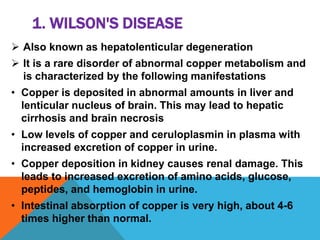
1. WILSON'S DISEASE
 Also known as hepatolenticular degeneration
 It is a rare disorder of abnormal copper metabolism and
is characterized by the following manifestations
• Copper is deposited in abnormal amounts in liver and
lenticular nucleus of brain. This may lead to hepatic
cirrhosis and brain necrosis
• Low levels of copper and ceruloplasmin in plasma with
increased excretion of copper in urine.
• Copper deposition in kidney causes renal damage. This
leads to increased excretion of amino acids, glucose,
peptides, and hemoglobin in urine.
• Intestinal absorption of copper is very high, about 4-6
times higher than normal.
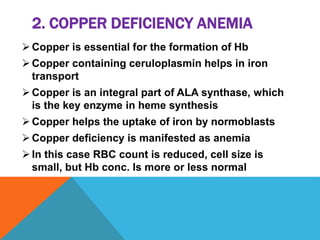
2. COPPER DEFICIENCY ANEMIA
Copper is essential for the formation of Hb
Copper containing ceruloplasmin helps in iron
transport
Copper is an integral part of ALA synthase, which
is the key enzyme in heme synthesis
Copper helps the uptake of iron by normoblasts
Copper deficiency is manifested as anemia
In this case RBC count is reduced, cell size is
small, but Hb conc. Is more or less normal
3. CARDIO VASCULAR DISEASES
 Copper is a constituent of lysyl oxidase
 It oxidize four lysine residues together to form
desmosine which makes cross linkages in
elastin
 In copper deficiency, elastin becomes
abnormal, leading to weakening of walls of
major blood vessels.
 This favors aneurysm and fetal rupture of the
wall of aorta
 Fibrosis of myocardium leading to cardiac
failure.
4. MENKE’S KINKY HAIR SYNDROME
 It is an X-linked disorder of intestinal copper
absorption.
 The absorption of copper and its uptake in the
mucosal cells and its intracellular transport with
in the mucosal cells are normal in patients with
this disease
 But the transport of copper across the serosal
aspect of the mucosal cell membrane is defective
 Symptoms :- mental retardation, temperature
instability, abnormal bone formation and
susceptibility to infection are not to be cured
 The clinical features show that unless therapy is
started promptly at birth.
TREATMENT
Wilson’s disease :- Administration of pencil
amine, a naturally occurring copper chelating
agent
Menke’s disease :- No effective treatment
DETERMINATION OF SERUM COPPER
SODIUM DIETHYL DITHIO CARBAMATE
METHOD
 Principle :-
The copper is released from its linkage
to protein by means of hydrochloric acids, the
proteins precipitated by trichloro acetic acid, and
the copper extracted from protein free fluid
obtained, into an amyl alcohol – ether mixture as a
golden yellow – coloured complex with sodium
diethyl dithio carbamate. The amount of this
formed is read colorimetrically
REAGENTS
HCl – 0.1 N
Hydrochloric acid – 6N
Trichloro acetic acid 20% aqous solution
Sodium pyrophosphate, 6% solution
Ammonia
Sodium diethyl dithio carbomate – 0.4%
solution
Amyl alcohol – ether mixture
Powdered anhydrous sodium sulphate
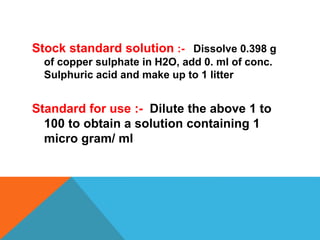
Stock standard solution :- Dissolve 0.398 g
of copper sulphate in H2O, add 0. ml of conc.
Sulphuric acid and make up to 1 litter
Standard for use :- Dilute the above 1 to
100 to obtain a solution containing 1
micro gram/ ml
TECHNIQUE
 To 3 ml of serum add 1 ml of 0.1 N HCl and
warm in boiling water, stirring continuously,
until the mixture begins to cloud
 Cool & then add 1.5 ml of 6 N hydrochloric acid
& stand for 10’
 Add 3 ml of trichloro acetic acid, mix & stand
for few minute and centrifuge.
 Remove the supernatant and wash the
precipitate with 3 ml of 5% trichloro acetic acid
 Centrifuge again and combine the supernatant
fluids
 Add 1 ml of 0.4% sodium di ethyl dithio amyl
alcohol - ether mixture to extract the copper
.
 Remove the amyl alcohol layer and dry by
shaking with a little powdered anhydrous
sodium sulphate
 Read using a violet filter or 440 milli microns.
 Treat 5 ml of standard in the same way as the
serum, and carry through a complete blank,
against which both standard and unknown are
read
CALCULATION
Micrograms copper/100 ml serum = Reading of unknown
×5×100/3
Reading of std
= Reading of unknown
×167
Reading of std
REFERENCE
REFERENCE
Text book of biochemistry for medical students
– D.M Vasudevan & Sreekumari.s, Kannan
vaidyanathan
Fundamentals of biochemistry - AC Deb
Biochemistry – satyanarayana
Clinical chemistry , techniques, principles,
correlations - Michael L. bishop, Edward .P.
fody, Larry .E. schoeff
Practical clinical biochemistry – Haroid Varley
Prepared by
Jijo George
4th MLT
Biochemistry  copper

Biochemistry copper

  • 2.
    Presented by :- JijoGeorge 4th MLT COPPER
  • 3.
    COPPER • It isa relatively soft yet tough metal with excellent electrical and heat conducting properties • Copper is widely distributed in nature both in element form and in compounds • It forms alloys with Zinc, Tin, nickel • In body contains about 100 mg copper distributed in different organs. ( muscle, Liver, Bone marrow, Brain, Kidney, Heart and in Hair )
  • 4.
    DIETARY REQUIREMENTS Adults :-2-3 mg/day Infants and children's : 0.5 -2 mg/day
  • 5.
    SOURCES  Liver  Kidney Meat  Green leafy vegetables  Egg yolk  Cereals  Nuts  Milk is a poor source
  • 6.
    FUNCTIONS • It isnecessary for iron absorption and incorporation of iron into hemoglobin. • It is necessary for tyrosine activity • It is a co-factor for vit.c requiring hydroxylation • It increases HDL and so protects the heart • Copper is necessary for the synthesis of melanin and phospholipids
  • 7.
    ABSORPTION About 10% ofdietary copper is absorbed, mainly in the duodenum Metallothionein is a transport protein that facilitates copper absorption Phytate, Zinc and Molybdenum decreases copper up take.
  • 8.
    EXCRETION Only 0 to32 mg of copper is excreted in normal urine in 24 hours The daily biliary excretion of copper is 0.5 to 1.3 mg and 0. to 0.3 mg is excreted across the intestinal mucosa into the bowel lumen
  • 9.
    BLOOD COPPER The normalconc. Of copper in serum is 75-160 mg/100ml Both red blood cells and serum contain copper In 80% of red cell copper is present as superoxide dismutase (erythrocuprein ) The copper in plasma occur in firmly bound and loosely bound forms. The firmly bound copper consists of ceruloplasmin. The loosely bound coper is known as direct reacting copper and is loosely bound to serum albumin The plasma copper levels increase in pregnancy because of their estrogen content Oral contraceptives have a similar effect.
  • 10.
    DISEASE STATES Copper deficiency:- severe deficiency of copper cause Demineralization of bones Demyelination of neutral tissue Anemia Fragility of arteries Myocardial fibrosis Hypopigmentation of skin Greying of hair
  • 11.
    1. WILSON'S DISEASE Also known as hepatolenticular degeneration  It is a rare disorder of abnormal copper metabolism and is characterized by the following manifestations • Copper is deposited in abnormal amounts in liver and lenticular nucleus of brain. This may lead to hepatic cirrhosis and brain necrosis • Low levels of copper and ceruloplasmin in plasma with increased excretion of copper in urine. • Copper deposition in kidney causes renal damage. This leads to increased excretion of amino acids, glucose, peptides, and hemoglobin in urine. • Intestinal absorption of copper is very high, about 4-6 times higher than normal.
  • 12.
    2. COPPER DEFICIENCYANEMIA Copper is essential for the formation of Hb Copper containing ceruloplasmin helps in iron transport Copper is an integral part of ALA synthase, which is the key enzyme in heme synthesis Copper helps the uptake of iron by normoblasts Copper deficiency is manifested as anemia In this case RBC count is reduced, cell size is small, but Hb conc. Is more or less normal
  • 13.
    3. CARDIO VASCULARDISEASES  Copper is a constituent of lysyl oxidase  It oxidize four lysine residues together to form desmosine which makes cross linkages in elastin  In copper deficiency, elastin becomes abnormal, leading to weakening of walls of major blood vessels.  This favors aneurysm and fetal rupture of the wall of aorta  Fibrosis of myocardium leading to cardiac failure.
  • 14.
    4. MENKE’S KINKYHAIR SYNDROME  It is an X-linked disorder of intestinal copper absorption.  The absorption of copper and its uptake in the mucosal cells and its intracellular transport with in the mucosal cells are normal in patients with this disease  But the transport of copper across the serosal aspect of the mucosal cell membrane is defective  Symptoms :- mental retardation, temperature instability, abnormal bone formation and susceptibility to infection are not to be cured  The clinical features show that unless therapy is started promptly at birth.
  • 15.
    TREATMENT Wilson’s disease :-Administration of pencil amine, a naturally occurring copper chelating agent Menke’s disease :- No effective treatment
  • 16.
  • 17.
    SODIUM DIETHYL DITHIOCARBAMATE METHOD  Principle :- The copper is released from its linkage to protein by means of hydrochloric acids, the proteins precipitated by trichloro acetic acid, and the copper extracted from protein free fluid obtained, into an amyl alcohol – ether mixture as a golden yellow – coloured complex with sodium diethyl dithio carbamate. The amount of this formed is read colorimetrically
  • 18.
    REAGENTS HCl – 0.1N Hydrochloric acid – 6N Trichloro acetic acid 20% aqous solution Sodium pyrophosphate, 6% solution Ammonia Sodium diethyl dithio carbomate – 0.4% solution Amyl alcohol – ether mixture Powdered anhydrous sodium sulphate
  • 19.
    Stock standard solution:- Dissolve 0.398 g of copper sulphate in H2O, add 0. ml of conc. Sulphuric acid and make up to 1 litter Standard for use :- Dilute the above 1 to 100 to obtain a solution containing 1 micro gram/ ml
  • 20.
    TECHNIQUE  To 3ml of serum add 1 ml of 0.1 N HCl and warm in boiling water, stirring continuously, until the mixture begins to cloud  Cool & then add 1.5 ml of 6 N hydrochloric acid & stand for 10’  Add 3 ml of trichloro acetic acid, mix & stand for few minute and centrifuge.  Remove the supernatant and wash the precipitate with 3 ml of 5% trichloro acetic acid  Centrifuge again and combine the supernatant fluids  Add 1 ml of 0.4% sodium di ethyl dithio amyl alcohol - ether mixture to extract the copper .
  • 21.
     Remove theamyl alcohol layer and dry by shaking with a little powdered anhydrous sodium sulphate  Read using a violet filter or 440 milli microns.  Treat 5 ml of standard in the same way as the serum, and carry through a complete blank, against which both standard and unknown are read
  • 22.
    CALCULATION Micrograms copper/100 mlserum = Reading of unknown ×5×100/3 Reading of std = Reading of unknown ×167 Reading of std
  • 23.
  • 24.
    REFERENCE Text book ofbiochemistry for medical students – D.M Vasudevan & Sreekumari.s, Kannan vaidyanathan Fundamentals of biochemistry - AC Deb Biochemistry – satyanarayana Clinical chemistry , techniques, principles, correlations - Michael L. bishop, Edward .P. fody, Larry .E. schoeff Practical clinical biochemistry – Haroid Varley
  • 25.