

We should know at least the
following…..
 Biochemical functions
 Sources and dietary requirements
 Absorption {factors inhibiting and promoting}
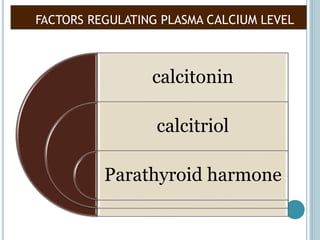
 Factors regulating plasma calcium level
 Excretion of calcium
 Diseased states
BIOCHEMICAL FUNCTIONS
Development of bones and teeth:
* Calcium along with phosphate required for formation of
hydroxyapatite.
* Bone is regarded as a mineralized connective tissue.
* Osteoblasts are responsible for bone formation while
osteoclasts result in demineralization.
Muscle contraction:
* Ca2+ interacts with troponin C to trigger muscle
contraction.
* Calcium activates ATPase, and increases the interaction
between actin and myosin.
BIOCHEMICAL FUNCTIONS
Blood coagulation:
*Several reactions in the cascade of blood clotting
process are dependent on Ca2+(factor lV).
Nerve transmission:
*Calcium is necessary for the transmission of nerve
impulse.
Membrane integrity and permeability:
*Calcium influences the membrane structure and
transport of water and several ions across
 Activation of enzymes :
* Activation of enzymes such as lipase (pancreatic),
ATPase and succinate dehydrogenase.
BIOCHEMICAL FUNCTIONS
Calmodulin mediated action of Calcium:
*Calmodulin is a calcium binding regulatory protein.
*Ca- calmodulin complex activates certain enzymes
- Adenylate cyclase,
-Ca2+ dependent protein kinases.
Calcium as intracellular messenger :
- Certain hormones exert their action through the
mediation of Ca2+ (instead of cAMP).
-Calcium is regarded as a second messenger
Epinephrine in liver glycogenolysis.
-Calcium serves as a third messenger
ADH acts through cAMP, then ca2+.
BIOCHEMICAL FUNCTIONS
Release of hormones :
Facilitates release of certain hormones like
insulin, PTH and calcitonin.
Secretory processes :
Calcium regulates endocytosis, exocytosis and
cell motility.
 Contact inhibition :
Calcium is believed to be involved in cell to cell
contact and adhesion of cells in a tissue.
Action on heart :
Calcium acts on myocardium and prolongs
systole.
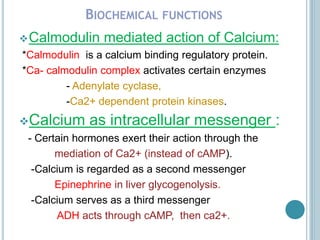
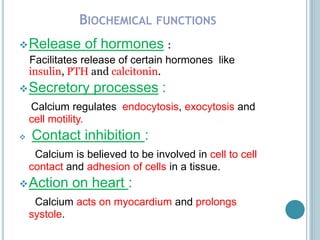
DAILY REQUIREMENTS OF CALCIUM
300-500
mg/day
800
mg/day
1.5g/day
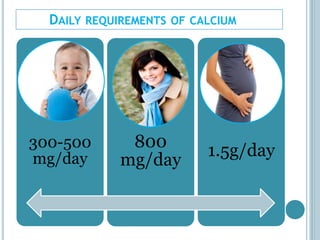
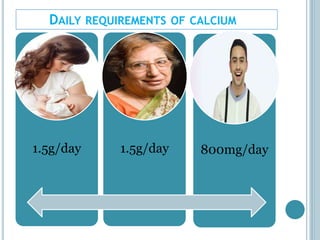
1.5g/day 1.5g/day 800mg/day
DAILY REQUIREMENTS OF CALCIUM
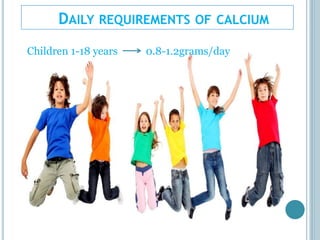
Children 1-18 years 0.8-1.2grams/day
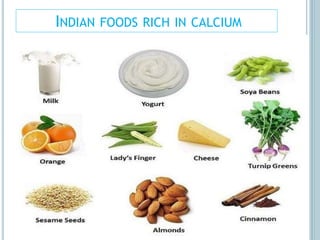
INDIAN FOODS RICH IN CALCIUM
ABSORPTION
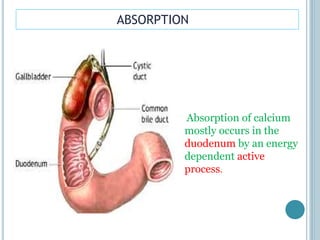
Absorption of calcium
mostly occurs in the
duodenum by an energy
dependent active
process.
FACTORS PROMOTING CALCIUM ABSORPTION
Vitamin-D:
Induces the synthesis of calcium binding protein in the
intestinal epithelial cells and promotes Ca absorption.
 Parathvroid hormone :
Enhances Ca absorption through the increased
synthesis of calcitriol.
 Acidity :
(low pH) is more favorable for Ca absorption.
 Lactose :
promotes calcium uptake by intestinal cells.
 lysine and arginine(amino acids)
Phytates and oxalates:
Form insoluble salts and interfere with Ca absorption.
 dietary phosphate:
Results in the formation of insoluble calcium phosphate
and prevents Ca uptake.
The dietary ratio of Ca and P between 1 : 2 and 2 : 1 is
ideal for optimum Ca absorption by intestinal cells.
 free fatty acids :
React with Ca to form insoluble calcium soaps.
 Alkaline condition (high pH) :
Unfavorable for Ca absorption.
High content of dietary fiber:
Interferes with Ca absorption.
FACTORS INHIBITING CALCIUM ABSORPTION
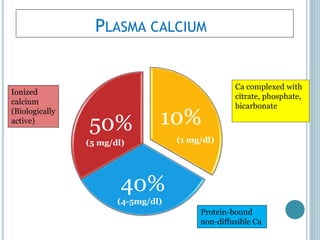
PLASMA CALCIUM
10%
40%
50%
Ca complexed with
citrate, phosphate,
bicarbonate
Protein-bound
non-diffusible Ca
Ionized
calcium
(Biologically
active)
(5 mg/dl) (1 mg/dl)
(4-5mg/dl)
 Normal concentration of plasma or serum Ca is 9-11
mg/dl (4.5-5.5 mEq/l)
 Ionized and citrate (or phosphate) bound Ca is
diffusible from blood to the tissues while protein bound
Ca is non-diffusible.
 Usually laboratory determination of serum Ca, all the
three fractions are measured together.
PLASMA CALCIUM
FACTORS REGULATING PLASMA CALCIUM LEVEL
calcitonin
calcitriol
Parathyroid harmone
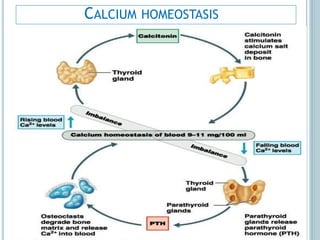
CALCIUM HOMEOSTASIS
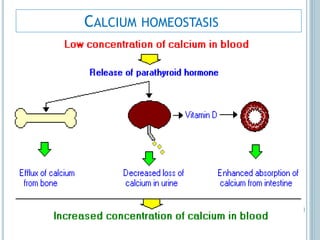
CALCIUM HOMEOSTASIS
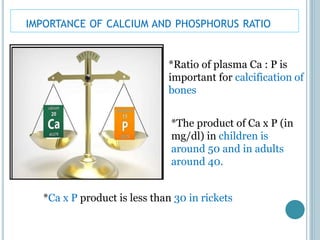
IMPORTANCE OF CALCIUM AND PHOSPHORUS RATIO
*Ratio of plasma Ca : P is
important for calcification of
bones
*The product of Ca x P (in
mg/dl) in children is
around 50 and in adults
around 40.
*Ca x P product is less than 30 in rickets
EXCRETION OF CALCIUM
 Partly through the kidneys and mostly through the
intestine.
 Renal threshold for serum Ca is 10 mgldl.
 Ingestion of excess protein causes increase in the
acidity of urine.
 Hence as a result of high protein diet ,increased
calcium excretion is seen in urine.
 Excretion of Ca into the feces is a continuous process
and this is increased in vitamin D deficiency.
CALCIUM IN TEETH
*The teeth calcium is not subjected to
regulation as observed for bone calcium.
*The adult teeth, once formed, do
not undergo decalcification to meet
the body needs of calcium.
* Proper calcification of teeth is
important in the growing children.
DISEASED STATES OF CALCIUM
 Hypercalcemia
 Hypocalcemia
 Rickets
 Renal rickets
 Osteoporosis
 Osteopetrosis
HYPERCALCEMIA
 Elevation in serum Ca level >11 mg/dl.
 Hypercalcemia is associated with hyperparathyroidism
caused by increased activity of parathyroid glands.
 Decrease in serum phosphate (due to increasedrenal
losses) and increase in alkaline phosphatase activity are
also found in hyperparathyroidism.
 Elevation in the urinary excretion of Ca and P, often
resulting in the formation of urinary calculi
 Determination of ionized serum calcium (elevated to 6-
9mg/dl) is more useful for the diagnosis of
hyperparathyroidism.
SYMPTOMS OF HYPERCALCEMIA
 Lethargy
 muscle weakness
 loss of appetite
 Constipation
 Nausea
 increased myocardial contractility
 and susceptibility to fractures.
HYPOCALCEMIA
 Hypocalcemia is a more serious and life threatening
condition.
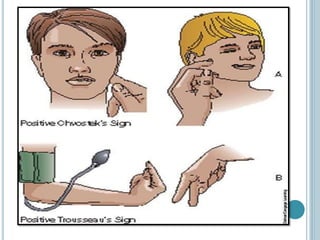
 Fall in the serum Ca to below 7 mg/dl, causing tetany
 Hypocalcemia is mostly due to hypoparathyroidism.
 May happen after an accidental surgical removal of
parathyroid glands or due to an autoimmune disease.
 symptoms of tetany include neuromuscular irritability,
spasms and convulsions.
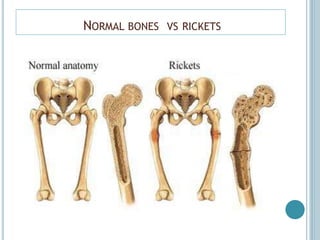
RICKETS
 Disorder of defective calcification of bones.
 Rickets may be due to a low levels of vitamin D in the
body or due to a dietary deficiencv of Ca and P or
both.
 Serum Ca and P may be low or normal.
 An increase in the activity of alkaline phosphatase is
a characteristic feature of rickets.
NORMAL BONES VS RICKETS
RENAL RICKETS
 Renal rickets is associated with damage to renal
tissue, causing impairment in the synthesis of
calcitriol.
 Does not respond to vitamin D in ordinary doses,
therefore, some workers regard this as vitamin D
resistant rickets.
 Renal rickets can be treated bv administration of
calcitriol.
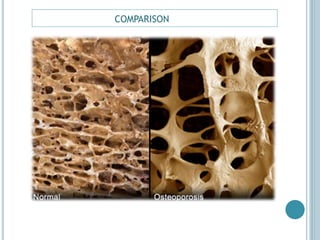
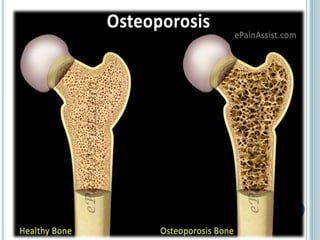
OSTEOPOROSIS
 Characterized by demineralization of bone resulting
in the progressive loss of bone mass.
 Elderly people (over 60 yr.) of both sexes are at risk
for osteoporosis.
 Predominantly occurs in the post-menopausal
women.
 Frequent bone fractures which are a major cause of
disability among the elderly.
 Etiology of osteoporosis is largely unknown.
 several causative factors may contribute to it.
 Deficiency of sex hormones (in women) has been
implicated in the development of osteoporosis.
 The ability to produce calcitriol from vitamin D is
decreased with age, particularly in the postmenopausal
women.
 Immobilized or sedentary individuals are more prone for
osteoporosis.
 Estrogen administration along with calcium
supplementation (in combination with vitamin D) to
postmenopausal women reduces the risk of fracture.
 Higher dietary intake of Ca (about 1.5 g/day) is
recommended for elderly people.
COMPARISON
OSTEOPETROSIS
(MARBLE BONE DISEASE)
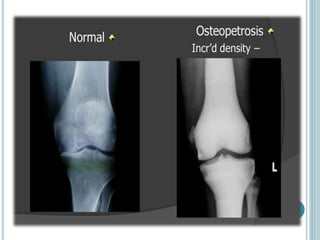
 Osteopetrosis is characterized by increased bone
density.
 primarily due to inability to resorb bone.
 This disorder is mostly observed in association with
renal tubular acidosis (due to a defect in the enzyme
carbonic anhydrase) and cerebral calcification.
CALCIUM AND ITS CLINICAL IIMPORTANCE

CALCIUM AND ITS CLINICAL IIMPORTANCE

  • 2.
    We should knowat least the following…..  Biochemical functions  Sources and dietary requirements  Absorption {factors inhibiting and promoting}  Factors regulating plasma calcium level  Excretion of calcium  Diseased states
  • 3.
    BIOCHEMICAL FUNCTIONS Development ofbones and teeth: * Calcium along with phosphate required for formation of hydroxyapatite. * Bone is regarded as a mineralized connective tissue. * Osteoblasts are responsible for bone formation while osteoclasts result in demineralization. Muscle contraction: * Ca2+ interacts with troponin C to trigger muscle contraction. * Calcium activates ATPase, and increases the interaction between actin and myosin.
  • 4.
    BIOCHEMICAL FUNCTIONS Blood coagulation: *Severalreactions in the cascade of blood clotting process are dependent on Ca2+(factor lV). Nerve transmission: *Calcium is necessary for the transmission of nerve impulse. Membrane integrity and permeability: *Calcium influences the membrane structure and transport of water and several ions across  Activation of enzymes : * Activation of enzymes such as lipase (pancreatic), ATPase and succinate dehydrogenase.
  • 5.
    BIOCHEMICAL FUNCTIONS Calmodulin mediatedaction of Calcium: *Calmodulin is a calcium binding regulatory protein. *Ca- calmodulin complex activates certain enzymes - Adenylate cyclase, -Ca2+ dependent protein kinases. Calcium as intracellular messenger : - Certain hormones exert their action through the mediation of Ca2+ (instead of cAMP). -Calcium is regarded as a second messenger Epinephrine in liver glycogenolysis. -Calcium serves as a third messenger ADH acts through cAMP, then ca2+.
  • 6.
    BIOCHEMICAL FUNCTIONS Release ofhormones : Facilitates release of certain hormones like insulin, PTH and calcitonin. Secretory processes : Calcium regulates endocytosis, exocytosis and cell motility.  Contact inhibition : Calcium is believed to be involved in cell to cell contact and adhesion of cells in a tissue. Action on heart : Calcium acts on myocardium and prolongs systole.
  • 7.
    DAILY REQUIREMENTS OFCALCIUM 300-500 mg/day 800 mg/day 1.5g/day
  • 8.
    1.5g/day 1.5g/day 800mg/day DAILYREQUIREMENTS OF CALCIUM
  • 9.
    DAILY REQUIREMENTS OFCALCIUM Children 1-18 years 0.8-1.2grams/day
  • 10.
  • 12.
    ABSORPTION Absorption of calcium mostlyoccurs in the duodenum by an energy dependent active process.
  • 13.
    FACTORS PROMOTING CALCIUMABSORPTION Vitamin-D: Induces the synthesis of calcium binding protein in the intestinal epithelial cells and promotes Ca absorption.  Parathvroid hormone : Enhances Ca absorption through the increased synthesis of calcitriol.  Acidity : (low pH) is more favorable for Ca absorption.  Lactose : promotes calcium uptake by intestinal cells.  lysine and arginine(amino acids)
  • 14.
    Phytates and oxalates: Forminsoluble salts and interfere with Ca absorption.  dietary phosphate: Results in the formation of insoluble calcium phosphate and prevents Ca uptake. The dietary ratio of Ca and P between 1 : 2 and 2 : 1 is ideal for optimum Ca absorption by intestinal cells.  free fatty acids : React with Ca to form insoluble calcium soaps.  Alkaline condition (high pH) : Unfavorable for Ca absorption. High content of dietary fiber: Interferes with Ca absorption. FACTORS INHIBITING CALCIUM ABSORPTION
  • 15.
    PLASMA CALCIUM 10% 40% 50% Ca complexedwith citrate, phosphate, bicarbonate Protein-bound non-diffusible Ca Ionized calcium (Biologically active) (5 mg/dl) (1 mg/dl) (4-5mg/dl)
  • 16.
     Normal concentrationof plasma or serum Ca is 9-11 mg/dl (4.5-5.5 mEq/l)  Ionized and citrate (or phosphate) bound Ca is diffusible from blood to the tissues while protein bound Ca is non-diffusible.  Usually laboratory determination of serum Ca, all the three fractions are measured together. PLASMA CALCIUM
  • 17.
    FACTORS REGULATING PLASMACALCIUM LEVEL calcitonin calcitriol Parathyroid harmone
  • 18.
  • 19.
  • 20.
    IMPORTANCE OF CALCIUMAND PHOSPHORUS RATIO *Ratio of plasma Ca : P is important for calcification of bones *The product of Ca x P (in mg/dl) in children is around 50 and in adults around 40. *Ca x P product is less than 30 in rickets
  • 21.
    EXCRETION OF CALCIUM Partly through the kidneys and mostly through the intestine.  Renal threshold for serum Ca is 10 mgldl.  Ingestion of excess protein causes increase in the acidity of urine.  Hence as a result of high protein diet ,increased calcium excretion is seen in urine.  Excretion of Ca into the feces is a continuous process and this is increased in vitamin D deficiency.
  • 22.
    CALCIUM IN TEETH *Theteeth calcium is not subjected to regulation as observed for bone calcium. *The adult teeth, once formed, do not undergo decalcification to meet the body needs of calcium. * Proper calcification of teeth is important in the growing children.
  • 23.
    DISEASED STATES OFCALCIUM  Hypercalcemia  Hypocalcemia  Rickets  Renal rickets  Osteoporosis  Osteopetrosis
  • 24.
    HYPERCALCEMIA  Elevation inserum Ca level >11 mg/dl.  Hypercalcemia is associated with hyperparathyroidism caused by increased activity of parathyroid glands.  Decrease in serum phosphate (due to increasedrenal losses) and increase in alkaline phosphatase activity are also found in hyperparathyroidism.  Elevation in the urinary excretion of Ca and P, often resulting in the formation of urinary calculi  Determination of ionized serum calcium (elevated to 6- 9mg/dl) is more useful for the diagnosis of hyperparathyroidism.
  • 25.
    SYMPTOMS OF HYPERCALCEMIA Lethargy  muscle weakness  loss of appetite  Constipation  Nausea  increased myocardial contractility  and susceptibility to fractures.
  • 26.
    HYPOCALCEMIA  Hypocalcemia isa more serious and life threatening condition.  Fall in the serum Ca to below 7 mg/dl, causing tetany  Hypocalcemia is mostly due to hypoparathyroidism.  May happen after an accidental surgical removal of parathyroid glands or due to an autoimmune disease.  symptoms of tetany include neuromuscular irritability, spasms and convulsions.
  • 28.
    RICKETS  Disorder ofdefective calcification of bones.  Rickets may be due to a low levels of vitamin D in the body or due to a dietary deficiencv of Ca and P or both.  Serum Ca and P may be low or normal.  An increase in the activity of alkaline phosphatase is a characteristic feature of rickets.
  • 29.
  • 30.
    RENAL RICKETS  Renalrickets is associated with damage to renal tissue, causing impairment in the synthesis of calcitriol.  Does not respond to vitamin D in ordinary doses, therefore, some workers regard this as vitamin D resistant rickets.  Renal rickets can be treated bv administration of calcitriol.
  • 31.
    OSTEOPOROSIS  Characterized bydemineralization of bone resulting in the progressive loss of bone mass.  Elderly people (over 60 yr.) of both sexes are at risk for osteoporosis.  Predominantly occurs in the post-menopausal women.  Frequent bone fractures which are a major cause of disability among the elderly.  Etiology of osteoporosis is largely unknown.  several causative factors may contribute to it.  Deficiency of sex hormones (in women) has been implicated in the development of osteoporosis.
  • 32.
     The abilityto produce calcitriol from vitamin D is decreased with age, particularly in the postmenopausal women.  Immobilized or sedentary individuals are more prone for osteoporosis.  Estrogen administration along with calcium supplementation (in combination with vitamin D) to postmenopausal women reduces the risk of fracture.  Higher dietary intake of Ca (about 1.5 g/day) is recommended for elderly people.
  • 33.
  • 35.
    OSTEOPETROSIS (MARBLE BONE DISEASE) Osteopetrosis is characterized by increased bone density.  primarily due to inability to resorb bone.  This disorder is mostly observed in association with renal tubular acidosis (due to a defect in the enzyme carbonic anhydrase) and cerebral calcification.