CALCIUM HOMEOSTATIS
OVERVIEW
Intro.
Absorption.
Function.
Regulation of calcium homeostasis:
 PTH.
 Vitamin D.
 Calcitonin.
Hypocalcaemia.
Hypercalcaemia.
References.
INTRO
Fifth most common element in the body.
99% present in skeleton (reservoir).
1% intracellular.
0.1% extracellular.
Forms of Ca in the blood:
 50% is free ionised calcium.
 40% is protein bound (mainly albumin).
 10% is complexed to small diffusible ligands (e.g. bicarbonate,
citrate, phosphate, lactate and sulphate).
Normal level 2.20 -2.6 mmol/L.
ABSORPTION
Widely distributed in food substances e.g. Milk, Cheese, Egg-yolk,
Fish , Beans, and Lentils.
The 2 mechanisms of intestinal absorption of calcium are:
 Active: is a saturable, transcellular process which involves calbindin
(calcium-binding protein) – regulated by the active form of vitamin D.
 Passive: is a nonsaturable, paracellular low efficiency process, which is
not affected by calcium status or parathyroid hormone.
 Both processes occur throughout the small intestine.
 Absorption is related to calcium intake.
ABSORPTION
Factors stimulating calcium absorption:
An acidic pH.
High protein diet – Lysine and Arginine cause maximal absorption.
Presence of vitamin D.
State of health and intact mucosa.
PTH stimulates the activation of vitamin D, consequently indirectly
increasing absorption of Calcium.
ABSORPTION
Factors inhibiting calcium absorption:
Alkaline pH
High fat diet – fatty acids form calcium soaps that cannot be
absorbed.
Excess phosphates, magnesium and iron.
Glucocorticoids reduce intestinal absorption of calcium.
Calcitonin decreases calcium absorption indirectly by inhibiting the
activation of vitamin D.
Advancing age and intestinal inflammatory disorders.
FUNCTION
 Major structural element in the bones and teeth.
Essenial for several physiological processes such as neuromuscular
transmission, smooth, skeletal, and cardiac muscle contractions,
nerve function, and cell division and movement.
Co-factor in Blood coagulation.
Plays an important role in the action of other intracellular
messengers e.g. cyclic adenosine monophosphate (cAMP) and
Inositol -triphosphate, which are responsible for mediating the
cellular response to various hormones including epinephrine,
glucagon, ADH, and secretin.
Release of neurotransmiters and hormones.
REGULATION OF CALCIUM HOMEASTASIS
The 3 main hormones involved in the homeostatic regulation:
PTH
Vitamin D
Calcitonin
Acting at 3 target organs: intestine, bone and kidneys.
PTH
Polypeptide containing 84 amino acids residues.
Secreted by the chief cells in the 4 parathyroid glands.
Part of a negative feedback loop to maintain calcium ions in the
extracellular fluid.
 In hypocalcaemia, parathyroid hormone secretion is stimulated.
 In hypercalacaemia, secretion is inhibited, and the calcium is deposited in the
bones.
PTH increases serum calcium levels through:
 Increasing bone resorption by activating osteoclastic activity.
 Increasing renal calcium reabsorption by the distal renal tubules.
 Increasing renal phosphate excretion by decreasing tubule phosphate reabsorption.
 Increasing the synthesis of 1,25-dihydroxyvitamin D (also called calcitriol) by
increasing the activity of alpha-hydroxylase enzyme in the kidney.
VITAMIN D

Group of closely related sterols produced by the action of UV
light.

Vitamin D3 (also called Cholecalciferol) is produced by the
action of sunlight and is hydroxylated to 25-hydroxy-
cholecalciferol (25-HCC) in the liver.

Further hydroxylation of 25-HCC occurs in the proximal
tubules of the kidney to form the active metabolite, 1,25-
hydroxy-cholecalciferol (1,25-DHCC) or calcitriol.

Calcitriol's formation is facilitated by PTH.
VITAMIN D
Vitamin D maintains calcium homeostasis by:
-Increasing calcium absorption from the intestine (by interacting with a
calcitriol receptor located in intestinal epithelial cells.
-Stimulating renal tubular reabsorption of calcium.
-Increasing bone calcification and mineralisation (by acting on
osteoclasts in the bone)
CALCITONIN
 32 amino acid polypeptide secreted by the parafollicular cells in
the thyroid gland.
 Major stimulus for calcitonin secretion is increased serum calcium.
 The major action of calcitonin is to inhibit osteoclastic bone
resorption, which decreases the serum calcium concentration.
 Clinical use:
 Used in the treatment of Paget's diease.
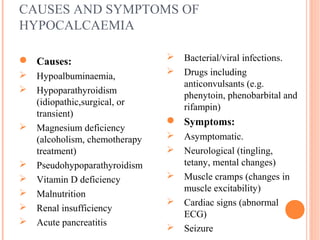
CAUSES AND SYMPTOMS OF
HYPOCALCAEMIA
 Causes:
 Hypoalbuminaemia,
 Hypoparathyroidism
(idiopathic,surgical, or
transient)
 Magnesium deficiency
(alcoholism, chemotherapy
treatment)
 Pseudohypoparathyroidism
 Vitamin D deficiency
 Malnutrition
 Renal insufficiency
 Acute pancreatitis
 Bacterial/viral infections.
 Drugs including
anticonvulsants (e.g.
phenytoin, phenobarbital and
rifampin)
 Symptoms:
 Asymptomatic.
 Neurological (tingling,
tetany, mental changes)
 Muscle cramps (changes in
muscle excitability)
 Cardiac signs (abnormal
ECG)
 Seizure
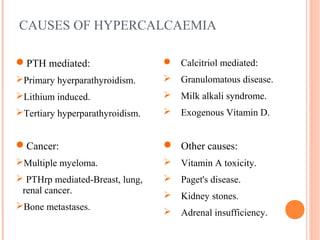
CAUSES OF HYPERCALCAEMIA
PTH mediated:
Primary hyerparathyroidism.
Lithium induced.
Tertiary hyperparathyroidism.
 Calcitriol mediated:
 Granulomatous disease.
 Milk alkali syndrome.
 Exogenous Vitamin D.
 Other causes:
 Vitamin A toxicity.
 Paget's disease.
 Kidney stones.
 Adrenal insufficiency.
Cancer:
Multiple myeloma.
 PTHrp mediated-Breast, lung,
renal cancer.
Bone metastases.
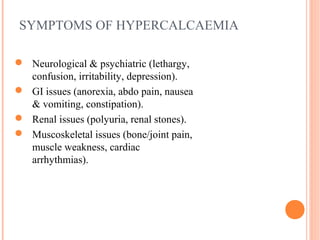
SYMPTOMS OF HYPERCALCAEMIA
 Neurological & psychiatric (lethargy,
confusion, irritability, depression).
 GI issues (anorexia, abdo pain, nausea
& vomiting, constipation).
 Renal issues (polyuria, renal stones).
 Muscoskeletal issues (bone/joint pain,
muscle weakness, cardiac
arrhythmias).
DIAGNOSIS
Total (amended) Calcium
amended[Ca]=measured total[Ca]+0.02(40-[albumin])
Albumin
PTH ( high hypocalcaemia, low hypercalcaemia)
Vitamin D (high hypocalcaemia, low hypercalcaemia)
LFT (ALP is raised hypercalcaemia and normal in hypocalcaemia)
(Phos raised in hypocalcaemia and low in hypercalcaemia)
U&E (urea and creatinine increased in hypercalcaemia)
Iron (raised in hypocalcaemia)
PH (Acidosis increases calcium and alkalosis decreases calicum)
24-hour urinary calcium (elevated in hyperparathyroidism, renal
failure and decreased in hypoparathyroidism, malabsorption disorders)
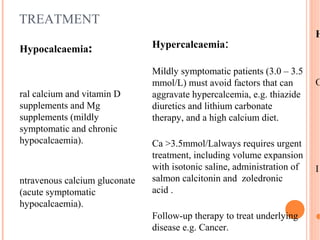
TREATMENT
H
Hypocalcaemia:
O
ral calcium and vitamin D
supplements and Mg
supplements (mildly
symptomatic and chronic
hypocalcaemia).
I
ntravenous calcium gluconate
(acute symptomatic
hypocalcaemia).

Hypercalcaemia:
Mildly symptomatic patients (3.0 – 3.5
mmol/L) must avoid factors that can
aggravate hypercalcemia, e.g. thiazide
diuretics and lithium carbonate
therapy, and a high calcium diet.
Ca >3.5mmol/Lalways requires urgent
treatment, including volume expansion
with isotonic saline, administration of
salmon calcitonin and zoledronic
acid .
Follow-up therapy to treat underlying
disease e.g. Cancer.
References

Baynes J. (1999) Medical Biochemistry. Basildon.Harcourt Brace and
Company Limited.

Baker S. et al.(2002) The essentials of Calcium, Magnesium and Phosphate
Metabolism. Critical Care and resuscitation. 4(4) pp. 301-306.[online]

Nessar A. (2010) Clinical Biochemistry. New York. Oxford University Press.

Mundy G. et al. (1999) Hormonal Control of Calcium Homeostasis, Clinical
Chemistry, 45 (8), pp.1347-1352.

Warrel D. et al.(2003) Oxford Textbook of Medicine. London.Oxford University
Press.[online]

Peacock M. (2010) Calcium Metabolism in Health and Disease, Clinical
Journal of American Society of Nephrology,5(1), pp. 23-30.[online]

Calcium homeostasis

  • 1.
  • 2.
    OVERVIEW Intro. Absorption. Function. Regulation of calciumhomeostasis:  PTH.  Vitamin D.  Calcitonin. Hypocalcaemia. Hypercalcaemia. References.
  • 3.
    INTRO Fifth most commonelement in the body. 99% present in skeleton (reservoir). 1% intracellular. 0.1% extracellular. Forms of Ca in the blood:  50% is free ionised calcium.  40% is protein bound (mainly albumin).  10% is complexed to small diffusible ligands (e.g. bicarbonate, citrate, phosphate, lactate and sulphate). Normal level 2.20 -2.6 mmol/L.
  • 4.
    ABSORPTION Widely distributed infood substances e.g. Milk, Cheese, Egg-yolk, Fish , Beans, and Lentils. The 2 mechanisms of intestinal absorption of calcium are:  Active: is a saturable, transcellular process which involves calbindin (calcium-binding protein) – regulated by the active form of vitamin D.  Passive: is a nonsaturable, paracellular low efficiency process, which is not affected by calcium status or parathyroid hormone.  Both processes occur throughout the small intestine.  Absorption is related to calcium intake.
  • 5.
    ABSORPTION Factors stimulating calciumabsorption: An acidic pH. High protein diet – Lysine and Arginine cause maximal absorption. Presence of vitamin D. State of health and intact mucosa. PTH stimulates the activation of vitamin D, consequently indirectly increasing absorption of Calcium.
  • 6.
    ABSORPTION Factors inhibiting calciumabsorption: Alkaline pH High fat diet – fatty acids form calcium soaps that cannot be absorbed. Excess phosphates, magnesium and iron. Glucocorticoids reduce intestinal absorption of calcium. Calcitonin decreases calcium absorption indirectly by inhibiting the activation of vitamin D. Advancing age and intestinal inflammatory disorders.
  • 7.
    FUNCTION  Major structuralelement in the bones and teeth. Essenial for several physiological processes such as neuromuscular transmission, smooth, skeletal, and cardiac muscle contractions, nerve function, and cell division and movement. Co-factor in Blood coagulation. Plays an important role in the action of other intracellular messengers e.g. cyclic adenosine monophosphate (cAMP) and Inositol -triphosphate, which are responsible for mediating the cellular response to various hormones including epinephrine, glucagon, ADH, and secretin. Release of neurotransmiters and hormones.
  • 8.
    REGULATION OF CALCIUMHOMEASTASIS The 3 main hormones involved in the homeostatic regulation: PTH Vitamin D Calcitonin Acting at 3 target organs: intestine, bone and kidneys.
  • 9.
    PTH Polypeptide containing 84amino acids residues. Secreted by the chief cells in the 4 parathyroid glands. Part of a negative feedback loop to maintain calcium ions in the extracellular fluid.  In hypocalcaemia, parathyroid hormone secretion is stimulated.  In hypercalacaemia, secretion is inhibited, and the calcium is deposited in the bones. PTH increases serum calcium levels through:  Increasing bone resorption by activating osteoclastic activity.  Increasing renal calcium reabsorption by the distal renal tubules.  Increasing renal phosphate excretion by decreasing tubule phosphate reabsorption.  Increasing the synthesis of 1,25-dihydroxyvitamin D (also called calcitriol) by increasing the activity of alpha-hydroxylase enzyme in the kidney.
  • 10.
    VITAMIN D  Group ofclosely related sterols produced by the action of UV light.  Vitamin D3 (also called Cholecalciferol) is produced by the action of sunlight and is hydroxylated to 25-hydroxy- cholecalciferol (25-HCC) in the liver.  Further hydroxylation of 25-HCC occurs in the proximal tubules of the kidney to form the active metabolite, 1,25- hydroxy-cholecalciferol (1,25-DHCC) or calcitriol.  Calcitriol's formation is facilitated by PTH.
  • 11.
    VITAMIN D Vitamin Dmaintains calcium homeostasis by: -Increasing calcium absorption from the intestine (by interacting with a calcitriol receptor located in intestinal epithelial cells. -Stimulating renal tubular reabsorption of calcium. -Increasing bone calcification and mineralisation (by acting on osteoclasts in the bone)
  • 12.
    CALCITONIN  32 aminoacid polypeptide secreted by the parafollicular cells in the thyroid gland.  Major stimulus for calcitonin secretion is increased serum calcium.  The major action of calcitonin is to inhibit osteoclastic bone resorption, which decreases the serum calcium concentration.  Clinical use:  Used in the treatment of Paget's diease.
  • 13.
    CAUSES AND SYMPTOMSOF HYPOCALCAEMIA  Causes:  Hypoalbuminaemia,  Hypoparathyroidism (idiopathic,surgical, or transient)  Magnesium deficiency (alcoholism, chemotherapy treatment)  Pseudohypoparathyroidism  Vitamin D deficiency  Malnutrition  Renal insufficiency  Acute pancreatitis  Bacterial/viral infections.  Drugs including anticonvulsants (e.g. phenytoin, phenobarbital and rifampin)  Symptoms:  Asymptomatic.  Neurological (tingling, tetany, mental changes)  Muscle cramps (changes in muscle excitability)  Cardiac signs (abnormal ECG)  Seizure
  • 14.
    CAUSES OF HYPERCALCAEMIA PTHmediated: Primary hyerparathyroidism. Lithium induced. Tertiary hyperparathyroidism.  Calcitriol mediated:  Granulomatous disease.  Milk alkali syndrome.  Exogenous Vitamin D.  Other causes:  Vitamin A toxicity.  Paget's disease.  Kidney stones.  Adrenal insufficiency. Cancer: Multiple myeloma.  PTHrp mediated-Breast, lung, renal cancer. Bone metastases.
  • 15.
    SYMPTOMS OF HYPERCALCAEMIA Neurological & psychiatric (lethargy, confusion, irritability, depression).  GI issues (anorexia, abdo pain, nausea & vomiting, constipation).  Renal issues (polyuria, renal stones).  Muscoskeletal issues (bone/joint pain, muscle weakness, cardiac arrhythmias).
  • 16.
    DIAGNOSIS Total (amended) Calcium amended[Ca]=measuredtotal[Ca]+0.02(40-[albumin]) Albumin PTH ( high hypocalcaemia, low hypercalcaemia) Vitamin D (high hypocalcaemia, low hypercalcaemia) LFT (ALP is raised hypercalcaemia and normal in hypocalcaemia) (Phos raised in hypocalcaemia and low in hypercalcaemia) U&E (urea and creatinine increased in hypercalcaemia) Iron (raised in hypocalcaemia) PH (Acidosis increases calcium and alkalosis decreases calicum) 24-hour urinary calcium (elevated in hyperparathyroidism, renal failure and decreased in hypoparathyroidism, malabsorption disorders)
  • 17.
    TREATMENT H Hypocalcaemia: O ral calcium andvitamin D supplements and Mg supplements (mildly symptomatic and chronic hypocalcaemia). I ntravenous calcium gluconate (acute symptomatic hypocalcaemia).  Hypercalcaemia: Mildly symptomatic patients (3.0 – 3.5 mmol/L) must avoid factors that can aggravate hypercalcemia, e.g. thiazide diuretics and lithium carbonate therapy, and a high calcium diet. Ca >3.5mmol/Lalways requires urgent treatment, including volume expansion with isotonic saline, administration of salmon calcitonin and zoledronic acid . Follow-up therapy to treat underlying disease e.g. Cancer.
  • 18.
    References  Baynes J. (1999)Medical Biochemistry. Basildon.Harcourt Brace and Company Limited.  Baker S. et al.(2002) The essentials of Calcium, Magnesium and Phosphate Metabolism. Critical Care and resuscitation. 4(4) pp. 301-306.[online]  Nessar A. (2010) Clinical Biochemistry. New York. Oxford University Press.  Mundy G. et al. (1999) Hormonal Control of Calcium Homeostasis, Clinical Chemistry, 45 (8), pp.1347-1352.  Warrel D. et al.(2003) Oxford Textbook of Medicine. London.Oxford University Press.[online]  Peacock M. (2010) Calcium Metabolism in Health and Disease, Clinical Journal of American Society of Nephrology,5(1), pp. 23-30.[online]