
CALCIUM & PHOSPHATE
METABOLISM
HYPOCALCAEMIA,
HYPERCALCAEMIA
Dr. Tasnim Ara Jhilky
MD- Biochemistry
Phase-A Student.
Sir Salimullah medical college.
INTRODUCTION
๏‚—The minerals in foods do not
contribute directly to energy needs
but are important as body regulators
and as essential constituents in many
vital substances within the body.
Principal Minerals include - Calcium,
Phosphorous,
Magnesium, Sodium, Potassium and
Sulphur.
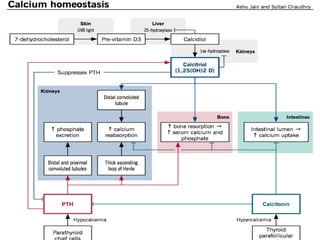
Calcium and phosphorous individually have
their own functions and together they are
required for the formation of hydroxyapatite
and physical strength of the skeletal tissue.
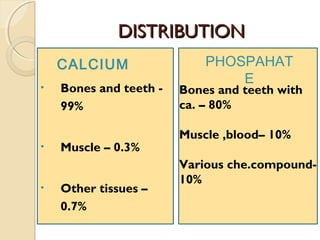
DISTRIBUTIONDISTRIBUTION
โ€ข Bones and teeth -
99%
โ€ข Muscle โ€“ 0.3%
โ€ข Other tissues โ€“
0.7%
CALCIUM PHOSPAHAT
E
Bones and teeth with
ca. โ€“ 80%
Muscle ,bloodโ€“ 10%
Various che.compound-
10%
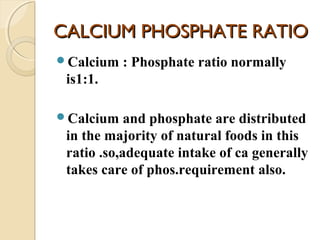
CALCIUM PHOSPHATE RATIOCALCIUM PHOSPHATE RATIO
๏‚—Calcium : Phosphate ratio normally
is1:1.
๏‚—Calcium and phosphate are distributed
in the majority of natural foods in this
ratio .so,adequate intake of ca generally
takes care of phos.requirement also.
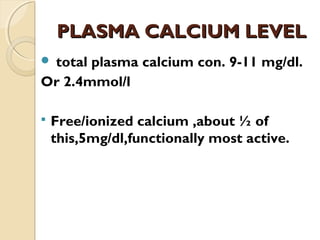
PLASMA CALCIUM LEVELPLASMA CALCIUM LEVEL
๏‚— total plasma calcium con. 9-11 mg/dl.
Or 2.4mmol/l
๏‚ง Free/ionized calcium ,about ยฝ of
this,5mg/dl,functionally most active.
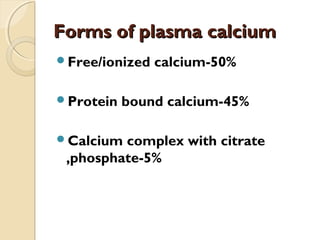
Forms of plasma calciumForms of plasma calcium
๏‚—Free/ionized calcium-50%
๏‚—Protein bound calcium-45%
๏‚—Calcium complex with citrate
,phosphate-5%
Serum Phosphate levels
Children - 4 to 7 mg/dL
Adults - 3 to 4.5
mg/dL
Daily Requirements Ca ,PhosphateDaily Requirements Ca ,Phosphate
๏‚ง Adults 800mg
๏‚ง Pregnancy 1500mg/d
๏‚ง Lactating mother 2ooomg/d
๏‚ง Infants 360mg/d
๏‚ง Children 800-1200mg/d
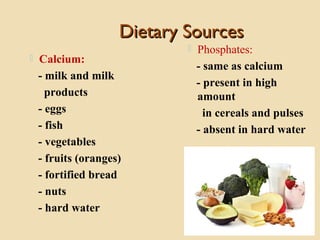
Dietary SourcesDietary Sources
๏‚ž Calcium:
- milk and milk
products
- eggs
- fish
- vegetables
- fruits (oranges)
- fortified bread
- nuts
- hard water
๏‚ž Phosphates:
- same as calcium
- present in high
amount
in cereals and pulses
- absent in hard water
Functions of CalciumFunctions of Calcium
๏ถ Formation of bone and teeth
๏ถ Muscle contraction
๏ถ Coagulation of blood
๏ถ Nerve transmission:Integrity of
cell membrane by
maintaining the resting
membrane potential of the cells
๏ถ Release of certain hormones
๏‚—Major structural element in the vertebrate
skeleton (bones and teeth) in the form of
calcium phosphate (Ca10(PO4)6(OH)2
known as hydroxyapatatite
๏‚—Key component in the maintenance of
the cell structure
๏‚—Membrane rigidity, permeability and
viscosity are partly dependent on local
calcium concentrations
๏‚—Release of hormone
๏‚—As intracellular messenger
Functions of PhosphatesFunctions of Phosphates
๏‚—Formation of bones,teeth
๏‚—Formation and utilization of energy rich bonds
in ATP.
๏‚—Important constituent of cells-
phospholipid,phosphoproteins
โ€ข Forms co-enzymes,NAD,ADP,NADP
๏‚—Regulates blood and urinary pH.
๏‚—Forms organic molecules like DNA &
๏‚—RNA
๏‚—Acts as buffer,facilitate urinary acid excretion
Absorption of CalciumAbsorption of Calcium
๏ฑCalcium is taken through dietary sources as
calcium phosphate, carbonate, tartarate and
oxalate.
๏ฑIt is absorbed from the gastrointestinal tract
(duodenum) in to blood and distributed to
various parts of the body.
๏ฑTwo mechanisms have been proposed for the
absorption of calcium by gut mucosa:
๏‚ง Simple Diffusion.
๏‚—An active transport process, involving energy
and calcium pump.
FACTORS PROMOTING CAFACTORS PROMOTING CA
ABSORPTIONABSORPTION
๏‚—Vita D
๏‚—Parathy.hormone
๏‚—Low ph
๏‚—Lactose
FACTORS INHIBIT ABSORPTION
๏‚—Phytate and oxalate
๏‚—High dietary phosphate
๏‚—FFA
๏‚—Alkaline condition
While passing through the kidney, large quantity of
calcium is filtered in the glomerulus. From the
filtrate, 98 to 99% of calcium is reabsorbed in the
renal tubules in to blood and only small quantity is
excreted through urine. In the bone, the calcium
may be deposited or resorbed depending upon the
level of calcium in the plasma
Calcium BalanceCalcium Balance
๏‚—Defined as the net gain or loss of calcium by
the body over a specified period of time.
๏‚—Calculated by deducting calcium in faeces
and urine from the calcium taken in diet.
๏‚—Positive calcium balance in growing children.
๏‚—Negative calcium balance in aging adults.
Hormonal Control of Calcium &Hormonal Control of Calcium &
Phosphate metabolismPhosphate metabolism
Three hormones regulate calcium and
phosphate metabolism.
๏‚—Vitamin D
๏‚—PTH
๏‚—Calcitonin
VITAMIN-D
Calcitriol (1,25-DHCC) is the biologically
active form of vit-d.
It regulates plasma levels of Ca and P.
Calcitrial acts at 3 different levels
intestine,kidney, bones.
Action on Intestines:
It increases the intestinal absorption of
ca&p in the intestine,by inducing syn.of a
specific ca binding protein in ines.cell.
Action on bone:
calcitriol stimulates ca uptake by
osteoblast of bone and promotes
calcification or mineralization(deposition
as capo4) and remodelling .
Action on kidney:
It is involved in minimizing the excretion
of ca&p through kidney by decreasing
their excretion and enhancing
reabsorption .
โ€ข Parathyroid hormone is one of the main
hormones controlling Ca+2
absorption.
โ€ข It mainly acts by controlling the formation of
1,25 DHCC, which is active form of Vit. D,
which is responsible for, increased Ca+2
absorption.
Parathyroid Hormone:
Stimulation for PTH secretionStimulation for PTH secretion
๏‚ž The stimulatory effect for PTH secretion
is low level of calcium in plasma.
๏‚ž Maximum secretion occurs when plasma
calcium level falls below 7mg/dl.
๏‚ž When plasma calcium level increases to
11mg/dl there is decreased secretion of
PTH
ActionsActions of PTHof PTH
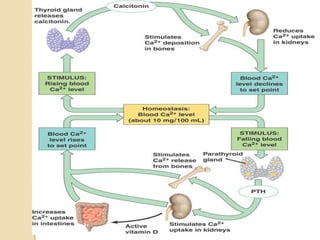
๏‚—The main function is to increase the
level of Ca in plasma within the critical
range of 9 to11 mg.
๏‚ง ON KIDNEY
๏‚ง Parathormone inhibits renal phosphate
reabsorption in the proximal tubule
and therefore increases phosphate
excretion.
๏‚ง Parathormone increases renal Calcium
reabsorption in the distal tubule, which
also increases the serum calcium.
๏‚— Net effect of PTH ๏ƒ  serumโ†‘
Action on boneAction on bone
๏‚—Demineralization of bone,carried by
osteoclastโ€ฆincrease blood ca.it very
important for ca homeostasis.it is
noted that,dietary ca deficiency
โ€ฆ.means loss of ca from bone.
๏‚—ACTION ON INTESTINE
๏‚—Increase intestional absorption of ca
by promoting synthsis of calcitriol
CALCITONINCALCITONIN
๏‚ž Minor regulator of calcium & phosphate
metabolism
๏‚ž Secreted by parafollicular cells or C-
cells of thyroid gland.
๏‚ž Also called as thyrocalcitonin.
Action of CalcitoninAction of Calcitonin
๏‚—Calcitonin is a Physiological Antagonist to
PTH with respect to Calcium.
๏‚—Effect on calcium-decrease ca level,by
increasing activity of osteoblast,decrease
bone resorption and increase excretion in
urine
๏‚—With respect to Phosphate it has the same
effect as PTH i.e. โ†“ Plasma Phosphate level
OTHER HORMONES on CALCIUMOTHER HORMONES on CALCIUM
METABOLISMMETABOLISM
๏ƒผGROWTH HORMONE
๏ƒผ INSULIN
๏ƒผ TESTOSTERONE & OTHER HORMONES
๏ƒผLACTOGEN & PROLACTIN
๏ƒผSTEROIDS
๏ƒผTHYROID HORMONES
๏ƒผIncreases the intestinal absorption of calcium and
increases its excretion from urine
๏ƒผStimulates production of insulin like growth factor
in bone which stimulates protein synthesis in bone
๏ƒผStimulates stomatomedian C which acts on
cartilage to increase the length of bones
GROWTH HORMONE
TESTOSTERONE
๏‚—Testosterone causes differential growth of
cartilage resulting to differential bone
development
๏‚—Acts on cartilage & increase the bone
INSULIN
โ€ข It is an anabolic hormone which favors
bone formation
Thyroid HormoneThyroid Hormone
๏‚—In infants ๏ƒ  stimulation of bone growth
๏‚—In adults
increased bone metabolism ๏ƒ  increased
calcium mobilization
GlucocorticoidsGlucocorticoids
๏‚—Anti vitamin D action, decrease
absorption of calcium in intestine
๏‚—Inhibit protein synthesis and so
decrease bone formation
๏‚—Inhibit new osteoclast formation &
decrease the activity of old osteoclasts.
DISEASE STATEDISEASE STATE
๏‚—The blood ca level is maintained
predominately byPTH.
๏‚—so disease mainly due to alterations
in PTH
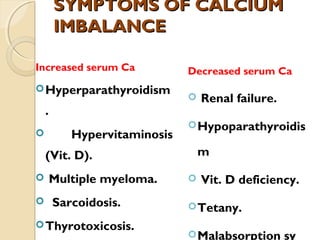
SYMPTOMS OF CALCIUMSYMPTOMS OF CALCIUM
IMBALANCEIMBALANCE
Increased serum Ca
๏‚ขHyperparathyroidism
.
๏‚ข Hypervitaminosis
(Vit. D).
๏‚ข Multiple myeloma.
๏‚ขย  Sarcoidosis.
๏‚ขThyrotoxicosis.
Decreased serum Ca
๏‚ข Renal failure.
๏‚ขHypoparathyroidis
m
๏‚ขย Vit. D deficiency.
๏‚ขTetany.
๏‚ขMalabsorption sy
Clinical ImportanceClinical Importance
๏‚ž Hypercalcemia
Adjusted total calcium level > 10.2 mg/dl
๏‚ž Consequence of hypercalcemia
๏‚ž Neuromuscular depression
๏‚ž Soft tissue calcification
๏‚ž Cardiac arrhythmia
๏‚ž Hypercalcemic nephropathy
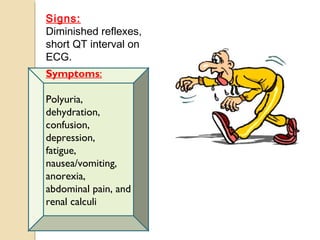
Symptoms:
Polyuria,
dehydration,
confusion,
depression,
fatigue,
nausea/vomiting,
anorexia,
abdominal pain, and
renal calculi
Signs:
Diminished reflexes,
short QT interval on
ECG.
Hypocalcaemia
๏‚—Adjusted total calcium in the blood <8.4
mg/dl
Conditions leading to hypocalcaemia
๏‚—Insufficient dietary calcium
๏‚—Hypoparathyroidism
๏‚—Insufficient vitamin D
๏‚—โ†‘ in calcitonin levels
Symptoms:
Irritability,
muscle cramps,
depression,
bronchospasm, and seizures.
Signs:
Increased reflexes, prolonged QT interval on
ECG (the only cause of a prolonged QT with a
normal duration of the T wave itself)
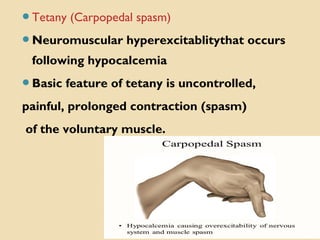
๏‚—Tetany (Carpopedal spasm)
๏‚—Neuromuscular hyperexcitablitythat occurs
following hypocalcemia
๏‚—Basic feature of tetany is uncontrolled,
painful, prolonged contraction (spasm)
of the voluntary muscle.
RicketsRickets
๏‚—Defective calcification of bone
๏‚—Cause..
๏‚—low level of vitD or
๏‚— due to dietary deficiency of ca, po4
๏‚—Increase alkaline phosphatase is
characteristic feature
Conโ€ฆConโ€ฆ
โ—ฆ Occurs in children between 6 months to
2 years of age.
โ—ฆ Affects long bones
โ—ฆ Lack of calcium causes failure of
mineralization resulting into formation
of cartilagenous form of bone.
โ—ฆ Most critical area that gets affected is
the center endochondral ossification at
the epiphyseal plates.
OSTEOMALACIAOSTEOMALACIA
๏‚—Osteomalacia is softening of the
bones, caused by not having enough
vitamin D, or by problems with the
metabolism (breakdown and use) of
this vitamin. These softer bones
have a normal amount of collagen
that gives the bones its structure,
but they are lacking in calcium
OSTEOPOROSISOSTEOPOROSIS
๏‚—It is the most common of all bone diseases in
adults ,
especially in old age.
๏‚—It is different from osteomalacia and rickets
because
it results from diminished organic bone
matrix rather than from poor bone
calcification.
๏‚ง Characterised by low bone mass,
microarchitectural
Conโ€ฆ.Conโ€ฆ.
๏‚—ETIOLOGY
๏‚—Unknown
๏‚—Decrease production of vit D with
age
๏‚—Deficiency of sex hormone
๏‚—TREATMENT
๏‚—Ca supplementation
๏‚—Estrogen administration
๏‚—Higher dietary intake of ca.
โ€ข Increased intake Diet containing Vit-D
โ€ข Increased release of P from cells (DM,
Acidaemia, Starvation)
โ€ข Increased release of P from bone (malignancy,
Renal failure, Increased PTH)
โ€ข Decreased excretion (Renal failure,
Hyperparathyroidism, Increased growth
โ€ข Decreased Intake (Starvation, Malabsorption, Vomiting
โ€ข Increased cell uptake (High dietary carbohydrate, Liver
disease)
โ€ข Increased Excretion (Diuretics, Hypomagnesaemia,
Increased PTH)
โ€ข It has often been supposed that a low
intake of calcium, or phosphorous, or both
might lead to poor calcification of teeth and
possibly, therefore, to an increased risk of
dental caries.
โ€ข the calcification of the teeth could be
affected if calcium was very low in the diet.
Pregnancy and growth:
โ€ข During later stages of pregnancy, greater
amount of calcium absorption is seen.
โ€ข 50% of this calcium is used for the
development of fetal skeleton and the rest is
stored in the bones to act as a reserve for
lactation.
โ€ข This is due to the increased level of placental
lactogen and estrogen which stimulates
increased hydroxylation of vitamin D.
.
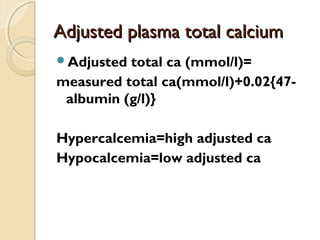
Adjusted plasma total calciumAdjusted plasma total calcium
๏‚—Adjusted total ca (mmol/l)=
measured total ca(mmol/l)+0.02{47-
albumin (g/l)}
Hypercalcemia=high adjusted ca
Hypocalcemia=low adjusted ca
Cal. po4 by dr tasnim

Cal. po4 by dr tasnim

  • 1.
    CALCIUM & PHOSPHATE METABOLISM HYPOCALCAEMIA, HYPERCALCAEMIA Dr.Tasnim Ara Jhilky MD- Biochemistry Phase-A Student. Sir Salimullah medical college.
  • 2.
    INTRODUCTION ๏‚—The minerals infoods do not contribute directly to energy needs but are important as body regulators and as essential constituents in many vital substances within the body.
  • 3.
    Principal Minerals include- Calcium, Phosphorous, Magnesium, Sodium, Potassium and Sulphur. Calcium and phosphorous individually have their own functions and together they are required for the formation of hydroxyapatite and physical strength of the skeletal tissue.
  • 4.
    DISTRIBUTIONDISTRIBUTION โ€ข Bones andteeth - 99% โ€ข Muscle โ€“ 0.3% โ€ข Other tissues โ€“ 0.7% CALCIUM PHOSPAHAT E Bones and teeth with ca. โ€“ 80% Muscle ,bloodโ€“ 10% Various che.compound- 10%
  • 5.
    CALCIUM PHOSPHATE RATIOCALCIUMPHOSPHATE RATIO ๏‚—Calcium : Phosphate ratio normally is1:1. ๏‚—Calcium and phosphate are distributed in the majority of natural foods in this ratio .so,adequate intake of ca generally takes care of phos.requirement also.
  • 6.
    PLASMA CALCIUM LEVELPLASMACALCIUM LEVEL ๏‚— total plasma calcium con. 9-11 mg/dl. Or 2.4mmol/l ๏‚ง Free/ionized calcium ,about ยฝ of this,5mg/dl,functionally most active.
  • 7.
    Forms of plasmacalciumForms of plasma calcium ๏‚—Free/ionized calcium-50% ๏‚—Protein bound calcium-45% ๏‚—Calcium complex with citrate ,phosphate-5%
  • 8.
    Serum Phosphate levels Children- 4 to 7 mg/dL Adults - 3 to 4.5 mg/dL
  • 9.
    Daily Requirements Ca,PhosphateDaily Requirements Ca ,Phosphate ๏‚ง Adults 800mg ๏‚ง Pregnancy 1500mg/d ๏‚ง Lactating mother 2ooomg/d ๏‚ง Infants 360mg/d ๏‚ง Children 800-1200mg/d
  • 10.
    Dietary SourcesDietary Sources ๏‚žCalcium: - milk and milk products - eggs - fish - vegetables - fruits (oranges) - fortified bread - nuts - hard water ๏‚ž Phosphates: - same as calcium - present in high amount in cereals and pulses - absent in hard water
  • 11.
    Functions of CalciumFunctionsof Calcium ๏ถ Formation of bone and teeth ๏ถ Muscle contraction ๏ถ Coagulation of blood ๏ถ Nerve transmission:Integrity of cell membrane by maintaining the resting membrane potential of the cells ๏ถ Release of certain hormones
  • 12.
    ๏‚—Major structural elementin the vertebrate skeleton (bones and teeth) in the form of calcium phosphate (Ca10(PO4)6(OH)2 known as hydroxyapatatite ๏‚—Key component in the maintenance of the cell structure ๏‚—Membrane rigidity, permeability and viscosity are partly dependent on local calcium concentrations ๏‚—Release of hormone ๏‚—As intracellular messenger
  • 13.
    Functions of PhosphatesFunctionsof Phosphates ๏‚—Formation of bones,teeth ๏‚—Formation and utilization of energy rich bonds in ATP. ๏‚—Important constituent of cells- phospholipid,phosphoproteins โ€ข Forms co-enzymes,NAD,ADP,NADP ๏‚—Regulates blood and urinary pH. ๏‚—Forms organic molecules like DNA & ๏‚—RNA ๏‚—Acts as buffer,facilitate urinary acid excretion
  • 14.
    Absorption of CalciumAbsorptionof Calcium ๏ฑCalcium is taken through dietary sources as calcium phosphate, carbonate, tartarate and oxalate. ๏ฑIt is absorbed from the gastrointestinal tract (duodenum) in to blood and distributed to various parts of the body. ๏ฑTwo mechanisms have been proposed for the absorption of calcium by gut mucosa: ๏‚ง Simple Diffusion. ๏‚—An active transport process, involving energy and calcium pump.
  • 15.
    FACTORS PROMOTING CAFACTORSPROMOTING CA ABSORPTIONABSORPTION ๏‚—Vita D ๏‚—Parathy.hormone ๏‚—Low ph ๏‚—Lactose FACTORS INHIBIT ABSORPTION ๏‚—Phytate and oxalate ๏‚—High dietary phosphate ๏‚—FFA ๏‚—Alkaline condition
  • 16.
    While passing throughthe kidney, large quantity of calcium is filtered in the glomerulus. From the filtrate, 98 to 99% of calcium is reabsorbed in the renal tubules in to blood and only small quantity is excreted through urine. In the bone, the calcium may be deposited or resorbed depending upon the level of calcium in the plasma
  • 17.
    Calcium BalanceCalcium Balance ๏‚—Definedas the net gain or loss of calcium by the body over a specified period of time. ๏‚—Calculated by deducting calcium in faeces and urine from the calcium taken in diet. ๏‚—Positive calcium balance in growing children. ๏‚—Negative calcium balance in aging adults.
  • 18.
    Hormonal Control ofCalcium &Hormonal Control of Calcium & Phosphate metabolismPhosphate metabolism Three hormones regulate calcium and phosphate metabolism. ๏‚—Vitamin D ๏‚—PTH ๏‚—Calcitonin
  • 19.
    VITAMIN-D Calcitriol (1,25-DHCC) isthe biologically active form of vit-d. It regulates plasma levels of Ca and P. Calcitrial acts at 3 different levels intestine,kidney, bones. Action on Intestines: It increases the intestinal absorption of ca&p in the intestine,by inducing syn.of a specific ca binding protein in ines.cell.
  • 20.
    Action on bone: calcitriolstimulates ca uptake by osteoblast of bone and promotes calcification or mineralization(deposition as capo4) and remodelling . Action on kidney: It is involved in minimizing the excretion of ca&p through kidney by decreasing their excretion and enhancing reabsorption .
  • 21.
    โ€ข Parathyroid hormoneis one of the main hormones controlling Ca+2 absorption. โ€ข It mainly acts by controlling the formation of 1,25 DHCC, which is active form of Vit. D, which is responsible for, increased Ca+2 absorption. Parathyroid Hormone:
  • 22.
    Stimulation for PTHsecretionStimulation for PTH secretion ๏‚ž The stimulatory effect for PTH secretion is low level of calcium in plasma. ๏‚ž Maximum secretion occurs when plasma calcium level falls below 7mg/dl. ๏‚ž When plasma calcium level increases to 11mg/dl there is decreased secretion of PTH
  • 23.
    ActionsActions of PTHofPTH ๏‚—The main function is to increase the level of Ca in plasma within the critical range of 9 to11 mg. ๏‚ง ON KIDNEY ๏‚ง Parathormone inhibits renal phosphate reabsorption in the proximal tubule and therefore increases phosphate excretion. ๏‚ง Parathormone increases renal Calcium reabsorption in the distal tubule, which also increases the serum calcium. ๏‚— Net effect of PTH ๏ƒ  serumโ†‘
  • 24.
    Action on boneActionon bone ๏‚—Demineralization of bone,carried by osteoclastโ€ฆincrease blood ca.it very important for ca homeostasis.it is noted that,dietary ca deficiency โ€ฆ.means loss of ca from bone. ๏‚—ACTION ON INTESTINE ๏‚—Increase intestional absorption of ca by promoting synthsis of calcitriol
  • 25.
    CALCITONINCALCITONIN ๏‚ž Minor regulatorof calcium & phosphate metabolism ๏‚ž Secreted by parafollicular cells or C- cells of thyroid gland. ๏‚ž Also called as thyrocalcitonin.
  • 26.
    Action of CalcitoninActionof Calcitonin ๏‚—Calcitonin is a Physiological Antagonist to PTH with respect to Calcium. ๏‚—Effect on calcium-decrease ca level,by increasing activity of osteoblast,decrease bone resorption and increase excretion in urine ๏‚—With respect to Phosphate it has the same effect as PTH i.e. โ†“ Plasma Phosphate level
  • 29.
    OTHER HORMONES onCALCIUMOTHER HORMONES on CALCIUM METABOLISMMETABOLISM ๏ƒผGROWTH HORMONE ๏ƒผ INSULIN ๏ƒผ TESTOSTERONE & OTHER HORMONES ๏ƒผLACTOGEN & PROLACTIN ๏ƒผSTEROIDS ๏ƒผTHYROID HORMONES
  • 30.
    ๏ƒผIncreases the intestinalabsorption of calcium and increases its excretion from urine ๏ƒผStimulates production of insulin like growth factor in bone which stimulates protein synthesis in bone ๏ƒผStimulates stomatomedian C which acts on cartilage to increase the length of bones GROWTH HORMONE
  • 31.
    TESTOSTERONE ๏‚—Testosterone causes differentialgrowth of cartilage resulting to differential bone development ๏‚—Acts on cartilage & increase the bone INSULIN โ€ข It is an anabolic hormone which favors bone formation
  • 32.
    Thyroid HormoneThyroid Hormone ๏‚—Ininfants ๏ƒ  stimulation of bone growth ๏‚—In adults increased bone metabolism ๏ƒ  increased calcium mobilization
  • 33.
    GlucocorticoidsGlucocorticoids ๏‚—Anti vitamin Daction, decrease absorption of calcium in intestine ๏‚—Inhibit protein synthesis and so decrease bone formation ๏‚—Inhibit new osteoclast formation & decrease the activity of old osteoclasts.
  • 34.
    DISEASE STATEDISEASE STATE ๏‚—Theblood ca level is maintained predominately byPTH. ๏‚—so disease mainly due to alterations in PTH
  • 35.
    SYMPTOMS OF CALCIUMSYMPTOMSOF CALCIUM IMBALANCEIMBALANCE Increased serum Ca ๏‚ขHyperparathyroidism . ๏‚ข Hypervitaminosis (Vit. D). ๏‚ข Multiple myeloma. ๏‚ขย  Sarcoidosis. ๏‚ขThyrotoxicosis. Decreased serum Ca ๏‚ข Renal failure. ๏‚ขHypoparathyroidis m ๏‚ขย Vit. D deficiency. ๏‚ขTetany. ๏‚ขMalabsorption sy
  • 36.
    Clinical ImportanceClinical Importance ๏‚žHypercalcemia Adjusted total calcium level > 10.2 mg/dl ๏‚ž Consequence of hypercalcemia ๏‚ž Neuromuscular depression ๏‚ž Soft tissue calcification ๏‚ž Cardiac arrhythmia ๏‚ž Hypercalcemic nephropathy
  • 37.
  • 38.
    Hypocalcaemia ๏‚—Adjusted total calciumin the blood <8.4 mg/dl Conditions leading to hypocalcaemia ๏‚—Insufficient dietary calcium ๏‚—Hypoparathyroidism ๏‚—Insufficient vitamin D ๏‚—โ†‘ in calcitonin levels
  • 39.
    Symptoms: Irritability, muscle cramps, depression, bronchospasm, andseizures. Signs: Increased reflexes, prolonged QT interval on ECG (the only cause of a prolonged QT with a normal duration of the T wave itself)
  • 40.
    ๏‚—Tetany (Carpopedal spasm) ๏‚—Neuromuscularhyperexcitablitythat occurs following hypocalcemia ๏‚—Basic feature of tetany is uncontrolled, painful, prolonged contraction (spasm) of the voluntary muscle.
  • 41.
    RicketsRickets ๏‚—Defective calcification ofbone ๏‚—Cause.. ๏‚—low level of vitD or ๏‚— due to dietary deficiency of ca, po4 ๏‚—Increase alkaline phosphatase is characteristic feature
  • 42.
    Conโ€ฆConโ€ฆ โ—ฆ Occurs inchildren between 6 months to 2 years of age. โ—ฆ Affects long bones โ—ฆ Lack of calcium causes failure of mineralization resulting into formation of cartilagenous form of bone. โ—ฆ Most critical area that gets affected is the center endochondral ossification at the epiphyseal plates.
  • 43.
    OSTEOMALACIAOSTEOMALACIA ๏‚—Osteomalacia is softeningof the bones, caused by not having enough vitamin D, or by problems with the metabolism (breakdown and use) of this vitamin. These softer bones have a normal amount of collagen that gives the bones its structure, but they are lacking in calcium
  • 44.
    OSTEOPOROSISOSTEOPOROSIS ๏‚—It is themost common of all bone diseases in adults , especially in old age. ๏‚—It is different from osteomalacia and rickets because it results from diminished organic bone matrix rather than from poor bone calcification. ๏‚ง Characterised by low bone mass, microarchitectural
  • 45.
    Conโ€ฆ.Conโ€ฆ. ๏‚—ETIOLOGY ๏‚—Unknown ๏‚—Decrease production ofvit D with age ๏‚—Deficiency of sex hormone ๏‚—TREATMENT ๏‚—Ca supplementation ๏‚—Estrogen administration ๏‚—Higher dietary intake of ca.
  • 46.
    โ€ข Increased intakeDiet containing Vit-D โ€ข Increased release of P from cells (DM, Acidaemia, Starvation) โ€ข Increased release of P from bone (malignancy, Renal failure, Increased PTH) โ€ข Decreased excretion (Renal failure, Hyperparathyroidism, Increased growth
  • 47.
    โ€ข Decreased Intake(Starvation, Malabsorption, Vomiting โ€ข Increased cell uptake (High dietary carbohydrate, Liver disease) โ€ข Increased Excretion (Diuretics, Hypomagnesaemia, Increased PTH)
  • 48.
    โ€ข It hasoften been supposed that a low intake of calcium, or phosphorous, or both might lead to poor calcification of teeth and possibly, therefore, to an increased risk of dental caries. โ€ข the calcification of the teeth could be affected if calcium was very low in the diet.
  • 49.
    Pregnancy and growth: โ€ขDuring later stages of pregnancy, greater amount of calcium absorption is seen. โ€ข 50% of this calcium is used for the development of fetal skeleton and the rest is stored in the bones to act as a reserve for lactation. โ€ข This is due to the increased level of placental lactogen and estrogen which stimulates increased hydroxylation of vitamin D. .
  • 50.
    Adjusted plasma totalcalciumAdjusted plasma total calcium ๏‚—Adjusted total ca (mmol/l)= measured total ca(mmol/l)+0.02{47- albumin (g/l)} Hypercalcemia=high adjusted ca Hypocalcemia=low adjusted ca

Editor's Notes

  • #18ย The positive balance is obvious in growing child, about 0.1 gm being retained each day in the growing &amp; mineralizing skeleton The Negative balance arises in later decades of age 50 yrs or more, this can be detected as a loss of skeletal tissue, not merely a reduction in the proportion of mineralization.