1
Presented BY :
Harsh Dhorada
Rex Francis
Maitrak Dulera
Dinky Krishnani
Apoorva Gajjar
• Ca – is the macro mineral.
• Itis the most abundant mineral of the
body.
• Theprimary site of storage is ourbones,
teeth etc.
• Some calcium is stored withincells
(endoplasmic reticulum and
mitochondria).
2
i. Child: about 0.8 to 1.2 g/day
ii. Adult: About 800 mg/day
iii. Requirement may be increased to 1500
mg/day during lactation and pregnancy.
iv. After the age of 50 there is a general
tendency for osteoporosis, which may be
prevented by increased Ca (1500
mg/day) plus Vitamin D.
3
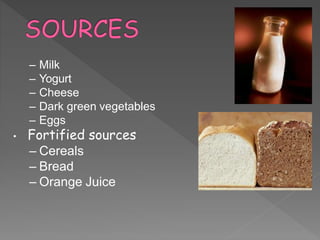
– Milk
– Yogurt
– Cheese
– Dark green vegetables
– Eggs
• Fortified sources
– Cereals
– Bread
– Orange Juice
4
Site: First and Second part ofDuodenum
Calcium is absorbed against concentration
gradient and requires energy.Absorption
requires a carrier protein, helped bycalcium
dependentATPase.
Calcium must be in a soluble and ionized
form before it can be absorbed.
5
• VITAMIN D: Calcitriol induces the synthesis of
carrier protein in the intestinal epithelial cells
and so facilitates the absorption ofcalcium.
• ParathyroidHormone
• Acidity
• Amino acids: Lysine and Arginine
6
• PhyticAcid: (Inositol hexaphosphate): in cereals binds
calcium in the intestinal lumen, preventing its
absorption. Fermentation and cooking reducephylate
content.
• High concentrations of Fattyacids in the intestinal
lumen, asaresult of impaired fat absorption, canalso
reduce calcium absorption by forming insolublecalcium
salts.
• High intake of oxalate cancausedeficiency sincecalcium
oxalate is insoluble.
• Phosphorus: High phosphate content will causethe
precipitation ascalcium phosphate.
7
8
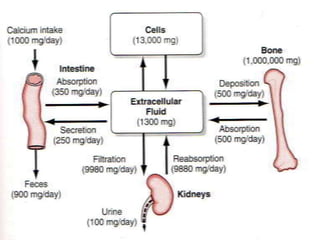
•Usual intake is 1000 mg/day
•About 35 % is absorbed by the intestines
•Ca remaining in the intestine is excreted in the faeces.
•250 mg/day enters intestine via
secreted gastrointestinal juices and sloughed mucosal cells.
•90 % of the daily intake is excreted
in the stool.
•10 % of the ingested Ca is excreted in the urine
The renal threshold for Ca in
blood is 10 mg/dl. Ca starts
excreting after this level. When
injected intravenously, most of the Ca is rapidly excreted.
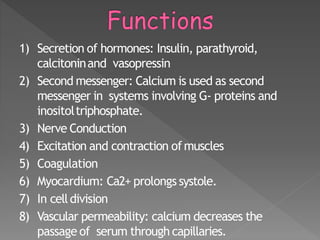
1) Secretion of hormones: Insulin, parathyroid,
calcitoninand vasopressin
2) Second messenger: Calcium is used as second
messenger in systems involving G- proteins and
inositoltriphosphate.
3) Nerve Conduction
4) Excitation and contraction ofmuscles
5) Coagulation
6) Myocardium: Ca2+ prolongs systole.
7) In celldivision
8) Vascular permeability: calcium decreases the
passage of serum through capillaries. 9
9) Bone and Teeth: Thebulk quantity of calcium is used
for bone and teeth formation.Bonesare reservoir for
calcium in the body. Osteoblasts induce bone
deposition and osteoclasts inducedemineralization.
10) Cadecreasesthe events of intestinal cancers
• Calcium binds to bile acids and fatty acids inthe
gastrointestinal tract to form insoluble
complexes
• Reducesthe ability of the acids todamage cells
in the lining of the colon and act directly in
reducing cell proliferation in the lining of the
colon
10
11) Following enzymes are activated bycalcium
and mediated by calmodulin:
• Pyruvate carboxylase, Pyruvate dehydrogenase,
Pyruvate kinase, PhospholipaseC, Phosphorylase
kinase, Myosin kinase, Glycogen synthase,
Adenyl cyclase, Glycerol-3-phospate
dehydrogenase.
• Pancreatic Lipase, enzymes of coagulation
pathway, rennin are activated directly bycalcium
without the intervention ofcalmodulin.
11
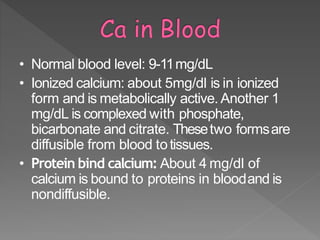
• Normal blood level: 9-11mg/dL
• Ionized calcium: about 5mg/dl is in ionized
form and is metabolically active. Another 1
mg/dL is complexed with phosphate,
bicarbonate and citrate. Thesetwo formsare
diffusible from blood totissues.
• Protein bind calcium: About 4 mg/dl of
calcium is bound to proteins in bloodand is
nondiffusible.
12
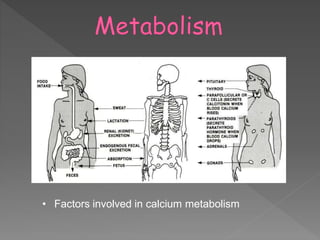
• Factors involved in calcium metabolism
13
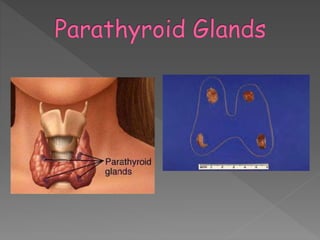
• Three principal hormones regulate Ca2+and
three organs that function in Ca2+
homeostasis.
• Parathyroid hormone (PTH), 1,25-dihydroxy
Vitamin D3 (Vitamin D3), and Calcitonin,
regulate Ca2+ resorption, reabsorption,
absorption and excretion from the bone,
kidney and intestine. In addition, many other
hormones effect bone formation and
resorption.
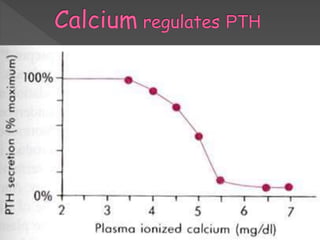
• Thedominant regulator of PTHis plasma Ca2+.
• Secretion of PTHis inversely related to [Ca2+].
• Maximum secretion of PTHoccurs at plasma Ca2+below
3.5 mg/dL.
• At Ca2+above 5.5 mg/dL, PTHsecretion is maximally
inhibited.
• Aunique calcium receptor within the parathyroid cell
plasma membrane senseschangesin the extracellularfluid
concentration of Ca2+.
• Thisis atypical G-protein coupled receptor thatactivates
phospholipase Cand inhibits adenylate cyclase—result is
increase in intracellular Ca2+via generation of inositol
phosphates and decrease in cAMPwhich prevents
exocytosis of PTHfrom secretorygranules.
17
• PTHacts to increase degradation of bone
(releaseof calcium).
-causesosteoblasts to release
cytokines,which stimulate osteoclast
activity
-stimulates bone stem cells to
develop into osteoclasts
- net result: increased release of calcium
from bone hydroxy proline is secreted
in urine.
• PTHacts on the kidney to increase the
reabsorptionof calcium (decreased
excretion).
• Also get increased excretion of phosphate
(other component of bone mineralization),
and decreased excretion of hydrogen ions
(more acidicenvironment favors
demineralization of bone)
• ALSO,get increased production of the active
metaboliteof vitamin D3(required for calcium
absorption from the small intestine, bone
demineralization).
• NETRESULT:increased plasma calciumlevels
21
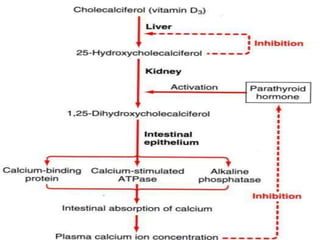
• PTHincreases 1-hydroxylase activity in kidney ,
increasing production of active formCalcitriol.
• This increases calcium absorption from the
intestines, increases calcium release from bone,
and decreasesloss of calcium through thekidney.
• Asaresult, PTHsecretion decreases, decreasing1-
hydroxylase activity (negativefeedback).
• Low phosphate concentrations also increase 1-
hydroxylase activity (vitamin D increases phosphate
reabsorption from the urine).
Calcitriol enters the intestinal cell and
binds to vitamin D receptor. The hormone
–receptor complex interacts causes the
release of Calbindin. Due to increased
availability of calcium binding protein, the
absorption of calcium is increased.
• Another important target for 1,25-(OH)2-
D isthe bone.
• Osteoblasts, but not osteoclasts have
vitamin D receptors.
• 1,25-(OH)2-D acts on osteoblasts which
produce a paracrine signal that activates
osteoclasts to resorb Ca++ from the bone
matrix.
• Proper bone formation is stimulated by 1,25-
(OH)2-D.
• Inadequate supply of vitamin Dresults in
rickets,a diseaseof bone deformation
• Calcitriol increases the reabsorption of
calcium and phosphorus by renal
tubules, therefore conserves both
minerals unlikePTH.
26
• Calcitonin acts to decrease plasma Ca2+levels. It
inhibits resorption of bone. Decreasethe activityof
osteoclasts and increases that of osteoblasts.
• While PTHand vitamin Dact to increase plasmaCa2+-
- only calcitonin causesadecrease in plasma Ca2+.
• Calcitonin is synthesized and secreted by the
parafollicular cells of the thyroidgland.
• Themajor stimulus of calcitonin secretion is arise in
plasma Ca2+levels
• Calcitonin is aphysiological antagonist to PTHwith
regard to Ca2+homeostasis
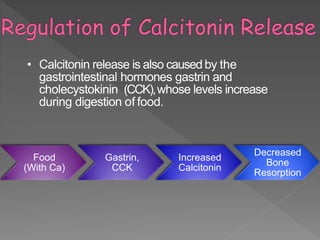
• Calcitonin release is also caused by the
gastrointestinal hormones gastrin and
cholecystokinin (CCK),whose levels increase
during digestion of food.
Food
(With Ca)
Gastrin,
CCK
Increased
Calcitonin
Decreased
Bone
Resorption
• EstrogensandAndrogens: both stimulate boneformation
during childhood andpuberty.
• Estrogen inhibits PTH-stimulated boneresorption.
• Estrogen increases calcitonin levels
• Osteoblasts haveestrogen receptors, respond to estrogen
with bonegrowth.
• Postmenopausal women (low estrogen) haveanincreased
incidence of osteoporosis and bonefractures.
Influences of Growth Hormone
• Normal GHlevels are required for skeletalgrowth.
• GHincreases intestinal calcium absorption and renal
phosphate resorption.
• Excessiveintake of Namay causerenal hypercalciuria
by impairing Careabsorption resulting in
compensatory increase in PTHsecretion.
• Stimulation of intestinal Caabsorption byPTH-induced
1,25-(OH)2-D production compensates for excessive
Caexcretion
• Post-menopausal women at greater risk for boneloss
due to excessiveNaintake due to impaired vitaminD
synthesis which accompanies estrogen deficiency.
Effect of Soft drinks
• Intake of carbonated beverages hasbeen associated
with increased excretion and loss of calcium
• Todaywe drink more than twice asmuch soda pop as
milk.
 Bonecells respond to pressure gradientsin
laying down bone.
 Lack of weight-bearing exercise decreases
bone formation, while increased exercise
helps form bone.
• Increased bone resorption during
immobilization may result in hypercalcemia
• When the blood calcium level is more than
10.5 to 11 mg/day. Themajor causeis
hyperparathyroidism(Due to Tumor).
• Increase in serum calcium produces
weakness. Polyuria is due to DCTdamage, so
reabsorption of water decreases producing
dehydration and thirst.
• Kidney stones of calcium phosphate or
oxalate usually occurs due to deposition
in renal parenchyma(Nephrocalcinosis).
32
1. Increase in Serum Calcium Level.
2. Decrease in Serum Phosphate Level.
3. Increase in Alkaline Phosphatase Enzyme.
• There ishypercalciuria.
Normal Caexcretion is 100mg/day, here itmay
increase to 400mg/day.
33
33
1. Gastrointestinal Symptoms :
a) Nausea
b) Constipation
c) Decreased Appetite
d) Peptic Ulcer Disease
2. Kidney Related Symptoms :
a) Frequent Urination
b) Kidney Stones
3. Psychological Conditions :
a) Dementia
b) Depression
c) Confusion
4. Bone Related Conditions :
a) Frequent Fractures
b) Bone aches and pains
c) Curving of spine and loss of height
1.Deficiency of VitaminD
2.Hypoparathyroidism
3.Deficiency of calcium
1.Intestinal malabsorption
2.Infusion of agents complexingcalcium
3.Alkalosis favors binding of more calcium with
proteins with consequent lowering of ionized calcium.
4.Hepaticdiseases
5.Hypoalbuminemia
6.Renal failure
34
1. Muscular cramps
2. Neuromuscular irritability
3. Bradycardia
4. Tetany
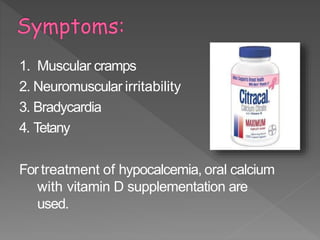
For treatment of hypocalcemia, oral calcium
with vitamin D supplementation are
used.
35
• Reducedbone density and mass:
OSTEOPOROSIS
• Susceptibility to fracture.
• Earlier in life for women than men but eventually
both genders succumb.
• Reduced risk:
– Calcium in thediet
– habitual exercise
– avoidance of smoking and alcoholintake
– avoid drinking carbonated softdrinks
Features :
 Delayed Milestones
 Delayed Closure of Anterior Fontanelle
 Delayed Dentition
 Bone Deformities
 Decreased Serum Calcium
Frontal Bossing
Beaded Ribs
Bow Legs
 Renal Rickets or VITAMIN-D Resistant
Rickets.
 Osteopetrosis – Increase in Bone Density. It
is also known as MARBLE BONE DISEASE.
Calcium

Calcium

  • 1.
    1 Presented BY : HarshDhorada Rex Francis Maitrak Dulera Dinky Krishnani Apoorva Gajjar
  • 2.
    • Ca –is the macro mineral. • Itis the most abundant mineral of the body. • Theprimary site of storage is ourbones, teeth etc. • Some calcium is stored withincells (endoplasmic reticulum and mitochondria). 2
  • 3.
    i. Child: about0.8 to 1.2 g/day ii. Adult: About 800 mg/day iii. Requirement may be increased to 1500 mg/day during lactation and pregnancy. iv. After the age of 50 there is a general tendency for osteoporosis, which may be prevented by increased Ca (1500 mg/day) plus Vitamin D. 3
  • 4.
    – Milk – Yogurt –Cheese – Dark green vegetables – Eggs • Fortified sources – Cereals – Bread – Orange Juice 4
  • 6.
    Site: First andSecond part ofDuodenum Calcium is absorbed against concentration gradient and requires energy.Absorption requires a carrier protein, helped bycalcium dependentATPase. Calcium must be in a soluble and ionized form before it can be absorbed. 5
  • 7.
    • VITAMIN D:Calcitriol induces the synthesis of carrier protein in the intestinal epithelial cells and so facilitates the absorption ofcalcium. • ParathyroidHormone • Acidity • Amino acids: Lysine and Arginine 6
  • 8.
    • PhyticAcid: (Inositolhexaphosphate): in cereals binds calcium in the intestinal lumen, preventing its absorption. Fermentation and cooking reducephylate content. • High concentrations of Fattyacids in the intestinal lumen, asaresult of impaired fat absorption, canalso reduce calcium absorption by forming insolublecalcium salts. • High intake of oxalate cancausedeficiency sincecalcium oxalate is insoluble. • Phosphorus: High phosphate content will causethe precipitation ascalcium phosphate. 7
  • 9.
    8 •Usual intake is1000 mg/day •About 35 % is absorbed by the intestines •Ca remaining in the intestine is excreted in the faeces. •250 mg/day enters intestine via secreted gastrointestinal juices and sloughed mucosal cells. •90 % of the daily intake is excreted in the stool. •10 % of the ingested Ca is excreted in the urine The renal threshold for Ca in blood is 10 mg/dl. Ca starts excreting after this level. When injected intravenously, most of the Ca is rapidly excreted.
  • 11.
    1) Secretion ofhormones: Insulin, parathyroid, calcitoninand vasopressin 2) Second messenger: Calcium is used as second messenger in systems involving G- proteins and inositoltriphosphate. 3) Nerve Conduction 4) Excitation and contraction ofmuscles 5) Coagulation 6) Myocardium: Ca2+ prolongs systole. 7) In celldivision 8) Vascular permeability: calcium decreases the passage of serum through capillaries. 9
  • 12.
    9) Bone andTeeth: Thebulk quantity of calcium is used for bone and teeth formation.Bonesare reservoir for calcium in the body. Osteoblasts induce bone deposition and osteoclasts inducedemineralization. 10) Cadecreasesthe events of intestinal cancers • Calcium binds to bile acids and fatty acids inthe gastrointestinal tract to form insoluble complexes • Reducesthe ability of the acids todamage cells in the lining of the colon and act directly in reducing cell proliferation in the lining of the colon 10
  • 13.
    11) Following enzymesare activated bycalcium and mediated by calmodulin: • Pyruvate carboxylase, Pyruvate dehydrogenase, Pyruvate kinase, PhospholipaseC, Phosphorylase kinase, Myosin kinase, Glycogen synthase, Adenyl cyclase, Glycerol-3-phospate dehydrogenase. • Pancreatic Lipase, enzymes of coagulation pathway, rennin are activated directly bycalcium without the intervention ofcalmodulin. 11
  • 14.
    • Normal bloodlevel: 9-11mg/dL • Ionized calcium: about 5mg/dl is in ionized form and is metabolically active. Another 1 mg/dL is complexed with phosphate, bicarbonate and citrate. Thesetwo formsare diffusible from blood totissues. • Protein bind calcium: About 4 mg/dl of calcium is bound to proteins in bloodand is nondiffusible. 12
  • 15.
    • Factors involvedin calcium metabolism 13
  • 16.
    • Three principalhormones regulate Ca2+and three organs that function in Ca2+ homeostasis. • Parathyroid hormone (PTH), 1,25-dihydroxy Vitamin D3 (Vitamin D3), and Calcitonin, regulate Ca2+ resorption, reabsorption, absorption and excretion from the bone, kidney and intestine. In addition, many other hormones effect bone formation and resorption.
  • 18.
    • Thedominant regulatorof PTHis plasma Ca2+. • Secretion of PTHis inversely related to [Ca2+]. • Maximum secretion of PTHoccurs at plasma Ca2+below 3.5 mg/dL. • At Ca2+above 5.5 mg/dL, PTHsecretion is maximally inhibited. • Aunique calcium receptor within the parathyroid cell plasma membrane senseschangesin the extracellularfluid concentration of Ca2+. • Thisis atypical G-protein coupled receptor thatactivates phospholipase Cand inhibits adenylate cyclase—result is increase in intracellular Ca2+via generation of inositol phosphates and decrease in cAMPwhich prevents exocytosis of PTHfrom secretorygranules.
  • 19.
  • 21.
    • PTHacts toincrease degradation of bone (releaseof calcium). -causesosteoblasts to release cytokines,which stimulate osteoclast activity -stimulates bone stem cells to develop into osteoclasts - net result: increased release of calcium from bone hydroxy proline is secreted in urine.
  • 22.
    • PTHacts onthe kidney to increase the reabsorptionof calcium (decreased excretion). • Also get increased excretion of phosphate (other component of bone mineralization), and decreased excretion of hydrogen ions (more acidicenvironment favors demineralization of bone) • ALSO,get increased production of the active metaboliteof vitamin D3(required for calcium absorption from the small intestine, bone demineralization). • NETRESULT:increased plasma calciumlevels
  • 23.
  • 25.
    • PTHincreases 1-hydroxylaseactivity in kidney , increasing production of active formCalcitriol. • This increases calcium absorption from the intestines, increases calcium release from bone, and decreasesloss of calcium through thekidney. • Asaresult, PTHsecretion decreases, decreasing1- hydroxylase activity (negativefeedback). • Low phosphate concentrations also increase 1- hydroxylase activity (vitamin D increases phosphate reabsorption from the urine).
  • 26.
    Calcitriol enters theintestinal cell and binds to vitamin D receptor. The hormone –receptor complex interacts causes the release of Calbindin. Due to increased availability of calcium binding protein, the absorption of calcium is increased.
  • 28.
    • Another importanttarget for 1,25-(OH)2- D isthe bone. • Osteoblasts, but not osteoclasts have vitamin D receptors. • 1,25-(OH)2-D acts on osteoblasts which produce a paracrine signal that activates osteoclasts to resorb Ca++ from the bone matrix. • Proper bone formation is stimulated by 1,25- (OH)2-D. • Inadequate supply of vitamin Dresults in rickets,a diseaseof bone deformation
  • 29.
    • Calcitriol increasesthe reabsorption of calcium and phosphorus by renal tubules, therefore conserves both minerals unlikePTH. 26
  • 30.
    • Calcitonin actsto decrease plasma Ca2+levels. It inhibits resorption of bone. Decreasethe activityof osteoclasts and increases that of osteoblasts. • While PTHand vitamin Dact to increase plasmaCa2+- - only calcitonin causesadecrease in plasma Ca2+. • Calcitonin is synthesized and secreted by the parafollicular cells of the thyroidgland. • Themajor stimulus of calcitonin secretion is arise in plasma Ca2+levels • Calcitonin is aphysiological antagonist to PTHwith regard to Ca2+homeostasis
  • 31.
    • Calcitonin releaseis also caused by the gastrointestinal hormones gastrin and cholecystokinin (CCK),whose levels increase during digestion of food. Food (With Ca) Gastrin, CCK Increased Calcitonin Decreased Bone Resorption
  • 32.
    • EstrogensandAndrogens: bothstimulate boneformation during childhood andpuberty. • Estrogen inhibits PTH-stimulated boneresorption. • Estrogen increases calcitonin levels • Osteoblasts haveestrogen receptors, respond to estrogen with bonegrowth. • Postmenopausal women (low estrogen) haveanincreased incidence of osteoporosis and bonefractures. Influences of Growth Hormone • Normal GHlevels are required for skeletalgrowth. • GHincreases intestinal calcium absorption and renal phosphate resorption.
  • 33.
    • Excessiveintake ofNamay causerenal hypercalciuria by impairing Careabsorption resulting in compensatory increase in PTHsecretion. • Stimulation of intestinal Caabsorption byPTH-induced 1,25-(OH)2-D production compensates for excessive Caexcretion • Post-menopausal women at greater risk for boneloss due to excessiveNaintake due to impaired vitaminD synthesis which accompanies estrogen deficiency. Effect of Soft drinks • Intake of carbonated beverages hasbeen associated with increased excretion and loss of calcium • Todaywe drink more than twice asmuch soda pop as milk.
  • 34.
     Bonecells respondto pressure gradientsin laying down bone.  Lack of weight-bearing exercise decreases bone formation, while increased exercise helps form bone. • Increased bone resorption during immobilization may result in hypercalcemia
  • 35.
    • When theblood calcium level is more than 10.5 to 11 mg/day. Themajor causeis hyperparathyroidism(Due to Tumor). • Increase in serum calcium produces weakness. Polyuria is due to DCTdamage, so reabsorption of water decreases producing dehydration and thirst. • Kidney stones of calcium phosphate or oxalate usually occurs due to deposition in renal parenchyma(Nephrocalcinosis). 32
  • 36.
    1. Increase inSerum Calcium Level. 2. Decrease in Serum Phosphate Level. 3. Increase in Alkaline Phosphatase Enzyme. • There ishypercalciuria. Normal Caexcretion is 100mg/day, here itmay increase to 400mg/day. 33
  • 37.
    33 1. Gastrointestinal Symptoms: a) Nausea b) Constipation c) Decreased Appetite d) Peptic Ulcer Disease 2. Kidney Related Symptoms : a) Frequent Urination b) Kidney Stones 3. Psychological Conditions : a) Dementia b) Depression c) Confusion 4. Bone Related Conditions : a) Frequent Fractures b) Bone aches and pains c) Curving of spine and loss of height
  • 38.
    1.Deficiency of VitaminD 2.Hypoparathyroidism 3.Deficiencyof calcium 1.Intestinal malabsorption 2.Infusion of agents complexingcalcium 3.Alkalosis favors binding of more calcium with proteins with consequent lowering of ionized calcium. 4.Hepaticdiseases 5.Hypoalbuminemia 6.Renal failure 34
  • 39.
    1. Muscular cramps 2.Neuromuscular irritability 3. Bradycardia 4. Tetany For treatment of hypocalcemia, oral calcium with vitamin D supplementation are used. 35
  • 40.
    • Reducedbone densityand mass: OSTEOPOROSIS • Susceptibility to fracture. • Earlier in life for women than men but eventually both genders succumb. • Reduced risk: – Calcium in thediet – habitual exercise – avoidance of smoking and alcoholintake – avoid drinking carbonated softdrinks
  • 41.
    Features :  DelayedMilestones  Delayed Closure of Anterior Fontanelle  Delayed Dentition  Bone Deformities  Decreased Serum Calcium
  • 42.
  • 43.
     Renal Ricketsor VITAMIN-D Resistant Rickets.  Osteopetrosis – Increase in Bone Density. It is also known as MARBLE BONE DISEASE.