Electrolytes
Objectives
• Electrolytes – Cations & Anions
• Functions – Electrolytes
• Electrolyte Imbalances – You See &
You Do
Electrolytes
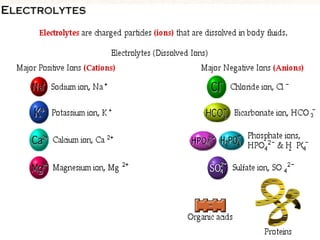
• Charged particles in solution
• Cations (+)
• Anions (-)
• Integral part of metabolic and
cellular processes
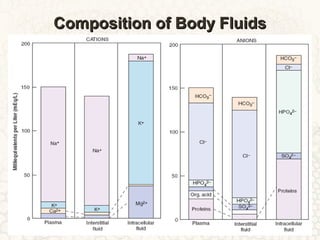
Composition of Body FluidsComposition of Body Fluids
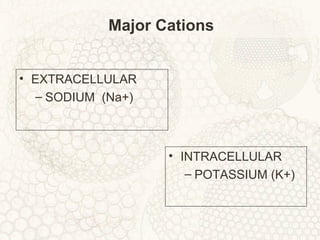
Major Cations
• EXTRACELLULAR
– SODIUM (Na+)
• INTRACELLULAR
– POTASSIUM (K+)
What do Electrolytes - Do?
• Promotes neuromuscular impulses.
• Maintain body fluid volume & Osmolarity.
• Distribute body water between fluid
compartments.
• Regulate acid base balance.
Electrolyte Imbalances
• Hyponatremia/
Hypernatremia
• Hypokalemia/
Hyperkalemia
• Hypomagnesemia/
Hypermagnesemia
• Hypocalcemia/
Hypercalcemia
• Hypophosphatemia/
Hyperphosphatemia
• Hypochloremia/
Hyperchloremia
Hyponatremia
• Serum Na+ level < 135 mEq/L
• Deficiency in Na+ related to amount of body
fluid
• Several types
– Dilutional
– Depletional
– Hypovolemic
– Hypervolemic
– Isovolemic
Surgical Causes - Hyponatremia
• Intestinal obstruction
• Intestinal fistulas – biliary / duodenal /
gastric / pancreatic
• GOO – severe vomiting
• Ryle’s tube aspiration
• Severe diarrhoea – Colitis / colerectal polyps
• After surgery & trauma – occurs
What Do You See ?
• Sunken eyes, Dry coated
tongue, poor skin turgor
• Headache, N/V, muscle
twitching, altered mental
status
• Irritability, neurological
symptoms, convulsions ,
coma
What Do We Do?
• MILD / CHRONIC
CASE
– Na < 115 mEq/ L
– Restrict fluid intake for
hyper/isovolemic
hyponatremia
– IV fluids and/or
increased Na+ intake
for hypovolemic
hyponatremia
• SEVERE / ACUTE
CASE
– Na < 100 mEq/L
– Infuse hypertonic
NaCl solution (3% or
5% NaCl)
– Frusemide to remove
excess fluid
– Monitor client in ICU
Hypernatremia
• Excess Na+ relative to body water
• Occurs less often than hyponatremia
• Na > 150 mEq / L
• When hypernatremia occurs, fluid shifts
outside the cells
• May be caused by water deficit or over-
ingestion of Na+ - Renal dysfuction
• Also may result from diabetes insipidus,
Cardiac failure, Drug – NSAID / Steroids
What Do You See ?
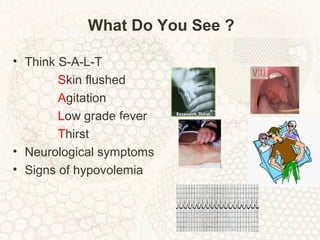
• Think S-A-L-T
Skin flushed
Agitation
Low grade fever
Thirst
• Neurological symptoms
• Signs of hypovolemia
Firm,
What Do We Do?
• Correct underlying
disorder
• Restrict saline &
sodium
• Gradual / Slow fluid
replacement
• Monitor for s/s of
cerebral edema
• Monitor serum Na+
level
• Seizure precautions
Potassium
• Major intracellular cation
• Untreated changes in K+ levels can lead to
serious neuromuscular and cardiac
problems
• Normal K+ levels = 3.5 - 5 mEq/L
Balancing Potassium
• Most K+ ingested is excreted by the kidneys
• Three other influential factors in K+ balance :
– Na+/K+ pump
– Renal regulation
– pH level
Hypokalemia
• Serum K+ < 3.5 mEq/L
• Caused by –
• SUDDEN = Pts in
Diabetic coma
• GRADUAL
– Diarrhoea – Villous+UC
– PS + GOO
– Duodenal fistula
– Ileostomy / USD
– Poisoning
– Beta agonists
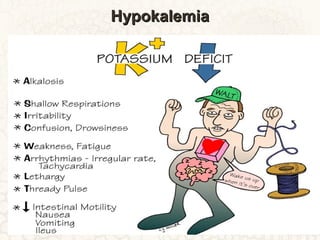
What Do You See?
• Think S-U-C-T-I-O-N
– Skeletal muscle weakness / Slurred speech
– U wave (ECG changes) - Arrythmias
– Constipation, ileus
– Tone – Hypotonia = Sign
– I rregular, weak pulse
– O rthostatic hypotension
– N umbness (paresthesias)
HypokalemiaHypokalemia
What Do We Do?
• Increase dietary K+
• Oral KCl supplements
• IV K+ replacement
• Change to K+-sparing diuretic
• Monitor ECG changes
IV K+ Replacement
• Mix well when
adding to an IV
solution bag
• Concentrations
should not exceed
40-60 mEq/L
• Rates usually 10-
20 mEq/hr
NEVER GIVE IVNEVER GIVE IV
PUSHPUSH
POTASSIUMPOTASSIUM
Hyperkalemia
• Serum K+ > 6 mEq/L
• Less common than
hypokalemia
• Caused by altered
kidney function,
increased intake (salt
substitutes), blood
transfusions, meds
(K+-sparing diuretics),
cell death (trauma)
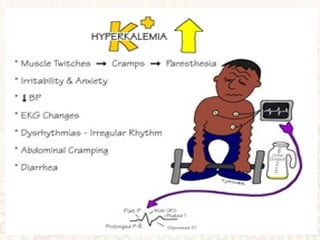
What Do You See?
• Irritability
• Paresthesia
• Muscle weakness (especially legs)
• ECG changes (tented / peak T wave)
• Irregular pulse
• Hypotension
• Nausea, abdominal cramps, diarrohea
What Do We Do?
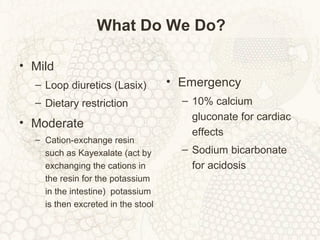
• Mild
– Loop diuretics (Lasix)
– Dietary restriction
• Moderate
– Cation-exchange resin
such as Kayexalate (act by
exchanging the cations in
the resin for the potassium
in the intestine) potassium
is then excreted in the stool
• Emergency
– 10% calcium
gluconate for cardiac
effects
– Sodium bicarbonate
for acidosis
Calcium
• 99% in bones, 1% in serum and soft tissue
(measured by serum Ca++)
• Works with phosphorus to form bones and
teeth
• Role in cell membrane permeability
• Affects cardiac muscle contraction
• Participates in blood clotting
• Normal value 8.5 – 10.5 mg/dl
Hypocalcemia
• Serum calcium < 8.9 mg/dl
• Caused by inadequate intake, malabsorption,
pancreatitis, thyroid or parathyroid surgery,
loop diuretics, low magnesium levels
What Do You See?
• Neuromuscular
– Anxiety, confusion, irritability, muscle
twitching, paresthesias (mouth, fingers,
toes), tetany, carpopedal spasms
• Fractures
• Diarrohea
• Diminished response to digoxin
• EKG changes
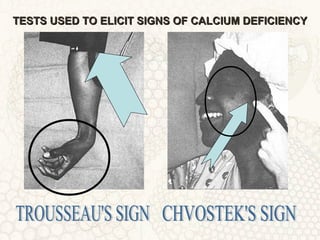
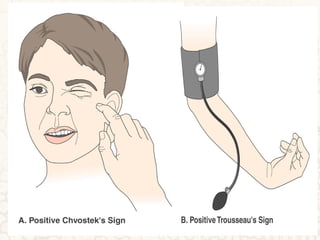
TESTS USED TO ELICIT SIGNS OF CALCIUM DEFICIENCYTESTS USED TO ELICIT SIGNS OF CALCIUM DEFICIENCY
What Do We Do?
• Calcium gluconate for postop thyroid or
parathyroid client
• Cardiac monitoring
• Oral or IV calcium replacement
Hypercalcemia
• Serum calcium > 10.1 mg/dl
• Two major causes
– Cancer
– Hyperparathyroidism
What Do You See?
• Fatigue, confusion, lethargy, coma
• Muscle weakness, hyporeflexia
• Bradycardia ⇒ cardiac arrest
• Anorexia, nausea/vomiting, decreased bowel
sounds, constipation
• Polyuria, renal calculi, renal failure
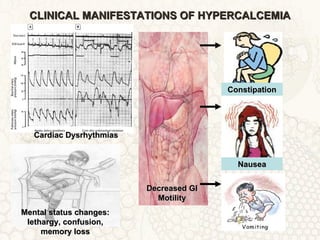
CLINICAL MANIFESTATIONS OF HYPERCALCEMIACLINICAL MANIFESTATIONS OF HYPERCALCEMIA
Decreased GIDecreased GI
MotilityMotility
Cardiac DysrhythmiasCardiac Dysrhythmias
ConstipationConstipation
NauseaNausea
Mental status changes:Mental status changes:
lethargy, confusion,lethargy, confusion,
memory lossmemory loss
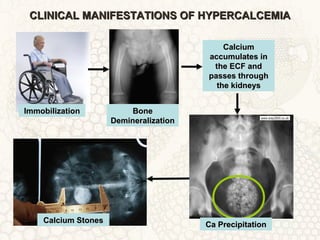
CLINICAL MANIFESTATIONS OF HYPERCALCEMIACLINICAL MANIFESTATIONS OF HYPERCALCEMIA
ImmobilizationImmobilization BoneBone
DemineralizationDemineralization
CalciumCalcium
accumulates inaccumulates in
the ECF andthe ECF and
passes throughpasses through
the kidneysthe kidneys
Ca PrecipitationCa PrecipitationCalcium StonesCalcium Stones
What Do We Do?
• If asymptomatic, treat underlying cause
• Hydrate the patient to encourage diuresis
• Loop diuretics
• Corticosteroids
Magnesium
• Cofactor for many enzymes – ATP
utilisation in muscle fiber
• Role in protein synthesis &
carbohydrate metabolism
• Helps cardiovascular system function
(vasodilation)
• Regulates muscle contractions
Hypomagnesemia
• Serum Mg++ level <
1.5 mEq/L
• Caused by poor
dietary intake, poor GI
absorption, excessive
GI/urinary losses
• High risk clients
– Chronic alcoholism
– Malabsorption
– GI/urinary system
disorders
– Sepsis
– Burns
– Wounds needing
debridement
What Do You See?
• CNS
–Altered LOC
–Confusion
–Hallucinations
• Neuromuscular
– Muscle weakness
– Leg/foot cramps
– Hyper DTRs
– Tetany
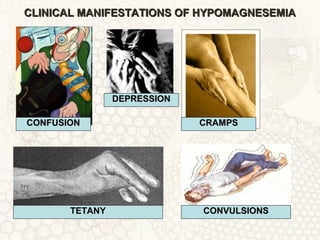
CLINICAL MANIFESTATIONS OF HYPOMAGNESEMIACLINICAL MANIFESTATIONS OF HYPOMAGNESEMIA
CONFUSIONCONFUSION
DEPRESSIONDEPRESSION
CRAMPSCRAMPS
TETANYTETANY CONVULSIONSCONVULSIONS
What Do You See?
• Cardiovascular
–Tachycardia
–Hypertension
–ECG changes
• Gastrointestinal
–Dysphagia
–Anorexia
–Nausea/vomiting
What Do We Do?
• Mild
– Dietary replacement
• Severe
– IV or IM magnesium sulfate
• Monitor
– Neuro status
– Cardiac status
– Safety
Mag Sulfate Infusion
• Use infusion pump - no faster than 150
mg/min
• Monitor vital signs for hypotension and
respiratory distress
• Monitor serum Mg++ level q6h
• Cardiac monitoring
• Calcium gluconate as an antidote for
overdosage
Hypermagnesemia
• Serum Mg++ level > 2.5 mEq/L
• Not common
• Renal dysfunction is most common
cause
– Renal failure
– Addison’s disease
– Adrenocortical insufficiency
– Untreated DKA
What Do You See?
• Decreased neuromuscular activity
• Hypoactive DTRs
• Generalized weakness
• Occasionally nausea/vomiting
What Do We Do?
• Increased fluids if renal function normal
• Loop diuretic if no response to fluids
• Calcium gluconate for toxicity
• Mechanical ventilation for respiratory
depression
• Hemodialysis (Mg++-free dialysate)
Electrolytes

Electrolytes

  • 1.
  • 2.
    Objectives • Electrolytes –Cations & Anions • Functions – Electrolytes • Electrolyte Imbalances – You See & You Do
  • 3.
    Electrolytes • Charged particlesin solution • Cations (+) • Anions (-) • Integral part of metabolic and cellular processes
  • 5.
    Composition of BodyFluidsComposition of Body Fluids
  • 6.
    Major Cations • EXTRACELLULAR –SODIUM (Na+) • INTRACELLULAR – POTASSIUM (K+)
  • 7.
    What do Electrolytes- Do? • Promotes neuromuscular impulses. • Maintain body fluid volume & Osmolarity. • Distribute body water between fluid compartments. • Regulate acid base balance.
  • 8.
    Electrolyte Imbalances • Hyponatremia/ Hypernatremia •Hypokalemia/ Hyperkalemia • Hypomagnesemia/ Hypermagnesemia • Hypocalcemia/ Hypercalcemia • Hypophosphatemia/ Hyperphosphatemia • Hypochloremia/ Hyperchloremia
  • 9.
    Hyponatremia • Serum Na+level < 135 mEq/L • Deficiency in Na+ related to amount of body fluid • Several types – Dilutional – Depletional – Hypovolemic – Hypervolemic – Isovolemic
  • 10.
    Surgical Causes -Hyponatremia • Intestinal obstruction • Intestinal fistulas – biliary / duodenal / gastric / pancreatic • GOO – severe vomiting • Ryle’s tube aspiration • Severe diarrhoea – Colitis / colerectal polyps • After surgery & trauma – occurs
  • 11.
    What Do YouSee ? • Sunken eyes, Dry coated tongue, poor skin turgor • Headache, N/V, muscle twitching, altered mental status • Irritability, neurological symptoms, convulsions , coma
  • 12.
    What Do WeDo? • MILD / CHRONIC CASE – Na < 115 mEq/ L – Restrict fluid intake for hyper/isovolemic hyponatremia – IV fluids and/or increased Na+ intake for hypovolemic hyponatremia • SEVERE / ACUTE CASE – Na < 100 mEq/L – Infuse hypertonic NaCl solution (3% or 5% NaCl) – Frusemide to remove excess fluid – Monitor client in ICU
  • 13.
    Hypernatremia • Excess Na+relative to body water • Occurs less often than hyponatremia • Na > 150 mEq / L • When hypernatremia occurs, fluid shifts outside the cells • May be caused by water deficit or over- ingestion of Na+ - Renal dysfuction • Also may result from diabetes insipidus, Cardiac failure, Drug – NSAID / Steroids
  • 14.
    What Do YouSee ? • Think S-A-L-T Skin flushed Agitation Low grade fever Thirst • Neurological symptoms • Signs of hypovolemia Firm,
  • 15.
    What Do WeDo? • Correct underlying disorder • Restrict saline & sodium • Gradual / Slow fluid replacement • Monitor for s/s of cerebral edema • Monitor serum Na+ level • Seizure precautions
  • 16.
    Potassium • Major intracellularcation • Untreated changes in K+ levels can lead to serious neuromuscular and cardiac problems • Normal K+ levels = 3.5 - 5 mEq/L
  • 17.
    Balancing Potassium • MostK+ ingested is excreted by the kidneys • Three other influential factors in K+ balance : – Na+/K+ pump – Renal regulation – pH level
  • 18.
    Hypokalemia • Serum K+< 3.5 mEq/L • Caused by – • SUDDEN = Pts in Diabetic coma • GRADUAL – Diarrhoea – Villous+UC – PS + GOO – Duodenal fistula – Ileostomy / USD – Poisoning – Beta agonists
  • 19.
    What Do YouSee? • Think S-U-C-T-I-O-N – Skeletal muscle weakness / Slurred speech – U wave (ECG changes) - Arrythmias – Constipation, ileus – Tone – Hypotonia = Sign – I rregular, weak pulse – O rthostatic hypotension – N umbness (paresthesias)
  • 20.
  • 21.
    What Do WeDo? • Increase dietary K+ • Oral KCl supplements • IV K+ replacement • Change to K+-sparing diuretic • Monitor ECG changes
  • 22.
    IV K+ Replacement •Mix well when adding to an IV solution bag • Concentrations should not exceed 40-60 mEq/L • Rates usually 10- 20 mEq/hr NEVER GIVE IVNEVER GIVE IV PUSHPUSH POTASSIUMPOTASSIUM
  • 23.
    Hyperkalemia • Serum K+> 6 mEq/L • Less common than hypokalemia • Caused by altered kidney function, increased intake (salt substitutes), blood transfusions, meds (K+-sparing diuretics), cell death (trauma)
  • 24.
    What Do YouSee? • Irritability • Paresthesia • Muscle weakness (especially legs) • ECG changes (tented / peak T wave) • Irregular pulse • Hypotension • Nausea, abdominal cramps, diarrohea
  • 26.
    What Do WeDo? • Mild – Loop diuretics (Lasix) – Dietary restriction • Moderate – Cation-exchange resin such as Kayexalate (act by exchanging the cations in the resin for the potassium in the intestine) potassium is then excreted in the stool • Emergency – 10% calcium gluconate for cardiac effects – Sodium bicarbonate for acidosis
  • 27.
    Calcium • 99% inbones, 1% in serum and soft tissue (measured by serum Ca++) • Works with phosphorus to form bones and teeth • Role in cell membrane permeability • Affects cardiac muscle contraction • Participates in blood clotting • Normal value 8.5 – 10.5 mg/dl
  • 28.
    Hypocalcemia • Serum calcium< 8.9 mg/dl • Caused by inadequate intake, malabsorption, pancreatitis, thyroid or parathyroid surgery, loop diuretics, low magnesium levels
  • 29.
    What Do YouSee? • Neuromuscular – Anxiety, confusion, irritability, muscle twitching, paresthesias (mouth, fingers, toes), tetany, carpopedal spasms • Fractures • Diarrohea • Diminished response to digoxin • EKG changes
  • 30.
    TESTS USED TOELICIT SIGNS OF CALCIUM DEFICIENCYTESTS USED TO ELICIT SIGNS OF CALCIUM DEFICIENCY
  • 32.
    What Do WeDo? • Calcium gluconate for postop thyroid or parathyroid client • Cardiac monitoring • Oral or IV calcium replacement
  • 33.
    Hypercalcemia • Serum calcium> 10.1 mg/dl • Two major causes – Cancer – Hyperparathyroidism
  • 34.
    What Do YouSee? • Fatigue, confusion, lethargy, coma • Muscle weakness, hyporeflexia • Bradycardia ⇒ cardiac arrest • Anorexia, nausea/vomiting, decreased bowel sounds, constipation • Polyuria, renal calculi, renal failure
  • 35.
    CLINICAL MANIFESTATIONS OFHYPERCALCEMIACLINICAL MANIFESTATIONS OF HYPERCALCEMIA Decreased GIDecreased GI MotilityMotility Cardiac DysrhythmiasCardiac Dysrhythmias ConstipationConstipation NauseaNausea Mental status changes:Mental status changes: lethargy, confusion,lethargy, confusion, memory lossmemory loss
  • 36.
    CLINICAL MANIFESTATIONS OFHYPERCALCEMIACLINICAL MANIFESTATIONS OF HYPERCALCEMIA ImmobilizationImmobilization BoneBone DemineralizationDemineralization CalciumCalcium accumulates inaccumulates in the ECF andthe ECF and passes throughpasses through the kidneysthe kidneys Ca PrecipitationCa PrecipitationCalcium StonesCalcium Stones
  • 37.
    What Do WeDo? • If asymptomatic, treat underlying cause • Hydrate the patient to encourage diuresis • Loop diuretics • Corticosteroids
  • 38.
    Magnesium • Cofactor formany enzymes – ATP utilisation in muscle fiber • Role in protein synthesis & carbohydrate metabolism • Helps cardiovascular system function (vasodilation) • Regulates muscle contractions
  • 39.
    Hypomagnesemia • Serum Mg++level < 1.5 mEq/L • Caused by poor dietary intake, poor GI absorption, excessive GI/urinary losses • High risk clients – Chronic alcoholism – Malabsorption – GI/urinary system disorders – Sepsis – Burns – Wounds needing debridement
  • 40.
    What Do YouSee? • CNS –Altered LOC –Confusion –Hallucinations • Neuromuscular – Muscle weakness – Leg/foot cramps – Hyper DTRs – Tetany
  • 41.
    CLINICAL MANIFESTATIONS OFHYPOMAGNESEMIACLINICAL MANIFESTATIONS OF HYPOMAGNESEMIA CONFUSIONCONFUSION DEPRESSIONDEPRESSION CRAMPSCRAMPS TETANYTETANY CONVULSIONSCONVULSIONS
  • 42.
    What Do YouSee? • Cardiovascular –Tachycardia –Hypertension –ECG changes • Gastrointestinal –Dysphagia –Anorexia –Nausea/vomiting
  • 43.
    What Do WeDo? • Mild – Dietary replacement • Severe – IV or IM magnesium sulfate • Monitor – Neuro status – Cardiac status – Safety
  • 44.
    Mag Sulfate Infusion •Use infusion pump - no faster than 150 mg/min • Monitor vital signs for hypotension and respiratory distress • Monitor serum Mg++ level q6h • Cardiac monitoring • Calcium gluconate as an antidote for overdosage
  • 45.
    Hypermagnesemia • Serum Mg++level > 2.5 mEq/L • Not common • Renal dysfunction is most common cause – Renal failure – Addison’s disease – Adrenocortical insufficiency – Untreated DKA
  • 46.
    What Do YouSee? • Decreased neuromuscular activity • Hypoactive DTRs • Generalized weakness • Occasionally nausea/vomiting
  • 47.
    What Do WeDo? • Increased fluids if renal function normal • Loop diuretic if no response to fluids • Calcium gluconate for toxicity • Mechanical ventilation for respiratory depression • Hemodialysis (Mg++-free dialysate)

Editor's Notes

  • #6 Deficit: abnormal losses through skin, anorexia third spacing, nausea, Excessive sweating, inability to access fluids, polyuria, impaired swallowing, Fever, confusion, NG suction, depression, bleeding, prolonged rapid respiration, Vomiting, diarrhea symptomatology: decreased BP, pulse, urine output &amp;lt;30 ml/ hour, decreased skin turgor, dry mucus membranes, sunken eyeballs, hemoconcentration, elevated temperature, concentrated urine weakness, confusion. Excess:, It can occur because of A. Excessive intake Na Cl B. rapid administration of sodium rich infusions, C. disease that impair regulatory mechanisms, like renal failure, congestive heart failure Symptomatology: weight gain &amp;gt; 2lbs in 24 hours, elevated BP, full bounding pulses, moist, labored respirations, large volume of pale urine, pitting edema, crackles, Auscultate in lungs, dyspnea, distended jugular veins