What do you do when you can’t separate out y? 2.5 Implicit Differentiation
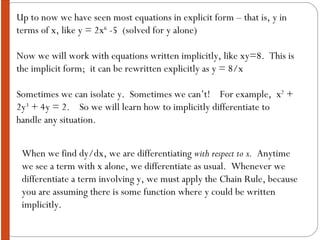
Up to now we have seen most equations in explicit form – that is, y in terms of x, like y = 2x 6  -5  (solved for y alone) Now we will work with equations written implicitly, like xy=8.  This is the implicit form;  it can be rewritten explicitly as y = 8/x Sometimes we can isolate y.  Sometimes we can’t!  For example,  x 2  + 2y 3  + 4y = 2.  So we will learn how to implicitly differentiate to handle any situation. When we find dy/dx, we are differentiating  with respect to x.   Anytime we see a term with x alone, we differentiate as usual.  Whenever we differentiate a term involving y, we must apply the Chain Rule, because you are assuming there is some function where y could be written implicitly.
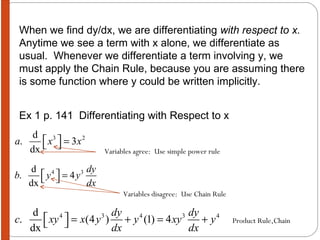
When we find dy/dx, we are differentiating  with respect to x.   Anytime we see a term with x alone, we differentiate as usual.  Whenever we differentiate a term involving y, we must apply the Chain Rule, because you are assuming there is some function where y could be written implicitly. Ex 1 p. 141  Differentiating with Respect to x Variables agree:  Use simple power rule Variables disagree:  Use Chain Rule Product Rule,Chain
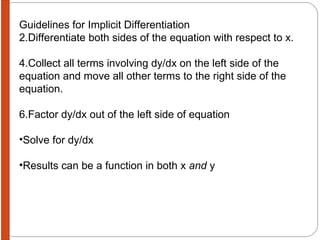
Guidelines for Implicit Differentiation Differentiate both sides of the equation with respect to x. Collect all terms involving dy/dx on the left side of the equation and move all other terms to the right side of the equation. Factor dy/dx out of the left side of equation Solve for dy/dx Results can be a function in both x  and  y
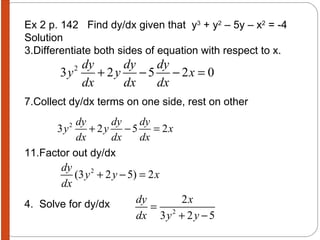
Ex 2 p. 142  Find dy/dx given that  y 3  + y 2  – 5y – x 2  = -4 Solution Differentiate both sides of equation with respect to x. Collect dy/dx terms on one side, rest on other Factor out dy/dx 4.  Solve for dy/dx
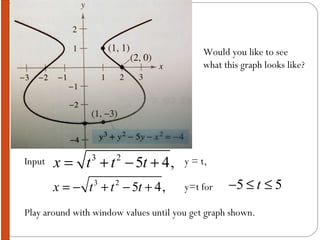
Input y = t,    y=t for Play around with window values until you get graph shown.  Would you like to see what this graph looks like?
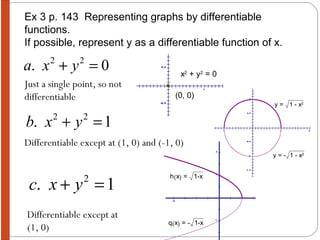
Ex 3 p. 143  Representing graphs by differentiable functions. If possible, represent y as a differentiable function of x. Just a single point, so not differentiable Differentiable except at (1, 0) and (-1, 0) Differentiable except at (1, 0)
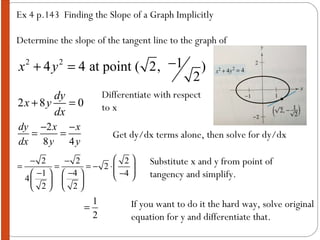
Ex 4 p.143  Finding the Slope of a Graph Implicitly Determine the slope of the tangent line to the graph of  Differentiate with respect to x Get dy/dx terms alone, then solve for dy/dx Substitute x and y from point of tangency and simplify. If you want to do it the hard way, solve original equation for y and differentiate that.
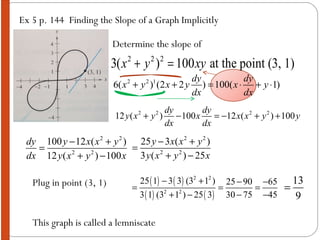
Ex 5 p. 144  Finding the Slope of a Graph Implicitly Determine the slope of Plug in point (3, 1) This graph is called a lemniscate
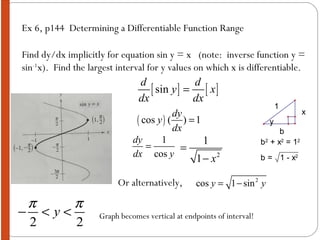
Ex 6, p144  Determining a Differentiable Function Range Find dy/dx implicitly for equation sin y = x  (note:  inverse function y = sin -1 x).  Find the largest interval for y values on which x is differentiable. Or alternatively, Graph becomes vertical at endpoints of interval!
2.5a p. 146 #1-16 all, 21,23,25

Calc 2.5a

  • 1.
    What do youdo when you can’t separate out y? 2.5 Implicit Differentiation
  • 2.
    Up to nowwe have seen most equations in explicit form – that is, y in terms of x, like y = 2x 6 -5 (solved for y alone) Now we will work with equations written implicitly, like xy=8. This is the implicit form; it can be rewritten explicitly as y = 8/x Sometimes we can isolate y. Sometimes we can’t! For example, x 2 + 2y 3 + 4y = 2. So we will learn how to implicitly differentiate to handle any situation. When we find dy/dx, we are differentiating with respect to x. Anytime we see a term with x alone, we differentiate as usual. Whenever we differentiate a term involving y, we must apply the Chain Rule, because you are assuming there is some function where y could be written implicitly.
  • 3.
    When we finddy/dx, we are differentiating with respect to x. Anytime we see a term with x alone, we differentiate as usual. Whenever we differentiate a term involving y, we must apply the Chain Rule, because you are assuming there is some function where y could be written implicitly. Ex 1 p. 141 Differentiating with Respect to x Variables agree: Use simple power rule Variables disagree: Use Chain Rule Product Rule,Chain
  • 4.
    Guidelines for ImplicitDifferentiation Differentiate both sides of the equation with respect to x. Collect all terms involving dy/dx on the left side of the equation and move all other terms to the right side of the equation. Factor dy/dx out of the left side of equation Solve for dy/dx Results can be a function in both x and y
  • 5.
    Ex 2 p.142 Find dy/dx given that y 3 + y 2 – 5y – x 2 = -4 Solution Differentiate both sides of equation with respect to x. Collect dy/dx terms on one side, rest on other Factor out dy/dx 4. Solve for dy/dx
  • 6.
    Input y =t, y=t for Play around with window values until you get graph shown. Would you like to see what this graph looks like?
  • 7.
    Ex 3 p.143 Representing graphs by differentiable functions. If possible, represent y as a differentiable function of x. Just a single point, so not differentiable Differentiable except at (1, 0) and (-1, 0) Differentiable except at (1, 0)
  • 8.
    Ex 4 p.143 Finding the Slope of a Graph Implicitly Determine the slope of the tangent line to the graph of Differentiate with respect to x Get dy/dx terms alone, then solve for dy/dx Substitute x and y from point of tangency and simplify. If you want to do it the hard way, solve original equation for y and differentiate that.
  • 9.
    Ex 5 p.144 Finding the Slope of a Graph Implicitly Determine the slope of Plug in point (3, 1) This graph is called a lemniscate
  • 10.
    Ex 6, p144 Determining a Differentiable Function Range Find dy/dx implicitly for equation sin y = x (note: inverse function y = sin -1 x). Find the largest interval for y values on which x is differentiable. Or alternatively, Graph becomes vertical at endpoints of interval!
  • 11.
    2.5a p. 146#1-16 all, 21,23,25