2.6 Lines of Best Fit 
Using linear regression features on 
graphing calculators.
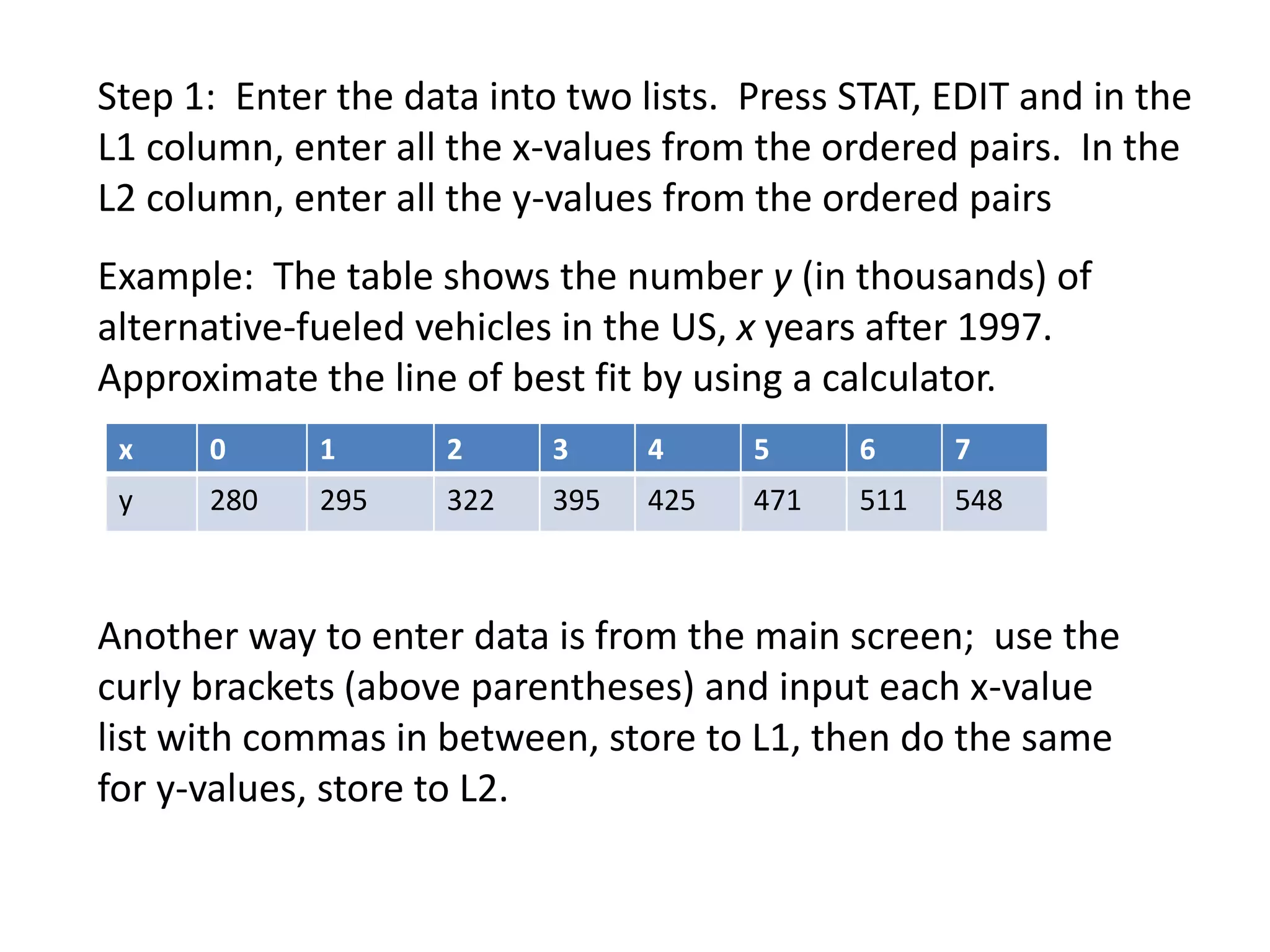
Step 1: Enter the data into two lists. Press STAT, EDIT and in the 
L1 column, enter all the x-values from the ordered pairs. In the 
L2 column, enter all the y-values from the ordered pairs 
Example: The table shows the number y (in thousands) of 
alternative-fueled vehicles in the US, x years after 1997. 
Approximate the line of best fit by using a calculator. 
x 0 1 2 3 4 5 6 7 
y 280 295 322 395 425 471 511 548 
Another way to enter data is from the main screen; use the 
curly brackets (above parentheses) and input each x-value 
list with commas in between, store to L1, then do the same 
for y-values, store to L2.
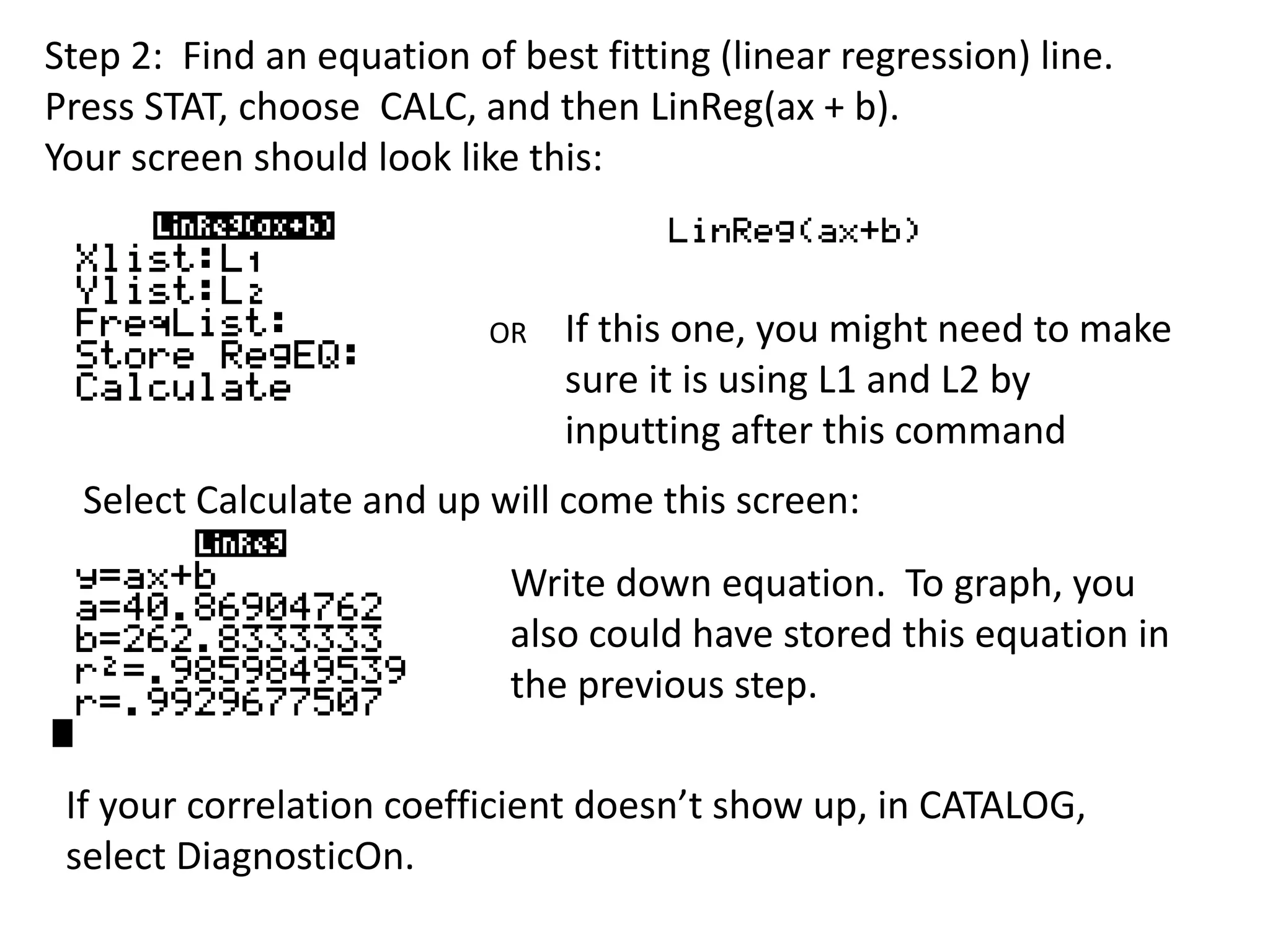
Step 2: Find an equation of best fitting (linear regression) line. 
Press STAT, choose CALC, and then LinReg(ax + b). 
Your screen should look like this: 
OR If this one, you might need to make 
sure it is using L1 and L2 by 
inputting after this command 
Select Calculate and up will come this screen: 
Write down equation. To graph, you 
also could have stored this equation in 
the previous step. 
If your correlation coefficient doesn’t show up, in CATALOG, 
select DiagnosticOn.
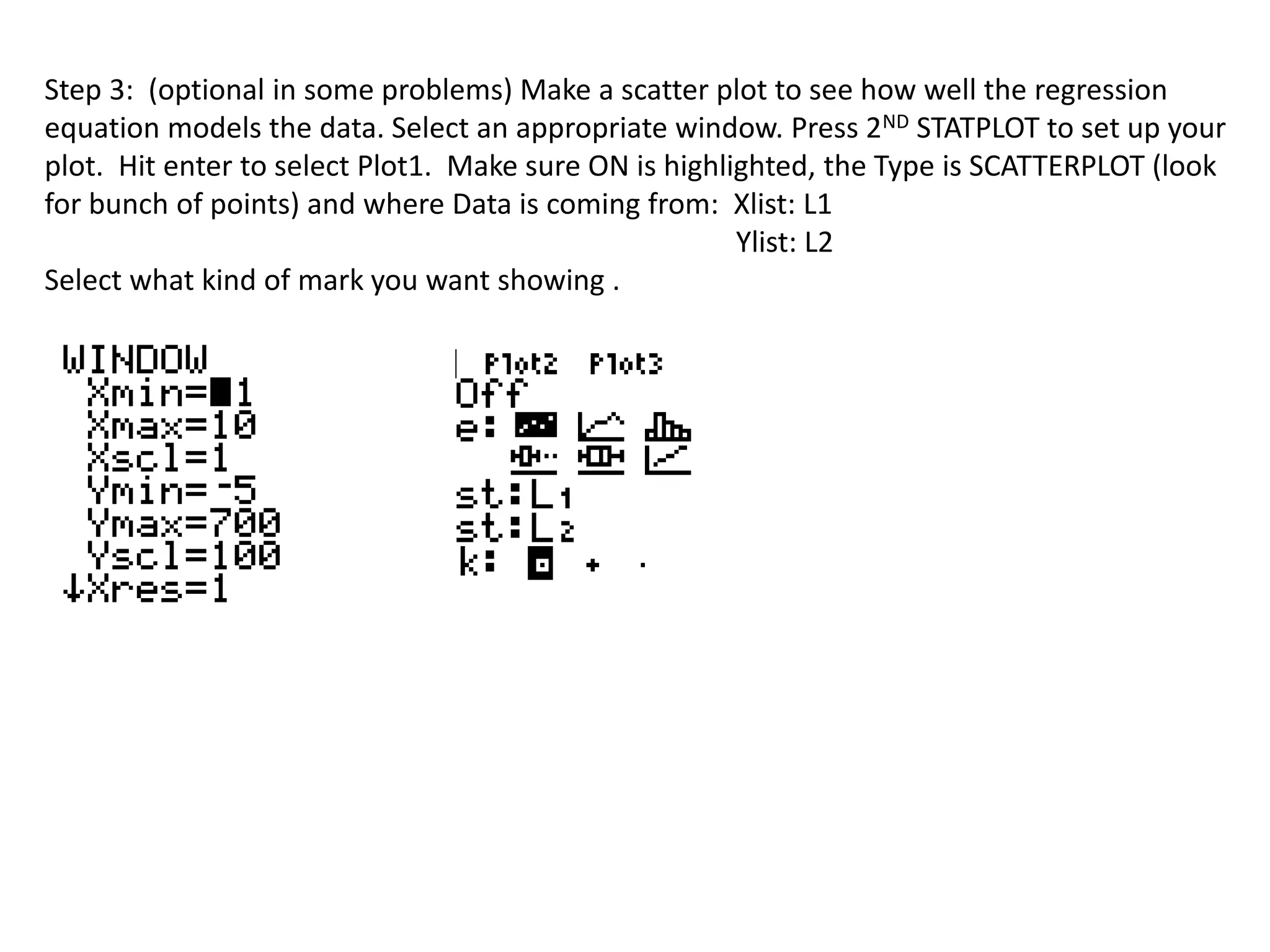
Step 3: (optional in some problems) Make a scatter plot to see how well the regression 
equation models the data. Select an appropriate window. Press 2ND STATPLOT to set up your 
plot. Hit enter to select Plot1. Make sure ON is highlighted, the Type is SCATTERPLOT (look 
for bunch of points) and where Data is coming from: Xlist: L1 
Ylist: L2 
Select what kind of mark you want showing .
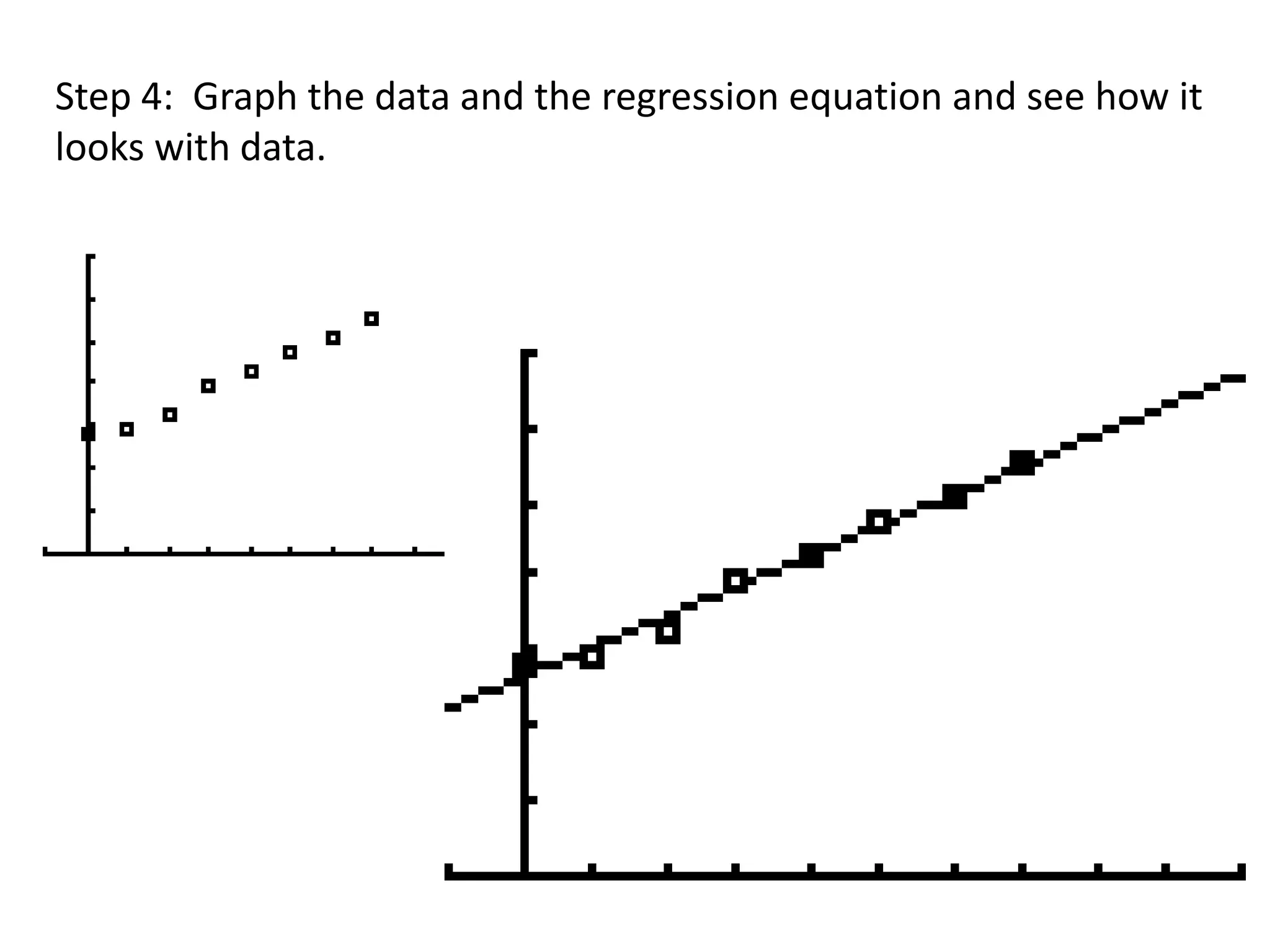
Step 4: Graph the data and the regression equation and see how it 
looks with data.
You can use this Line of BEST FIT to predict values in regions 
where you don’t have data. This is called Forecasting , and is 
used extensively in business and scientific applications 
For example, use the equation in our example to 
predict how many alternative-fueled cars there are in 
2014. 
Solution: Since t = 0 represented 1997, and 2014 
represents t = 17, we would take our equation and 
input t = 17 
You could do this with trace, but might need to change 
your window to include x = 17. Make sure you are 
paying attention to which graph you are tracing on. 
If x = 17, y = 957.6, which is in thousands of cars.
HOW DID WE DO?

2.6b scatter plots and lines of best fit

  • 1.
    2.6 Lines ofBest Fit Using linear regression features on graphing calculators.
  • 2.
    Step 1: Enterthe data into two lists. Press STAT, EDIT and in the L1 column, enter all the x-values from the ordered pairs. In the L2 column, enter all the y-values from the ordered pairs Example: The table shows the number y (in thousands) of alternative-fueled vehicles in the US, x years after 1997. Approximate the line of best fit by using a calculator. x 0 1 2 3 4 5 6 7 y 280 295 322 395 425 471 511 548 Another way to enter data is from the main screen; use the curly brackets (above parentheses) and input each x-value list with commas in between, store to L1, then do the same for y-values, store to L2.
  • 3.
    Step 2: Findan equation of best fitting (linear regression) line. Press STAT, choose CALC, and then LinReg(ax + b). Your screen should look like this: OR If this one, you might need to make sure it is using L1 and L2 by inputting after this command Select Calculate and up will come this screen: Write down equation. To graph, you also could have stored this equation in the previous step. If your correlation coefficient doesn’t show up, in CATALOG, select DiagnosticOn.
  • 4.
    Step 3: (optionalin some problems) Make a scatter plot to see how well the regression equation models the data. Select an appropriate window. Press 2ND STATPLOT to set up your plot. Hit enter to select Plot1. Make sure ON is highlighted, the Type is SCATTERPLOT (look for bunch of points) and where Data is coming from: Xlist: L1 Ylist: L2 Select what kind of mark you want showing .
  • 5.
    Step 4: Graphthe data and the regression equation and see how it looks with data.
  • 6.
    You can usethis Line of BEST FIT to predict values in regions where you don’t have data. This is called Forecasting , and is used extensively in business and scientific applications For example, use the equation in our example to predict how many alternative-fueled cars there are in 2014. Solution: Since t = 0 represented 1997, and 2014 represents t = 17, we would take our equation and input t = 17 You could do this with trace, but might need to change your window to include x = 17. Make sure you are paying attention to which graph you are tracing on. If x = 17, y = 957.6, which is in thousands of cars.
  • 7.