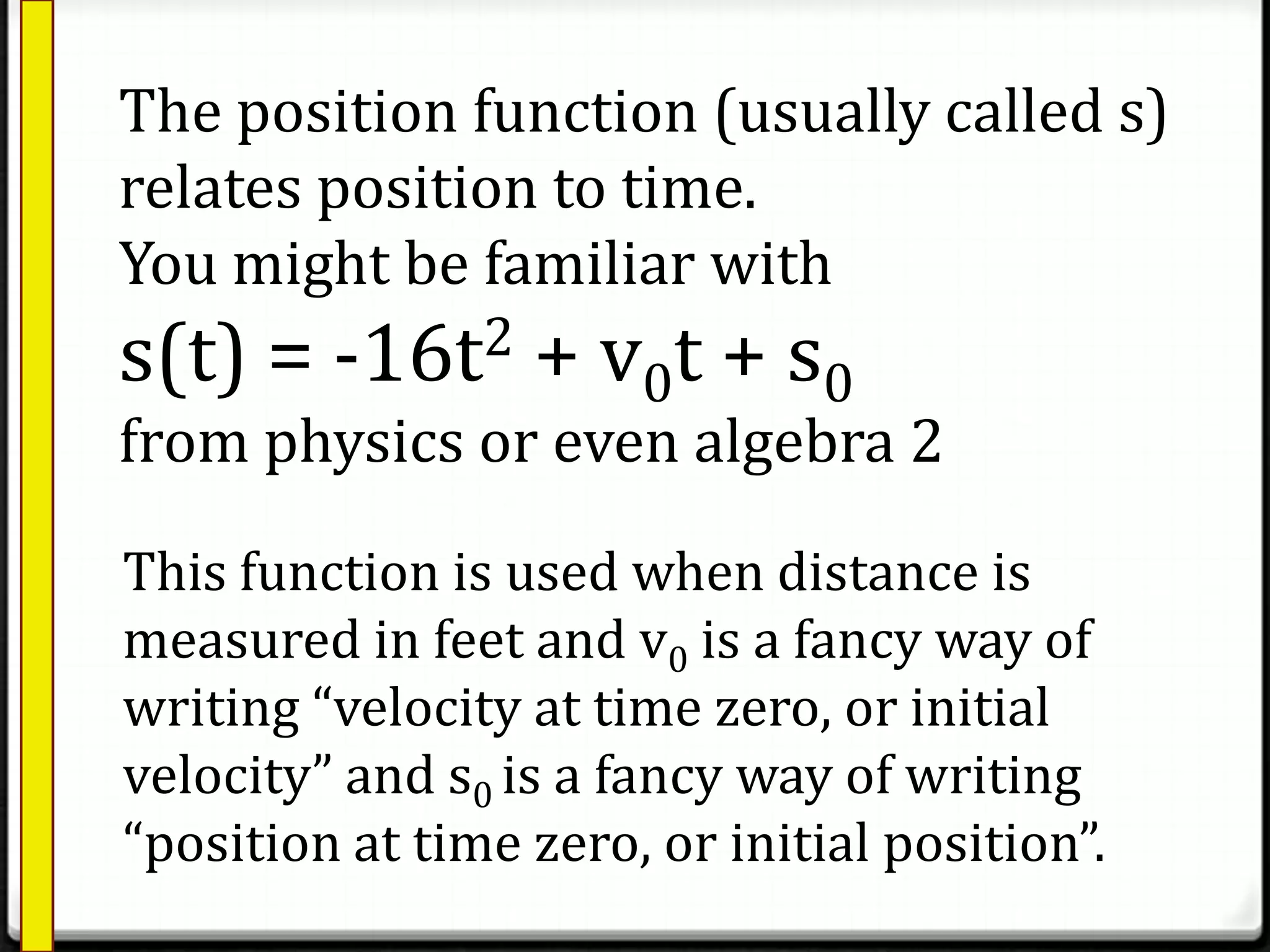
The position function (usually called s)
relates position to time.
You might be familiar with
s(t) = -16t2 + v0t + s0
from physics or even algebra 2
This function is used when distance is
measured in feet and v0 is a fancy way of
writing “velocity at time zero, or initial
velocity” and s0 is a fancy way of writing
“position at time zero, or initial position”.
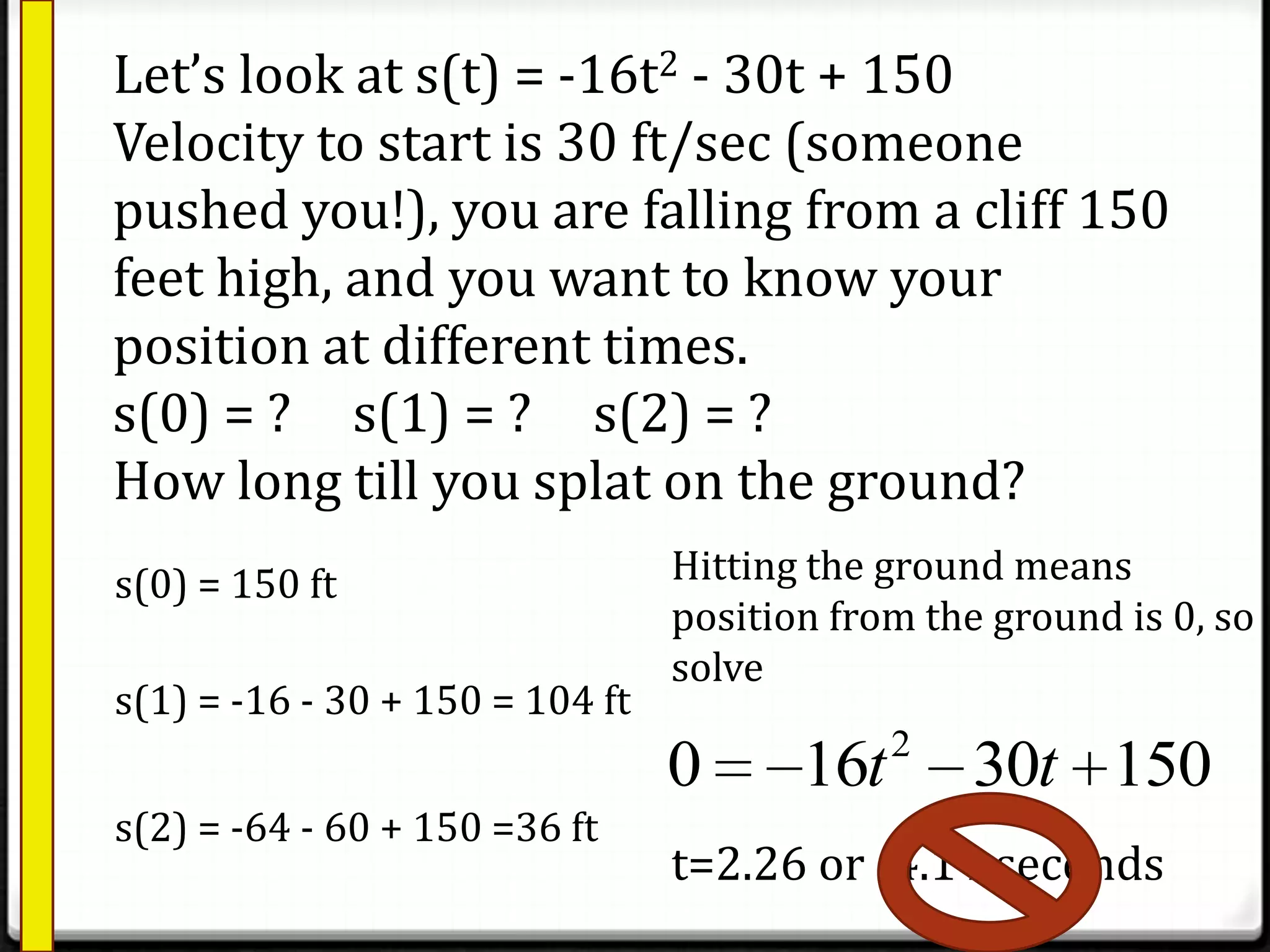
Let’s look at s(t) = -16t2 - 30t + 150
Velocity to start is 30 ft/sec (someone
pushed you!), you are falling from a cliff 150
feet high, and you want to know your
position at different times.
s(0) = ? s(1) = ? s(2) = ?
How long till you splat on the ground?
s(0) = 150 ft
s(1) = -16 - 30 + 150 = 104 ft
s(2) = -64 - 60 + 150 =36 ft
Hitting the ground means
position from the ground is 0, so
solve
2
0 16 30 150t t
t=2.26 or -4.14 seconds
Change in Distance
Average velocity=
Change in Time
s
t
Distance
Rate=
Time
Ex. 9 p. 113
If a billiard ball is dropped from a height of 100 feet its position is given by
s(t) = -16t2 +100.
Find the average velocity over the following intervals.
a. [1, 2]
b. [1, 1.5]
c. [1, 1.1]
a. Δs = s(2) – s(1) = 36 – 84 = -48 avg vel = -48/1 = -48 ft/sec
b. Δs = s(1.5) – s(1) = 64 – 84 = -20 avg vel = -20/.5= -40 ft/sec
c. Δs = s(1.1) – s(1) = 80.64 – 84 = -3.36 avg vel = -3.36/.1= -33.6 ft/sec
Note that the average velocities are negative, indicating downward movement
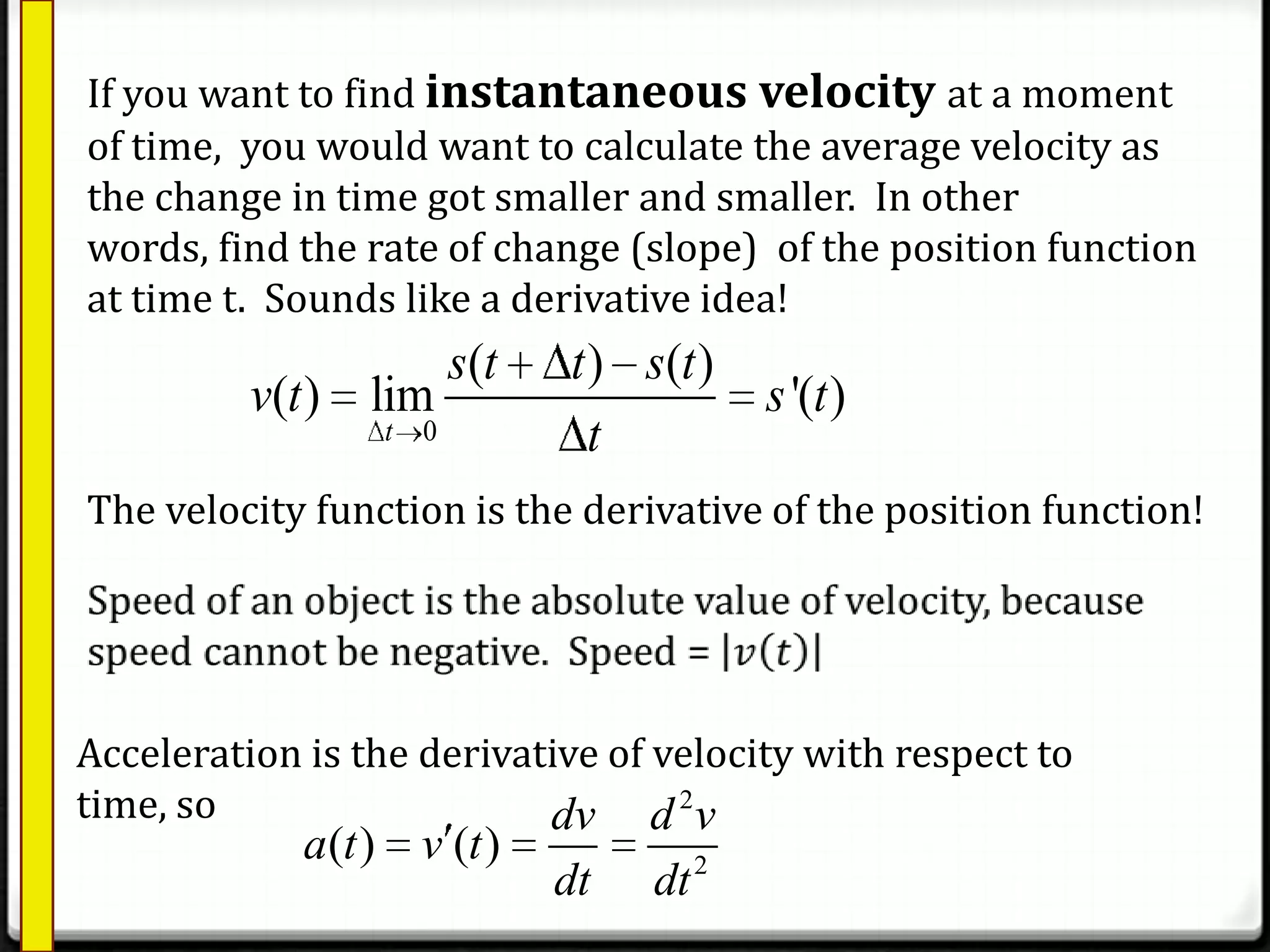
If you want to find instantaneous velocity at a moment
of time, you would want to calculate the average velocity as
the change in time got smaller and smaller. In other
words, find the rate of change (slope) of the position function
at time t. Sounds like a derivative idea!
0
( ) ( )
( ) lim '( )
t
s t t s t
v t s t
t
The velocity function is the derivative of the position function!
Acceleration is the derivative of velocity with respect to
time, so 2
2
( ) ( )
dv d v
a t v t
dt dt
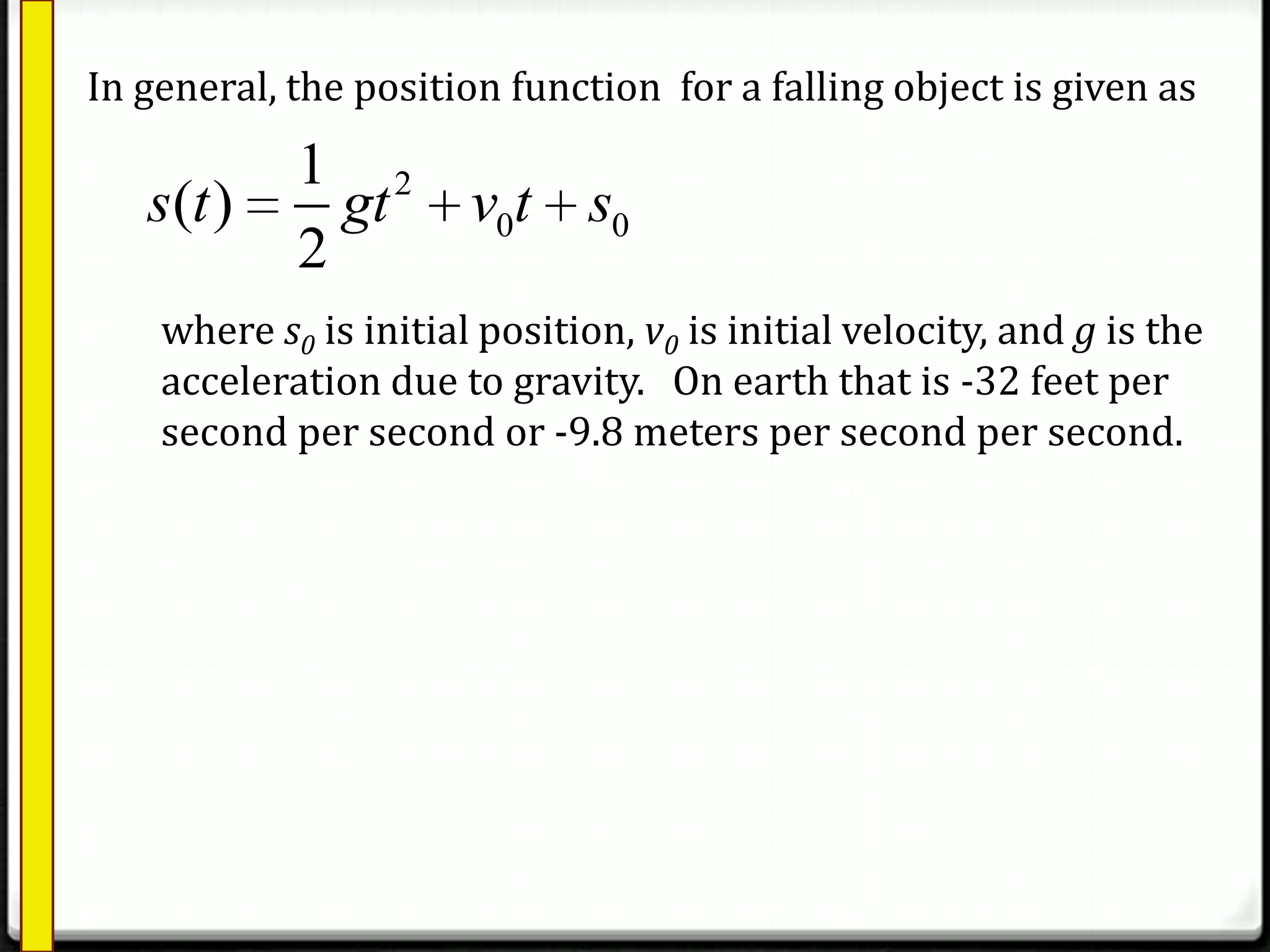
2
0 0
1
( )
2
s t gt v t s
In general, the position function for a falling object is given as
where s0 is initial position, v0 is initial velocity, and g is the
acceleration due to gravity. On earth that is -32 feet per
second per second or -9.8 meters per second per second.
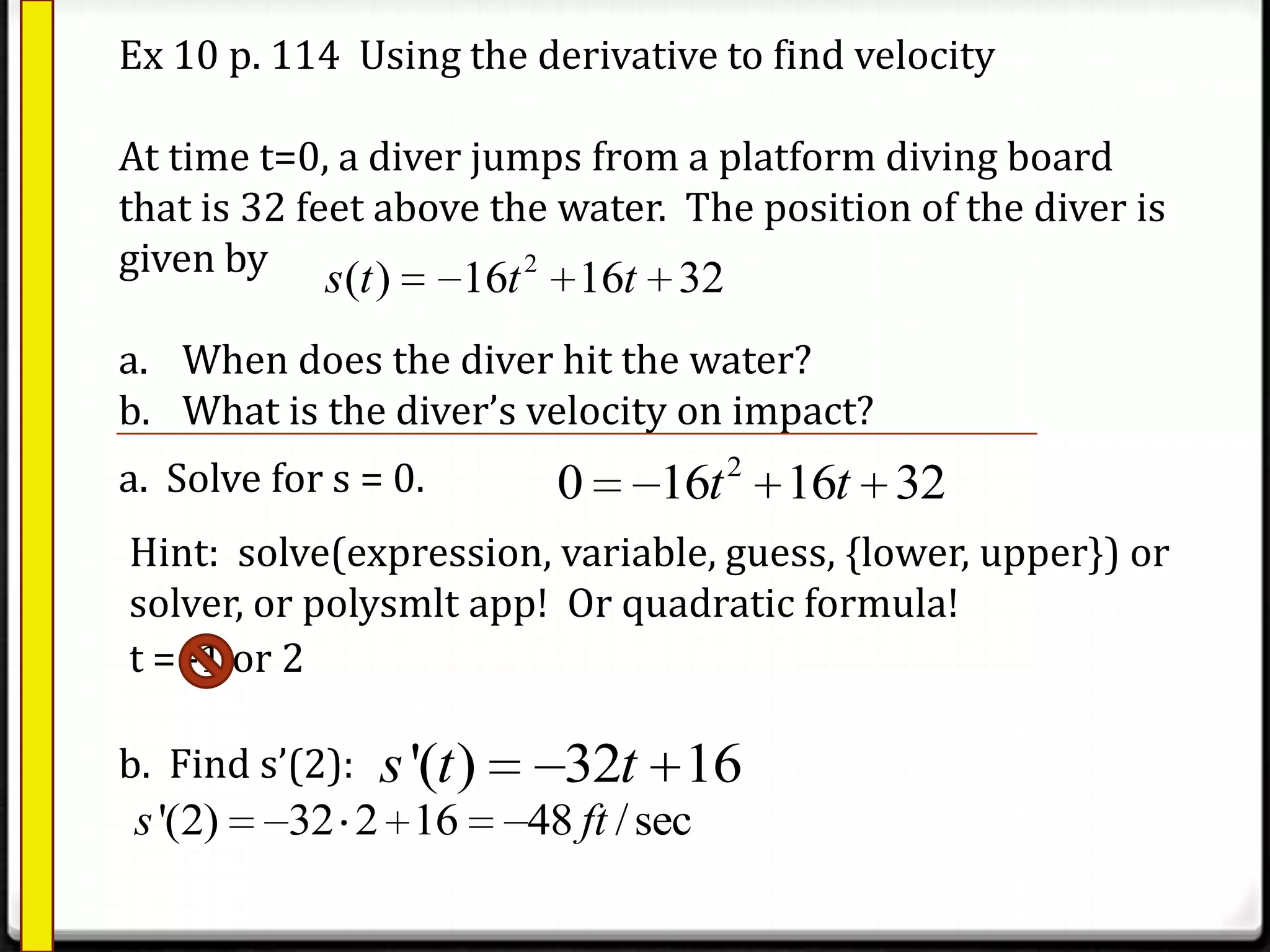
Ex 10 p. 114 Using the derivative to find velocity
At time t=0, a diver jumps from a platform diving board
that is 32 feet above the water. The position of the diver is
given by
a. When does the diver hit the water?
b. What is the diver’s velocity on impact?
2
( ) 16 16 32s t t t
a. Solve for s = 0. 2
0 16 16 32t t
Hint: solve(expression, variable, guess, {lower, upper}) or
solver, or polysmlt app! Or quadratic formula!
t = -1 or 2
b. Find s’(2): '( ) 32 16s t t
'(2) 32 2 16 48 /secs ft
35
30
25
20
15
10
5
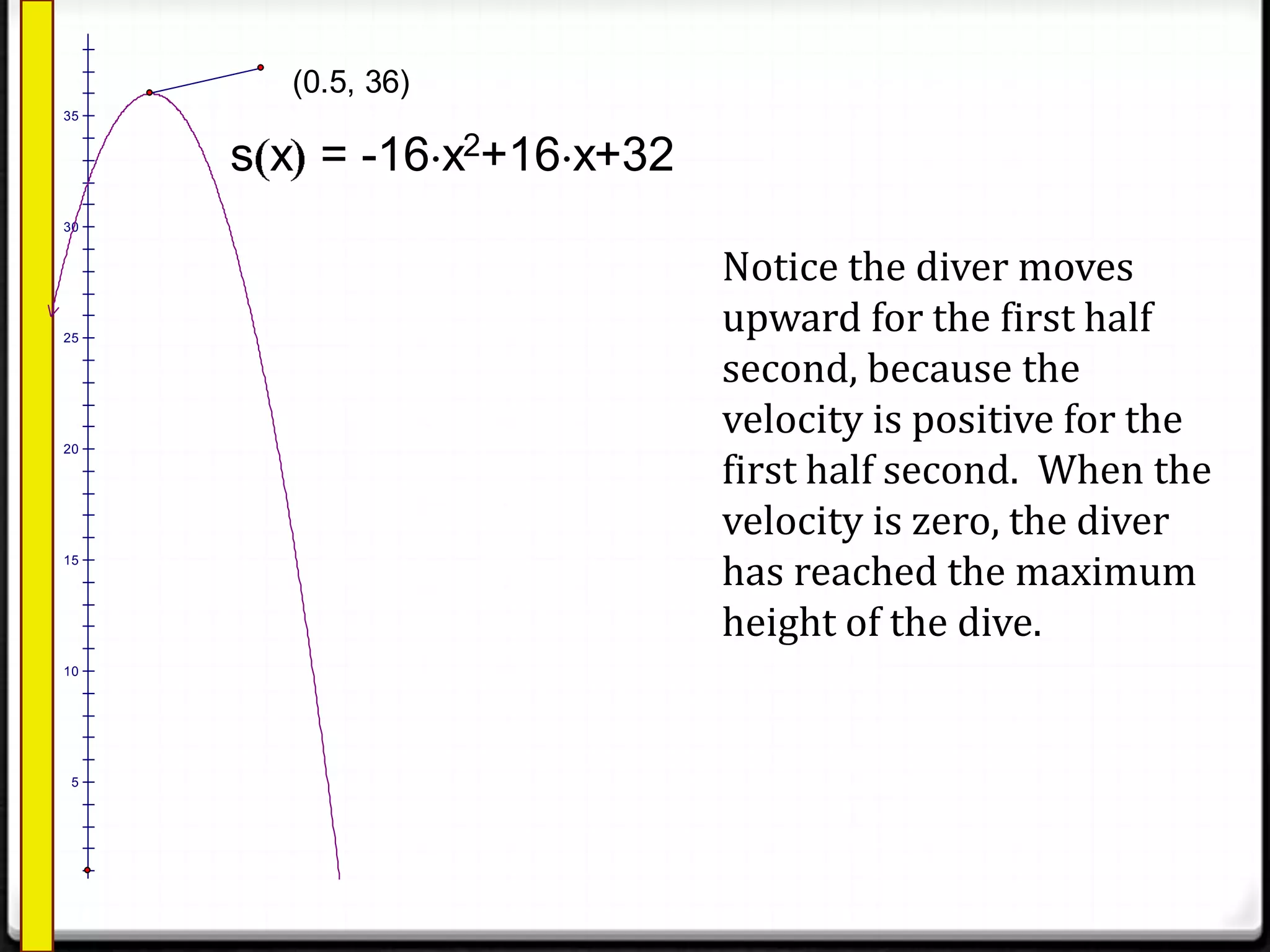
s x = -16 x2+16 x+32
(0.5, 36)
Notice the diver moves
upward for the first half
second, because the
velocity is positive for the
first half second. When the
velocity is zero, the diver
has reached the maximum
height of the dive.
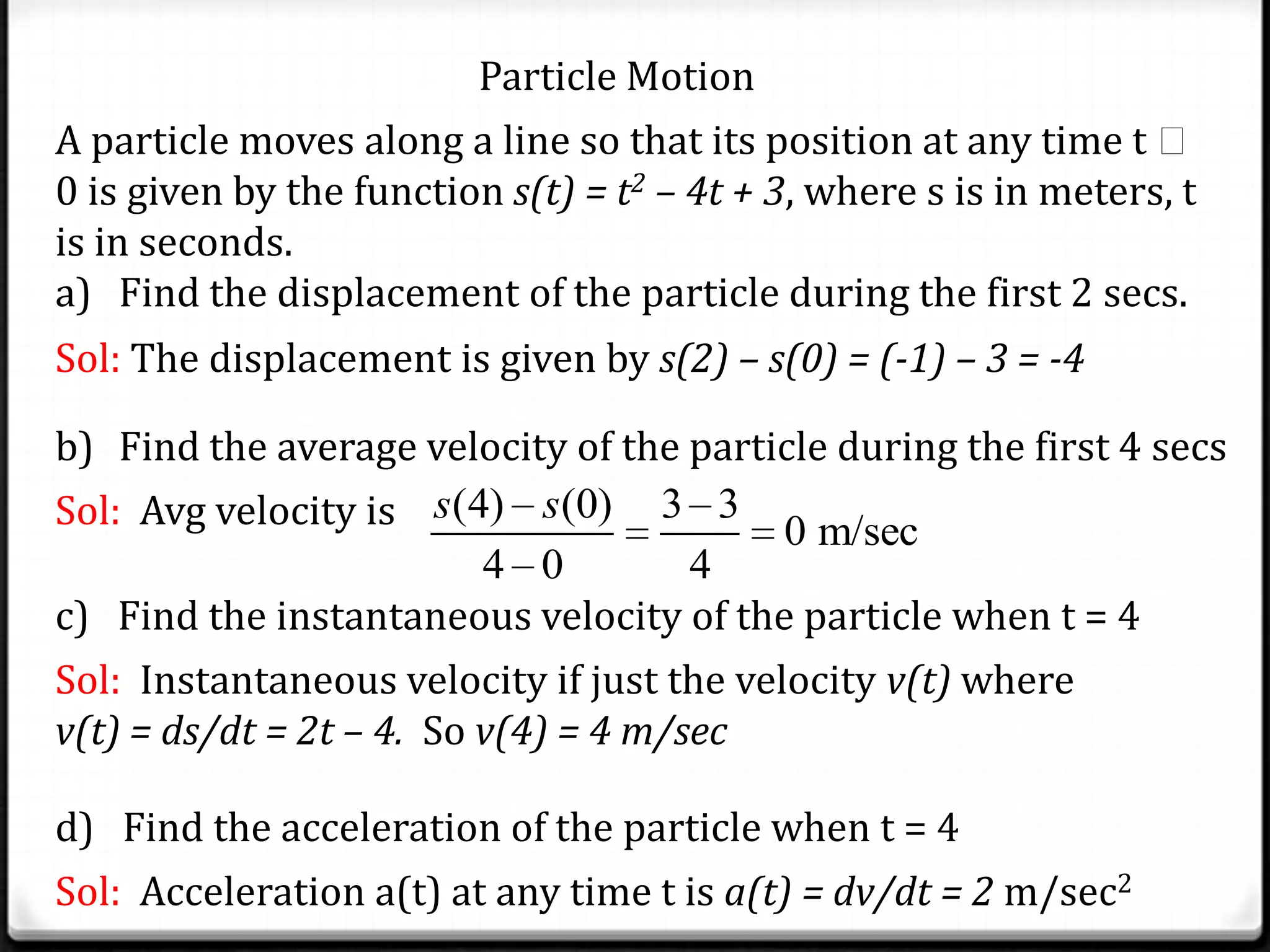
Particle Motion
A particle moves along a line so that its position at any time t 
0 is given by the function s(t) = t2 – 4t + 3, where s is in meters, t
is in seconds.
a) Find the displacement of the particle during the first 2 secs.
Sol: The displacement is given by s(2) – s(0) = (-1) – 3 = -4
b) Find the average velocity of the particle during the first 4 secs
Sol: Avg velocity is (4) (0) 3 3
0 m/sec
4 0 4
s s
c) Find the instantaneous velocity of the particle when t = 4
Sol: Instantaneous velocity if just the velocity v(t) where
v(t) = ds/dt = 2t – 4. So v(4) = 4 m/sec
d) Find the acceleration of the particle when t = 4
Sol: Acceleration a(t) at any time t is a(t) = dv/dt = 2 m/sec2
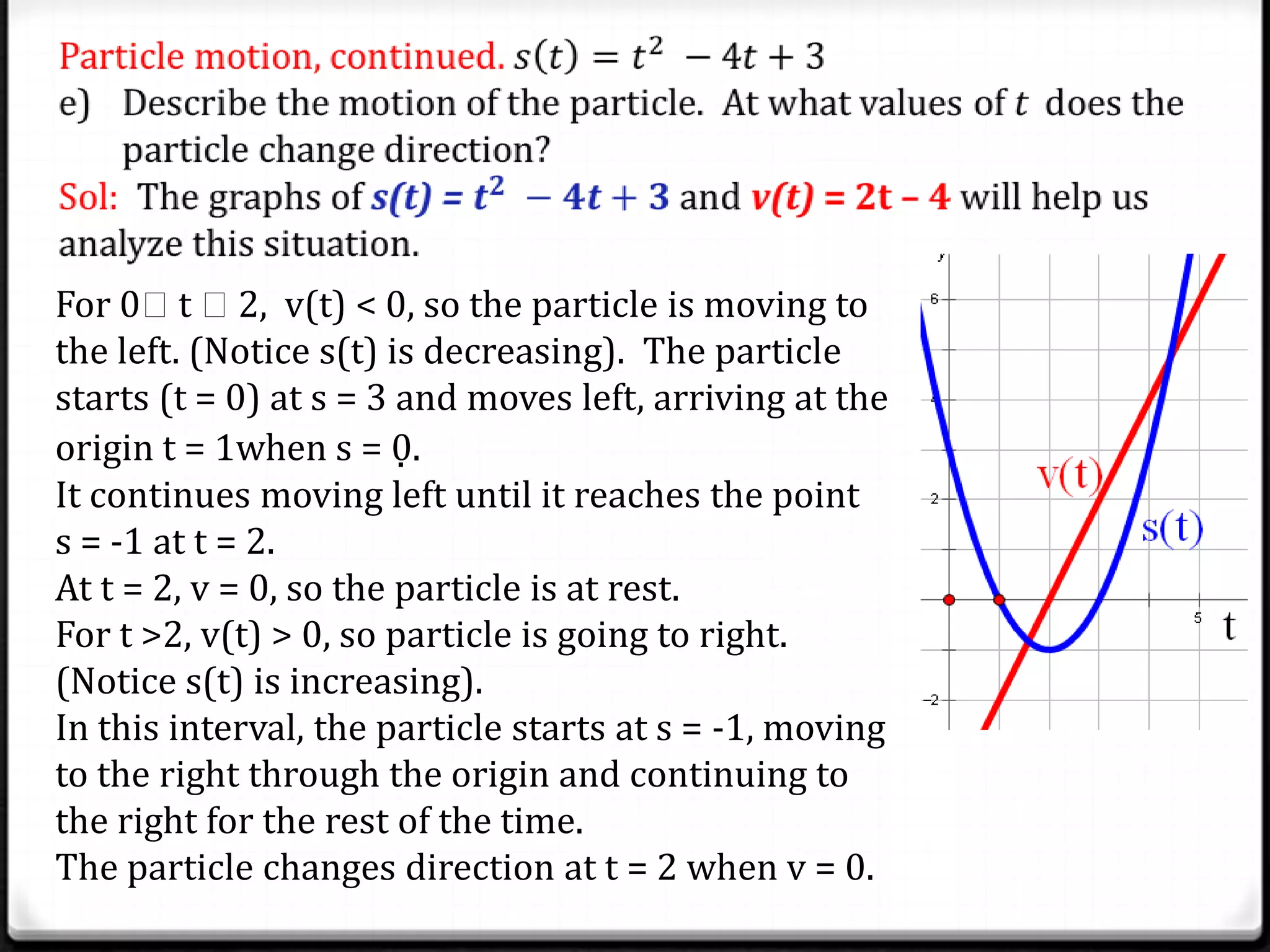
For 0t 2, v(t) < 0, so the particle is moving to
the left. (Notice s(t) is decreasing). The particle
starts (t = 0) at s = 3 and moves left, arriving at the
origin t = 1when s = 0.
It continues moving left until it reaches the point
s = -1 at t = 2.
At t = 2, v = 0, so the particle is at rest.
For t >2, v(t) > 0, so particle is going to right.
(Notice s(t) is increasing).
In this interval, the particle starts at s = -1, moving
to the right through the origin and continuing to
the right for the rest of the time.
The particle changes direction at t = 2 when v = 0.
f) Use parametric graphing to view the motion of the particle
on the horizontal line y = 2
Sol: Change mode to PAR (parametric)
Enter
And graph in window [-5, 5] by [-2, 4]
with Tmin = 0, Tmax = 10 (could go to
infinity) and Xscl = Yscl= 1. Use trace
to follow the path of the particle.
If you change your Tstep = 0,5, you see
what is happening every half second.
2
1TX 4 3,T T 1T 2,Y
2.2b Assignment: p. 115 #75-76, 83-
90, 93-96, 103-104 and
Particle Motion Prob 1.

Calc 2.2b

  • 2.
    The position function(usually called s) relates position to time. You might be familiar with s(t) = -16t2 + v0t + s0 from physics or even algebra 2 This function is used when distance is measured in feet and v0 is a fancy way of writing “velocity at time zero, or initial velocity” and s0 is a fancy way of writing “position at time zero, or initial position”.
  • 3.
    Let’s look ats(t) = -16t2 - 30t + 150 Velocity to start is 30 ft/sec (someone pushed you!), you are falling from a cliff 150 feet high, and you want to know your position at different times. s(0) = ? s(1) = ? s(2) = ? How long till you splat on the ground? s(0) = 150 ft s(1) = -16 - 30 + 150 = 104 ft s(2) = -64 - 60 + 150 =36 ft Hitting the ground means position from the ground is 0, so solve 2 0 16 30 150t t t=2.26 or -4.14 seconds
  • 4.
    Change in Distance Averagevelocity= Change in Time s t Distance Rate= Time Ex. 9 p. 113 If a billiard ball is dropped from a height of 100 feet its position is given by s(t) = -16t2 +100. Find the average velocity over the following intervals. a. [1, 2] b. [1, 1.5] c. [1, 1.1] a. Δs = s(2) – s(1) = 36 – 84 = -48 avg vel = -48/1 = -48 ft/sec b. Δs = s(1.5) – s(1) = 64 – 84 = -20 avg vel = -20/.5= -40 ft/sec c. Δs = s(1.1) – s(1) = 80.64 – 84 = -3.36 avg vel = -3.36/.1= -33.6 ft/sec Note that the average velocities are negative, indicating downward movement
  • 5.
    If you wantto find instantaneous velocity at a moment of time, you would want to calculate the average velocity as the change in time got smaller and smaller. In other words, find the rate of change (slope) of the position function at time t. Sounds like a derivative idea! 0 ( ) ( ) ( ) lim '( ) t s t t s t v t s t t The velocity function is the derivative of the position function! Acceleration is the derivative of velocity with respect to time, so 2 2 ( ) ( ) dv d v a t v t dt dt
  • 6.
    2 0 0 1 ( ) 2 st gt v t s In general, the position function for a falling object is given as where s0 is initial position, v0 is initial velocity, and g is the acceleration due to gravity. On earth that is -32 feet per second per second or -9.8 meters per second per second.
  • 7.
    Ex 10 p.114 Using the derivative to find velocity At time t=0, a diver jumps from a platform diving board that is 32 feet above the water. The position of the diver is given by a. When does the diver hit the water? b. What is the diver’s velocity on impact? 2 ( ) 16 16 32s t t t a. Solve for s = 0. 2 0 16 16 32t t Hint: solve(expression, variable, guess, {lower, upper}) or solver, or polysmlt app! Or quadratic formula! t = -1 or 2 b. Find s’(2): '( ) 32 16s t t '(2) 32 2 16 48 /secs ft
  • 8.
    35 30 25 20 15 10 5 s x =-16 x2+16 x+32 (0.5, 36) Notice the diver moves upward for the first half second, because the velocity is positive for the first half second. When the velocity is zero, the diver has reached the maximum height of the dive.
  • 9.
    Particle Motion A particlemoves along a line so that its position at any time t  0 is given by the function s(t) = t2 – 4t + 3, where s is in meters, t is in seconds. a) Find the displacement of the particle during the first 2 secs. Sol: The displacement is given by s(2) – s(0) = (-1) – 3 = -4 b) Find the average velocity of the particle during the first 4 secs Sol: Avg velocity is (4) (0) 3 3 0 m/sec 4 0 4 s s c) Find the instantaneous velocity of the particle when t = 4 Sol: Instantaneous velocity if just the velocity v(t) where v(t) = ds/dt = 2t – 4. So v(4) = 4 m/sec d) Find the acceleration of the particle when t = 4 Sol: Acceleration a(t) at any time t is a(t) = dv/dt = 2 m/sec2
  • 10.
    For 0t 2,v(t) < 0, so the particle is moving to the left. (Notice s(t) is decreasing). The particle starts (t = 0) at s = 3 and moves left, arriving at the origin t = 1when s = 0. It continues moving left until it reaches the point s = -1 at t = 2. At t = 2, v = 0, so the particle is at rest. For t >2, v(t) > 0, so particle is going to right. (Notice s(t) is increasing). In this interval, the particle starts at s = -1, moving to the right through the origin and continuing to the right for the rest of the time. The particle changes direction at t = 2 when v = 0.
  • 11.
    f) Use parametricgraphing to view the motion of the particle on the horizontal line y = 2 Sol: Change mode to PAR (parametric) Enter And graph in window [-5, 5] by [-2, 4] with Tmin = 0, Tmax = 10 (could go to infinity) and Xscl = Yscl= 1. Use trace to follow the path of the particle. If you change your Tstep = 0,5, you see what is happening every half second. 2 1TX 4 3,T T 1T 2,Y
  • 12.
    2.2b Assignment: p.115 #75-76, 83- 90, 93-96, 103-104 and Particle Motion Prob 1.