

Section	2.6
                                  Implicit	Differentiation

                                   V63.0121.034, Calculus	I


                                       October	7, 2009


        Announcements
                 Midterm	next	, covering	§§1.1–2.4.

        .
.
Image	credit: Telstar	Logistics
                                                         .    .   .   .   .   .
Outline


  The	big	idea, by	example


  Examples
     Vertical	and	Horizontal	Tangents
     Orthogonal	Trajectories
     Chemistry


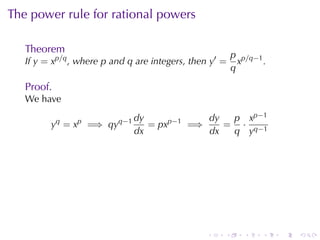
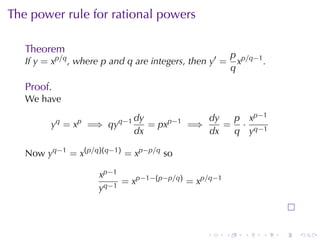
  The	power	rule	for	rational	powers


                                        .   .   .   .   .   .
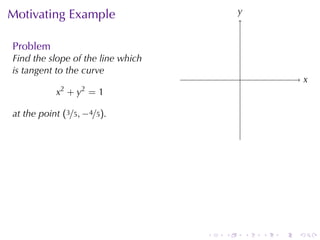
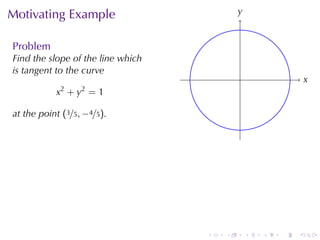
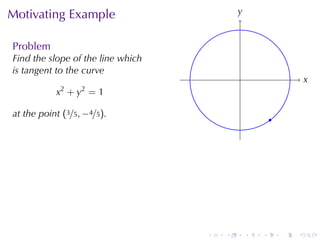
Motivating	Example                         y
                                           .


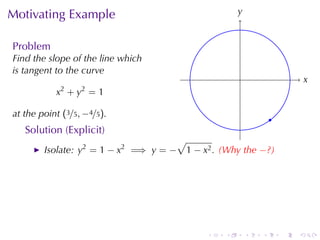
Problem
Find	the	slope	of	the	line	which
is	tangent	to	the	curve
                                           .                   x
                                                               .
            2     2
           x +y =1

at	the	point (3/5, −4/5).


                                   .   .       .   .   .   .
Motivating	Example                         y
                                           .


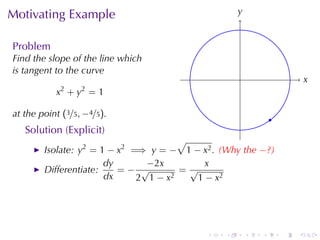
Problem
Find	the	slope	of	the	line	which
is	tangent	to	the	curve
                                           .                   x
                                                               .
            2     2
           x +y =1

at	the	point (3/5, −4/5).


                                   .   .       .   .   .   .
Motivating	Example                         y
                                           .


Problem
Find	the	slope	of	the	line	which
is	tangent	to	the	curve
                                           .                       x
                                                                   .
            2     2
           x +y =1

at	the	point (3/5, −4/5).                              .


                                   .   .       .   .       .   .
Motivating	Example                                  y
                                                    .


Problem
Find	the	slope	of	the	line	which
is	tangent	to	the	curve
                                                    .                       x
                                                                            .
            2     2
           x +y =1

at	the	point (3/5, −4/5).                                       .
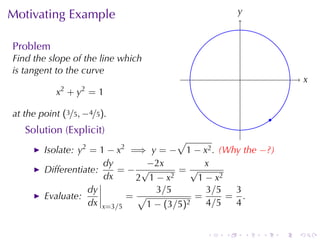
   Solution	(Explicit)
                                     √
        Isolate: y2 = 1 − x2 =⇒ y = − 1 − x2 . (Why	the −?)


                                            .   .       .   .       .   .
Motivating	Example                                  y
                                                    .


Problem
Find	the	slope	of	the	line	which
is	tangent	to	the	curve
                                                    .                       x
                                                                            .
            2     2
           x +y =1

at	the	point (3/5, −4/5).                                       .
   Solution	(Explicit)
                                      √
        Isolate: y2 = 1 − x2 =⇒ y = − 1 − x2 . (Why	the −?)
                       dy       −2x        x
        Differentiate:    =− √        =√
                       dx     2 1−x 2    1 − x2


                                            .   .       .   .       .   .
Motivating	Example                                  y
                                                    .


Problem
Find	the	slope	of	the	line	which
is	tangent	to	the	curve
                                                    .                       x
                                                                            .
            2     2
           x +y =1

at	the	point (3/5, −4/5).                                       .
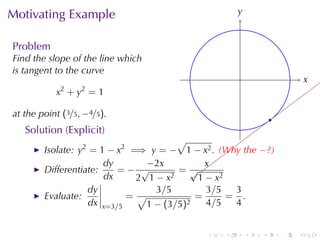
   Solution	(Explicit)
                                        √
        Isolate: y2 = 1 − x2 =⇒ y = − 1 − x2 . (Why	the −?)
                       dy       −2x            x
        Differentiate:    =− √          =√
                       dx     2 1−x   2      1 − x2
                   dy             3 /5         3/5   3
        Evaluate:           =√               =      = .
                   dx x=3/5     1 − (3 /5 )2   4/5   4


                                            .   .       .   .       .   .
Motivating	Example                                  y
                                                    .


Problem
Find	the	slope	of	the	line	which
is	tangent	to	the	curve
                                                    .                       x
                                                                            .
            2     2
           x +y =1

at	the	point (3/5, −4/5).                                       .
   Solution	(Explicit)
                                        √
        Isolate: y2 = 1 − x2 =⇒ y = − 1 − x2 . (Why	the −?)
                       dy       −2x            x
        Differentiate:    =− √          =√
                       dx     2 1−x   2      1 − x2
                   dy             3 /5         3/5   3
        Evaluate:           =√               =      = .
                   dx x=3/5     1 − (3 /5 )2   4/5   4


                                            .   .       .   .       .   .
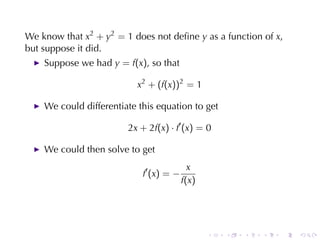
We	know	that x2 + y2 = 1 does	not	define y as	a	function	of x,
but	suppose	it	did.
    Suppose	we	had y = f(x), so	that

                          x2 + (f(x))2 = 1

    We	could	differentiate	this	equation	to	get

                        2x + 2f(x) · f′ (x) = 0

    We	could	then	solve	to	get
                                             x
                            f ′ (x ) = −
                                           f(x)


                                                  .   .   .   .   .   .
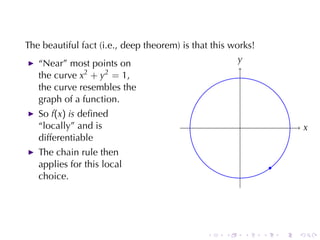
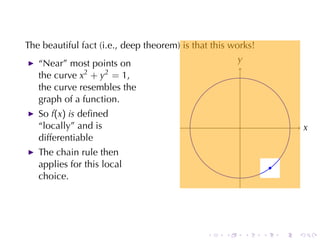
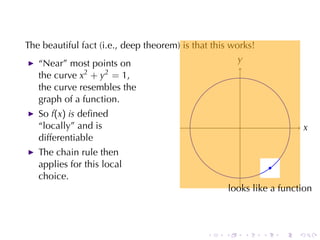
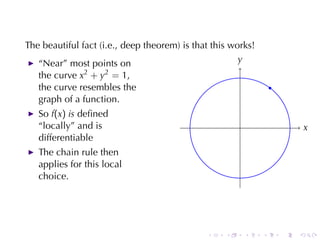
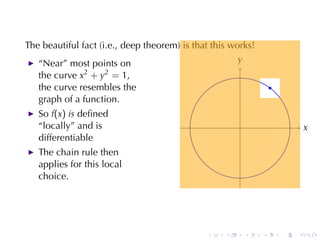
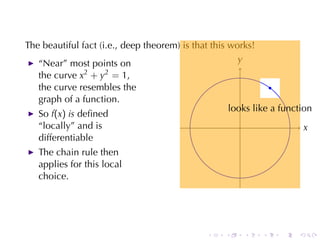
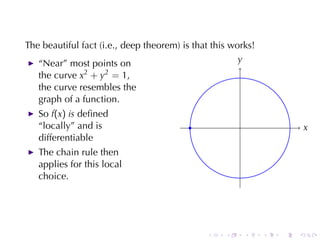
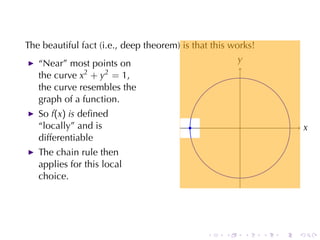
The	beautiful	fact	(i.e., deep	theorem)	is	that	this	works!
   “Near”	most	points	on                               y
                                                       .
   the	curve x2 + y2 = 1,
   the	curve	resembles	the
   graph	of	a	function.
   So f(x) is defined
   “locally”	and	is                                    .                       x
                                                                               .
   differentiable
   The	chain	rule	then
   applies	for	this	local                                          .
   choice.


                                              .    .       .   .       .   .
The	beautiful	fact	(i.e., deep	theorem)	is	that	this	works!
   “Near”	most	points	on                               y
                                                       .
   the	curve x2 + y2 = 1,
   the	curve	resembles	the
   graph	of	a	function.
   So f(x) is defined
   “locally”	and	is                                    .                       x
                                                                               .
   differentiable
   The	chain	rule	then
   applies	for	this	local                                          .
   choice.


                                              .    .       .   .       .   .
The	beautiful	fact	(i.e., deep	theorem)	is	that	this	works!
   “Near”	most	points	on                               y
                                                       .
   the	curve x2 + y2 = 1,
   the	curve	resembles	the
   graph	of	a	function.
   So f(x) is defined
   “locally”	and	is                                      .                       x
                                                                                 .
   differentiable
   The	chain	rule	then
   applies	for	this	local                                            .
   choice.
                                                       l
                                                       .ooks	like	a	function


                                              .    .         .   .       .   .
The	beautiful	fact	(i.e., deep	theorem)	is	that	this	works!
   “Near”	most	points	on                               y
                                                       .
   the	curve x2 + y2 = 1,
   the	curve	resembles	the                                         .
   graph	of	a	function.
   So f(x) is defined
   “locally”	and	is                                    .                       x
                                                                               .
   differentiable
   The	chain	rule	then
   applies	for	this	local
   choice.


                                              .    .       .   .       .   .
The	beautiful	fact	(i.e., deep	theorem)	is	that	this	works!
   “Near”	most	points	on                               y
                                                       .
   the	curve x2 + y2 = 1,
   the	curve	resembles	the                                         .
   graph	of	a	function.
   So f(x) is defined
   “locally”	and	is                                    .                       x
                                                                               .
   differentiable
   The	chain	rule	then
   applies	for	this	local
   choice.


                                              .    .       .   .       .   .
The	beautiful	fact	(i.e., deep	theorem)	is	that	this	works!
   “Near”	most	points	on                               y
                                                       .
   the	curve x2 + y2 = 1,
   the	curve	resembles	the                                           .
   graph	of	a	function.
                                                       l
                                                       .ooks	like	a	function
   So f(x) is defined
   “locally”	and	is                                      .                       x
                                                                                 .
   differentiable
   The	chain	rule	then
   applies	for	this	local
   choice.


                                              .    .         .   .       .   .
The	beautiful	fact	(i.e., deep	theorem)	is	that	this	works!
   “Near”	most	points	on                               y
                                                       .
   the	curve x2 + y2 = 1,
   the	curve	resembles	the
   graph	of	a	function.
   So f(x) is defined
   “locally”	and	is                       .            .                   x
                                                                           .
   differentiable
   The	chain	rule	then
   applies	for	this	local
   choice.


                                              .    .       .   .   .   .
The	beautiful	fact	(i.e., deep	theorem)	is	that	this	works!
   “Near”	most	points	on                               y
                                                       .
   the	curve x2 + y2 = 1,
   the	curve	resembles	the
   graph	of	a	function.
   So f(x) is defined
   “locally”	and	is                       .            .                   x
                                                                           .
   differentiable
   The	chain	rule	then
   applies	for	this	local
   choice.


                                              .    .       .   .   .   .
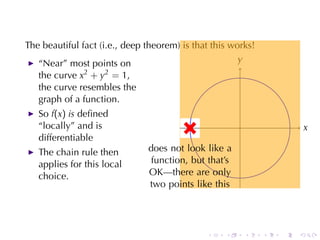
The	beautiful	fact	(i.e., deep	theorem)	is	that	this	works!
   “Near”	most	points	on                               y
                                                       .
   the	curve x2 + y2 = 1,
   the	curve	resembles	the
   graph	of	a	function.
   So f(x) is defined
   “locally”	and	is                        .             .                   x
                                                                             .
   differentiable            .
   The	chain	rule	then           does not look like a
   applies	for	this	local         function, but that’s
   choice.                       OK—there are only
                                 two points like this


                                               .    .        .   .   .   .
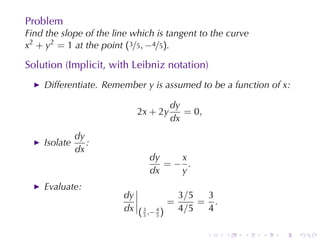
Problem
Find	the	slope	of	the	line	which	is	tangent	to	the	curve
x2 + y2 = 1 at	the	point (3/5, −4/5).

Solution	(Implicit, with	Leibniz	notation)
    Differentiate. Remember y is	assumed	to	be	a	function	of x:

                                      dy
                            2x + 2y      = 0,
                                      dx
              dy
    Isolate      :
              dx
                               dy   x
                                  =− .
                               dx   y
    Evaluate:
                        dy             3 /5  3
                                     =      = .
                        dx ( 3 ,− 4 ) 4/5    4
                             5    5


                                                .   .   .   .   .   .
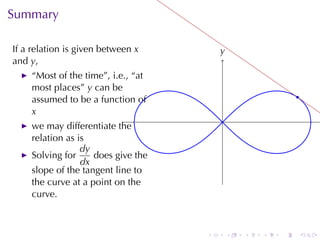
Summary

If	a	relation	is	given	between x        y
                                        .
and y,
    “Most	of	the	time”, i.e., “at
    most	places” y can	be
                                                            .
    assumed	to	be	a	function	of
    x
                                        .
    we	may	differentiate	the
    relation	as	is
                 dy
    Solving	for     does	give	the
                 dx
    slope	of	the	tangent	line	to
    the	curve	at	a	point	on	the
    curve.


                                    .       .   .   .   .   .
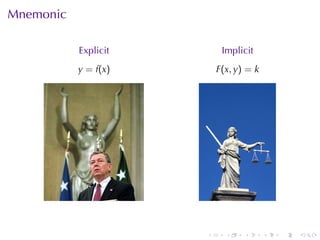
Mnemonic

           Explicit        Implicit
           y = f(x)       F(x, y) = k


                      .     .    .      .   .   .
Outline


  The	big	idea, by	example


  Examples
     Vertical	and	Horizontal	Tangents
     Orthogonal	Trajectories
     Chemistry


  The	power	rule	for	rational	powers


                                        .   .   .   .   .   .
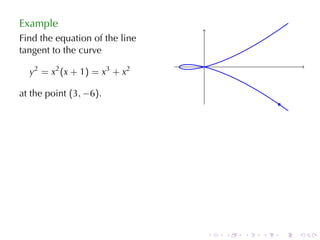
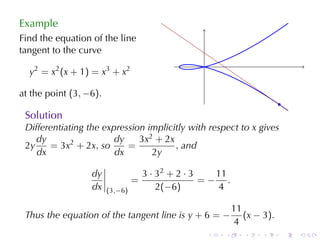
Example
Find	the	equation	of	the	line
tangent	to	the	curve
                                   .
  y 2 = x 2 (x + 1 ) = x 3 + x 2

at	the	point (3, −6).
                                                       .


                                       .   .   .   .   .   .
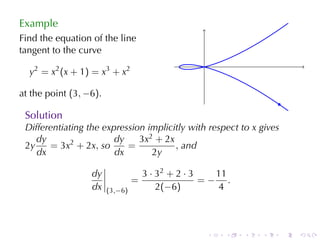
Example
Find	the	equation	of	the	line
tangent	to	the	curve
                                                    .
  y 2 = x 2 (x + 1 ) = x 3 + x 2

at	the	point (3, −6).
                                                                        .
 Solution
 Differentiating	the	expression	implicitly	with	respect	to x gives
    dy                  dy    3x2 + 2x
 2y    = 3x2 + 2x, so      =           , and
    dx                  dx       2y

                    dy                 3 · 32 + 2 · 3   11
                                   =                  =− .
                    dx   (3,−6)            2(−6)         4


                                                        .   .   .   .   .   .
Example
Find	the	equation	of	the	line
tangent	to	the	curve
                                                    .
  y 2 = x 2 (x + 1 ) = x 3 + x 2

at	the	point (3, −6).
                                                                              .
 Solution
 Differentiating	the	expression	implicitly	with	respect	to x gives
    dy                  dy    3x2 + 2x
 2y    = 3x2 + 2x, so      =           , and
    dx                  dx       2y

                    dy                 3 · 32 + 2 · 3   11
                                   =                  =− .
                    dx   (3,−6)            2(−6)         4

                                                                11
 Thus	the	equation	of	the	tangent	line	is y + 6 = −                (x − 3).
                                                                4
                                                        .   .      .    .     .   .
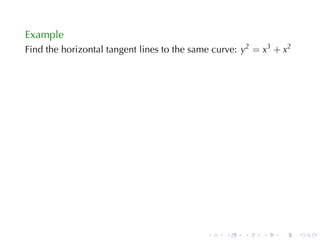
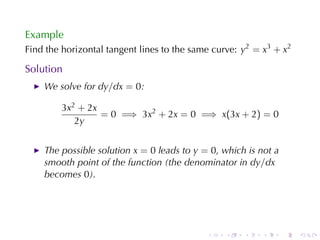
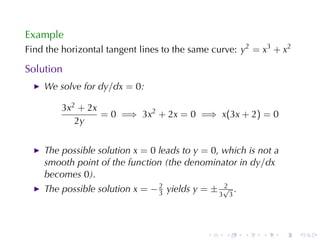
Example
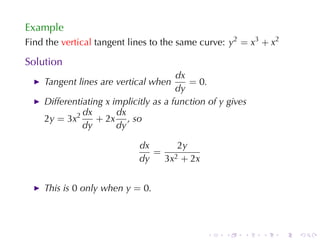
Find	the	horizontal	tangent	lines	to	the	same	curve: y2 = x3 + x2


                                            .    .   .    .   .     .
Example
Find	the	horizontal	tangent	lines	to	the	same	curve: y2 = x3 + x2

Solution


                                            .    .   .    .   .     .
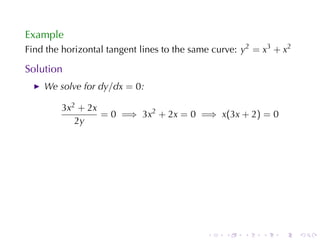
Example
Find	the	horizontal	tangent	lines	to	the	same	curve: y2 = x3 + x2

Solution
    We	solve	for dy/dx = 0:

        3x2 + 2x
                 = 0 =⇒ 3x2 + 2x = 0 =⇒ x(3x + 2) = 0
           2y


                                            .    .   .    .   .     .
Example
Find	the	horizontal	tangent	lines	to	the	same	curve: y2 = x3 + x2

Solution
    We	solve	for dy/dx = 0:

        3x2 + 2x
                 = 0 =⇒ 3x2 + 2x = 0 =⇒ x(3x + 2) = 0
           2y


    The	possible	solution x = 0 leads	to y = 0, which	is	not	a
    smooth	point	of	the	function	(the	denominator	in dy/dx
    becomes 0).


                                            .    .   .    .      .   .
Example
Find	the	horizontal	tangent	lines	to	the	same	curve: y2 = x3 + x2

Solution
    We	solve	for dy/dx = 0:

        3x2 + 2x
                 = 0 =⇒ 3x2 + 2x = 0 =⇒ x(3x + 2) = 0
           2y


    The	possible	solution x = 0 leads	to y = 0, which	is	not	a
    smooth	point	of	the	function	(the	denominator	in dy/dx
    becomes 0).
    The	possible	solution x = − 2 yields y = ± 3√3 .
                                3
                                                2


                                            .    .     .   .     .   .
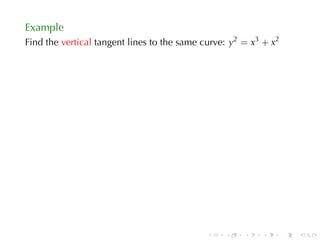
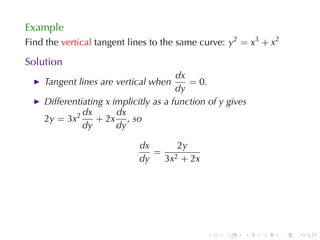
Example
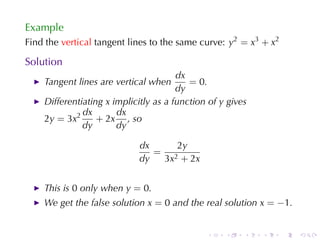
Find	the vertical tangent	lines	to	the	same	curve: y2 = x3 + x2


                                             .   .    .   .       .   .
Example
Find	the vertical tangent	lines	to	the	same	curve: y2 = x3 + x2

Solution
                                       dx
    Tangent	lines	are	vertical	when       = 0.
                                       dy
    Differentiating x implicitly	as	a	function	of y gives
              dx       dx
    2y = 3x2      + 2x , so
              dy       dy

                            dx    2y
                               = 2
                            dy  3x + 2x


                                              .    .    .   .     .   .
Example
Find	the vertical tangent	lines	to	the	same	curve: y2 = x3 + x2

Solution
                                       dx
    Tangent	lines	are	vertical	when       = 0.
                                       dy
    Differentiating x implicitly	as	a	function	of y gives
              dx       dx
    2y = 3x2      + 2x , so
              dy       dy

                            dx    2y
                               = 2
                            dy  3x + 2x


    This	is 0 only	when y = 0.


                                              .    .    .   .     .   .
Example
Find	the vertical tangent	lines	to	the	same	curve: y2 = x3 + x2

Solution
                                       dx
    Tangent	lines	are	vertical	when       = 0.
                                       dy
    Differentiating x implicitly	as	a	function	of y gives
              dx       dx
    2y = 3x2      + 2x , so
              dy       dy

                            dx    2y
                               = 2
                            dy  3x + 2x


    This	is 0 only	when y = 0.
    We	get	the	false	solution x = 0 and	the	real	solution x = −1.


                                              .    .    .   .     .   .
Example
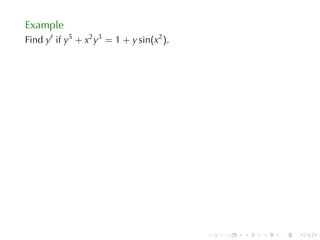
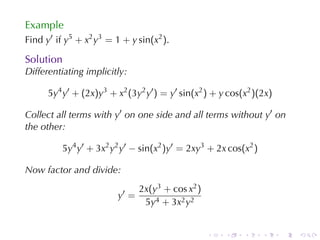
Find y′ if y5 + x2 y3 = 1 + y sin(x2 ).


                                          .   .   .   .   .   .
Example
Find y′ if y5 + x2 y3 = 1 + y sin(x2 ).

Solution
Differentiating	implicitly:

      5y4 y′ + (2x)y3 + x2 (3y2 y′ ) = y′ sin(x2 ) + y cos(x2 )(2x)

Collect	all	terms	with y′ on	one	side	and	all	terms	without y′ on
the	other:

          5y4 y′ + 3x2 y2 y′ − sin(x2 )y′ = 2xy3 + 2x cos(x2 )

Now	factor	and	divide:
                                2x(y3 + cos x2 )
                         y′ =
                                 5y4 + 3x2 y2


                                                   .   .   .     .    .   .
Examples
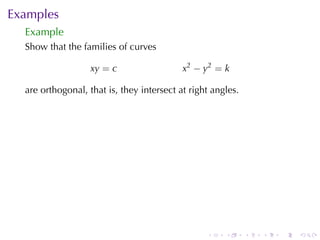
  Example
  Show	that	the	families	of	curves

                   xy = c                  x2 − y2 = k

  are	orthogonal, that	is, they	intersect	at	right	angles.


                                                 .    .      .   .   .   .
Examples
  Example
  Show	that	the	families	of	curves

                   xy = c                  x2 − y2 = k

  are	orthogonal, that	is, they	intersect	at	right	angles.
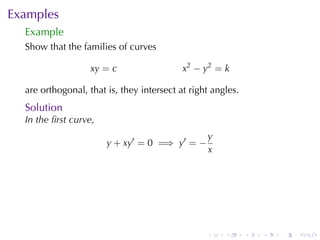
  Solution
  In	the	first	curve,
                                                 y
                       y + xy′ = 0 =⇒ y′ = −
                                                 x


                                                 .    .      .   .   .   .
Examples
  Example
  Show	that	the	families	of	curves

                   xy = c                  x2 − y2 = k

  are	orthogonal, that	is, they	intersect	at	right	angles.
  Solution
  In	the	first	curve,
                                                 y
                        y + xy′ = 0 =⇒ y′ = −
                                                 x
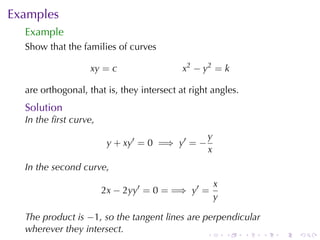
  In	the	second	curve,
                                                     x
                       2x − 2yy′ = 0 = =⇒ y′ =
                                                     y

  The	product	is −1, so	the	tangent	lines	are	perpendicular
  wherever	they	intersect.
                                                 .       .   .   .   .   .
Ideal	gases


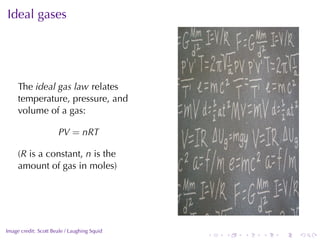
     The ideal	gas	law relates
     temperature, pressure, and
     volume	of	a	gas:

                      PV = nRT

     (R is	a	constant, n is	the
     amount	of	gas	in	moles)


                                                                 .
.
Image	credit: Scott	Beale	/	Laughing	Squid
                                             .   .   .   .   .   .
.

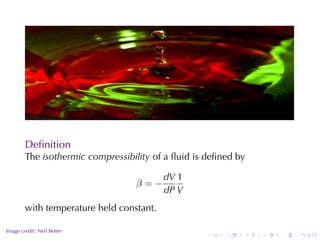
        Definition
        The isothermic	compressibility of	a	fluid	is	defined	by

                                          dV 1
                                  β=−
                                          dP V
        with	temperature	held	constant.

.
Image	credit: Neil	Better
                                                   .    .   .   .   .       .
.

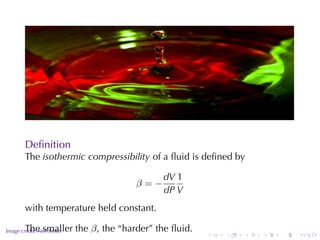
        Definition
        The isothermic	compressibility of	a	fluid	is	defined	by

                                          dV 1
                                   β=−
                                          dP V
        with	temperature	held	constant.

.       The	smaller	the β , the	“harder”	the	fluid.
Image	credit: Neil	Better
                                                     .   .   .   .   .       .
Example
Find	the	isothermic	compressibility	of	an	ideal	gas.


                                             .   .     .   .   .   .
Example
Find	the	isothermic	compressibility	of	an	ideal	gas.

Solution
If PV = k (n is	constant	for	our	purposes, T is	constant	because	of
the	word isothermic, and R really	is	constant), then

                dP      dV        dV    V
                   ·V+P    = 0 =⇒    =−
                dP      dP        dP    P
So
                              1 dV      1
                        β=−     ·    =
                              V dP      P
Compressibility	and	pressure	are	inversely	related.


                                             .   .     .   .   .      .
Nonideal	gasses
Not	that	there’s	anything	wrong	with	that


   Example
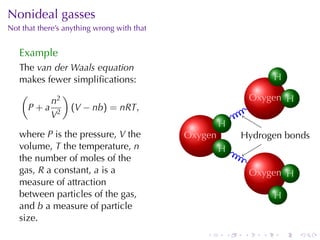
   The van	der	Waals	equation
   makes	fewer	simplifications:                                                H
                                                                              ..
   (         )                                                         O .
                                                                       . xygen . .
          n2                                                                   H
     P + a 2 (V − nb) = nRT,                                   .
          V
                                                      H
                                                      ..
   where P is	the	pressure, V the           O .
                                            . xygen            H
                                                               . ydrogen	bonds
   volume, T the	temperature, n                       H
                                                      ..


   the	number	of	moles	of	the                                  .
   gas, R a	constant, a is	a                                           O .
                                                                       . xygen . .
                                                                               H
   measure	of	attraction
   between	particles	of	the	gas,                                              H
                                                                              ..
   and b a	measure	of	particle
   size.
                                                .          .       .      .    .     .
Nonideal	gasses
Not	that	there’s	anything	wrong	with	that


     Example
     The van	der	Waals	equation
     makes	fewer	simplifications:
     (         )
            n2
       P + a 2 (V − nb) = nRT,
            V

     where P is	the	pressure, V the
     volume, T the	temperature, n
     the	number	of	moles	of	the
     gas, R a	constant, a is	a
     measure	of	attraction
     between	particles	of	the	gas,
     and b a	measure	of	particle
                                                                .
     size.
.
Image	credit: Wikimedia	Commons
                                            .   .   .   .   .   .
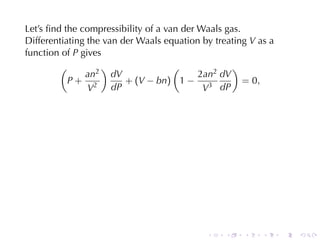
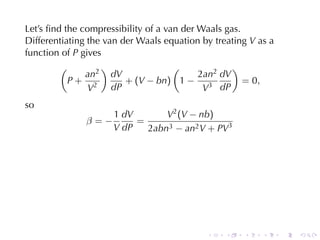
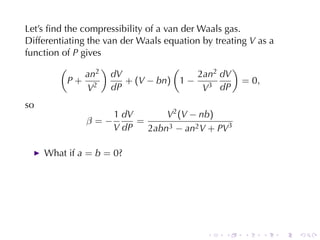
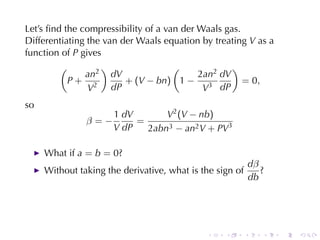
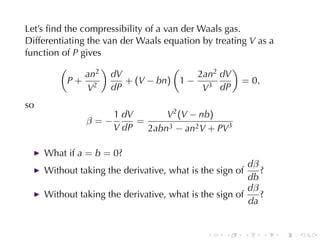
Let’s	find	the	compressibility	of	a	van	der	Waals	gas.
Differentiating	the	van	der	Waals	equation	by	treating V as	a
function	of P gives
         (         )                 (             )
               an2 dV                      2an2 dV
           P+ 2          + (V − bn) 1 − 3             = 0,
                V     dP                    V dP


                                            .    .   .    .     .   .
Let’s	find	the	compressibility	of	a	van	der	Waals	gas.
Differentiating	the	van	der	Waals	equation	by	treating V as	a
function	of P gives
         (         )                 (             )
               an2 dV                      2an2 dV
           P+ 2          + (V − bn) 1 − 3             = 0,
                V     dP                    V dP
so
                     1 dV       V2 (V − nb)
               β=−        =
                     V dP   2abn3 − an2 V + PV3


                                            .    .   .    .     .   .
Let’s	find	the	compressibility	of	a	van	der	Waals	gas.
Differentiating	the	van	der	Waals	equation	by	treating V as	a
function	of P gives
         (         )                 (             )
               an2 dV                      2an2 dV
           P+ 2          + (V − bn) 1 − 3             = 0,
                V     dP                    V dP
so
                     1 dV       V2 (V − nb)
               β=−        =
                     V dP   2abn3 − an2 V + PV3

     What	if a = b = 0?


                                            .    .   .    .     .   .
Let’s	find	the	compressibility	of	a	van	der	Waals	gas.
Differentiating	the	van	der	Waals	equation	by	treating V as	a
function	of P gives
         (         )                 (             )
               an2 dV                      2an2 dV
           P+ 2          + (V − bn) 1 − 3             = 0,
                V     dP                    V dP
so
                      1 dV       V2 (V − nb)
               β=−         =
                      V dP   2abn3 − an2 V + PV3

     What	if a = b = 0?
                                                              dβ
     Without	taking	the	derivative, what	is	the	sign	of          ?
                                                              db


                                             .    .       .      .   .   .
Let’s	find	the	compressibility	of	a	van	der	Waals	gas.
Differentiating	the	van	der	Waals	equation	by	treating V as	a
function	of P gives
         (         )                 (             )
               an2 dV                      2an2 dV
           P+ 2          + (V − bn) 1 − 3             = 0,
                V     dP                    V dP
so
                      1 dV       V2 (V − nb)
               β=−         =
                      V dP   2abn3 − an2 V + PV3

     What	if a = b = 0?
                                                        dβ
     Without	taking	the	derivative, what	is	the	sign	of    ?
                                                        db
                                                        dβ
     Without	taking	the	derivative, what	is	the	sign	of    ?
                                                        da


                                             .    .       .   .   .   .
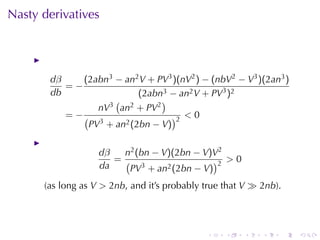
Nasty	derivatives


       dβ    (2abn3 − an2 V + PV3 )(nV2 ) − (nbV2 − V3 )(2an3 )
          =−
       db                  (2abn3 − an2 V + PV3 )2
                     ( 2        )
                 nV3 an + PV2
          = −(                    )2 < 0
               PV3 + an2 (2bn − V)

                   dβ   n2 (bn − V)(2bn − V)V2
                      = (                    )2 > 0
                   da     PV3 + an2 (2bn − V)
      (as	long	as V > 2nb, and	it’s	probably	true	that V ≫ 2nb).


                                             .    .   .    .       .   .
Outline


  The	big	idea, by	example


  Examples
     Vertical	and	Horizontal	Tangents
     Orthogonal	Trajectories
     Chemistry


  The	power	rule	for	rational	powers


                                        .   .   .   .   .   .
Using	implicit	differentiation	to	find	derivatives


   Example
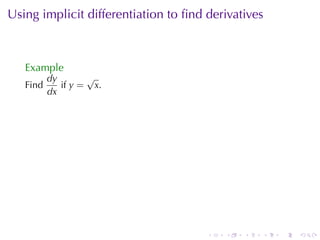
          dy       √
   Find      if y = x.
          dx


                                      .   .   .   .   .   .
Using	implicit	differentiation	to	find	derivatives


   Example
          dy       √
   Find      if y = x.
          dx
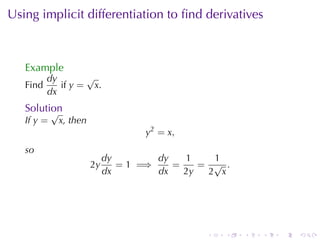
   Solution
         √
   If y =   x, then
                                  y2 = x,
   so
                           dy        dy   1    1
                      2y      = 1 =⇒    =    = √ .
                           dx        dx   2y  2 x


                                             .   .   .   .   .   .
The	power	rule	for	rational	powers

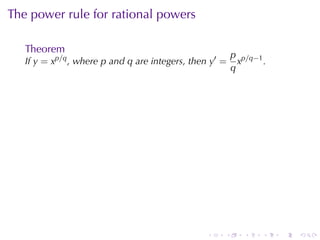
   Theorem
                                                         p p/q−1
   If y = xp/q , where p and q are	integers, then y′ =     x     .
                                                         q


                                                 .   .      .    .   .   .
The	power	rule	for	rational	powers

   Theorem
                                                         p p/q−1
   If y = xp/q , where p and q are	integers, then y′ =     x     .
                                                         q

   Proof.
   We	have
                              dy            dy  p x p −1
         yq = xp =⇒ qyq−1        = pxp−1 =⇒    = · q−1
                              dx            dx  q y


                                                 .   .      .    .   .   .
The	power	rule	for	rational	powers

   Theorem
                                                          p p/q−1
   If y = xp/q , where p and q are	integers, then y′ =      x     .
                                                          q

   Proof.
   We	have
                              dy            dy  p x p −1
         yq = xp =⇒ qyq−1        = pxp−1 =⇒    = · q−1
                              dx            dx  q y

   Now yq−1 = x(p/q)(q−1) = xp−p/q so

                     x p −1
                            = xp−1−(p−p/q) = xp/q−1
                     y q −1


                                                 .    .      .    .   .   .

Lesson 11: Implicit Differentiation

  • 1.
    Section 2.6 Implicit Differentiation V63.0121.034, Calculus I October 7, 2009 Announcements Midterm next , covering §§1.1–2.4. . . Image credit: Telstar Logistics . . . . . .
  • 2.
    Outline The big idea,by example Examples Vertical and Horizontal Tangents Orthogonal Trajectories Chemistry The power rule for rational powers . . . . . .
  • 3.
    Motivating Example y . Problem Find the slope of the line which is tangent to the curve . x . 2 2 x +y =1 at the point (3/5, −4/5). . . . . . .
  • 4.
    Motivating Example y . Problem Find the slope of the line which is tangent to the curve . x . 2 2 x +y =1 at the point (3/5, −4/5). . . . . . .
  • 5.
    Motivating Example y . Problem Find the slope of the line which is tangent to the curve . x . 2 2 x +y =1 at the point (3/5, −4/5). . . . . . . .
  • 6.
    Motivating Example y . Problem Find the slope of the line which is tangent to the curve . x . 2 2 x +y =1 at the point (3/5, −4/5). . Solution (Explicit) √ Isolate: y2 = 1 − x2 =⇒ y = − 1 − x2 . (Why the −?) . . . . . .
  • 7.
    Motivating Example y . Problem Find the slope of the line which is tangent to the curve . x . 2 2 x +y =1 at the point (3/5, −4/5). . Solution (Explicit) √ Isolate: y2 = 1 − x2 =⇒ y = − 1 − x2 . (Why the −?) dy −2x x Differentiate: =− √ =√ dx 2 1−x 2 1 − x2 . . . . . .
  • 8.
    Motivating Example y . Problem Find the slope of the line which is tangent to the curve . x . 2 2 x +y =1 at the point (3/5, −4/5). . Solution (Explicit) √ Isolate: y2 = 1 − x2 =⇒ y = − 1 − x2 . (Why the −?) dy −2x x Differentiate: =− √ =√ dx 2 1−x 2 1 − x2 dy 3 /5 3/5 3 Evaluate: =√ = = . dx x=3/5 1 − (3 /5 )2 4/5 4 . . . . . .
  • 9.
    Motivating Example y . Problem Find the slope of the line which is tangent to the curve . x . 2 2 x +y =1 at the point (3/5, −4/5). . Solution (Explicit) √ Isolate: y2 = 1 − x2 =⇒ y = − 1 − x2 . (Why the −?) dy −2x x Differentiate: =− √ =√ dx 2 1−x 2 1 − x2 dy 3 /5 3/5 3 Evaluate: =√ = = . dx x=3/5 1 − (3 /5 )2 4/5 4 . . . . . .
  • 10.
    We know that x2 +y2 = 1 does not define y as a function of x, but suppose it did. Suppose we had y = f(x), so that x2 + (f(x))2 = 1 We could differentiate this equation to get 2x + 2f(x) · f′ (x) = 0 We could then solve to get x f ′ (x ) = − f(x) . . . . . .
  • 11.
    The beautiful fact (i.e., deep theorem) is that this works! “Near” most points on y . the curve x2 + y2 = 1, the curve resembles the graph of a function. So f(x) is defined “locally” and is . x . differentiable The chain rule then applies for this local . choice. . . . . . .
  • 12.
    The beautiful fact (i.e., deep theorem) is that this works! “Near” most points on y . the curve x2 + y2 = 1, the curve resembles the graph of a function. So f(x) is defined “locally” and is . x . differentiable The chain rule then applies for this local . choice. . . . . . .
  • 13.
    The beautiful fact (i.e., deep theorem) is that this works! “Near” most points on y . the curve x2 + y2 = 1, the curve resembles the graph of a function. So f(x) is defined “locally” and is . x . differentiable The chain rule then applies for this local . choice. l .ooks like a function . . . . . .
  • 14.
    The beautiful fact (i.e., deep theorem) is that this works! “Near” most points on y . the curve x2 + y2 = 1, the curve resembles the . graph of a function. So f(x) is defined “locally” and is . x . differentiable The chain rule then applies for this local choice. . . . . . .
  • 15.
    The beautiful fact (i.e., deep theorem) is that this works! “Near” most points on y . the curve x2 + y2 = 1, the curve resembles the . graph of a function. So f(x) is defined “locally” and is . x . differentiable The chain rule then applies for this local choice. . . . . . .
  • 16.
    The beautiful fact (i.e., deep theorem) is that this works! “Near” most points on y . the curve x2 + y2 = 1, the curve resembles the . graph of a function. l .ooks like a function So f(x) is defined “locally” and is . x . differentiable The chain rule then applies for this local choice. . . . . . .
  • 17.
    The beautiful fact (i.e., deep theorem) is that this works! “Near” most points on y . the curve x2 + y2 = 1, the curve resembles the graph of a function. So f(x) is defined “locally” and is . . x . differentiable The chain rule then applies for this local choice. . . . . . .
  • 18.
    The beautiful fact (i.e., deep theorem) is that this works! “Near” most points on y . the curve x2 + y2 = 1, the curve resembles the graph of a function. So f(x) is defined “locally” and is . . x . differentiable The chain rule then applies for this local choice. . . . . . .
  • 19.
    The beautiful fact (i.e., deep theorem) is that this works! “Near” most points on y . the curve x2 + y2 = 1, the curve resembles the graph of a function. So f(x) is defined “locally” and is . . x . differentiable . The chain rule then does not look like a applies for this local function, but that’s choice. OK—there are only two points like this . . . . . .
  • 20.
    Problem Find the slope of the line which is tangent to the curve x2 + y2= 1 at the point (3/5, −4/5). Solution (Implicit, with Leibniz notation) Differentiate. Remember y is assumed to be a function of x: dy 2x + 2y = 0, dx dy Isolate : dx dy x =− . dx y Evaluate: dy 3 /5 3 = = . dx ( 3 ,− 4 ) 4/5 4 5 5 . . . . . .
  • 21.
    Summary If a relation is given between x y . and y, “Most of the time”, i.e., “at most places” y can be . assumed to be a function of x . we may differentiate the relation as is dy Solving for does give the dx slope of the tangent line to the curve at a point on the curve. . . . . . .
  • 22.
    Mnemonic Explicit Implicit y = f(x) F(x, y) = k . . . . . .
  • 23.
    Outline The big idea,by example Examples Vertical and Horizontal Tangents Orthogonal Trajectories Chemistry The power rule for rational powers . . . . . .
  • 24.
    Example Find the equation of the line tangent to the curve . y 2 = x 2 (x + 1 ) = x 3 + x 2 at the point (3, −6). . . . . . . .
  • 25.
    Example Find the equation of the line tangent to the curve . y 2 = x 2 (x + 1 ) = x 3 + x 2 at the point (3, −6). . Solution Differentiating the expression implicitly with respect to x gives dy dy 3x2 + 2x 2y = 3x2 + 2x, so = , and dx dx 2y dy 3 · 32 + 2 · 3 11 = =− . dx (3,−6) 2(−6) 4 . . . . . .
  • 26.
    Example Find the equation of the line tangent to the curve . y 2 = x 2 (x + 1 ) = x 3 + x 2 at the point (3, −6). . Solution Differentiating the expression implicitly with respect to x gives dy dy 3x2 + 2x 2y = 3x2 + 2x, so = , and dx dx 2y dy 3 · 32 + 2 · 3 11 = =− . dx (3,−6) 2(−6) 4 11 Thus the equation of the tangent line is y + 6 = − (x − 3). 4 . . . . . .
  • 27.
  • 28.
  • 29.
    Example Find the horizontal tangent lines to the same curve: y2 =x3 + x2 Solution We solve for dy/dx = 0: 3x2 + 2x = 0 =⇒ 3x2 + 2x = 0 =⇒ x(3x + 2) = 0 2y . . . . . .
  • 30.
    Example Find the horizontal tangent lines to the same curve: y2 =x3 + x2 Solution We solve for dy/dx = 0: 3x2 + 2x = 0 =⇒ 3x2 + 2x = 0 =⇒ x(3x + 2) = 0 2y The possible solution x = 0 leads to y = 0, which is not a smooth point of the function (the denominator in dy/dx becomes 0). . . . . . .
  • 31.
    Example Find the horizontal tangent lines to the same curve: y2 =x3 + x2 Solution We solve for dy/dx = 0: 3x2 + 2x = 0 =⇒ 3x2 + 2x = 0 =⇒ x(3x + 2) = 0 2y The possible solution x = 0 leads to y = 0, which is not a smooth point of the function (the denominator in dy/dx becomes 0). The possible solution x = − 2 yields y = ± 3√3 . 3 2 . . . . . .
  • 32.
  • 33.
    Example Find the vertical tangent lines to the same curve:y2 = x3 + x2 Solution dx Tangent lines are vertical when = 0. dy Differentiating x implicitly as a function of y gives dx dx 2y = 3x2 + 2x , so dy dy dx 2y = 2 dy 3x + 2x . . . . . .
  • 34.
    Example Find the vertical tangent lines to the same curve:y2 = x3 + x2 Solution dx Tangent lines are vertical when = 0. dy Differentiating x implicitly as a function of y gives dx dx 2y = 3x2 + 2x , so dy dy dx 2y = 2 dy 3x + 2x This is 0 only when y = 0. . . . . . .
  • 35.
    Example Find the vertical tangent lines to the same curve:y2 = x3 + x2 Solution dx Tangent lines are vertical when = 0. dy Differentiating x implicitly as a function of y gives dx dx 2y = 3x2 + 2x , so dy dy dx 2y = 2 dy 3x + 2x This is 0 only when y = 0. We get the false solution x = 0 and the real solution x = −1. . . . . . .
  • 36.
    Example Find y′ ify5 + x2 y3 = 1 + y sin(x2 ). . . . . . .
  • 37.
    Example Find y′ ify5 + x2 y3 = 1 + y sin(x2 ). Solution Differentiating implicitly: 5y4 y′ + (2x)y3 + x2 (3y2 y′ ) = y′ sin(x2 ) + y cos(x2 )(2x) Collect all terms with y′ on one side and all terms without y′ on the other: 5y4 y′ + 3x2 y2 y′ − sin(x2 )y′ = 2xy3 + 2x cos(x2 ) Now factor and divide: 2x(y3 + cos x2 ) y′ = 5y4 + 3x2 y2 . . . . . .
  • 38.
    Examples Example Show that the families of curves xy = c x2 − y2 = k are orthogonal, that is, they intersect at right angles. . . . . . .
  • 39.
    Examples Example Show that the families of curves xy = c x2 − y2 = k are orthogonal, that is, they intersect at right angles. Solution In the first curve, y y + xy′ = 0 =⇒ y′ = − x . . . . . .
  • 40.
    Examples Example Show that the families of curves xy = c x2 − y2 = k are orthogonal, that is, they intersect at right angles. Solution In the first curve, y y + xy′ = 0 =⇒ y′ = − x In the second curve, x 2x − 2yy′ = 0 = =⇒ y′ = y The product is −1, so the tangent lines are perpendicular wherever they intersect. . . . . . .
  • 41.
    Ideal gases The ideal gas law relates temperature, pressure, and volume of a gas: PV = nRT (R is a constant, n is the amount of gas in moles) . . Image credit: Scott Beale / Laughing Squid . . . . . .
  • 42.
    . Definition The isothermic compressibility of a fluid is defined by dV 1 β=− dP V with temperature held constant. . Image credit: Neil Better . . . . . .
  • 43.
    . Definition The isothermic compressibility of a fluid is defined by dV 1 β=− dP V with temperature held constant. . The smaller the β , the “harder” the fluid. Image credit: Neil Better . . . . . .
  • 44.
  • 45.
    Example Find the isothermic compressibility of an ideal gas. Solution If PV =k (n is constant for our purposes, T is constant because of the word isothermic, and R really is constant), then dP dV dV V ·V+P = 0 =⇒ =− dP dP dP P So 1 dV 1 β=− · = V dP P Compressibility and pressure are inversely related. . . . . . .
  • 46.
    Nonideal gasses Not that there’s anything wrong with that Example The van der Waals equation makes fewer simplifications: H .. ( ) O . . xygen . . n2 H P + a 2 (V − nb) = nRT, . V H .. where P is the pressure, V the O . . xygen H . ydrogen bonds volume, T the temperature, n H .. the number of moles of the . gas, R a constant, a is a O . . xygen . . H measure of attraction between particles of the gas, H .. and b a measure of particle size. . . . . . .
  • 47.
    Nonideal gasses Not that there’s anything wrong with that Example The van der Waals equation makes fewer simplifications: ( ) n2 P + a 2 (V − nb) = nRT, V where P is the pressure, V the volume, T the temperature, n the number of moles of the gas, R a constant, a is a measure of attraction between particles of the gas, and b a measure of particle . size. . Image credit: Wikimedia Commons . . . . . .
  • 48.
  • 49.
    Let’s find the compressibility of a van der Waals gas. Differentiating the van der Waals equation by treating V as a function ofP gives ( ) ( ) an2 dV 2an2 dV P+ 2 + (V − bn) 1 − 3 = 0, V dP V dP so 1 dV V2 (V − nb) β=− = V dP 2abn3 − an2 V + PV3 . . . . . .
  • 50.
    Let’s find the compressibility of a van der Waals gas. Differentiating the van der Waals equation by treating V as a function ofP gives ( ) ( ) an2 dV 2an2 dV P+ 2 + (V − bn) 1 − 3 = 0, V dP V dP so 1 dV V2 (V − nb) β=− = V dP 2abn3 − an2 V + PV3 What if a = b = 0? . . . . . .
  • 51.
    Let’s find the compressibility of a van der Waals gas. Differentiating the van der Waals equation by treating V as a function ofP gives ( ) ( ) an2 dV 2an2 dV P+ 2 + (V − bn) 1 − 3 = 0, V dP V dP so 1 dV V2 (V − nb) β=− = V dP 2abn3 − an2 V + PV3 What if a = b = 0? dβ Without taking the derivative, what is the sign of ? db . . . . . .
  • 52.
    Let’s find the compressibility of a van der Waals gas. Differentiating the van der Waals equation by treating V as a function ofP gives ( ) ( ) an2 dV 2an2 dV P+ 2 + (V − bn) 1 − 3 = 0, V dP V dP so 1 dV V2 (V − nb) β=− = V dP 2abn3 − an2 V + PV3 What if a = b = 0? dβ Without taking the derivative, what is the sign of ? db dβ Without taking the derivative, what is the sign of ? da . . . . . .
  • 53.
    Nasty derivatives dβ (2abn3 − an2 V + PV3 )(nV2 ) − (nbV2 − V3 )(2an3 ) =− db (2abn3 − an2 V + PV3 )2 ( 2 ) nV3 an + PV2 = −( )2 < 0 PV3 + an2 (2bn − V) dβ n2 (bn − V)(2bn − V)V2 = ( )2 > 0 da PV3 + an2 (2bn − V) (as long as V > 2nb, and it’s probably true that V ≫ 2nb). . . . . . .
  • 54.
    Outline The big idea,by example Examples Vertical and Horizontal Tangents Orthogonal Trajectories Chemistry The power rule for rational powers . . . . . .
  • 55.
    Using implicit differentiation to find derivatives Example dy √ Find if y = x. dx . . . . . .
  • 56.
    Using implicit differentiation to find derivatives Example dy √ Find if y = x. dx Solution √ If y = x, then y2 = x, so dy dy 1 1 2y = 1 =⇒ = = √ . dx dx 2y 2 x . . . . . .
  • 57.
    The power rule for rational powers Theorem p p/q−1 If y = xp/q , where p and q are integers, then y′ = x . q . . . . . .
  • 58.
    The power rule for rational powers Theorem p p/q−1 If y = xp/q , where p and q are integers, then y′ = x . q Proof. We have dy dy p x p −1 yq = xp =⇒ qyq−1 = pxp−1 =⇒ = · q−1 dx dx q y . . . . . .
  • 59.
    The power rule for rational powers Theorem p p/q−1 If y = xp/q , where p and q are integers, then y′ = x . q Proof. We have dy dy p x p −1 yq = xp =⇒ qyq−1 = pxp−1 =⇒ = · q−1 dx dx q y Now yq−1 = x(p/q)(q−1) = xp−p/q so x p −1 = xp−1−(p−p/q) = xp/q−1 y q −1 . . . . . .