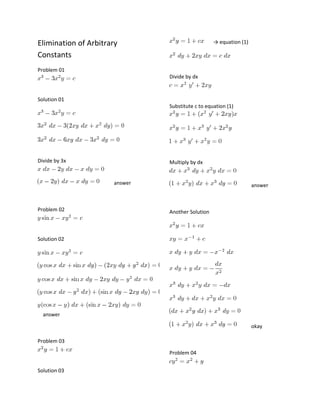
Elimination of Arbitrary
Constants

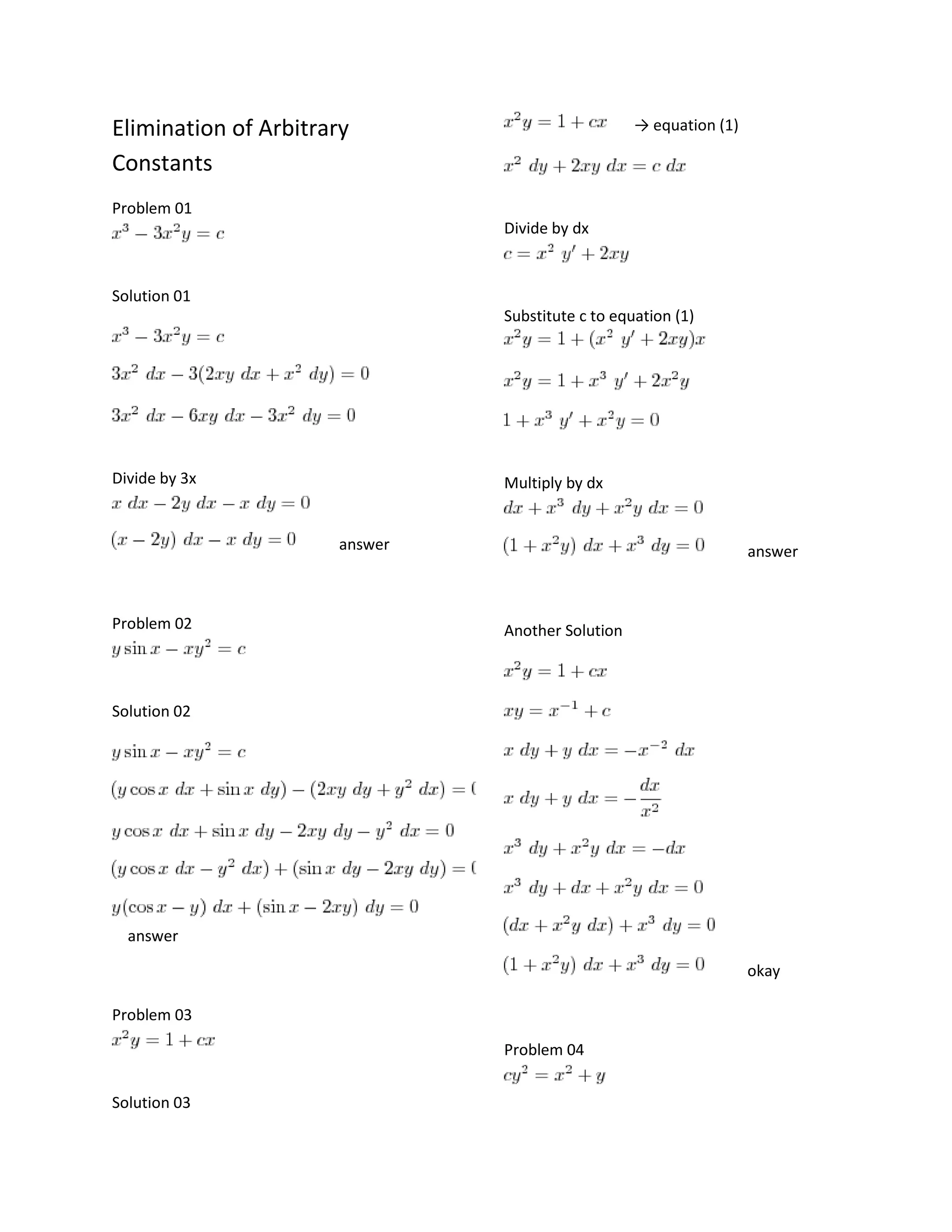
→ equation (1)

Problem 01
Divide by dx

Solution 01
Substitute c to equation (1)

Divide by 3x

Multiply by dx

answer

Problem 02

answer

Another Solution

Solution 02

answer
okay
Problem 03
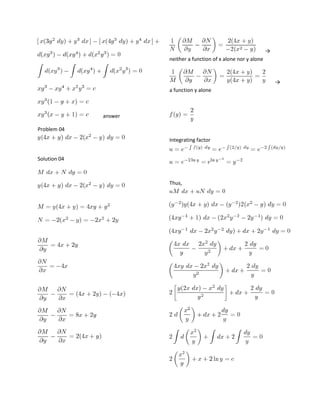
Problem 04
Solution 03
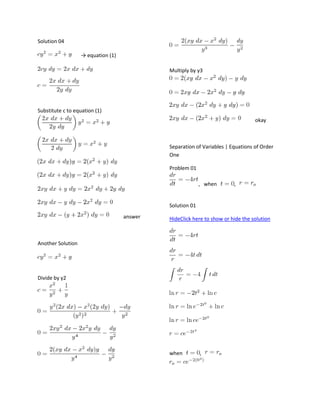
Solution 04
→ equation (1)
Multiply by y3

Substitute c to equation (1)
okay

Separation of Variables | Equations of Order
One
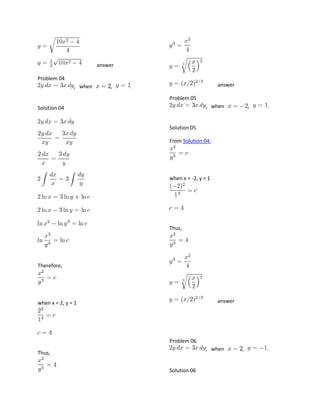
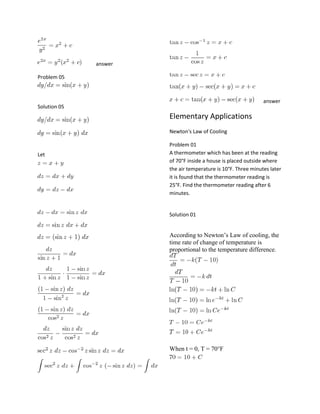
Problem 01
, when

,

Solution 01
answer

HideClick here to show or hide the solution

Another Solution

Divide by y2

when

,
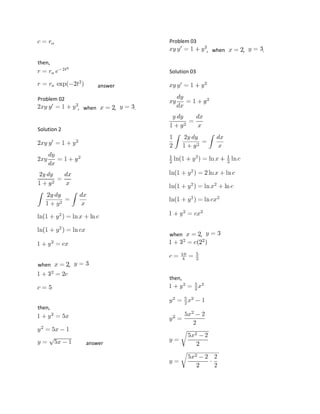
Problem 03
, when
then,
Solution 03
answer
Problem 02
, when

,

.

Solution 2

when

when

,
then,

then,

answer

,

,

.
answer
Problem 04
, when

,

answer

.
Problem 05

, when

Solution 04

,

.

Solution 05
From Solution 04,

when x = -2, y = 1

Thus,

Therefore,

answer

when x = 2, y = 1

Problem 06
, when

Thus,
Solution 06

,

.
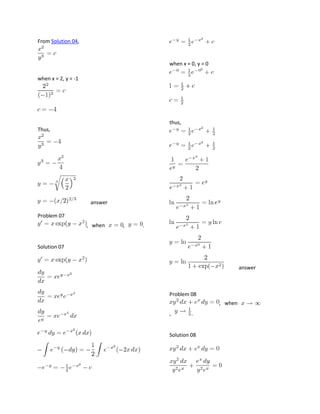
From Solution 04,

when x = 0, y = 0
when x = 2, y = -1

thus,
Thus,

answer
Problem 07
, when

,

.

Solution 07

answer

Problem 08
, when
,

.

Solution 08
answer

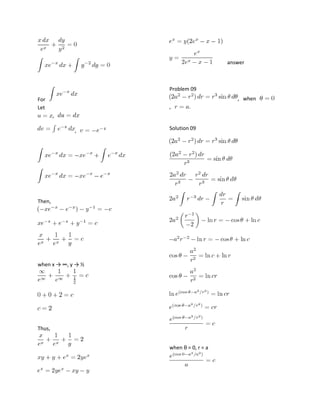
Problem 09
, when

For
Let

,

.

,
,

Solution 09

Then,

when x → ∞, y → ½

Thus,
when θ = 0, r = a
answer

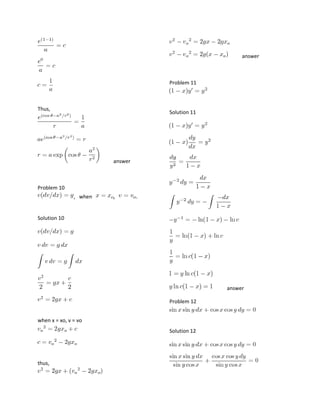
Problem 11

Thus,

Solution 11

answer

Problem 10
, when

,

.

Solution 10

answer
Problem 12
when x = xo, v = vo
Solution 12

thus,
answer
Problem 15
answer

Solution 15

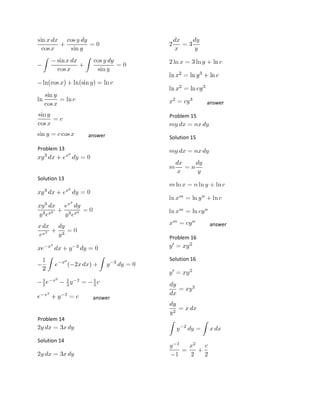
Problem 13

Solution 13

answer
Problem 16

Solution 16

answer

Problem 14

Solution 14
answer
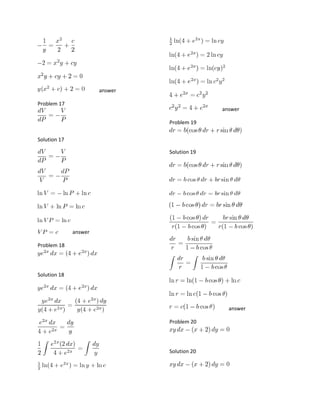
Problem 17

answer
Problem 19

Solution 17
Solution 19

answer
Problem 18

Solution 18

answer
Problem 20

Solution 20
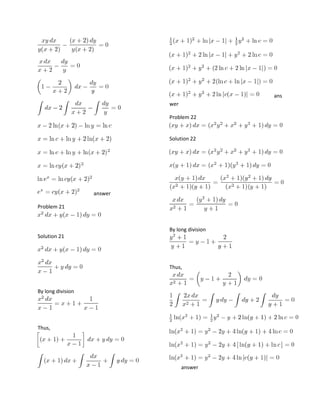
ans
wer
Problem 22

Solution 22

answer
Problem 21

By long division
Solution 21

Thus,

By long division

Thus,

answer
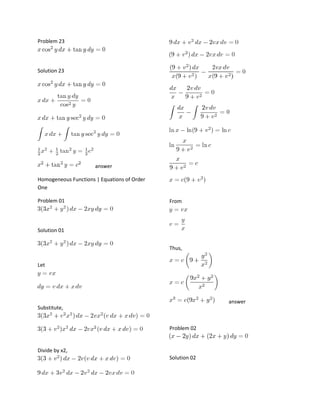
Problem 23

Solution 23

answer
Homogeneous Functions | Equations of Order
One
Problem 01

From

Solution 01
Thus,
Let

answer
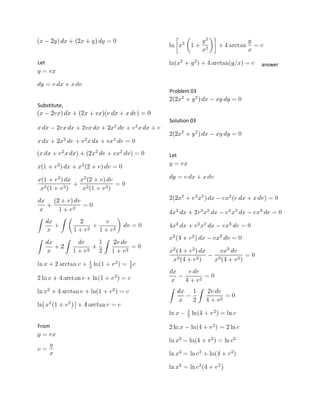
Substitute,

Problem 02

Divide by x2,
Solution 02
Let

answer

Problem 03
Substitute,
Solution 03

Let

From
From

Thus,

answer

From

Problem 04
Thus,
Solution 04
answer

Let

Exact Equations | Equations of Order One
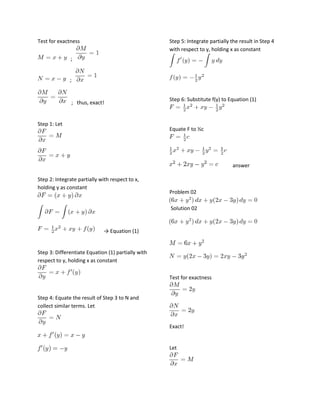
Problem 01

Solution 01
Test for exactness

Step 5: Integrate partially the result in Step 4
with respect to y, holding x as constant

;

;

; thus, exact!

Step 1: Let

Step 6: Substitute f(y) to Equation (1)

Equate F to ½c

answer
Step 2: Integrate partially with respect to x,
holding y as constant

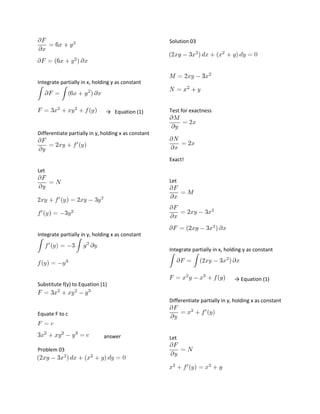
Problem 02
Solution 02

→ Equation (1)

Step 3: Differentiate Equation (1) partially with
respect to y, holding x as constant
Test for exactness

Step 4: Equate the result of Step 3 to N and
collect similar terms. Let

Exact!

Let
Solution 03

Integrate partially in x, holding y as constant

→ Equation (1)

Test for exactness

Differentiate partially in y, holding x as constant

Exact!
Let
Let

Integrate partially in y, holding x as constant
Integrate partially in x, holding y as constant

→ Equation (1)

Substitute f(y) to Equation (1)

Differentiate partially in y, holding x as constant
Equate F to c

answer
Problem 03

Let
Integrate partially in y, holding x as constant
Integrate partially in x, holding y as constant

→ Equation

Substitute f(y) to Equation (1)
(1)

Differentiate partially in y, holding x as constant

Equate F to c

answer
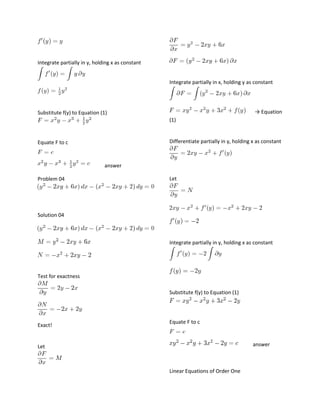
Problem 04

Let

Solution 04

Integrate partially in y, holding x as constant

Test for exactness
Substitute f(y) to Equation (1)

Exact!

Equate F to c

answer

Let

Linear Equations of Order One
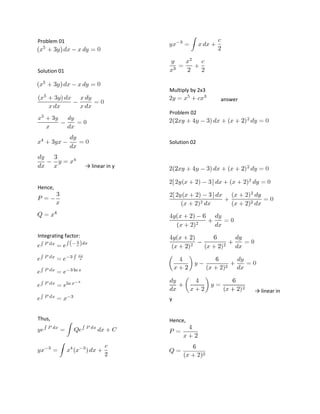
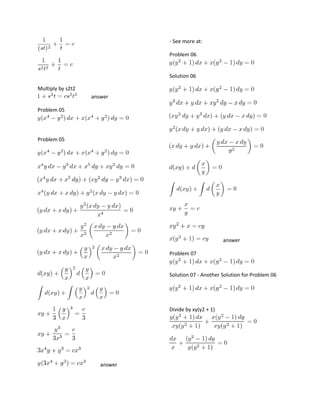
Problem 01

Solution 01
Multiply by 2x3
answer
Problem 02

Solution 02

→ linear in y

Hence,

Integrating factor:

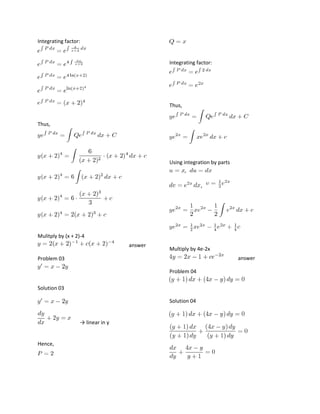
→ linear in
y
Thus,

Hence,
Integrating factor:

Integrating factor:

Thus,
Thus,

Using integration by parts
,
,

Mulitply by (x + 2)-4
answer

Multiply by 4e-2x
answer

Problem 03
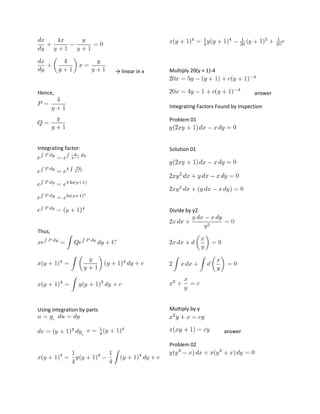
Problem 04
Solution 03
Solution 04

→ linear in y

Hence,
→ linear in x

Multiply 20(y + 1)-4

Hence,

answer
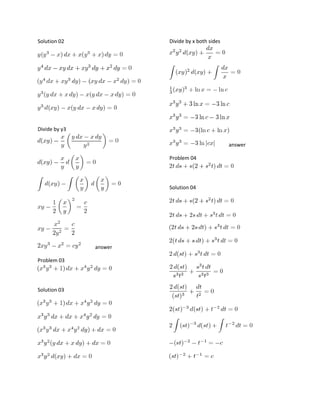
Integrating Factors Found by Inspection
Problem 01

Integrating factor:

Solution 01

Divide by y2

Thus,

Using integration by parts
,

Multiply by y

answer

,
Problem 02
Divide by x both sides

Solution 02

Divide by y3
answer
Problem 04

Solution 04

answer
Problem 03

Solution 03
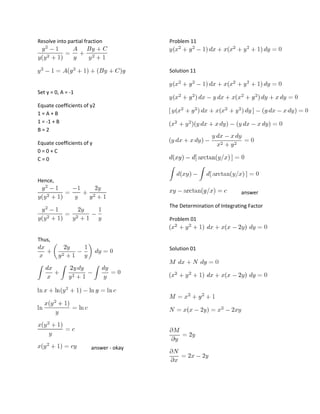
- See more at:
Problem 06

Solution 06
Multiply by s2t2
answer
Problem 05

Problem 05

answer
Problem 07

Solution 07 - Another Solution for Problem 06

Divide by xy(y2 + 1)

answer
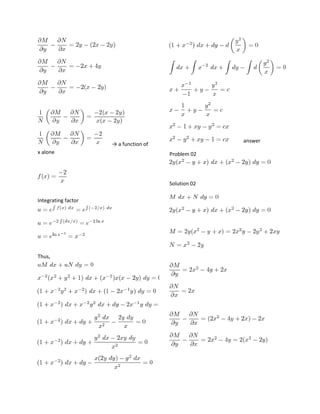
Resolve into partial fraction

Problem 11

Solution 11

Set y = 0, A = -1
Equate coefficients of y2
1=A+B
1 = -1 + B
B=2
Equate coefficients of y
0=0+C
C=0

Hence,
answer
The Determination of Integrating Factor
Problem 01

Thus,
Solution 01

answer - okay
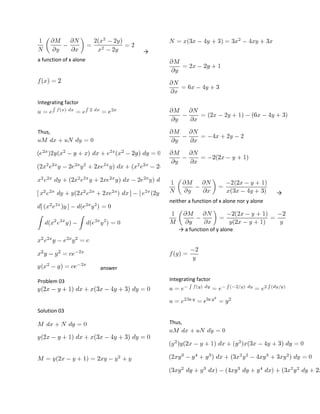
answer

→ a function of
x alone

Problem 02

Solution 02
Integrating factor

Thus,
→
a function of x alone

Integrating factor

Thus,

→
neither a function of x alone nor y alone

→ a function of y alone

answer
Problem 03

Integrating factor

Solution 03
Thus,
→
neither a function of x alone nor y alone

→
a function y alone

answer
Problem 04
Integrating factor
Solution 04

Thus,
answer
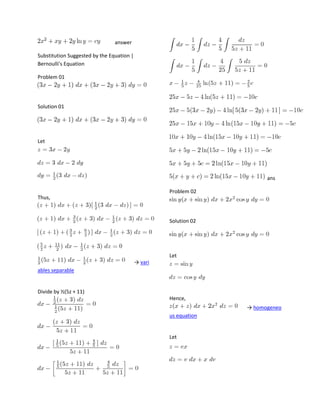
Substitution Suggested by the Equation |
Bernoulli's Equation
Problem 01

Solution 01

Let

ans
Problem 02
Thus,

Solution 02

Let
→ vari
ables separable

Divide by ½(5z + 11)
Hence,
→ homogeneo
us equation

Let
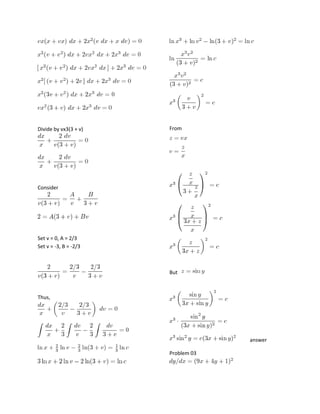
Divide by vx3(3 + v)

From

Consider

Set v = 0, A = 2/3
Set v = -3, B = -2/3

But

Thus,

answer
Problem 03
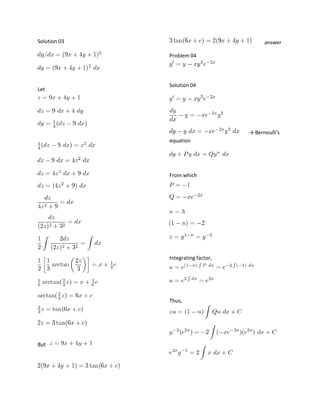
Solution 03

answer
Problem 04

Let

Solution 04

→ Bernoulli's
equation

From which

Integrating factor,

Thus,

But
answer
Problem 05

answer

Solution 05

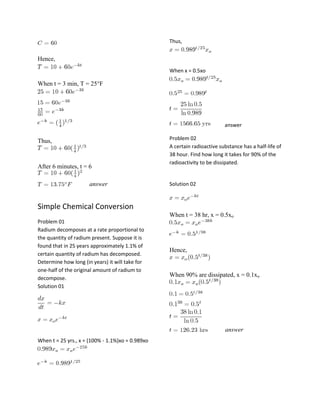
Elementary Applications
Newton's Law of Cooling

Let

Problem 01
A thermometer which has been at the reading
of 70°F inside a house is placed outside where
the air temperature is 10°F. Three minutes later
it is found that the thermometer reading is
25°F. Find the thermometer reading after 6
minutes.

Solution 01

According to Newton’s Law of cooling, the
time rate of change of temperature is
proportional to the temperature difference.

When t = 0, T = 70°F
Thus,

Hence,
When x = 0.5xo

When t = 3 min, T = 25°F

answer

Thus,

After 6 minutes, t = 6
answer

Problem 02
A certain radioactive substance has a half-life of
38 hour. Find how long it takes for 90% of the
radioactivity to be dissipated.

Solution 02

Simple Chemical Conversion
When t = 38 hr, x = 0.5xo
Problem 01
Radium decomposes at a rate proportional to
the quantity of radium present. Suppose it is
found that in 25 years approximately 1.1% of
certain quantity of radium has decomposed.
Determine how long (in years) it will take for
one-half of the original amount of radium to
decompose.
Solution 01

Hence,

When 90% are dissipated, x = 0.1xo

answer
When t = 25 yrs., x = (100% - 1.1%)xo = 0.989xo

Elementary differential equation

  • 1.
    Elimination of Arbitrary Constants →equation (1) Problem 01 Divide by dx Solution 01 Substitute c to equation (1) Divide by 3x Multiply by dx answer Problem 02 answer Another Solution Solution 02 answer okay Problem 03 Problem 04 Solution 03
  • 2.
    Solution 04 → equation(1) Multiply by y3 Substitute c to equation (1) okay Separation of Variables | Equations of Order One Problem 01 , when , Solution 01 answer HideClick here to show or hide the solution Another Solution Divide by y2 when ,
  • 3.
    Problem 03 , when then, Solution03 answer Problem 02 , when , . Solution 2 when when , then, then, answer , , .
  • 4.
    answer Problem 04 , when , answer . Problem05 , when Solution 04 , . Solution 05 From Solution 04, when x = -2, y = 1 Thus, Therefore, answer when x = 2, y = 1 Problem 06 , when Thus, Solution 06 , .
  • 5.
    From Solution 04, whenx = 0, y = 0 when x = 2, y = -1 thus, Thus, answer Problem 07 , when , . Solution 07 answer Problem 08 , when , . Solution 08
  • 6.
    answer Problem 09 , when For Let , . , , Solution09 Then, when x → ∞, y → ½ Thus, when θ = 0, r = a
  • 7.
    answer Problem 11 Thus, Solution 11 answer Problem10 , when , . Solution 10 answer Problem 12 when x = xo, v = vo Solution 12 thus,
  • 8.
    answer Problem 15 answer Solution 15 Problem13 Solution 13 answer Problem 16 Solution 16 answer Problem 14 Solution 14
  • 9.
    answer Problem 17 answer Problem 19 Solution17 Solution 19 answer Problem 18 Solution 18 answer Problem 20 Solution 20
  • 10.
    ans wer Problem 22 Solution 22 answer Problem21 By long division Solution 21 Thus, By long division Thus, answer
  • 11.
    Problem 23 Solution 23 answer HomogeneousFunctions | Equations of Order One Problem 01 From Solution 01 Thus, Let answer Substitute, Problem 02 Divide by x2, Solution 02
  • 12.
  • 13.
    From Thus, answer From Problem 04 Thus, Solution 04 answer Let ExactEquations | Equations of Order One Problem 01 Solution 01
  • 14.
    Test for exactness Step5: Integrate partially the result in Step 4 with respect to y, holding x as constant ; ; ; thus, exact! Step 1: Let Step 6: Substitute f(y) to Equation (1) Equate F to ½c answer Step 2: Integrate partially with respect to x, holding y as constant Problem 02 Solution 02 → Equation (1) Step 3: Differentiate Equation (1) partially with respect to y, holding x as constant Test for exactness Step 4: Equate the result of Step 3 to N and collect similar terms. Let Exact! Let
  • 15.
    Solution 03 Integrate partiallyin x, holding y as constant → Equation (1) Test for exactness Differentiate partially in y, holding x as constant Exact! Let Let Integrate partially in y, holding x as constant Integrate partially in x, holding y as constant → Equation (1) Substitute f(y) to Equation (1) Differentiate partially in y, holding x as constant Equate F to c answer Problem 03 Let
  • 16.
    Integrate partially iny, holding x as constant Integrate partially in x, holding y as constant → Equation Substitute f(y) to Equation (1) (1) Differentiate partially in y, holding x as constant Equate F to c answer Problem 04 Let Solution 04 Integrate partially in y, holding x as constant Test for exactness Substitute f(y) to Equation (1) Exact! Equate F to c answer Let Linear Equations of Order One
  • 17.
    Problem 01 Solution 01 Multiplyby 2x3 answer Problem 02 Solution 02 → linear in y Hence, Integrating factor: → linear in y Thus, Hence,
  • 18.
    Integrating factor: Integrating factor: Thus, Thus, Usingintegration by parts , , Mulitply by (x + 2)-4 answer Multiply by 4e-2x answer Problem 03 Problem 04 Solution 03 Solution 04 → linear in y Hence,
  • 19.
    → linear inx Multiply 20(y + 1)-4 Hence, answer Integrating Factors Found by Inspection Problem 01 Integrating factor: Solution 01 Divide by y2 Thus, Using integration by parts , Multiply by y answer , Problem 02
  • 20.
    Divide by xboth sides Solution 02 Divide by y3 answer Problem 04 Solution 04 answer Problem 03 Solution 03
  • 21.
    - See moreat: Problem 06 Solution 06 Multiply by s2t2 answer Problem 05 Problem 05 answer Problem 07 Solution 07 - Another Solution for Problem 06 Divide by xy(y2 + 1) answer
  • 22.
    Resolve into partialfraction Problem 11 Solution 11 Set y = 0, A = -1 Equate coefficients of y2 1=A+B 1 = -1 + B B=2 Equate coefficients of y 0=0+C C=0 Hence, answer The Determination of Integrating Factor Problem 01 Thus, Solution 01 answer - okay
  • 23.
    answer → a functionof x alone Problem 02 Solution 02 Integrating factor Thus,
  • 24.
    → a function ofx alone Integrating factor Thus, → neither a function of x alone nor y alone → a function of y alone answer Problem 03 Integrating factor Solution 03 Thus,
  • 25.
    → neither a functionof x alone nor y alone → a function y alone answer Problem 04 Integrating factor Solution 04 Thus,
  • 26.
    answer Substitution Suggested bythe Equation | Bernoulli's Equation Problem 01 Solution 01 Let ans Problem 02 Thus, Solution 02 Let → vari ables separable Divide by ½(5z + 11) Hence, → homogeneo us equation Let
  • 27.
    Divide by vx3(3+ v) From Consider Set v = 0, A = 2/3 Set v = -3, B = -2/3 But Thus, answer Problem 03
  • 28.
    Solution 03 answer Problem 04 Let Solution04 → Bernoulli's equation From which Integrating factor, Thus, But
  • 29.
    answer Problem 05 answer Solution 05 ElementaryApplications Newton's Law of Cooling Let Problem 01 A thermometer which has been at the reading of 70°F inside a house is placed outside where the air temperature is 10°F. Three minutes later it is found that the thermometer reading is 25°F. Find the thermometer reading after 6 minutes. Solution 01 According to Newton’s Law of cooling, the time rate of change of temperature is proportional to the temperature difference. When t = 0, T = 70°F
  • 30.
    Thus, Hence, When x =0.5xo When t = 3 min, T = 25°F answer Thus, After 6 minutes, t = 6 answer Problem 02 A certain radioactive substance has a half-life of 38 hour. Find how long it takes for 90% of the radioactivity to be dissipated. Solution 02 Simple Chemical Conversion When t = 38 hr, x = 0.5xo Problem 01 Radium decomposes at a rate proportional to the quantity of radium present. Suppose it is found that in 25 years approximately 1.1% of certain quantity of radium has decomposed. Determine how long (in years) it will take for one-half of the original amount of radium to decompose. Solution 01 Hence, When 90% are dissipated, x = 0.1xo answer When t = 25 yrs., x = (100% - 1.1%)xo = 0.989xo