Differential Equations
&
Linear Algebra
MATH - 211
Book for the course
Differential Equations & Linear Algebra
Third Edition
by
C. Henry Edwards & David E. Penney
Pearson International Edition
Chapter 1.
First-Order Ordinary Differential Equations
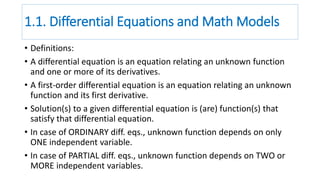
1.1. Differential Equations and Math Models
• Definitions:
• A differential equation is an equation relating an unknown function
and one or more of its derivatives.
• A first-order differential equation is an equation relating an unknown
function and its first derivative.
• Solution(s) to a given differential equation is (are) function(s) that
satisfy that differential equation.
• In case of ORDINARY diff. eqs., unknown function depends on only
ONE independent variable.
• In case of PARTIAL diff. eqs., unknown function depends on TWO or
MORE independent variables.
Examples of differential equations
• First-order:
• t: independent variable belonging to an interval
• y(t): dependent variable (function)
• x: independent variable belonging to an interval
• y(x): dependent variable (function)
𝑦′
=
𝑑𝑦
𝑑𝑥
= 𝑥 + sin 𝑦
𝑦′ =
𝑑𝑦
𝑑𝑡
= 3𝑡 + 4𝑦 − 17
Examples of differential equations
• Second-order:
𝑦′′ = −12𝑦′ + 3𝑦 − 5
𝑦′′
= 2𝑦′
+ 14
𝑦′′
= −𝑦 + 3
Examples of differential equations
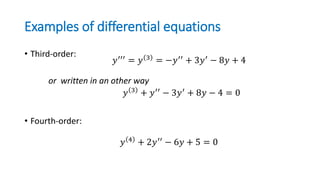
• Third-order:
or written in an other way
• Fourth-order:
𝑦′′′ = 𝑦 3 = −𝑦′′ + 3𝑦′ − 8𝑦 + 4
𝑦 3
+ 𝑦′′
− 3𝑦′
+ 8𝑦 − 4 = 0
𝑦 4
+ 2𝑦′′
− 6𝑦 + 5 = 0
Examples of Mathematical Models
• Example 3 (p.2)
• Example 4 (p.2)
• Example 5 (p.3)
• Example 6 (p.3)
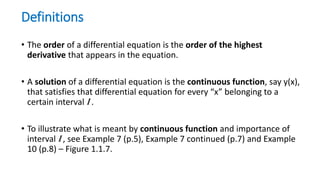
Definitions
• The order of a differential equation is the order of the highest
derivative that appears in the equation.
• A solution of a differential equation is the continuous function, say y(x),
that satisfies that differential equation for every “x” belonging to a
certain interval I .
• To illustrate what is meant by continuous function and importance of
interval I , see Example 7 (p.5), Example 7 continued (p.7) and Example
10 (p.8) – Figure 1.1.7.
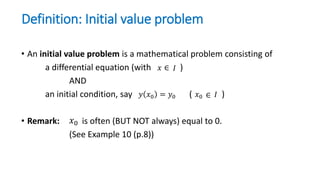
Definition: Initial value problem
• An initial value problem is a mathematical problem consisting of
a differential equation (with )
AND
an initial condition, say ( )
• Remark: is often (BUT NOT always) equal to 0.
(See Example 10 (p.8))
𝑦 𝑥0 = 𝑦0
𝑥0
𝑥 ∈ 𝐼
𝑥0 ∈ 𝐼
Definition: Solution of an Initial value problem
• A solution of an initial value problem is the continuous function, say
y(x), that satisfies BOTH
the differential equation (for all )
AND
the initial condition, say ( )
For illustration, see Example 10 (p.8) and Figure 1.1.7.
𝑦 𝑥0 = 𝑦0
𝑥 ∈ 𝐼
𝑥0 ∈ 𝐼
Very Important Examples to Study:
Example 5 and Example 6 (p.3) **
** means “inspiration for Quiz/Exam questions”
Problems to Solve (p.8 and p.9) **
1 to 26 AND 32 to 36
** means “inspiration for Quiz/Exam questions”
1.2. Integrals as General and Particular Solutions
• Definitions:
• A general solution of a differential equation is a function involving an
arbitrary constant (thus representing a family of functions) and
satisfying the differential equation under study.
• A particular solution of a differential equation is a function that
satisfies differential equation and an initial condition. This is the
solution of an initial value problem.
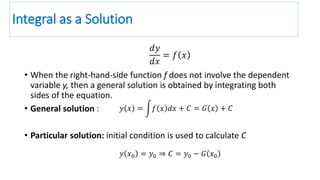
Integral as a Solution
• When the right-hand-side function f does not involve the dependent
variable y, then a general solution is obtained by integrating both
sides of the equation.
• General solution :
• Particular solution: initial condition is used to calculate C
𝑑𝑦
𝑑𝑥
= 𝑓 𝑥
𝑦 𝑥 = 𝑓 𝑥 𝑑𝑥 + 𝐶 = 𝐺 𝑥 + 𝐶
𝑦 𝑥0 = 𝑦0 ⇒ 𝐶 = 𝑦0 − 𝐺 𝑥0
Integral as a Solution
• Example 1 : p.11
• Velocity and Acceleration : p.12, 13
• Problems (p.17)** : 1 to 18
** means “inspiration for Quiz/Exam questions”
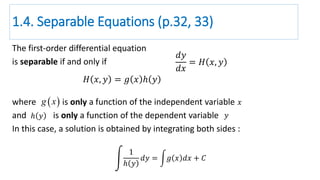
1.4. Separable Equations (p.32, 33)
The first-order differential equation
is separable if and only if
where is only a function of the independent variable
and is only a function of the dependent variable
In this case, a solution is obtained by integrating both sides :
𝑑𝑦
𝑑𝑥
= 𝐻 𝑥, 𝑦
𝐻 𝑥, 𝑦 = 𝑔 𝑥 ℎ 𝑦
 g x 𝑥
ℎ 𝑦 𝑦
1
ℎ 𝑦
𝑑𝑦 = 𝑔 𝑥 𝑑𝑥 + 𝐶
1.4. Separable Equations
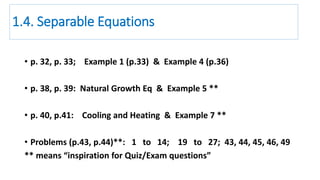
• p. 32, p. 33; Example 1 (p.33) & Example 4 (p.36)
• p. 38, p. 39: Natural Growth Eq & Example 5 **
• p. 40, p.41: Cooling and Heating & Example 7 **
• Problems (p.43, p.44)**: 1 to 14; 19 to 27; 43, 44, 45, 46, 49
** means “inspiration for Quiz/Exam questions”
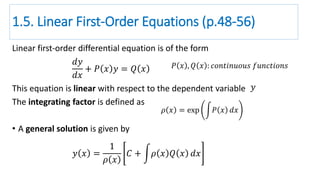
1.5. Linear First-Order Equations (p.48-56)
Linear first-order differential equation is of the form
This equation is linear with respect to the dependent variable
The integrating factor is defined as
• A general solution is given by
𝑑𝑦
𝑑𝑥
+ 𝑃 𝑥 𝑦 = 𝑄 𝑥
𝑦
𝑃 𝑥 , 𝑄 𝑥 : 𝑐𝑜𝑛𝑡𝑖𝑛𝑢𝑜𝑢𝑠 𝑓𝑢𝑛𝑐𝑡𝑖𝑜𝑛𝑠
𝜌 𝑥 = exp 𝑃 𝑥 𝑑𝑥
𝑦 𝑥 =
1
𝜌 𝑥
𝐶 + 𝜌 𝑥 𝑄 𝑥 𝑑𝑥
Applications
• Examples: 1, 2, 3, 4 and 5
• Problems (p.56)**: 1 to 24
** means “inspiration for Quiz/Exam questions”
1.6. Substitution Methods
• Many first-order differential equation are neither separable nor linear.
• Some creativity is needed to transform a “difficult” differential equation
into one that we already know how to solve (separable or linear).
• We need to substitute a part of the original equation by defining a new
dependent variable (v). The function that links the new variable “v” and
the original variable “y” must be invertible.
• This process will transform our original equation written in terms of “y”
into a new differential equation written in terms of a new variable “v”.
Substitution Methods
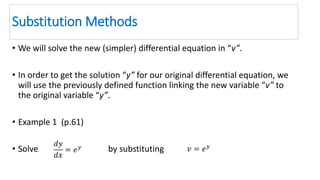
• We will solve the new (simpler) differential equation in “v”.
• In order to get the solution “y” for our original differential equation, we
will use the previously defined function linking the new variable “v” to
the original variable “y”.
• Example 1 (p.61)
• Solve by substituting
𝑑𝑦
𝑑𝑥
= 𝑒 𝑦 𝑣 = 𝑒 𝑦
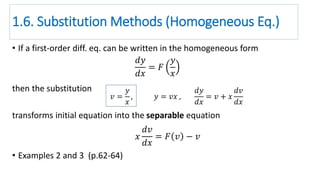
1.6. Substitution Methods (Homogeneous Eq.)
• If a first-order diff. eq. can be written in the homogeneous form
then the substitution
transforms initial equation into the separable equation
• Examples 2 and 3 (p.62-64)
𝑑𝑦
𝑑𝑥
= 𝐹
𝑦
𝑥
𝑣 =
𝑦
𝑥
, 𝑦 = 𝑣𝑥 ,
𝑑𝑦
𝑑𝑥
= 𝑣 + 𝑥
𝑑𝑣
𝑑𝑥
𝑥
𝑑𝑣
𝑑𝑥
= 𝐹 𝑣 − 𝑣
1.6. Substitution Methods (Bernoulli Eq.)
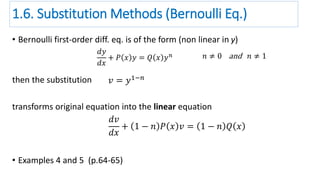
• Bernoulli first-order diff. eq. is of the form (non linear in y)
then the substitution
transforms original equation into the linear equation
• Examples 4 and 5 (p.64-65)
𝑑𝑦
𝑑𝑥
+ 𝑃 𝑥 𝑦 = 𝑄 𝑥 𝑦 𝑛 𝑛 ≠ 0 and 𝑛 ≠ 1
𝑣 = 𝑦1−𝑛
𝑑𝑣
𝑑𝑥
+ 1 − 𝑛 𝑃 𝑥 𝑣 = 1 − 𝑛 𝑄 𝑥
Problems (p. 74)
• Problems **: 1 to 24; 26, 27
** means “inspiration for Quiz/Exam questions”
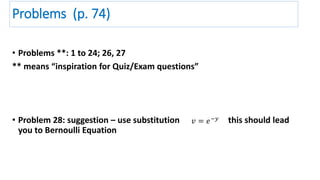
• Problem 28: suggestion – use substitution this should lead
you to Bernoulli Equation
𝑣 = 𝑒−𝑦
That is all
for
Chapter 1

Chapter 1: First-Order Ordinary Differential Equations/Slides

  • 1.
  • 2.
    Book for thecourse Differential Equations & Linear Algebra Third Edition by C. Henry Edwards & David E. Penney Pearson International Edition
  • 3.
    Chapter 1. First-Order OrdinaryDifferential Equations
  • 4.
    1.1. Differential Equationsand Math Models • Definitions: • A differential equation is an equation relating an unknown function and one or more of its derivatives. • A first-order differential equation is an equation relating an unknown function and its first derivative. • Solution(s) to a given differential equation is (are) function(s) that satisfy that differential equation. • In case of ORDINARY diff. eqs., unknown function depends on only ONE independent variable. • In case of PARTIAL diff. eqs., unknown function depends on TWO or MORE independent variables.
  • 5.
    Examples of differentialequations • First-order: • t: independent variable belonging to an interval • y(t): dependent variable (function) • x: independent variable belonging to an interval • y(x): dependent variable (function) 𝑦′ = 𝑑𝑦 𝑑𝑥 = 𝑥 + sin 𝑦 𝑦′ = 𝑑𝑦 𝑑𝑡 = 3𝑡 + 4𝑦 − 17
  • 6.
    Examples of differentialequations • Second-order: 𝑦′′ = −12𝑦′ + 3𝑦 − 5 𝑦′′ = 2𝑦′ + 14 𝑦′′ = −𝑦 + 3
  • 7.
    Examples of differentialequations • Third-order: or written in an other way • Fourth-order: 𝑦′′′ = 𝑦 3 = −𝑦′′ + 3𝑦′ − 8𝑦 + 4 𝑦 3 + 𝑦′′ − 3𝑦′ + 8𝑦 − 4 = 0 𝑦 4 + 2𝑦′′ − 6𝑦 + 5 = 0
  • 8.
    Examples of MathematicalModels • Example 3 (p.2) • Example 4 (p.2) • Example 5 (p.3) • Example 6 (p.3)
  • 9.
    Definitions • The orderof a differential equation is the order of the highest derivative that appears in the equation. • A solution of a differential equation is the continuous function, say y(x), that satisfies that differential equation for every “x” belonging to a certain interval I . • To illustrate what is meant by continuous function and importance of interval I , see Example 7 (p.5), Example 7 continued (p.7) and Example 10 (p.8) – Figure 1.1.7.
  • 10.
    Definition: Initial valueproblem • An initial value problem is a mathematical problem consisting of a differential equation (with ) AND an initial condition, say ( ) • Remark: is often (BUT NOT always) equal to 0. (See Example 10 (p.8)) 𝑦 𝑥0 = 𝑦0 𝑥0 𝑥 ∈ 𝐼 𝑥0 ∈ 𝐼
  • 11.
    Definition: Solution ofan Initial value problem • A solution of an initial value problem is the continuous function, say y(x), that satisfies BOTH the differential equation (for all ) AND the initial condition, say ( ) For illustration, see Example 10 (p.8) and Figure 1.1.7. 𝑦 𝑥0 = 𝑦0 𝑥 ∈ 𝐼 𝑥0 ∈ 𝐼
  • 12.
    Very Important Examplesto Study: Example 5 and Example 6 (p.3) ** ** means “inspiration for Quiz/Exam questions” Problems to Solve (p.8 and p.9) ** 1 to 26 AND 32 to 36 ** means “inspiration for Quiz/Exam questions”
  • 13.
    1.2. Integrals asGeneral and Particular Solutions • Definitions: • A general solution of a differential equation is a function involving an arbitrary constant (thus representing a family of functions) and satisfying the differential equation under study. • A particular solution of a differential equation is a function that satisfies differential equation and an initial condition. This is the solution of an initial value problem.
  • 14.
    Integral as aSolution • When the right-hand-side function f does not involve the dependent variable y, then a general solution is obtained by integrating both sides of the equation. • General solution : • Particular solution: initial condition is used to calculate C 𝑑𝑦 𝑑𝑥 = 𝑓 𝑥 𝑦 𝑥 = 𝑓 𝑥 𝑑𝑥 + 𝐶 = 𝐺 𝑥 + 𝐶 𝑦 𝑥0 = 𝑦0 ⇒ 𝐶 = 𝑦0 − 𝐺 𝑥0
  • 15.
    Integral as aSolution • Example 1 : p.11 • Velocity and Acceleration : p.12, 13 • Problems (p.17)** : 1 to 18 ** means “inspiration for Quiz/Exam questions”
  • 16.
    1.4. Separable Equations(p.32, 33) The first-order differential equation is separable if and only if where is only a function of the independent variable and is only a function of the dependent variable In this case, a solution is obtained by integrating both sides : 𝑑𝑦 𝑑𝑥 = 𝐻 𝑥, 𝑦 𝐻 𝑥, 𝑦 = 𝑔 𝑥 ℎ 𝑦  g x 𝑥 ℎ 𝑦 𝑦 1 ℎ 𝑦 𝑑𝑦 = 𝑔 𝑥 𝑑𝑥 + 𝐶
  • 17.
    1.4. Separable Equations •p. 32, p. 33; Example 1 (p.33) & Example 4 (p.36) • p. 38, p. 39: Natural Growth Eq & Example 5 ** • p. 40, p.41: Cooling and Heating & Example 7 ** • Problems (p.43, p.44)**: 1 to 14; 19 to 27; 43, 44, 45, 46, 49 ** means “inspiration for Quiz/Exam questions”
  • 18.
    1.5. Linear First-OrderEquations (p.48-56) Linear first-order differential equation is of the form This equation is linear with respect to the dependent variable The integrating factor is defined as • A general solution is given by 𝑑𝑦 𝑑𝑥 + 𝑃 𝑥 𝑦 = 𝑄 𝑥 𝑦 𝑃 𝑥 , 𝑄 𝑥 : 𝑐𝑜𝑛𝑡𝑖𝑛𝑢𝑜𝑢𝑠 𝑓𝑢𝑛𝑐𝑡𝑖𝑜𝑛𝑠 𝜌 𝑥 = exp 𝑃 𝑥 𝑑𝑥 𝑦 𝑥 = 1 𝜌 𝑥 𝐶 + 𝜌 𝑥 𝑄 𝑥 𝑑𝑥
  • 19.
    Applications • Examples: 1,2, 3, 4 and 5 • Problems (p.56)**: 1 to 24 ** means “inspiration for Quiz/Exam questions”
  • 20.
    1.6. Substitution Methods •Many first-order differential equation are neither separable nor linear. • Some creativity is needed to transform a “difficult” differential equation into one that we already know how to solve (separable or linear). • We need to substitute a part of the original equation by defining a new dependent variable (v). The function that links the new variable “v” and the original variable “y” must be invertible. • This process will transform our original equation written in terms of “y” into a new differential equation written in terms of a new variable “v”.
  • 21.
    Substitution Methods • Wewill solve the new (simpler) differential equation in “v”. • In order to get the solution “y” for our original differential equation, we will use the previously defined function linking the new variable “v” to the original variable “y”. • Example 1 (p.61) • Solve by substituting 𝑑𝑦 𝑑𝑥 = 𝑒 𝑦 𝑣 = 𝑒 𝑦
  • 22.
    1.6. Substitution Methods(Homogeneous Eq.) • If a first-order diff. eq. can be written in the homogeneous form then the substitution transforms initial equation into the separable equation • Examples 2 and 3 (p.62-64) 𝑑𝑦 𝑑𝑥 = 𝐹 𝑦 𝑥 𝑣 = 𝑦 𝑥 , 𝑦 = 𝑣𝑥 , 𝑑𝑦 𝑑𝑥 = 𝑣 + 𝑥 𝑑𝑣 𝑑𝑥 𝑥 𝑑𝑣 𝑑𝑥 = 𝐹 𝑣 − 𝑣
  • 23.
    1.6. Substitution Methods(Bernoulli Eq.) • Bernoulli first-order diff. eq. is of the form (non linear in y) then the substitution transforms original equation into the linear equation • Examples 4 and 5 (p.64-65) 𝑑𝑦 𝑑𝑥 + 𝑃 𝑥 𝑦 = 𝑄 𝑥 𝑦 𝑛 𝑛 ≠ 0 and 𝑛 ≠ 1 𝑣 = 𝑦1−𝑛 𝑑𝑣 𝑑𝑥 + 1 − 𝑛 𝑃 𝑥 𝑣 = 1 − 𝑛 𝑄 𝑥
  • 24.
    Problems (p. 74) •Problems **: 1 to 24; 26, 27 ** means “inspiration for Quiz/Exam questions” • Problem 28: suggestion – use substitution this should lead you to Bernoulli Equation 𝑣 = 𝑒−𝑦
  • 25.