8.7 L’Hopital’s Rule revisited
Transcendental functions and applications
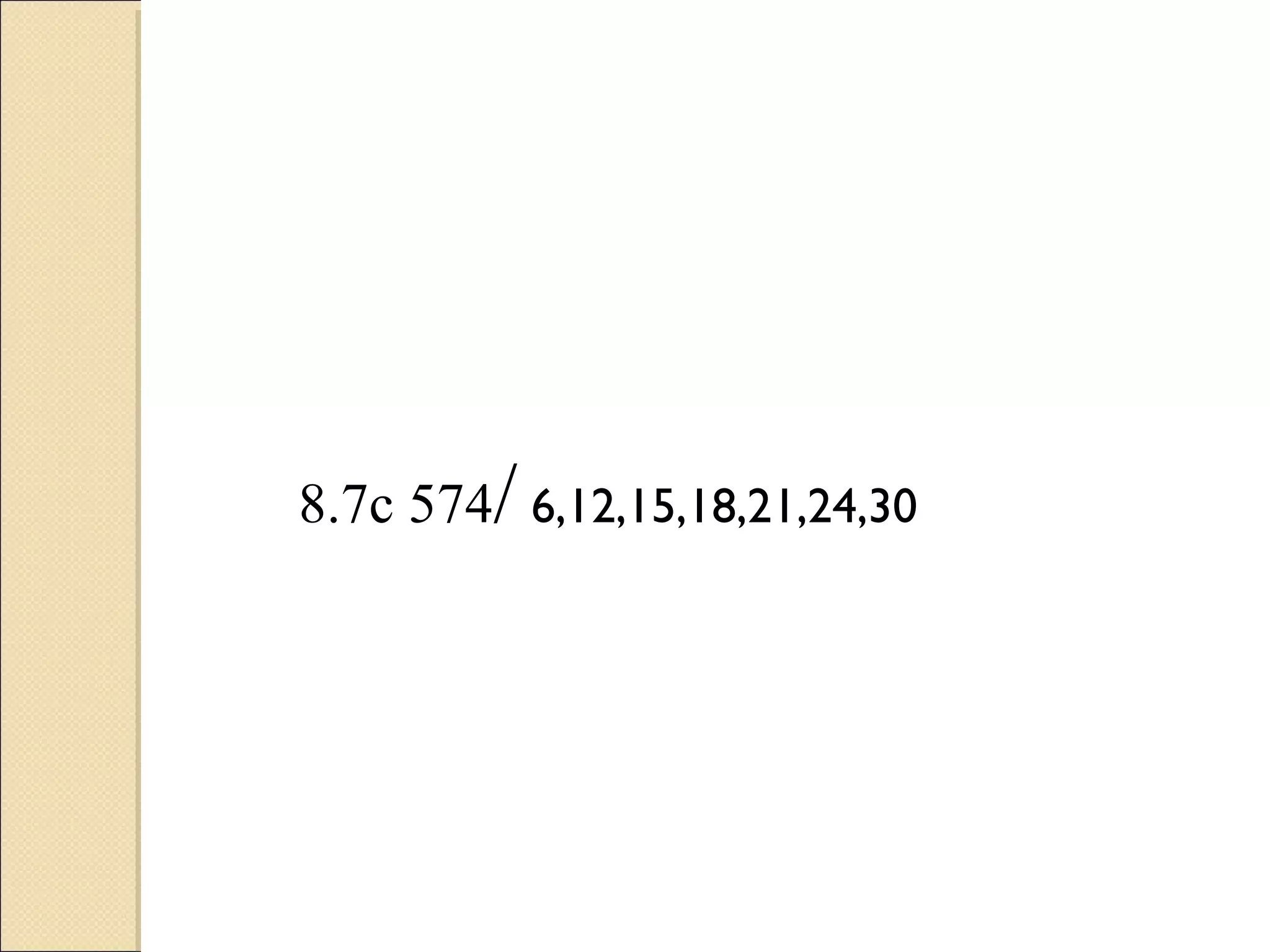
Recall that there are some functions that when finding limits
produce the indeterminate forms 0/0 or ∞/∞. When these come
up, they do not guarantee a limit exists, nor what that limit
is.


Some examples:              2x2 − 2               3x 2 − 2
                       lim                   lim 2
                       x →−1 x + 1           x →∞ 2 x + 1


 Rewriting with algebraic techniques can handle some of them, for
 example dividing out techniques, rationalizing denominators or
 numerators, or using the squeeze theorem.
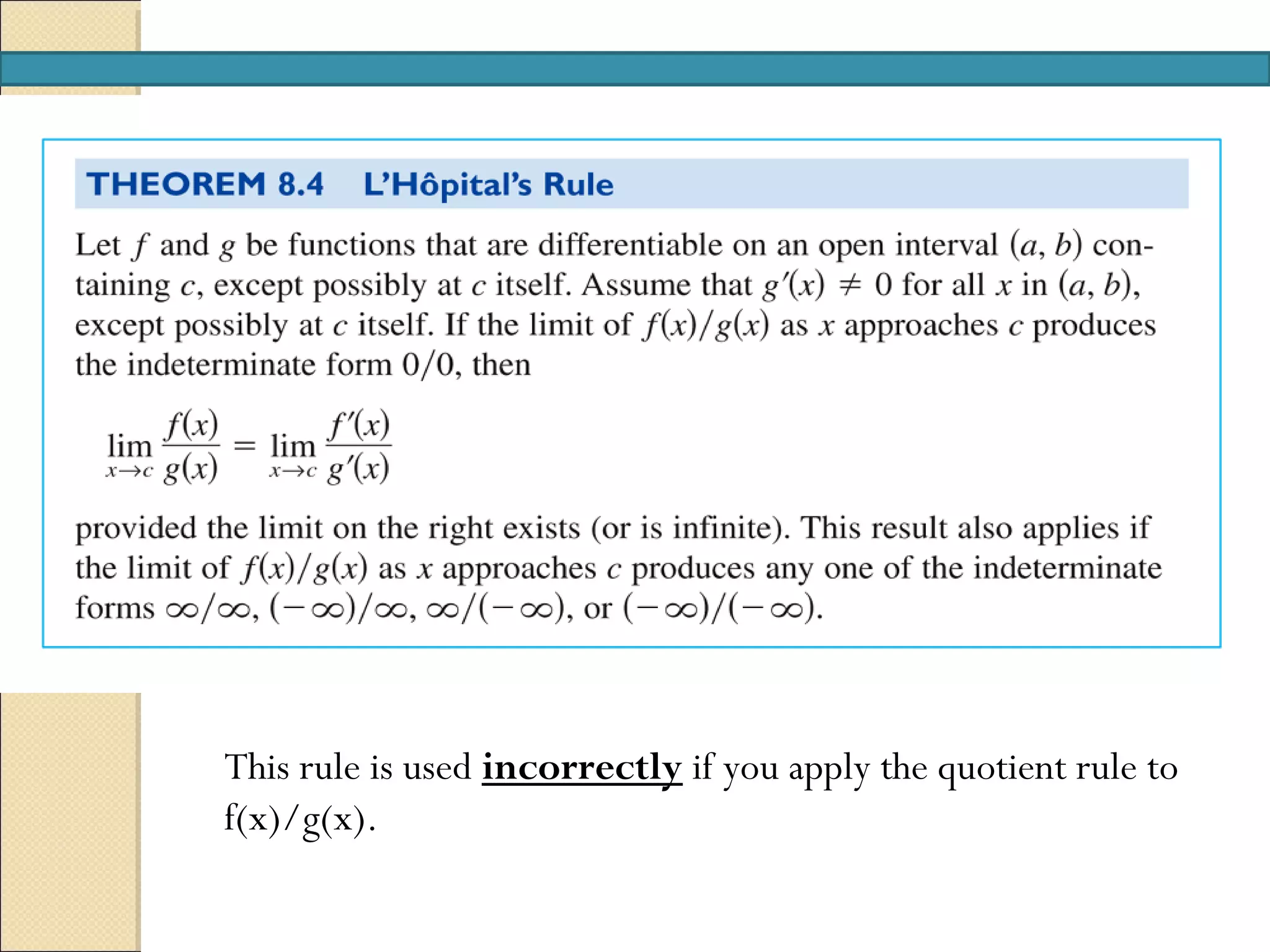
This rule is used incorrectly if you apply the quotient rule to
f(x)/g(x).
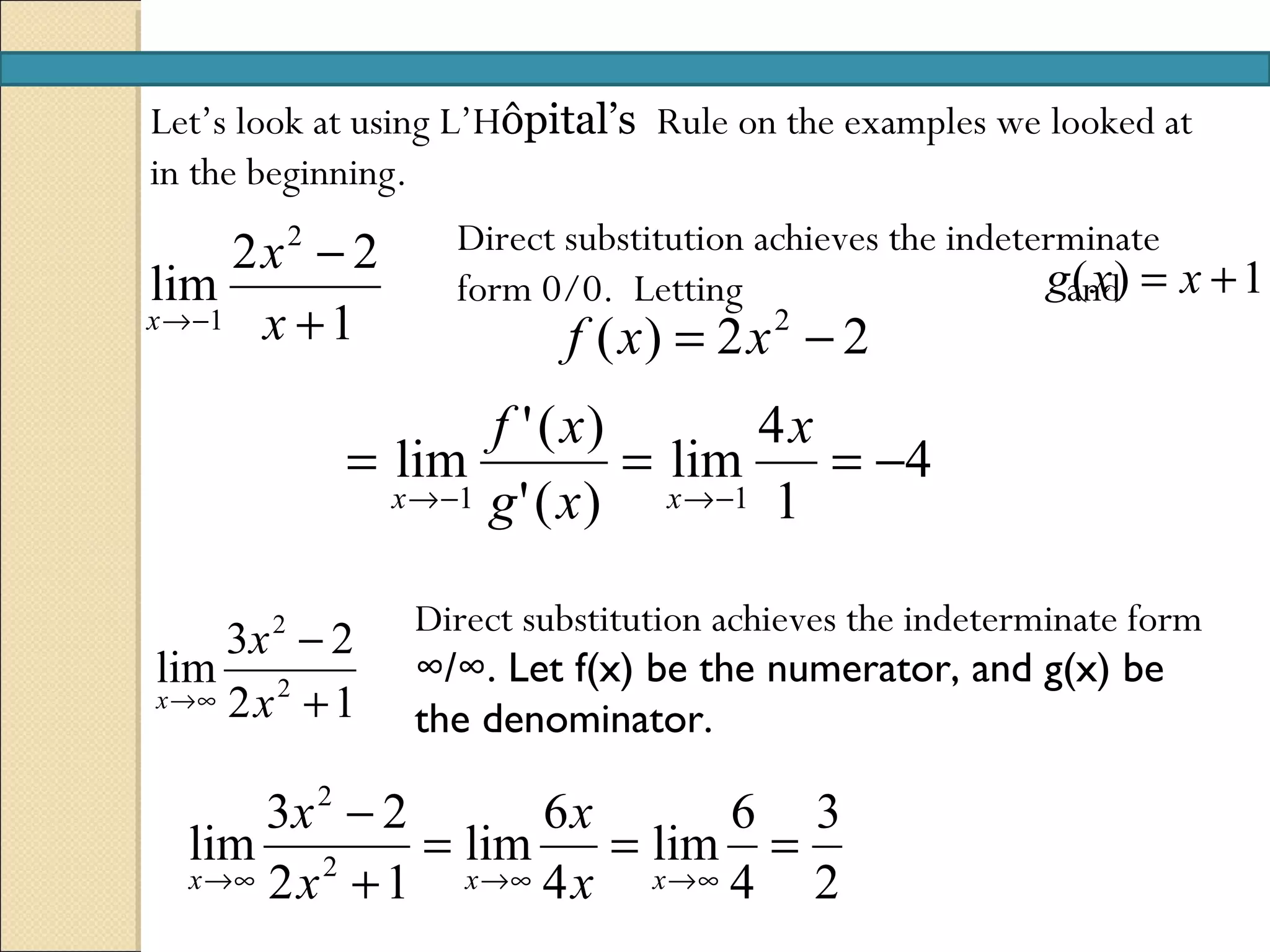
Let’s look at using L’Hôpital’s Rule on the examples we looked at
in the beginning.
     2x2 − 2       Direct substitution achieves the indeterminate
lim                form 0/0. Letting                      gand) = x + 1
                                                            (x
x →−1 x + 1
                          f ( x) = 2 x − 2
                                       2


                    f ' ( x)         4x
            = lim             = lim     = −4
              x →−1 g ' ( x )   x →−1 1


                Direct substitution achieves the indeterminate form
     3x 2 − 2
lim 2           ∞/∞. Let f(x) be the numerator, and g(x) be
x →∞ 2 x + 1
                the denominator.

       3x 2 − 2        6x         6 3
  lim 2         = lim      = lim =
  x →∞ 2 x + 1    x →∞ 4 x   x →∞ 4 2
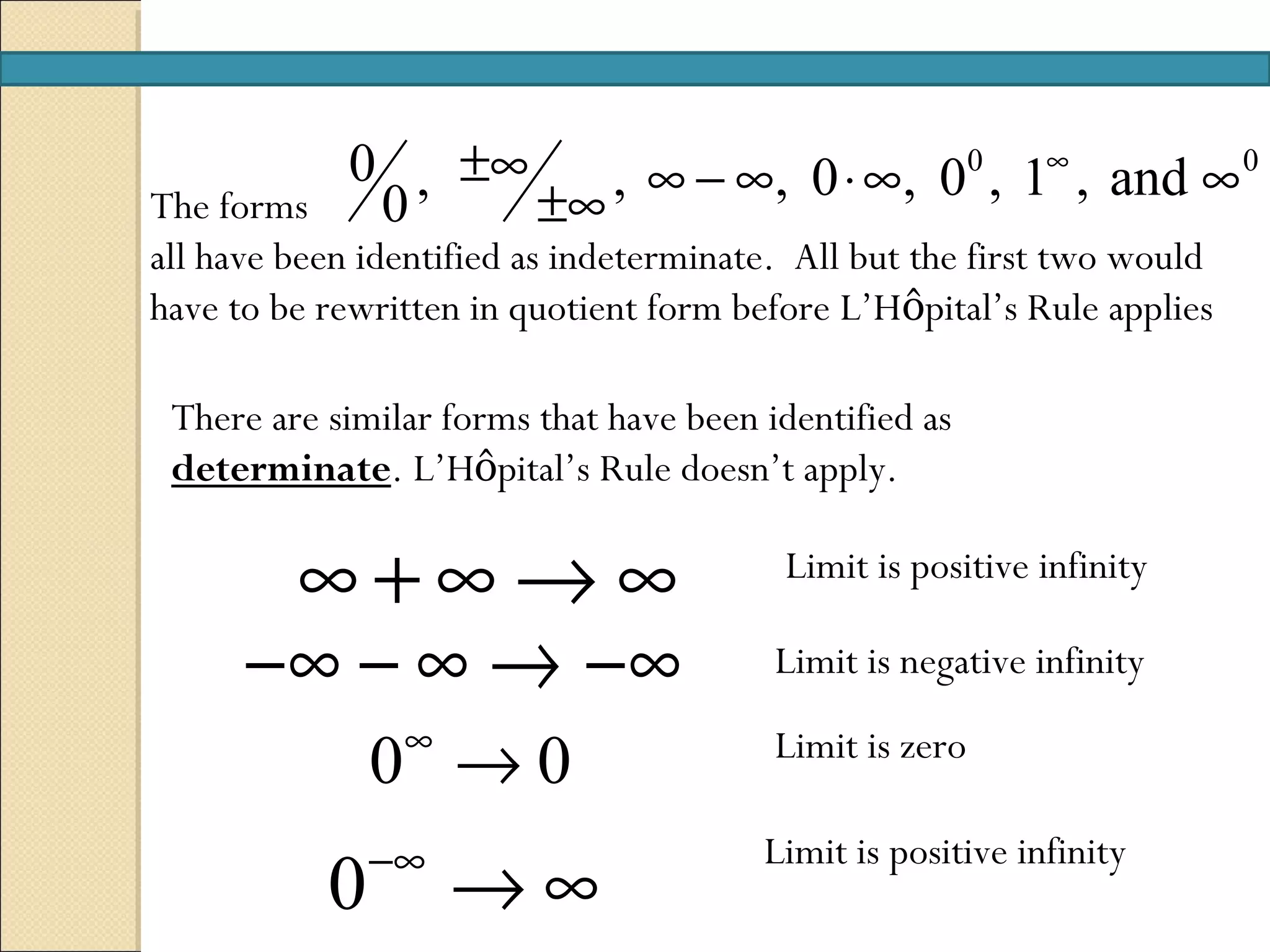
0 , ±∞    , ∞ − ∞, 0 ⋅ ∞, 00 , 1∞ , and ∞ 0
The forms     0     ±∞
all have been identified as indeterminate. All but the first two would
have to be rewritten in quotient form before L’Hôpital’s Rule applies

 There are similar forms that have been identified as
 determinate. L’Hôpital’s Rule doesn’t apply.

       ∞+∞→∞                             Limit is positive infinity

      −∞ − ∞ → −∞                        Limit is negative infinity
                ∞
               0 →0                      Limit is zero

               −∞                       Limit is positive infinity
           0        →∞
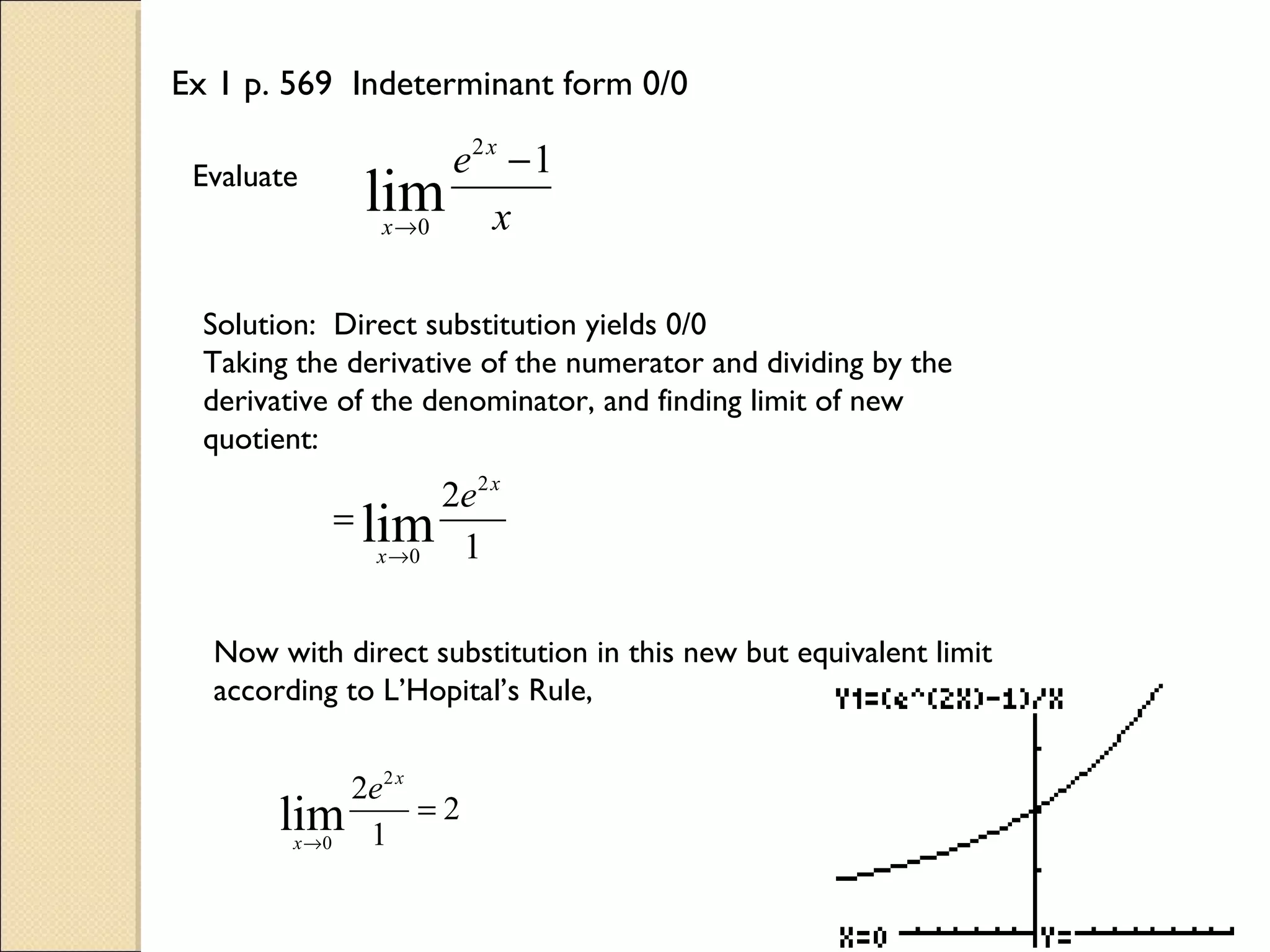
Ex 1 p. 569 Indeterminant form 0/0

 Evaluate           e2 x − 1
              lim x
               x →0


  Solution: Direct substitution yields 0/0
  Taking the derivative of the numerator and dividing by the
  derivative of the denominator, and finding limit of new
  quotient:
                    2e 2 x
            = lim
               x →0  1

  Now with direct substitution in this new but equivalent limit
  according to L’Hopital’s Rule,


             2e 2 x
       lim 1 = 2
        x →0
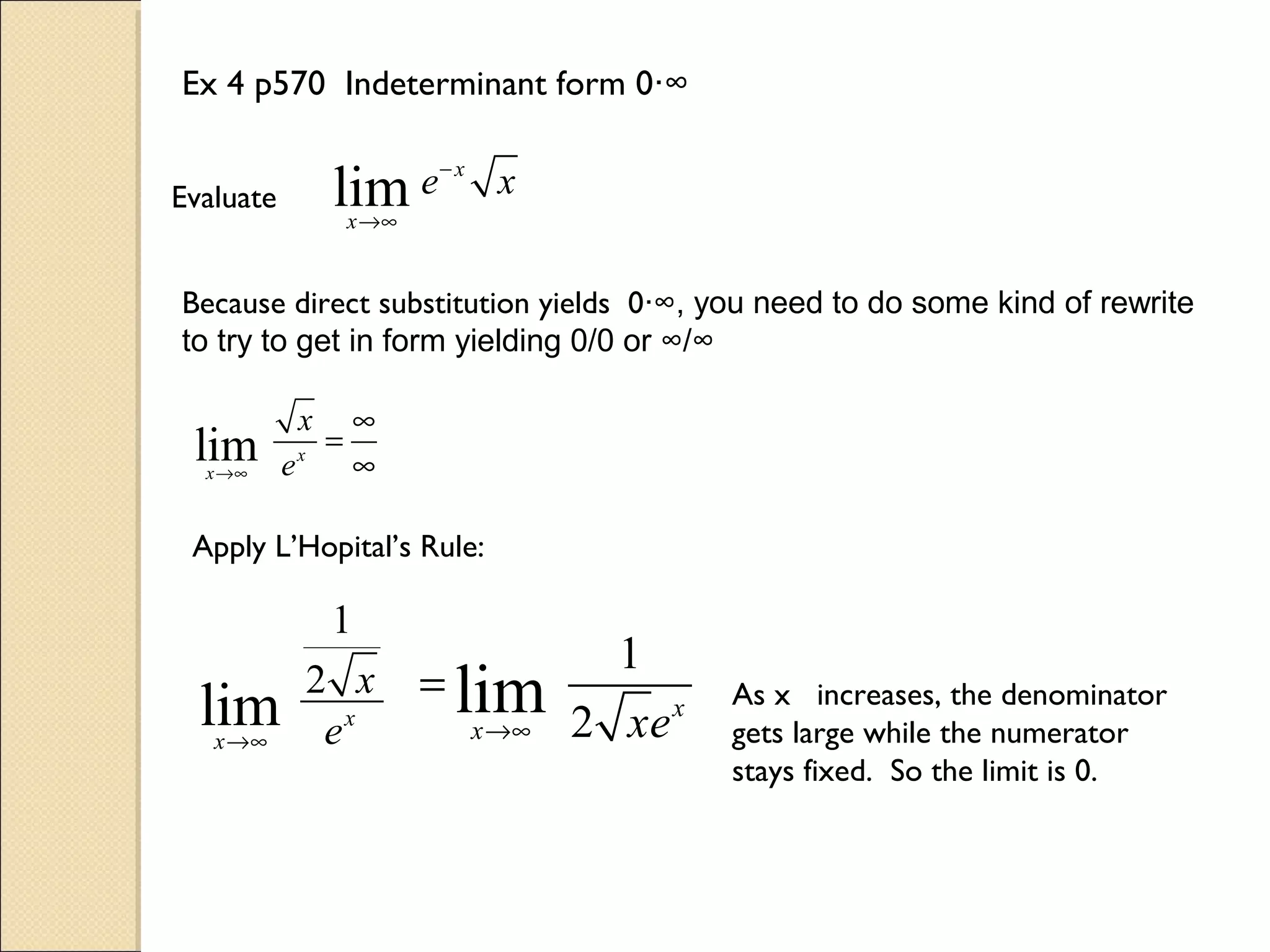
Ex 4 p570 Indeterminant form 0∙∞


Evaluate         lim e− x x
                    x →∞


Because direct substitution yields 0∙∞, you need to do some kind of rewrite
to try to get in form yielding 0/0 or ∞/∞

            x        ∞
 lim
  x →∞     ex
                =
                     ∞

 Apply L’Hopital’s Rule:

                 1
                                      1
                2 x        = lim
  lim
   x →∞          ex          x →∞   2 xe x
                                             As x increases, the denominator
                                             gets large while the numerator
                                             stays fixed. So the limit is 0.
8.7c 574/ 6,12,15,18,21,24,30

Calc 8.7 again

  • 1.
    8.7 L’Hopital’s Rulerevisited Transcendental functions and applications
  • 2.
    Recall that thereare some functions that when finding limits produce the indeterminate forms 0/0 or ∞/∞. When these come up, they do not guarantee a limit exists, nor what that limit is. Some examples: 2x2 − 2 3x 2 − 2 lim lim 2 x →−1 x + 1 x →∞ 2 x + 1 Rewriting with algebraic techniques can handle some of them, for example dividing out techniques, rationalizing denominators or numerators, or using the squeeze theorem.
  • 3.
    This rule isused incorrectly if you apply the quotient rule to f(x)/g(x).
  • 4.
    Let’s look atusing L’Hôpital’s Rule on the examples we looked at in the beginning. 2x2 − 2 Direct substitution achieves the indeterminate lim form 0/0. Letting gand) = x + 1 (x x →−1 x + 1 f ( x) = 2 x − 2 2 f ' ( x) 4x = lim = lim = −4 x →−1 g ' ( x ) x →−1 1 Direct substitution achieves the indeterminate form 3x 2 − 2 lim 2 ∞/∞. Let f(x) be the numerator, and g(x) be x →∞ 2 x + 1 the denominator. 3x 2 − 2 6x 6 3 lim 2 = lim = lim = x →∞ 2 x + 1 x →∞ 4 x x →∞ 4 2
  • 5.
    0 , ±∞ , ∞ − ∞, 0 ⋅ ∞, 00 , 1∞ , and ∞ 0 The forms 0 ±∞ all have been identified as indeterminate. All but the first two would have to be rewritten in quotient form before L’Hôpital’s Rule applies There are similar forms that have been identified as determinate. L’Hôpital’s Rule doesn’t apply. ∞+∞→∞ Limit is positive infinity −∞ − ∞ → −∞ Limit is negative infinity ∞ 0 →0 Limit is zero −∞ Limit is positive infinity 0 →∞
  • 6.
    Ex 1 p.569 Indeterminant form 0/0 Evaluate e2 x − 1 lim x x →0 Solution: Direct substitution yields 0/0 Taking the derivative of the numerator and dividing by the derivative of the denominator, and finding limit of new quotient: 2e 2 x = lim x →0 1 Now with direct substitution in this new but equivalent limit according to L’Hopital’s Rule, 2e 2 x lim 1 = 2 x →0
  • 7.
    Ex 4 p570Indeterminant form 0∙∞ Evaluate lim e− x x x →∞ Because direct substitution yields 0∙∞, you need to do some kind of rewrite to try to get in form yielding 0/0 or ∞/∞ x ∞ lim x →∞ ex = ∞ Apply L’Hopital’s Rule: 1 1 2 x = lim lim x →∞ ex x →∞ 2 xe x As x increases, the denominator gets large while the numerator stays fixed. So the limit is 0.
  • 8.