Ex 4 p460 Integrating with Respect to y, Two-Integral case.
Find the volume of the solid formed by revolving the region
bounded by the graphs of y = x2 + 1, y = 0, x= 0 and x = 1 about
the y-axis.
Part of this region will revolve and be washers,
and part will be disks. So the region must be
split up at the level where y=1.
I am revolving about y-axis, so y is being sliced
up as dy. I will need functions in terms of y for
the radii.
In the upper part, the inner radius is
determined by and the outer
radius is still x = 1
1
y x
 
 
1 2
2
2 2
0 1
1 [1 1 ]
dy y dy
 
  
 
1 2
0 1
1 [2 ]
dy y dy
 
  
 
3
2


X = 1
1
x y
 
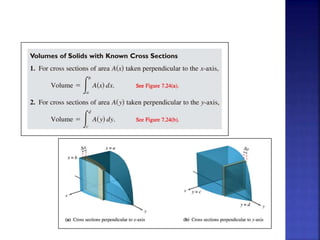
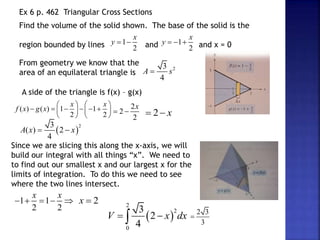
Ex 6 p. 462 Triangular Cross Sections
Find the volume of the solid shown. The base of the solid is the
region bounded by lines and and x = 0
1
2
x
y   1
2
x
y   
From geometry we know that the
area of an equilateral triangle is
2
3
4
A s

A side of the triangle is f(x) – g(x)
( ) ( ) 1 1
2 2
x x
f x g x
   
     
   
   
2
2
2
x
  2 x
 
 
2
3
( ) 2
4
A x x
 
Since we are slicing this along the x-axis, we will
build our integral with all things “x”. We need to
to find out our smallest x and our largest x for the
limits of integration. To do this we need to see
where the two lines intersect.
 
2
2
0
3
2
4
V x dx
 

1 1
2 2
x x
     2
x 
2 3
3

7.2b p. 463/ 17-35 odd

Calc 7.2b

  • 2.
    Ex 4 p460Integrating with Respect to y, Two-Integral case. Find the volume of the solid formed by revolving the region bounded by the graphs of y = x2 + 1, y = 0, x= 0 and x = 1 about the y-axis. Part of this region will revolve and be washers, and part will be disks. So the region must be split up at the level where y=1. I am revolving about y-axis, so y is being sliced up as dy. I will need functions in terms of y for the radii. In the upper part, the inner radius is determined by and the outer radius is still x = 1 1 y x     1 2 2 2 2 0 1 1 [1 1 ] dy y dy        1 2 0 1 1 [2 ] dy y dy        3 2   X = 1 1 x y  
  • 4.
    Ex 6 p.462 Triangular Cross Sections Find the volume of the solid shown. The base of the solid is the region bounded by lines and and x = 0 1 2 x y   1 2 x y    From geometry we know that the area of an equilateral triangle is 2 3 4 A s  A side of the triangle is f(x) – g(x) ( ) ( ) 1 1 2 2 x x f x g x                   2 2 2 x   2 x     2 3 ( ) 2 4 A x x   Since we are slicing this along the x-axis, we will build our integral with all things “x”. We need to to find out our smallest x and our largest x for the limits of integration. To do this we need to see where the two lines intersect.   2 2 0 3 2 4 V x dx    1 1 2 2 x x      2 x  2 3 3 
  • 5.
    7.2b p. 463/17-35 odd