IPE-409 CAD/CAM
Dr. Nafis Ahmad
Professor
Department of IPE, BUET
Email:nafis@ipe.buet.ac.bd
Ch#7.
Data Exchange Standards
2
Reference books:
• CADCAM Principles, practice and manufacturing
management-
• Chris McMohan and Jimmie Browne
• CAD/CAM Theory and Practice
• Ibrahim Zeid
Introduction
• A critical concern of CAD and CAM is the
communication of design and manufacturing data
within an engineering organization and indeed
between those organizations involved in the
manufacturing of a product.
• Earlier software and hardware were incompatible
with each other.
• Each system vendor used a unique data structure
• Divergence in data formats had the effect of tying
companies to particular CAD/CAM systems, other
vendors found themselves constrained.
• The wish to improve the accessibility of computer
languages led early on to the establishment of
standards for these
Introduction
Introduction
Data Exchange standards
• Application of CAD has been accompanied both by growth
in product variety and a broadening of the range of
companies involved in the design of a particular product.
• Traditionally car companies designed almost all parts.
Now the trend is to delegate design authority to the
suppliers.
• As a result thousands of parties need to share their design
information with others.
• To support this process, a great deal of design data has
to be exchanged between various companies.
• In order to accomplish this transfer quickly and accurately,
CAD systems employed by various manufacturers should
be capable of exchanging data with each other.
Data Exchange standards
• The easiest way is to use the same
CADCAM software operating at the
same level.
• Large manufacturers put pressure on
their suppliers to adopt the same
system as themselves.
• But a more equitable solution is for
the various CADCAM systems in the
market to be able to exchange data
with each other.
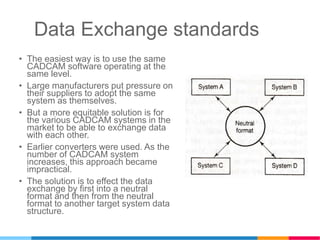
• Earlier converters were used. As the
number of CADCAM system
increases, this approach became
impractical.
• The solution is to effect the data
exchange by first into a neutral
format and then from the neutral
format to another target system data
structure.
Data Exchange standards
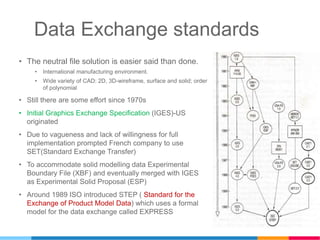
• The neutral file solution is easier said than done.
• International manufacturing environment.
• Wide variety of CAD: 2D, 3D-wireframe, surface and solid; order
of polynomial
• Still there are some effort since 1970s
• Initial Graphics Exchange Specification (IGES)-US
originated
• Due to vagueness and lack of willingness for full
implementation prompted French company to use
SET(Standard Exchange Transfer)
• To accommodate solid modelling data Experimental
Boundary File (XBF) and eventually merged with IGES
as Experimental Solid Proposal (ESP)
• Around 1989 ISO introduced STEP ( Standard for the
Exchange of Product Model Data) which uses a formal
model for the data exchange called EXPRESS
Data Exchange standards
• EXPRESS language is human readable and computer
processable.
Neutral Format Examples
IGES
Sections:
1. Start section-manually entered by creator to assist end user.
2. Global Section -parameters necessary to translate the file
3. Directory Section -entry for each entity and it’s associated with
the code representing the entity
4. Parameter Data Section -Entity specific data like coordinates
etc.
5. Termination Section -Marks the end of the data
Neutral Format Examples
DXF
Sections:
• HEADER section-AudoCAD system variables
• TABLES Section-Line styles, user coordinate system etc.
• BLOCKS Section- Definitions of block instances in the model
• ENTITIES Data Section-Entity specific data like coordinates etc.
Neutral Format Examples
DXF
Neutral Format Examples
DXF
16
Thanks!
Any questions?
You can find me at: https//ahmadn.info
Twitter@ahmadn
Email:nafis@ipe.buet.ac.bd

CADCAM: Data exchange standards

  • 1.
    IPE-409 CAD/CAM Dr. NafisAhmad Professor Department of IPE, BUET Email:nafis@ipe.buet.ac.bd
  • 2.
  • 3.
    Reference books: • CADCAMPrinciples, practice and manufacturing management- • Chris McMohan and Jimmie Browne • CAD/CAM Theory and Practice • Ibrahim Zeid
  • 4.
    Introduction • A criticalconcern of CAD and CAM is the communication of design and manufacturing data within an engineering organization and indeed between those organizations involved in the manufacturing of a product. • Earlier software and hardware were incompatible with each other. • Each system vendor used a unique data structure • Divergence in data formats had the effect of tying companies to particular CAD/CAM systems, other vendors found themselves constrained. • The wish to improve the accessibility of computer languages led early on to the establishment of standards for these
  • 5.
  • 6.
  • 7.
    Data Exchange standards •Application of CAD has been accompanied both by growth in product variety and a broadening of the range of companies involved in the design of a particular product. • Traditionally car companies designed almost all parts. Now the trend is to delegate design authority to the suppliers. • As a result thousands of parties need to share their design information with others. • To support this process, a great deal of design data has to be exchanged between various companies. • In order to accomplish this transfer quickly and accurately, CAD systems employed by various manufacturers should be capable of exchanging data with each other.
  • 8.
    Data Exchange standards •The easiest way is to use the same CADCAM software operating at the same level. • Large manufacturers put pressure on their suppliers to adopt the same system as themselves. • But a more equitable solution is for the various CADCAM systems in the market to be able to exchange data with each other. • Earlier converters were used. As the number of CADCAM system increases, this approach became impractical. • The solution is to effect the data exchange by first into a neutral format and then from the neutral format to another target system data structure.
  • 9.
    Data Exchange standards •The neutral file solution is easier said than done. • International manufacturing environment. • Wide variety of CAD: 2D, 3D-wireframe, surface and solid; order of polynomial • Still there are some effort since 1970s • Initial Graphics Exchange Specification (IGES)-US originated • Due to vagueness and lack of willingness for full implementation prompted French company to use SET(Standard Exchange Transfer) • To accommodate solid modelling data Experimental Boundary File (XBF) and eventually merged with IGES as Experimental Solid Proposal (ESP) • Around 1989 ISO introduced STEP ( Standard for the Exchange of Product Model Data) which uses a formal model for the data exchange called EXPRESS
  • 10.
    Data Exchange standards •EXPRESS language is human readable and computer processable.
  • 11.
    Neutral Format Examples IGES Sections: 1.Start section-manually entered by creator to assist end user. 2. Global Section -parameters necessary to translate the file 3. Directory Section -entry for each entity and it’s associated with the code representing the entity 4. Parameter Data Section -Entity specific data like coordinates etc. 5. Termination Section -Marks the end of the data
  • 13.
    Neutral Format Examples DXF Sections: •HEADER section-AudoCAD system variables • TABLES Section-Line styles, user coordinate system etc. • BLOCKS Section- Definitions of block instances in the model • ENTITIES Data Section-Entity specific data like coordinates etc.
  • 14.
  • 15.
  • 16.
    16 Thanks! Any questions? You canfind me at: https//ahmadn.info Twitter@ahmadn Email:nafis@ipe.buet.ac.bd