CAD Standards
Need for Graphics Standards
• The real issue with choosing the standards is
portability and device independence.
• Complex CAD/CAM systems.
• Shape, Non shape, design and Manufacturing data.
• Need to integrate and automate design and
manufacturing process to obtain maximum benefits
from CAD/CAM.
• Direct Translators and neutral formats.
CAD Standards
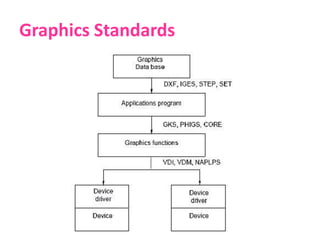
• Graphics Standards
– GKS,PHIGS,NAPLPS,GKS 3D, IGES
• Standards for Exchange images
– Open GL
• Data Exchange Standards
– IGES,STEP,DXF,STL,CALS,PDES,VRML,CGM
• Communication Standards
– LAN,WAN,CGI,VDI,
Various Interface Standards Exchange Format
• GKS ( Graphical Kernel System)
• PHIGS (Programmer’s Hierarchical Interface for GraphicS)
• GKS -3D
• IGES (Initial Graphics Exchange Specification)
• DXF (Drawing eXchange Format)
• STEP (STandard for the Exchange of Product Model Data)
• CALS (Continuous Acquisition and Life cycle Support)
• ACIS ( *.sat ) [Alan, Charles, Ian's System]
• OpenGL – Open Graphics Laboratory
• DMIS (Dimensional Measurement Interface Specification)
• VDI (Virtual Device Interface)
• CGI (Computer Graphics Interface)
• VDM (Virtual Device Metafile)
• CGM (Computer Graphics Metafile)
• GKSM (GKS Metafile)
• PDES (Product Data Exchange Standards)
• VRML (Virtual Reality Modelling Language)
CAD Function
• Graphics Output Primitives
– Line, polygon, sphere, …
• Attributes
– Color, line width, texture, …
• Geometric transformations
– Modeling, Viewing
• Shading and illumination
• Input functions
Graphics Standards
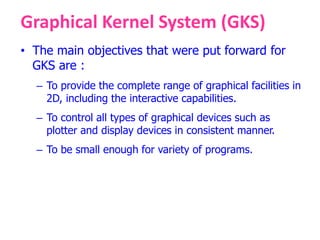
Graphical Kernel System (GKS)
• The main objectives that were put forward for
GKS are :
– To provide the complete range of graphical facilities in
2D, including the interactive capabilities.
– To control all types of graphical devices such as
plotter and display devices in consistent manner.
– To be small enough for variety of programs.
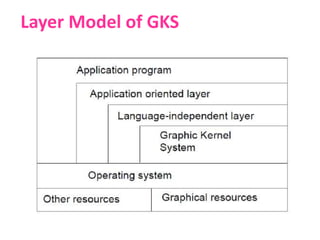
Layer Model of GKS
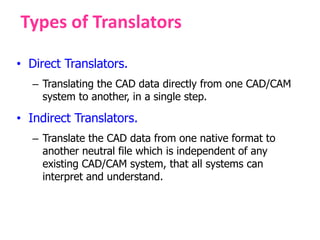
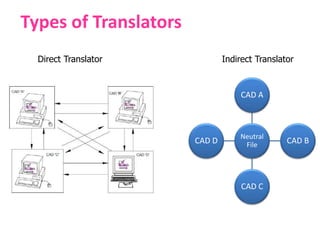
Types of Translators
• Direct Translators.
– Translating the CAD data directly from one CAD/CAM
system to another, in a single step.
• Indirect Translators.
– Translate the CAD data from one native format to
another neutral file which is independent of any
existing CAD/CAM system, that all systems can
interpret and understand.
Types of Translators
Direct Translator
Neutral
File
CAD A
CAD B
CAD C
CAD D
Indirect Translator
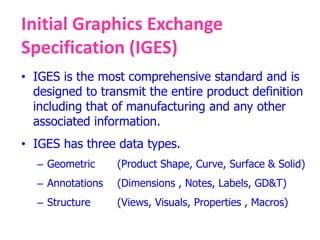
Initial Graphics Exchange
Specification (IGES)
• IGES is the most comprehensive standard and is
designed to transmit the entire product definition
including that of manufacturing and any other
associated information.
• IGES has three data types.
– Geometric (Product Shape, Curve, Surface & Solid)
– Annotations (Dimensions , Notes, Labels, GD&T)
– Structure (Views, Visuals, Properties , Macros)
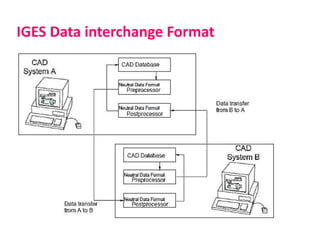
IGES Data interchange Format
IGES - File Structure
• Optional
• ASCII/Binary/Compressed ASCII
Flag Section
• Man Readable Prologue
• Initialize IGES file
Start Section
• Details of Product
• Drafting Standards Used
Global Section
• Index for File
• Color, Line Type etc
Directory Section
• Geometry, Annotation & StructureParameter Entry
Section
• Subtotals of Record in every sections
Terminate Section
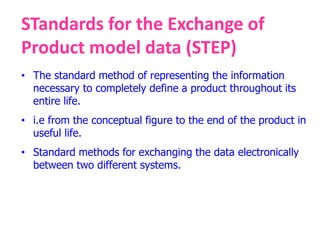
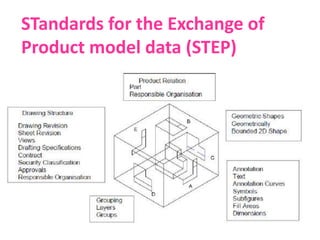
STandards for the Exchange of
Product model data (STEP)
• The standard method of representing the information
necessary to completely define a product throughout its
entire life.
• i.e from the conceptual figure to the end of the product in
useful life.
• Standard methods for exchanging the data electronically
between two different systems.
STandards for the Exchange of
Product model data (STEP)
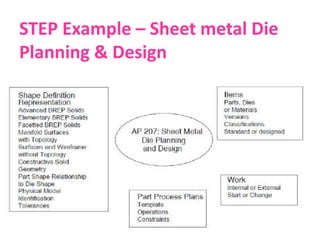
STEP Example – Sheet metal Die
Planning & Design
Drawing Exchange Format (DXF)
• DXF format has been developed and
supported by Autodesk for use with the
AutoCAD drawing files.
• Depending on the software creating the
DXF file, it can either be in an ASCII or a
binary format.
Dimensional Measurement
Interface Specification (DMIS)
• A new standard communication being
established by CAM-I for Manufacturing.
• Used to identify and develop industrial
automation standards.
Communication Standards
• Collaborative Design :
– It is an interactive process of real time
communication between the members of a
design team who are physically in different
locations.
– Exchanging documents between designers on
time.
Concepts of Collaborative Design
• Distributed Computing
• Intranets
• Internet
• Virtual Reality Modelling Language (VRML)
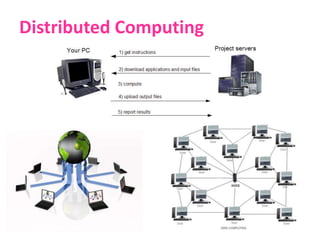
Distributed Computing
Virtual Reality Modelling Language
(VRML)
• VRML is a standard file format for representing 3-
dimensional (3D) interactive vector graphics,
designed particularly with the World Wide Web.
• Using VRML, you can build a sequence of visual
images into Web settings with which a user can
interact by viewing, moving, rotating, and
otherwise interacting with an apparently 3-D
scene.
• To view a VRML file, you need a VRML viewer or
browser, which can be a plug-in for a Web
browser you already have .
Thank You

Cad standards

  • 1.
  • 2.
    Need for GraphicsStandards • The real issue with choosing the standards is portability and device independence. • Complex CAD/CAM systems. • Shape, Non shape, design and Manufacturing data. • Need to integrate and automate design and manufacturing process to obtain maximum benefits from CAD/CAM. • Direct Translators and neutral formats.
  • 3.
    CAD Standards • GraphicsStandards – GKS,PHIGS,NAPLPS,GKS 3D, IGES • Standards for Exchange images – Open GL • Data Exchange Standards – IGES,STEP,DXF,STL,CALS,PDES,VRML,CGM • Communication Standards – LAN,WAN,CGI,VDI,
  • 4.
    Various Interface StandardsExchange Format • GKS ( Graphical Kernel System) • PHIGS (Programmer’s Hierarchical Interface for GraphicS) • GKS -3D • IGES (Initial Graphics Exchange Specification) • DXF (Drawing eXchange Format) • STEP (STandard for the Exchange of Product Model Data) • CALS (Continuous Acquisition and Life cycle Support) • ACIS ( *.sat ) [Alan, Charles, Ian's System] • OpenGL – Open Graphics Laboratory • DMIS (Dimensional Measurement Interface Specification) • VDI (Virtual Device Interface) • CGI (Computer Graphics Interface) • VDM (Virtual Device Metafile) • CGM (Computer Graphics Metafile) • GKSM (GKS Metafile) • PDES (Product Data Exchange Standards) • VRML (Virtual Reality Modelling Language)
  • 5.
    CAD Function • GraphicsOutput Primitives – Line, polygon, sphere, … • Attributes – Color, line width, texture, … • Geometric transformations – Modeling, Viewing • Shading and illumination • Input functions
  • 6.
  • 7.
    Graphical Kernel System(GKS) • The main objectives that were put forward for GKS are : – To provide the complete range of graphical facilities in 2D, including the interactive capabilities. – To control all types of graphical devices such as plotter and display devices in consistent manner. – To be small enough for variety of programs.
  • 8.
  • 9.
    Types of Translators •Direct Translators. – Translating the CAD data directly from one CAD/CAM system to another, in a single step. • Indirect Translators. – Translate the CAD data from one native format to another neutral file which is independent of any existing CAD/CAM system, that all systems can interpret and understand.
  • 10.
    Types of Translators DirectTranslator Neutral File CAD A CAD B CAD C CAD D Indirect Translator
  • 11.
    Initial Graphics Exchange Specification(IGES) • IGES is the most comprehensive standard and is designed to transmit the entire product definition including that of manufacturing and any other associated information. • IGES has three data types. – Geometric (Product Shape, Curve, Surface & Solid) – Annotations (Dimensions , Notes, Labels, GD&T) – Structure (Views, Visuals, Properties , Macros)
  • 12.
  • 13.
    IGES - FileStructure • Optional • ASCII/Binary/Compressed ASCII Flag Section • Man Readable Prologue • Initialize IGES file Start Section • Details of Product • Drafting Standards Used Global Section • Index for File • Color, Line Type etc Directory Section • Geometry, Annotation & StructureParameter Entry Section • Subtotals of Record in every sections Terminate Section
  • 14.
    STandards for theExchange of Product model data (STEP) • The standard method of representing the information necessary to completely define a product throughout its entire life. • i.e from the conceptual figure to the end of the product in useful life. • Standard methods for exchanging the data electronically between two different systems.
  • 15.
    STandards for theExchange of Product model data (STEP)
  • 16.
    STEP Example –Sheet metal Die Planning & Design
  • 17.
    Drawing Exchange Format(DXF) • DXF format has been developed and supported by Autodesk for use with the AutoCAD drawing files. • Depending on the software creating the DXF file, it can either be in an ASCII or a binary format.
  • 18.
    Dimensional Measurement Interface Specification(DMIS) • A new standard communication being established by CAM-I for Manufacturing. • Used to identify and develop industrial automation standards.
  • 19.
    Communication Standards • CollaborativeDesign : – It is an interactive process of real time communication between the members of a design team who are physically in different locations. – Exchanging documents between designers on time.
  • 20.
    Concepts of CollaborativeDesign • Distributed Computing • Intranets • Internet • Virtual Reality Modelling Language (VRML)
  • 21.
  • 22.
    Virtual Reality ModellingLanguage (VRML) • VRML is a standard file format for representing 3- dimensional (3D) interactive vector graphics, designed particularly with the World Wide Web. • Using VRML, you can build a sequence of visual images into Web settings with which a user can interact by viewing, moving, rotating, and otherwise interacting with an apparently 3-D scene. • To view a VRML file, you need a VRML viewer or browser, which can be a plug-in for a Web browser you already have .
  • 23.