

Dr. Nafis Ahmad
Professor
Department of IPE, BUET
Email:nafis@ipe.buet.ac.bd
AEM-6235 Maintenance
and Safety Management
6.
Reliability Centered
Maintenance
3
Topics
▷ Introduction to RCM
▷ RCM Goals
▷ Principles of RCM
▷ Basic RCM Process
▷ RCM Components
▷ Conclusions
4
Reliability Centered Maintenance
5
Reliability centered maintenance (RCM) is a systematic
process used to determine what has to be
accomplished to ensure that any physical facility is able
to continuously meet its designed functions in its
current operating context.
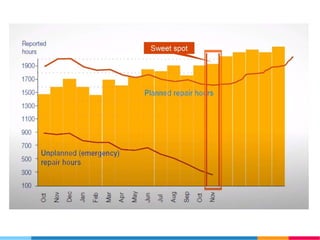
RCM leads to a maintenance program that focuses
preventive maintenance (PM) on specific failure modes
likely to occur. Any organization can benefit from RCM
if its breakdowns account for more than 20 to 25% of
the total maintenance workload.
RCM Goals
6
Some of the important goals of RCM are as follows:
• To develop design-associated priorities that can
facilitate PM.
• To gather information useful for improving the design
of items with proven unsatisfactory, inherent reliability.
• To develop PM-related tasks that can reinstate
reliability and safety to their inherent levels in the
event of equipment or system deterioration.
• To achieve the above goals when the total cost is
minimal.
Principles of RCM Cont…
8
• RCM is system/equipment focused. RCM is concerned more with
maintaining system function as opposed to maintaining
individual component function.
• Safety and economics drive RCM. Safety is of paramount
importance, thus it must be ensured at any cost and then cost
effectiveness becomes the criterion.
• RCM is function-oriented. RCM plays an instrumental role in
preserving system/equipment function, not just operability for its
own sake.
• Design limitations are acknowledged by RCM. The goal of RCM is
to maintain the inherent reliability of the equipment/system design
and at the same time recognize that changes in inherent reliability
can only be made through design rather than maintenance.
Principles of RCM
9
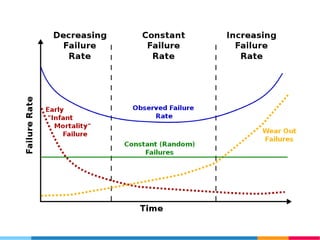
• RCM is reliability-centered. RCM is not overly concerned with
simple failure rate, but it places importance on the relationship
between operating age and failures experienced. RCM treats
failure statistics in an actuarial fashion.
• An unsatisfactory condition is defined as a failure by RCM. A
failure could be either a loss of acceptable quality or a loss of
function.
• RCM is a living system. RCM collects information from the
results achieved and feeds it back to improve design and future
maintenance.
• Three types of maintenance tasks along with run-to-failure are
acknowledged by RCM. These tasks are defined as failure-
finding, time-directed, and condition-directed.
Basic RCM process
11
RCM is a structured method to review systems and
components to determine applicable and effective action and
apply a variety of maintenance strategies to the task.
• Identify important items with respect to maintenance
• Obtain appropriate failure data
• Develop fault tree analysis data
• Apply decision logic to critical failure modes
• Classify maintenance requirements.
• Implement RCM decisions.
• Apply sustaining-engineering on the basis of field
experience.
RCM Components
13
The four major components of RCM are:
1. Reactive maintenance
2. Preventive maintenance
3. Predictive testing and inspection and
4. Proactive maintenance
RCM Components
14
Reactive maintenance:
• This type of maintenance is also known as breakdown, fix-
when-fail, run-to-failure, or repair maintenance.
• When using this maintenance approach, equipment repair,
maintenance, or replacement takes place only when
deterioration in the condition of an item/equipment results in
a functional failure.
• When reactive maintenance is practiced solely, a high
replacement of part inventories, poor use of maintenance
effort, and high percentage of unplanned maintenance
activities are typical.
RCM Components
15
• Reactive maintenance can be practiced effectively only if it
is carried out as a conscious decision, based on the
conclusions of an RCM analysis that compares risk and
cost of failure with the cost of maintenance needed to
mitigate that risk and failure cost.
• Ineffective and inefficient in use of manpower and capital.
• No preventive maintenance.
• Cost is not a focus
• Easy to deploy
• Value destroyer
• Dangerous
RCM Components
16
Preventive maintenance
Preventive maintenance (PM), also called time-driven or interval-
based maintenance, is performed without regard to equipment
condition.
• It consists of periodically scheduled inspection, parts
replacement, repair of components/ items, adjustments,
calibration, lubrication, and cleaning.
• PM schedules regular inspection and maintenance at set
intervals to reduce failures for susceptible equipment.
• Practicing PM can lead to a significant increase in inspections
and routine maintenance. On the other hand, it can help reduce
the frequency and severity of unplanned failures.
• Preventive maintenance can be costly and ineffective if it is
the only type of maintenance practiced.
RCM Components
17
Predictive testing and inspection
• Predictive testing and inspections (PTI) is sometimes
called condition monitoring or predictive maintenance.
• To assess item/equipment condition, it uses
performance data, nonintrusive testing techniques, and
visual inspection.
• PTI replaces arbitrarily timed maintenance tasks with
maintenance that is performed as warranted by the
item/equipment condition.
• Analysis of item/equipment condition-monitoring data
on a continuous basis is useful for planning and
scheduling maintenance/repair in advance of
catastrophic or functional failure.
RCM Components
18
The collected PTI data are used to determine the equipment
condition and to highlight the precursors of failure in several
ways, including
 pattern recognition,
 trend analysis,
 correlation of multiple technologies,
 data comparison,
 statistical process analysis, and
 tests against limits and ranges.
RCM Components
19
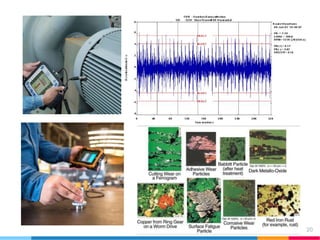
Six PTI technologies/approaches are:
 Vibration monitoring and analysis
 Electrical condition monitoring
 Thermography
 Lubricant and wear particle analysis
 Passive (airborne) ultrasonic
 Nondestructive testing
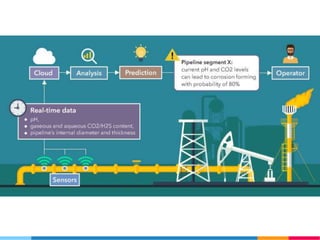
20
RCM Components
21
Proactive maintenance:
• This type of maintenance helps improve maintenance through
actions such as better design, workmanship, installation,
scheduling, and maintenance procedures.
• The characteristics of proactive maintenance include
practicing a continuous process of improvement, using
feedback and communications to ensure that changes in
design/procedures are efficiently made available to item
designers/management, ensuring that nothing affecting
maintenance occurs in total isolation, with the ultimate goal of
correcting the concerned equipment forever, optimizing and
tailoring maintenance methods and technologies to each
application.
RCM Components
22
• Proactive maintenance performs root-cause failure analysis
and predictive analysis to enhance maintenance
effectiveness,
• conducts periodic evaluation of the technical content and
performance interval of maintenance tasks,
• integrates functions with support maintenance into
maintenance program planning, and
• uses a life cycle view of maintenance and supporting
functions.
Selecting RCM Strategies
Conclusions
25
• Definition of RCM, principles and goals of RCM are
discussed.
• The four major components of RCM are: reactive
maintenance, preventive maintenance, predictive testing
and inspection and proactive maintenance.
• RCM strategies are discussed.
Thanks!
Any questions?
You can find me at:
@ahmadn
nafis@ipe.buet.ac.bd
26

Reliability Centered Maintenance

  • 1.
    Dr. Nafis Ahmad Professor Departmentof IPE, BUET Email:nafis@ipe.buet.ac.bd AEM-6235 Maintenance and Safety Management
  • 3.
  • 4.
    Topics ▷ Introduction toRCM ▷ RCM Goals ▷ Principles of RCM ▷ Basic RCM Process ▷ RCM Components ▷ Conclusions 4
  • 5.
    Reliability Centered Maintenance 5 Reliabilitycentered maintenance (RCM) is a systematic process used to determine what has to be accomplished to ensure that any physical facility is able to continuously meet its designed functions in its current operating context. RCM leads to a maintenance program that focuses preventive maintenance (PM) on specific failure modes likely to occur. Any organization can benefit from RCM if its breakdowns account for more than 20 to 25% of the total maintenance workload.
  • 6.
    RCM Goals 6 Some ofthe important goals of RCM are as follows: • To develop design-associated priorities that can facilitate PM. • To gather information useful for improving the design of items with proven unsatisfactory, inherent reliability. • To develop PM-related tasks that can reinstate reliability and safety to their inherent levels in the event of equipment or system deterioration. • To achieve the above goals when the total cost is minimal.
  • 8.
    Principles of RCMCont… 8 • RCM is system/equipment focused. RCM is concerned more with maintaining system function as opposed to maintaining individual component function. • Safety and economics drive RCM. Safety is of paramount importance, thus it must be ensured at any cost and then cost effectiveness becomes the criterion. • RCM is function-oriented. RCM plays an instrumental role in preserving system/equipment function, not just operability for its own sake. • Design limitations are acknowledged by RCM. The goal of RCM is to maintain the inherent reliability of the equipment/system design and at the same time recognize that changes in inherent reliability can only be made through design rather than maintenance.
  • 9.
    Principles of RCM 9 •RCM is reliability-centered. RCM is not overly concerned with simple failure rate, but it places importance on the relationship between operating age and failures experienced. RCM treats failure statistics in an actuarial fashion. • An unsatisfactory condition is defined as a failure by RCM. A failure could be either a loss of acceptable quality or a loss of function. • RCM is a living system. RCM collects information from the results achieved and feeds it back to improve design and future maintenance. • Three types of maintenance tasks along with run-to-failure are acknowledged by RCM. These tasks are defined as failure- finding, time-directed, and condition-directed.
  • 11.
    Basic RCM process 11 RCMis a structured method to review systems and components to determine applicable and effective action and apply a variety of maintenance strategies to the task. • Identify important items with respect to maintenance • Obtain appropriate failure data • Develop fault tree analysis data • Apply decision logic to critical failure modes • Classify maintenance requirements. • Implement RCM decisions. • Apply sustaining-engineering on the basis of field experience.
  • 13.
    RCM Components 13 The fourmajor components of RCM are: 1. Reactive maintenance 2. Preventive maintenance 3. Predictive testing and inspection and 4. Proactive maintenance
  • 14.
    RCM Components 14 Reactive maintenance: •This type of maintenance is also known as breakdown, fix- when-fail, run-to-failure, or repair maintenance. • When using this maintenance approach, equipment repair, maintenance, or replacement takes place only when deterioration in the condition of an item/equipment results in a functional failure. • When reactive maintenance is practiced solely, a high replacement of part inventories, poor use of maintenance effort, and high percentage of unplanned maintenance activities are typical.
  • 15.
    RCM Components 15 • Reactivemaintenance can be practiced effectively only if it is carried out as a conscious decision, based on the conclusions of an RCM analysis that compares risk and cost of failure with the cost of maintenance needed to mitigate that risk and failure cost. • Ineffective and inefficient in use of manpower and capital. • No preventive maintenance. • Cost is not a focus • Easy to deploy • Value destroyer • Dangerous
  • 16.
    RCM Components 16 Preventive maintenance Preventivemaintenance (PM), also called time-driven or interval- based maintenance, is performed without regard to equipment condition. • It consists of periodically scheduled inspection, parts replacement, repair of components/ items, adjustments, calibration, lubrication, and cleaning. • PM schedules regular inspection and maintenance at set intervals to reduce failures for susceptible equipment. • Practicing PM can lead to a significant increase in inspections and routine maintenance. On the other hand, it can help reduce the frequency and severity of unplanned failures. • Preventive maintenance can be costly and ineffective if it is the only type of maintenance practiced.
  • 17.
    RCM Components 17 Predictive testingand inspection • Predictive testing and inspections (PTI) is sometimes called condition monitoring or predictive maintenance. • To assess item/equipment condition, it uses performance data, nonintrusive testing techniques, and visual inspection. • PTI replaces arbitrarily timed maintenance tasks with maintenance that is performed as warranted by the item/equipment condition. • Analysis of item/equipment condition-monitoring data on a continuous basis is useful for planning and scheduling maintenance/repair in advance of catastrophic or functional failure.
  • 18.
    RCM Components 18 The collectedPTI data are used to determine the equipment condition and to highlight the precursors of failure in several ways, including  pattern recognition,  trend analysis,  correlation of multiple technologies,  data comparison,  statistical process analysis, and  tests against limits and ranges.
  • 19.
    RCM Components 19 Six PTItechnologies/approaches are:  Vibration monitoring and analysis  Electrical condition monitoring  Thermography  Lubricant and wear particle analysis  Passive (airborne) ultrasonic  Nondestructive testing
  • 20.
  • 21.
    RCM Components 21 Proactive maintenance: •This type of maintenance helps improve maintenance through actions such as better design, workmanship, installation, scheduling, and maintenance procedures. • The characteristics of proactive maintenance include practicing a continuous process of improvement, using feedback and communications to ensure that changes in design/procedures are efficiently made available to item designers/management, ensuring that nothing affecting maintenance occurs in total isolation, with the ultimate goal of correcting the concerned equipment forever, optimizing and tailoring maintenance methods and technologies to each application.
  • 22.
    RCM Components 22 • Proactivemaintenance performs root-cause failure analysis and predictive analysis to enhance maintenance effectiveness, • conducts periodic evaluation of the technical content and performance interval of maintenance tasks, • integrates functions with support maintenance into maintenance program planning, and • uses a life cycle view of maintenance and supporting functions.
  • 23.
  • 25.
    Conclusions 25 • Definition ofRCM, principles and goals of RCM are discussed. • The four major components of RCM are: reactive maintenance, preventive maintenance, predictive testing and inspection and proactive maintenance. • RCM strategies are discussed.
  • 26.
    Thanks! Any questions? You canfind me at: @ahmadn nafis@ipe.buet.ac.bd 26