Operations Management Short-Term Scheduling Chapter 8 OPM 533 8-
Strategic Implications of  Short-Term Scheduling By scheduling effectively, companies use assets more effectively and create greater capacity per dollar invested, which, in turn,  lowers cost This added capacity and related flexibility provides faster delivery and therefore better  customer service Good scheduling is a competitive advantage which contributes to  dependable delivery OPM 533 8-
Scheduling Issues Scheduling deals with the timing of operations The task is the allocation and prioritization of demand Significant issues are The type of scheduling, forward or backward The criteria for priorities
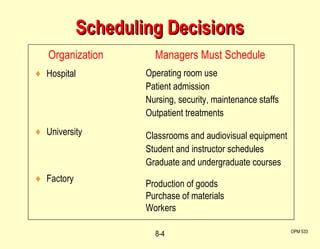
Scheduling Decisions Hospital University Factory OPM 533 8- Organization  Managers Must Schedule Operating room use Patient admission Nursing, security, maintenance staffs Outpatient treatments Classrooms and audiovisual equipment Student and instructor schedules Graduate and undergraduate courses Production of goods Purchase of materials Workers
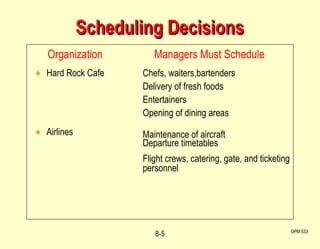
Scheduling Decisions Hard Rock Cafe Airlines OPM 533 8- Organization  Managers Must Schedule Chefs, waiters,bartenders Delivery of fresh foods Entertainers Opening of dining areas Maintenance of aircraft Departure timetables Flight crews, catering, gate, and ticketing personnel
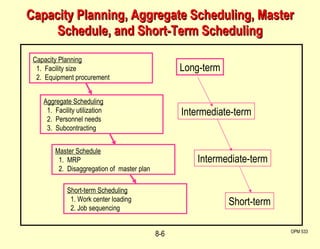
Capacity Planning, Aggregate Scheduling, Master Schedule, and Short-Term Scheduling OPM 533 8- Capacity Planning 1.  Facility size 2.  Equipment procurement Aggregate Scheduling 1.  Facility utilization 2.  Personnel needs 3.  Subcontracting Master Schedule 1.  MRP 2.  Disaggregation of  master plan Long-term Intermediate-term Short-term Intermediate-term Short-term Scheduling 1. Work center loading 2. Job sequencing
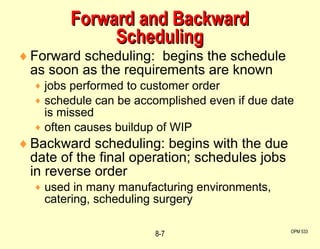
Forward and Backward Scheduling Forward scheduling:  begins the schedule as soon as the requirements are known jobs performed to customer order schedule can be accomplished even if due date is missed often causes buildup of WIP Backward scheduling: begins with the due date of the final operation; schedules jobs in reverse order used in many manufacturing environments, catering, scheduling surgery OPM 533 8-
Scheduling Criteria Minimize completion time Maximize utilization of facilities Minimize work-in-process (WIP) inventory Minimize customer waiting time Objective of scheduling : To optimize the use of resources so that production objectives are met
Qualitative factors Number and variety of jobs Complexity of jobs Nature of operations Quantitative criteria Average completion time Utilization (% of time facility is used) WIP inventory (average # jobs in system) Customer waiting time (average lateness) Choosing a Scheduling Method OPM 533 8-
Requirements for Scheduling Process-Focused Work Centers Schedule incoming orders without violating capacity constraints of individual work centers Check availability of tools and materials before releasing an order to a department Establish due dates for each job & check progress against need dates & order lead times Check work-in-progress as jobs move through the shop Provide feedback on plant & production activities Provide work-efficiency statistics & monitor operator times for payroll & labor distribution analyses OPM 533 8-
Planning and Control Files An item master file contains information about each component A routing file indicates each component’s flow through the shop A work-center master file contains information about the work center Planning Files Control Files Track the actual progress made against the plan
Assigning jobs to work centers Considerations Job priority (e.g., due date) Capacity Work center hours available Hours needed for job Approaches Gantt charts (load & scheduling) - capacity Assignment method - job to specific work center Loading Jobs in Work Centers OPM 533 8-
Input-Output Control Identifies overloading and underloading conditions Prompts managerial action to resolve scheduling problems Can be maintained using ConWIP cards that control the scheduling of batches
Options for Managing Facility Work Flow Correcting performance Increasing capacity Increasing or reducing input to the work center by: routing work to or from other work centers increasing or decreasing subcontracting producing less (or more) OPM 533 8-
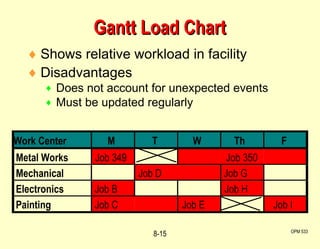
Shows relative workload in facility Disadvantages Does not account for unexpected events Must be updated regularly Gantt Load Chart OPM 533 8- Work Center M T W Th F Metal Works Job 349 Job 350 Mechanical Job D Job G Electronics Job B Job H Painting Job C Job E Job I
Assigns tasks or jobs to resources Type of linear programming model Objective Minimize total cost, time etc. Constraints 1 job per resource (e.g., machine) 1 resource (e.g., machine) per job Assignment Method OPM 533 8-
Specifies order jobs will be worked Sequencing rules First come, first served ( FCFS ) Shortest processing time ( SPT ) Earliest due date ( EDD ) Longest processing time ( LPT ) Critical ratio ( CR ) Johnson’s rule Sequencing OPM 533 8-
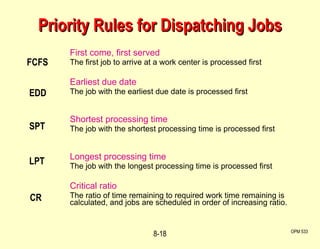
Priority Rules for Dispatching Jobs First come, first served The first job to arrive at a work center is processed first Earliest due date The job with the earliest due date is processed first Shortest processing time The job with the shortest processing time is processed first Longest processing time The job with the longest processing time is processed first Critical ratio The ratio of time remaining to required work time remaining is calculated, and jobs are scheduled in order of increasing ratio. OPM 533 8- FCFS EDD SPT LPT CR
Process first job to arrive at a work center first Average performance on most scheduling criteria Appears ‘fair’ & reasonable to customers Important for service organizations Example: Restaurants First Come, First Served Rule OPM 533 8- Shortest Processing Time Rule Process job with shortest processing time first. Usually best at minimizing job flow and minimizing the number of jobs in the system Major disadvantage is that long jobs may be continuously pushed back in the queue.
Longest Processing Time Rule Process job with longest processing time first. Usually the least effective method of sequencing. OPM 533 8- Earliest Due Date Rule Process job with earliest due date first Widely used by many companies If due dates important If MRP used Due dates updated by each MRP run Performs poorly on many scheduling criteria
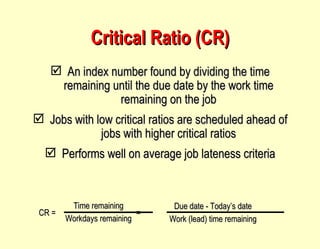
Critical Ratio (CR) An index number found by dividing the time remaining until the due date by the work time remaining on the job Jobs with low critical ratios are scheduled ahead of jobs with higher critical ratios Performs well on average job lateness criteria CR =  = Due date - Today’s date Work (lead) time remaining Time remaining Workdays remaining
Advantages of the Critical Ratio Scheduling Rule Use of the critical ratio can help to: determine the status of a specific job establish a relative priority among jobs on a common basis relate both stock and make-to-order jobs on a  common basis adjust priorities and revise schedules automatically for changes in both demand and job progress dynamically track job progress and location OPM 533 8-
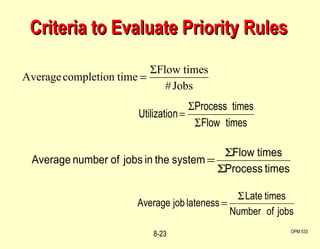
Criteria to Evaluate Priority Rules OPM 533 8-
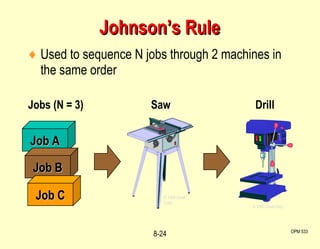
Used to sequence N jobs through 2 machines in the same order Johnson’s Rule OPM 533 8- © 1995 Corel Corp. © 1995 Corel Corp. Saw Drill Job A Job B Job C Jobs (N = 3)
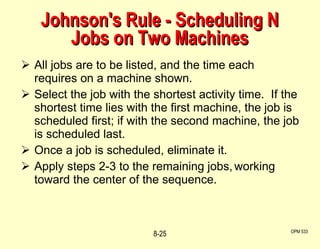
Johnson's Rule - Scheduling N Jobs on Two Machines All jobs are to be listed, and the time each requires on a machine shown. Select the job with the shortest activity time.  If the shortest time lies with the first machine, the job is scheduled first; if with the second machine, the job is scheduled last. Once a job is scheduled, eliminate it. Apply steps 2-3 to the remaining jobs, working toward the center of the sequence. OPM 533 8-
Limitations of Rule-Based Dispatching Systems Scheduling is dynamic; therefore, rules need to be revised to adjust to changes in process, equipment, product mix, etc. Rules do not look upstream or downstream; idle resources and bottleneck resources in other departments may not be recognized Rules do not look beyond due dates OPM 533 8-
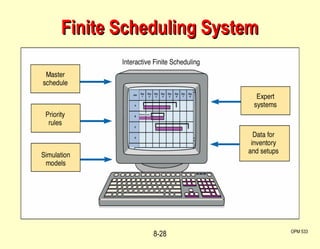
Finite Capacity Scheduling Overcomes disadvantages of rule-based systems by providing an interactive, computer-based graphical system May include rules and expert systems or simulation to allow real-time response to system changes Initial data often from an MRP system FCS allows the balancing of delivery needs and efficiency
Finite Scheduling System OPM 533 8-
Deals with factors limiting company’s ability to achieve goals Types of constraints Physical Example: Machines, raw materials Non-physical Example: Morale, training Limits throughput in operations   Theory of Constraints OPM 533 8-
Theory of Constraints A Five Step Process Identify the constraints Develop a plan for overcoming the identified constraints Focus resources on accomplishing the constraints identified in step 2 Reduce the effects of the constraints by off-loading work or by expanding capability Once one set of constraints is overcome, return to the first step and identify new constraints OPM 533 8-
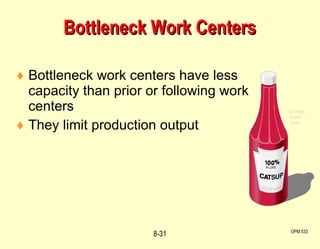
Bottleneck work centers have less capacity than prior or following work centers They limit production output Bottleneck Work Centers OPM 533 8- © 1995 Corel Corp.
Techniques for Dealing With Bottlenecks Increase the capacity of the constraint Ensure well-trained and cross-trained employees are available to operate and maintain the work center causing the constraint Develop alternate routings, processing procedures, or subcontractors Move inspections and tests to a position just before the constraint Schedule throughput to match the capacity of the bottleneck OPM 533 8-
The 10 Commandments for  Correct Scheduling Utilization of a non-bottleneck resource is determined not by its own capacity but by some other constraint in the system Activating a resource is not synonymous with utilizing a resource An hour lost at a bottleneck is an hour lost of the whole system An hour saved at a non-bottleneck is a mirage The transfer batch may not, and many times should not, be equal to the process batch OPM 533 8-
OPM 533 8- The 10 Commandments for  Correct Scheduling The amount processed should be verifiable and not fixed Capacity and priority need to be considered simultaneously, not sequentially Damage from unforeseen problems can be isolated and minimized Plant capacity should not be balanced The sum of the local optimums is not equal to the global optimum
Drum, Buffer, Rope The drum is the beat of the system and provides the schedule or pace of production The buffer is the inventory necessary to keep constraints operating at capacity The rope provides the synchronization necessary to pull units through the system
Scheduling Repetitive Facilities Level material use can help repetitive facilities  Better satisfy customer demand Lower inventory investment Reduce batch size Better utilize equipment and facilities
Repetitive Manufacturing - Advantages of Level Material Use Lower inventory levels, releasing capital for other uses Faster product throughput Improved component quality and hence improved product quality Reduced floor space requirements Improved communication among employees because they are closer together Smoother production process because large lots have not “hidden” the problems OPM 533 8-
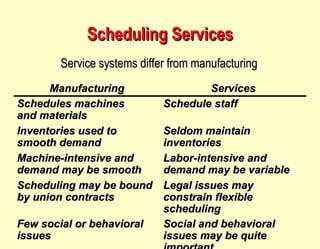
Scheduling Services Service systems differ from manufacturing Manufacturing Services Schedules machines  and materials Schedule staff Inventories used to  smooth demand Seldom maintain inventories Machine-intensive and demand may be smooth Labor-intensive and demand may be variable Scheduling may be bound by union contracts Legal issues may constrain flexible scheduling Few social or behavioral issues Social and behavioral issues may be quite important
Scheduling for Services Appointment systems - doctor’s office Reservations systems - restaurant, car rental First come, first served - deli Most critical first - hospital trauma room OPM 533 8-
Scheduling Service Employees With Cyclical Scheduling Objective is to meet staffing requirements with the minimum number of workers Schedules need to be smooth and keep personnel happy Many techniques exist from simple algorithms to complex linear programming solutions
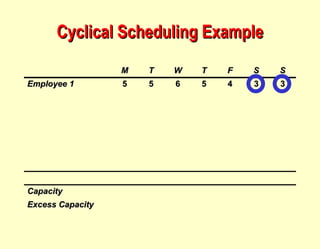
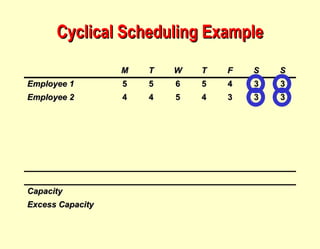
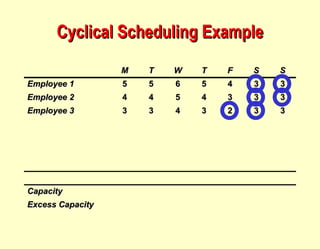
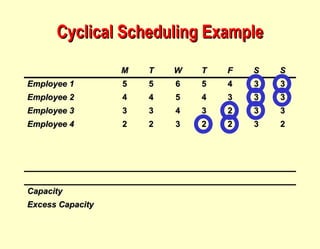
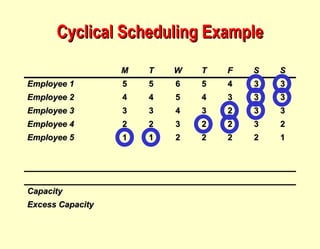
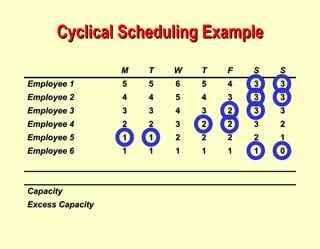
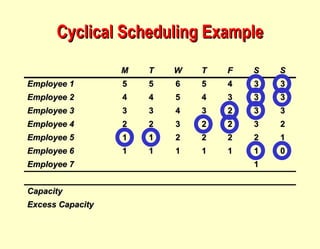
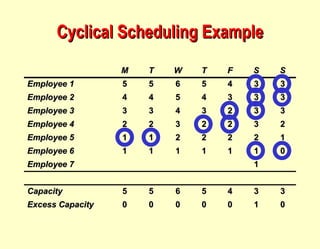
Cyclical Scheduling Example Determine the staffing requirements Identify two consecutive days with the lowest total requirements and assign these as days off Make a new set of requirements subtracting the days worked by the first employee Apply step 2 to the new row  Repeat steps 3 and 4 until all requirements have been met
Cyclical Scheduling Example M T W T F S S Employee 1 5 5 6 5 4 3 3 Capacity Excess Capacity
Cyclical Scheduling Example M T W T F S S Employee 1 5 5 6 5 4 3 3 Employee 2 4 4 5 4 3 3 3 Capacity Excess Capacity
Cyclical Scheduling Example M T W T F S S Employee 1 5 5 6 5 4 3 3 Employee 2 4 4 5 4 3 3 3 Employee 3 3 3 4 3 2 3 3 Capacity Excess Capacity
Cyclical Scheduling Example M T W T F S S Employee 1 5 5 6 5 4 3 3 Employee 2 4 4 5 4 3 3 3 Employee 3 3 3 4 3 2 3 3 Employee 4 2 2 3 2 2 3 2 Capacity Excess Capacity
Cyclical Scheduling Example M T W T F S S Employee 1 5 5 6 5 4 3 3 Employee 2 4 4 5 4 3 3 3 Employee 3 3 3 4 3 2 3 3 Employee 4 2 2 3 2 2 3 2 Employee 5 1 1 2 2 2 2 1 Capacity Excess Capacity
Cyclical Scheduling Example M T W T F S S Employee 1 5 5 6 5 4 3 3 Employee 2 4 4 5 4 3 3 3 Employee 3 3 3 4 3 2 3 3 Employee 4 2 2 3 2 2 3 2 Employee 5 1 1 2 2 2 2 1 Employee 6 1 1 1 1 1 1 0 Capacity Excess Capacity
Cyclical Scheduling Example M T W T F S S Employee 1 5 5 6 5 4 3 3 Employee 2 4 4 5 4 3 3 3 Employee 3 3 3 4 3 2 3 3 Employee 4 2 2 3 2 2 3 2 Employee 5 1 1 2 2 2 2 1 Employee 6 1 1 1 1 1 1 0 Employee 7 1 Capacity Excess Capacity
Cyclical Scheduling Example M T W T F S S Employee 1 5 5 6 5 4 3 3 Employee 2 4 4 5 4 3 3 3 Employee 3 3 3 4 3 2 3 3 Employee 4 2 2 3 2 2 3 2 Employee 5 1 1 2 2 2 2 1 Employee 6 1 1 1 1 1 1 0 Employee 7 1 Capacity 5 5 6 5 4 3 3 Excess Capacity 0 0 0 0 0 1 0

C8 scheduling

  • 1.
    Operations Management Short-TermScheduling Chapter 8 OPM 533 8-
  • 2.
    Strategic Implications of Short-Term Scheduling By scheduling effectively, companies use assets more effectively and create greater capacity per dollar invested, which, in turn, lowers cost This added capacity and related flexibility provides faster delivery and therefore better customer service Good scheduling is a competitive advantage which contributes to dependable delivery OPM 533 8-
  • 3.
    Scheduling Issues Schedulingdeals with the timing of operations The task is the allocation and prioritization of demand Significant issues are The type of scheduling, forward or backward The criteria for priorities
  • 4.
    Scheduling Decisions HospitalUniversity Factory OPM 533 8- Organization Managers Must Schedule Operating room use Patient admission Nursing, security, maintenance staffs Outpatient treatments Classrooms and audiovisual equipment Student and instructor schedules Graduate and undergraduate courses Production of goods Purchase of materials Workers
  • 5.
    Scheduling Decisions HardRock Cafe Airlines OPM 533 8- Organization Managers Must Schedule Chefs, waiters,bartenders Delivery of fresh foods Entertainers Opening of dining areas Maintenance of aircraft Departure timetables Flight crews, catering, gate, and ticketing personnel
  • 6.
    Capacity Planning, AggregateScheduling, Master Schedule, and Short-Term Scheduling OPM 533 8- Capacity Planning 1. Facility size 2. Equipment procurement Aggregate Scheduling 1. Facility utilization 2. Personnel needs 3. Subcontracting Master Schedule 1. MRP 2. Disaggregation of master plan Long-term Intermediate-term Short-term Intermediate-term Short-term Scheduling 1. Work center loading 2. Job sequencing
  • 7.
    Forward and BackwardScheduling Forward scheduling: begins the schedule as soon as the requirements are known jobs performed to customer order schedule can be accomplished even if due date is missed often causes buildup of WIP Backward scheduling: begins with the due date of the final operation; schedules jobs in reverse order used in many manufacturing environments, catering, scheduling surgery OPM 533 8-
  • 8.
    Scheduling Criteria Minimizecompletion time Maximize utilization of facilities Minimize work-in-process (WIP) inventory Minimize customer waiting time Objective of scheduling : To optimize the use of resources so that production objectives are met
  • 9.
    Qualitative factors Numberand variety of jobs Complexity of jobs Nature of operations Quantitative criteria Average completion time Utilization (% of time facility is used) WIP inventory (average # jobs in system) Customer waiting time (average lateness) Choosing a Scheduling Method OPM 533 8-
  • 10.
    Requirements for SchedulingProcess-Focused Work Centers Schedule incoming orders without violating capacity constraints of individual work centers Check availability of tools and materials before releasing an order to a department Establish due dates for each job & check progress against need dates & order lead times Check work-in-progress as jobs move through the shop Provide feedback on plant & production activities Provide work-efficiency statistics & monitor operator times for payroll & labor distribution analyses OPM 533 8-
  • 11.
    Planning and ControlFiles An item master file contains information about each component A routing file indicates each component’s flow through the shop A work-center master file contains information about the work center Planning Files Control Files Track the actual progress made against the plan
  • 12.
    Assigning jobs towork centers Considerations Job priority (e.g., due date) Capacity Work center hours available Hours needed for job Approaches Gantt charts (load & scheduling) - capacity Assignment method - job to specific work center Loading Jobs in Work Centers OPM 533 8-
  • 13.
    Input-Output Control Identifiesoverloading and underloading conditions Prompts managerial action to resolve scheduling problems Can be maintained using ConWIP cards that control the scheduling of batches
  • 14.
    Options for ManagingFacility Work Flow Correcting performance Increasing capacity Increasing or reducing input to the work center by: routing work to or from other work centers increasing or decreasing subcontracting producing less (or more) OPM 533 8-
  • 15.
    Shows relative workloadin facility Disadvantages Does not account for unexpected events Must be updated regularly Gantt Load Chart OPM 533 8- Work Center M T W Th F Metal Works Job 349 Job 350 Mechanical Job D Job G Electronics Job B Job H Painting Job C Job E Job I
  • 16.
    Assigns tasks orjobs to resources Type of linear programming model Objective Minimize total cost, time etc. Constraints 1 job per resource (e.g., machine) 1 resource (e.g., machine) per job Assignment Method OPM 533 8-
  • 17.
    Specifies order jobswill be worked Sequencing rules First come, first served ( FCFS ) Shortest processing time ( SPT ) Earliest due date ( EDD ) Longest processing time ( LPT ) Critical ratio ( CR ) Johnson’s rule Sequencing OPM 533 8-
  • 18.
    Priority Rules forDispatching Jobs First come, first served The first job to arrive at a work center is processed first Earliest due date The job with the earliest due date is processed first Shortest processing time The job with the shortest processing time is processed first Longest processing time The job with the longest processing time is processed first Critical ratio The ratio of time remaining to required work time remaining is calculated, and jobs are scheduled in order of increasing ratio. OPM 533 8- FCFS EDD SPT LPT CR
  • 19.
    Process first jobto arrive at a work center first Average performance on most scheduling criteria Appears ‘fair’ & reasonable to customers Important for service organizations Example: Restaurants First Come, First Served Rule OPM 533 8- Shortest Processing Time Rule Process job with shortest processing time first. Usually best at minimizing job flow and minimizing the number of jobs in the system Major disadvantage is that long jobs may be continuously pushed back in the queue.
  • 20.
    Longest Processing TimeRule Process job with longest processing time first. Usually the least effective method of sequencing. OPM 533 8- Earliest Due Date Rule Process job with earliest due date first Widely used by many companies If due dates important If MRP used Due dates updated by each MRP run Performs poorly on many scheduling criteria
  • 21.
    Critical Ratio (CR)An index number found by dividing the time remaining until the due date by the work time remaining on the job Jobs with low critical ratios are scheduled ahead of jobs with higher critical ratios Performs well on average job lateness criteria CR = = Due date - Today’s date Work (lead) time remaining Time remaining Workdays remaining
  • 22.
    Advantages of theCritical Ratio Scheduling Rule Use of the critical ratio can help to: determine the status of a specific job establish a relative priority among jobs on a common basis relate both stock and make-to-order jobs on a common basis adjust priorities and revise schedules automatically for changes in both demand and job progress dynamically track job progress and location OPM 533 8-
  • 23.
    Criteria to EvaluatePriority Rules OPM 533 8-
  • 24.
    Used to sequenceN jobs through 2 machines in the same order Johnson’s Rule OPM 533 8- © 1995 Corel Corp. © 1995 Corel Corp. Saw Drill Job A Job B Job C Jobs (N = 3)
  • 25.
    Johnson's Rule -Scheduling N Jobs on Two Machines All jobs are to be listed, and the time each requires on a machine shown. Select the job with the shortest activity time. If the shortest time lies with the first machine, the job is scheduled first; if with the second machine, the job is scheduled last. Once a job is scheduled, eliminate it. Apply steps 2-3 to the remaining jobs, working toward the center of the sequence. OPM 533 8-
  • 26.
    Limitations of Rule-BasedDispatching Systems Scheduling is dynamic; therefore, rules need to be revised to adjust to changes in process, equipment, product mix, etc. Rules do not look upstream or downstream; idle resources and bottleneck resources in other departments may not be recognized Rules do not look beyond due dates OPM 533 8-
  • 27.
    Finite Capacity SchedulingOvercomes disadvantages of rule-based systems by providing an interactive, computer-based graphical system May include rules and expert systems or simulation to allow real-time response to system changes Initial data often from an MRP system FCS allows the balancing of delivery needs and efficiency
  • 28.
  • 29.
    Deals with factorslimiting company’s ability to achieve goals Types of constraints Physical Example: Machines, raw materials Non-physical Example: Morale, training Limits throughput in operations Theory of Constraints OPM 533 8-
  • 30.
    Theory of ConstraintsA Five Step Process Identify the constraints Develop a plan for overcoming the identified constraints Focus resources on accomplishing the constraints identified in step 2 Reduce the effects of the constraints by off-loading work or by expanding capability Once one set of constraints is overcome, return to the first step and identify new constraints OPM 533 8-
  • 31.
    Bottleneck work centershave less capacity than prior or following work centers They limit production output Bottleneck Work Centers OPM 533 8- © 1995 Corel Corp.
  • 32.
    Techniques for DealingWith Bottlenecks Increase the capacity of the constraint Ensure well-trained and cross-trained employees are available to operate and maintain the work center causing the constraint Develop alternate routings, processing procedures, or subcontractors Move inspections and tests to a position just before the constraint Schedule throughput to match the capacity of the bottleneck OPM 533 8-
  • 33.
    The 10 Commandmentsfor Correct Scheduling Utilization of a non-bottleneck resource is determined not by its own capacity but by some other constraint in the system Activating a resource is not synonymous with utilizing a resource An hour lost at a bottleneck is an hour lost of the whole system An hour saved at a non-bottleneck is a mirage The transfer batch may not, and many times should not, be equal to the process batch OPM 533 8-
  • 34.
    OPM 533 8-The 10 Commandments for Correct Scheduling The amount processed should be verifiable and not fixed Capacity and priority need to be considered simultaneously, not sequentially Damage from unforeseen problems can be isolated and minimized Plant capacity should not be balanced The sum of the local optimums is not equal to the global optimum
  • 35.
    Drum, Buffer, RopeThe drum is the beat of the system and provides the schedule or pace of production The buffer is the inventory necessary to keep constraints operating at capacity The rope provides the synchronization necessary to pull units through the system
  • 36.
    Scheduling Repetitive FacilitiesLevel material use can help repetitive facilities Better satisfy customer demand Lower inventory investment Reduce batch size Better utilize equipment and facilities
  • 37.
    Repetitive Manufacturing -Advantages of Level Material Use Lower inventory levels, releasing capital for other uses Faster product throughput Improved component quality and hence improved product quality Reduced floor space requirements Improved communication among employees because they are closer together Smoother production process because large lots have not “hidden” the problems OPM 533 8-
  • 38.
    Scheduling Services Servicesystems differ from manufacturing Manufacturing Services Schedules machines and materials Schedule staff Inventories used to smooth demand Seldom maintain inventories Machine-intensive and demand may be smooth Labor-intensive and demand may be variable Scheduling may be bound by union contracts Legal issues may constrain flexible scheduling Few social or behavioral issues Social and behavioral issues may be quite important
  • 39.
    Scheduling for ServicesAppointment systems - doctor’s office Reservations systems - restaurant, car rental First come, first served - deli Most critical first - hospital trauma room OPM 533 8-
  • 40.
    Scheduling Service EmployeesWith Cyclical Scheduling Objective is to meet staffing requirements with the minimum number of workers Schedules need to be smooth and keep personnel happy Many techniques exist from simple algorithms to complex linear programming solutions
  • 41.
    Cyclical Scheduling ExampleDetermine the staffing requirements Identify two consecutive days with the lowest total requirements and assign these as days off Make a new set of requirements subtracting the days worked by the first employee Apply step 2 to the new row Repeat steps 3 and 4 until all requirements have been met
  • 42.
    Cyclical Scheduling ExampleM T W T F S S Employee 1 5 5 6 5 4 3 3 Capacity Excess Capacity
  • 43.
    Cyclical Scheduling ExampleM T W T F S S Employee 1 5 5 6 5 4 3 3 Employee 2 4 4 5 4 3 3 3 Capacity Excess Capacity
  • 44.
    Cyclical Scheduling ExampleM T W T F S S Employee 1 5 5 6 5 4 3 3 Employee 2 4 4 5 4 3 3 3 Employee 3 3 3 4 3 2 3 3 Capacity Excess Capacity
  • 45.
    Cyclical Scheduling ExampleM T W T F S S Employee 1 5 5 6 5 4 3 3 Employee 2 4 4 5 4 3 3 3 Employee 3 3 3 4 3 2 3 3 Employee 4 2 2 3 2 2 3 2 Capacity Excess Capacity
  • 46.
    Cyclical Scheduling ExampleM T W T F S S Employee 1 5 5 6 5 4 3 3 Employee 2 4 4 5 4 3 3 3 Employee 3 3 3 4 3 2 3 3 Employee 4 2 2 3 2 2 3 2 Employee 5 1 1 2 2 2 2 1 Capacity Excess Capacity
  • 47.
    Cyclical Scheduling ExampleM T W T F S S Employee 1 5 5 6 5 4 3 3 Employee 2 4 4 5 4 3 3 3 Employee 3 3 3 4 3 2 3 3 Employee 4 2 2 3 2 2 3 2 Employee 5 1 1 2 2 2 2 1 Employee 6 1 1 1 1 1 1 0 Capacity Excess Capacity
  • 48.
    Cyclical Scheduling ExampleM T W T F S S Employee 1 5 5 6 5 4 3 3 Employee 2 4 4 5 4 3 3 3 Employee 3 3 3 4 3 2 3 3 Employee 4 2 2 3 2 2 3 2 Employee 5 1 1 2 2 2 2 1 Employee 6 1 1 1 1 1 1 0 Employee 7 1 Capacity Excess Capacity
  • 49.
    Cyclical Scheduling ExampleM T W T F S S Employee 1 5 5 6 5 4 3 3 Employee 2 4 4 5 4 3 3 3 Employee 3 3 3 4 3 2 3 3 Employee 4 2 2 3 2 2 3 2 Employee 5 1 1 2 2 2 2 1 Employee 6 1 1 1 1 1 1 0 Employee 7 1 Capacity 5 5 6 5 4 3 3 Excess Capacity 0 0 0 0 0 1 0

Editor's Notes