Assembly-Line Balancing:
      A Valuable Tool for
    Increasing Efficiency
                      By :
    Joseph George Konnully
Coverage
1.  What is assembly-line balancing?
2.  History – 1st time introduces.
3.  How can assembly-line balancing be used in
    organization?
4. Unbalance Line and Its effect.
5. Balanced Line and its effect.
6. What are the steps in balancing an assembly line?
7. Example of assembly-line balancing.
8. Assembly-Line Balancing in the real world.
9. Assembly-Line Balancing by Digital
    Manufacturing.
10. Summary.
11. Suggested reading list.
                      rcsaini.blogspot.com             2
What is assembly-line balancing?

 Assigning each task to a workstation within an
  assembly line in order to meet the required
  production rate and to achieve a minimum amount
  of idle time.

 Line balancing is the procedure in which tasks along
  the assembly line are assigned to work station so
  each has approximately same amount of work.


                       rcsaini.blogspot.com          3
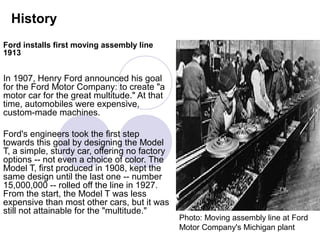
History
Ford installs first moving assembly line
1913


In 1907, Henry Ford announced his goal
for the Ford Motor Company: to create "a
motor car for the great multitude." At that
time, automobiles were expensive,
custom-made machines.

Ford's engineers took the first step
towards this goal by designing the Model
T, a simple, sturdy car, offering no factory
options -- not even a choice of color. The
Model T, first produced in 1908, kept the
same design until the last one -- number
15,000,000 -- rolled off the line in 1927.
From the start, the Model T was less
expensive than most other cars, but it was
still not attainable for the "multitude."
                                               Photo: Moving assembly line at Ford
                                               Motor Company's Michigan plant
How Can Assembly-Line Balancing Help
Organization?
 Increased efficiency

 Increased productivity


 Potential increase in profits and decrease in costs


                         rcsaini.blogspot.com           5
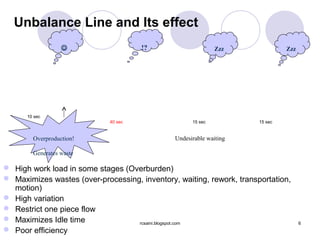
Unbalance Line and Its effect
                                     !?                      Zzz               Zzz


      10 sec
                             40 sec                  15 sec            15 sec


        Overproduction!                        Undesirable waiting

        Generates waste

 High work load in some stages (Overburden)
 Maximizes wastes (over-processing, inventory, waiting, rework, transportation,
  motion)
 High variation
 Restrict one piece flow
 Maximizes Idle time              rcsaini.blogspot.com                               6
 Poor efficiency
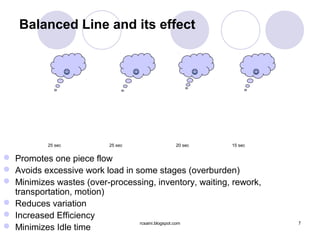
Balanced Line and its effect


                                                              


           25 sec         25 sec          20 sec        15 sec


 Promotes one piece flow
 Avoids excessive work load in some stages (overburden)
 Minimizes wastes (over-processing, inventory, waiting, rework,
  transportation, motion)
 Reduces variation
 Increased Efficiency
                                 rcsaini.blogspot.com                7
 Minimizes Idle time
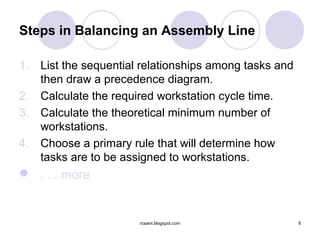
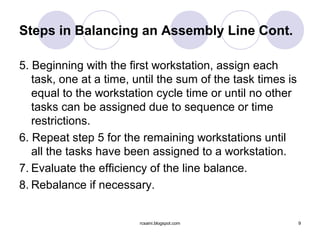
Steps in Balancing an Assembly Line

1.   List the sequential relationships among tasks and
     then draw a precedence diagram.
2.   Calculate the required workstation cycle time.
3.   Calculate the theoretical minimum number of
     workstations.
4.   Choose a primary rule that will determine how
     tasks are to be assigned to workstations.
 . . . more


                        rcsaini.blogspot.com             8
Steps in Balancing an Assembly Line Cont.

5. Beginning with the first workstation, assign each
   task, one at a time, until the sum of the task times is
   equal to the workstation cycle time or until no other
   tasks can be assigned due to sequence or time
   restrictions.
6. Repeat step 5 for the remaining workstations until
   all the tasks have been assigned to a workstation.
7. Evaluate the efficiency of the line balance.
8. Rebalance if necessary.


                         rcsaini.blogspot.com                9
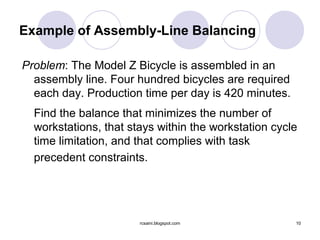
Example of Assembly-Line Balancing

Problem: The Model Z Bicycle is assembled in an
  assembly line. Four hundred bicycles are required
  each day. Production time per day is 420 minutes.
  Find the balance that minimizes the number of
  workstations, that stays within the workstation cycle
  time limitation, and that complies with task
  precedent constraints.


                       rcsaini.blogspot.com           10
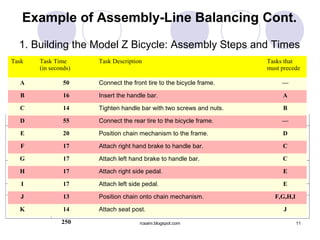
Example of Assembly-Line Balancing Cont.
  1. Building the Model Z Bicycle: Assembly Steps and Times
Task   Task Time      Task Description                               Tasks that
       (in seconds)                                                  must precede

  A             50    Connect the front tire to the bicycle frame.        —

   B            16    Insert the handle bar.                              A

  C             14    Tighten handle bar with two screws and nuts.        B

  D             55    Connect the rear tire to the bicycle frame.         —

   E            20    Position chain mechanism to the frame.              D

   F            17    Attach right hand brake to handle bar.              C

  G             17    Attach left hand brake to handle bar.               C

  H             17    Attach right side pedal.                            E

   I            17    Attach left side pedal.                             E

   J            13    Position chain onto chain mechanism.             F,G,H,I

  K             14    Attach seat post.                                    J

               250                   rcsaini.blogspot.com                        11
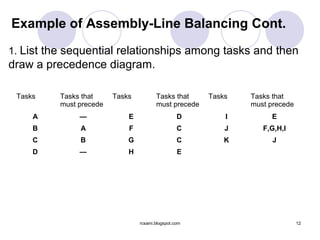
Example of Assembly-Line Balancing Cont.
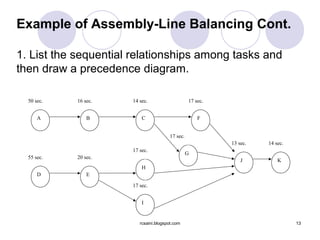
1. List the sequential relationships among tasks and then
draw a precedence diagram.

 Tasks    Tasks that     Tasks           Tasks that     Tasks   Tasks that
          must precede                   must precede           must precede
     A         —             E                     D        I        E
     B         A             F                     C        J      F,G,H,I
     C         B             G                     C        K         J
     D         —             H                     E


                                 rcsaini.blogspot.com                          12
Example of Assembly-Line Balancing Cont.

1. List the sequential relationships among tasks and
then draw a precedence diagram.

  50 sec.   16 sec.   14 sec.                    17 sec.


      A         B         C                          F


                                       17 sec.
                                                           13 sec.   14 sec.
                      17 sec.
                                                 G
  55 sec.   20 sec.
                                                               J         K
                          H
      D         E

                      17 sec.


                          I


                         rcsaini.blogspot.com                                  13
Example of Assembly-Line Balancing Cont.
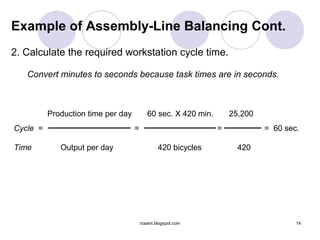
2. Calculate the required workstation cycle time.

   Convert minutes to seconds because task times are in seconds.


          Production time per day          60 sec. X 420 min.       25,200
Cycle =                             =                           =            = 60 sec.

Time         Output per day                     420 bicycles          420


                                        rcsaini.blogspot.com                         14
Example of Assembly-Line Balancing Cont.

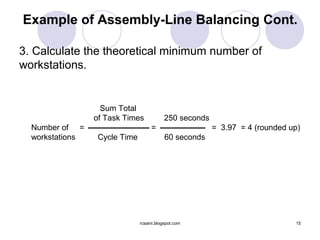
3. Calculate the theoretical minimum number of
workstations.


                   Sum Total
                 of Task Times             250 seconds
  Number of =                       =                    = 3.97 = 4 (rounded up)
  workstations    Cycle Time               60 seconds


                               rcsaini.blogspot.com                           15
Example of Assembly-Line Balancing Cont.

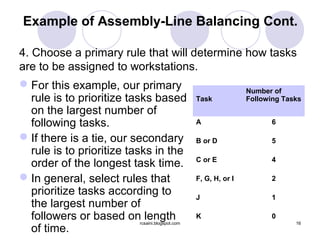
4. Choose a primary rule that will determine how tasks
are to be assigned to workstations.
 For this example, our primary                                 Number of
  rule is to prioritize tasks based             Task            Following Tasks
  on the largest number of
  following tasks.                              A                      6

 If there is a tie, our secondary              B or D                 5
  rule is to prioritize tasks in the
                                                C or E                 4
  order of the longest task time.
 In general, select rules that                 F, G, H, or I          2
  prioritize tasks according to                 J                      1
  the largest number of
  followers or based on length
                         rcsaini.blogspot.com
                                                K                      0
                                                                             16
  of time.
Example of Assembly-Line Balancing Cont.


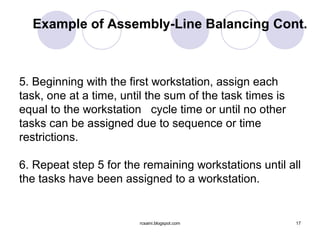
5. Beginning with the first workstation, assign each
task, one at a time, until the sum of the task times is
equal to the workstation cycle time or until no other
tasks can be assigned due to sequence or time
restrictions.

6. Repeat step 5 for the remaining workstations until all
the tasks have been assigned to a workstation.


                        rcsaini.blogspot.com              17
Example of Assembly-Line Balancing Cont.
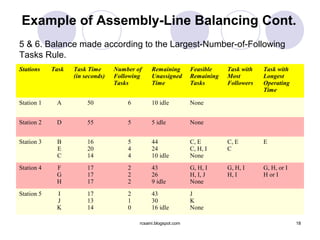
5 & 6. Balance made according to the Largest-Number-of-Following
Tasks Rule.
Stations    Task   Task Time      Number of    Remaining         Feasible    Task with   Task with
                   (in seconds)   Following    Unassigned        Remaining   Most        Longest
                                  Tasks        Time              Tasks       Followers   Operating
                                                                                         Time

Station 1    A          50            6        10 idle           None


Station 2    D          55            5        5 idle            None


Station 3    B          16            5        44                C, E        C, E        E
             E          20            4        24                C, H, I     C
             C          14            4        10 idle           None
Station 4    F          17            2        43                G, H, I     G, H, I     G, H, or I
             G          17            2        26                H, I, J     H, I        H or I
             H          17            2        9 idle            None
Station 5    I          17            2        43                J
             J          13            1        30                K
             K          14            0        16 idle           None

                                          rcsaini.blogspot.com                                        18
Example of Assembly-Line Balancing Cont.
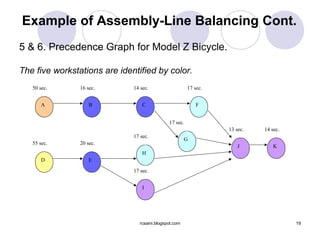
5 & 6. Precedence Graph for Model Z Bicycle.

The five workstations are identified by color.
   50 sec.      16 sec.       14 sec.                   17 sec.


       A            B             C                         F


                                              17 sec.
                                                                  13 sec.   14 sec.
                              17 sec.
                                                       G
   55 sec.      20 sec.
                                                                      J         K
                                  H
       D            E

                              17 sec.


                                  I


                                rcsaini.blogspot.com                                  19
Example of Assembly-Line Balancing Cont.


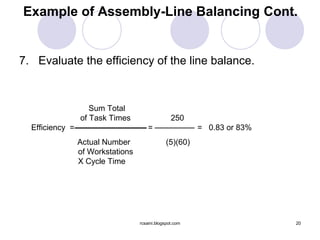
7. Evaluate the efficiency of the line balance.


                    Sum Total
                 of Task Times                    250
  Efficiency =                         =                  = 0.83 or 83%
                 Actual Number                 (5)(60)
                 of Workstations
                 X Cycle Time


                                   rcsaini.blogspot.com                   20
Assembly-Line Balancing in the real world

The simple ALB problem approach is limited by some
  constraints:
 Balance on existing and operating lines.
    Workstations have spatial constraints.
    Some workstations cannot be eliminated.
    Need to smooth workload among workstations.
 Multiple operators per workstation.
    Different paces among operators, different lead times within the
     same workstation.


                             rcsaini.blogspot.com                       21
Assembly-Line Balancing in the real
world(cont.)
 Operator spatial constraints.
    Different workstation imposed working positions.
    More than one task to be performed in what should be the space
     for one task.
 Multiple Products.
    Coping with different products, some operations are needed for
     some products but not for others.
    Some products can introduce “peak times” in some workstations.
 Different task times performed in different shifts.
    Particularly when introducing new employees or workers with
     some degree of incapacity.


                            rcsaini.blogspot.com                   22
Assembly-Line Balancing by Digital
Manufacturing
 Build AL in virtual environment.
 Put Input data e.g. No.Assembly part, Task at each
  station and estimated time, Human ergonomics etc.
 Run the Virtual AL and find outcome.
 Make changes in AL in virtual world and find best
  ALB outcome.
 Build in real world.


                      rcsaini.blogspot.com         23
Assembly-Line Balancing by Digital
Manufacturing Cont.
Advantages

 Time Saving.
 Money Saving (Time Is Money, make changes in
  virtual world).
 Simplifies complex assembly line balancing
  problems.
 Faster, easier, and more accurate than calculating
  by hand.

                       rcsaini.blogspot.com            24
Summary

1.   Assembly-Line Balancing consists of assigning each task to
     a workstation to meet the required production rate and to
     achieve a minimum amount of idle time.
2.   Benefits of line balancing includes increased efficiency and
     increased productivity.
3.   Balance assembly line by determining sequential task
     relationships, the required workstation cycle time, the
     theoretical minimum number of workstations, workstation
     assignments, and assembly line efficiency.
4.   Digital Manufacturing Simplifies complex assembly line
     balancing problems with faster, easier, and more accurate
     than calculating by hand and its save time & money.

                            rcsaini.blogspot.com                25
Thank you


   rcsaini.blogspot.com   26

79971255 assembly-line-balancing

  • 1.
    Assembly-Line Balancing: A Valuable Tool for Increasing Efficiency By : Joseph George Konnully
  • 2.
    Coverage 1. Whatis assembly-line balancing? 2. History – 1st time introduces. 3. How can assembly-line balancing be used in organization? 4. Unbalance Line and Its effect. 5. Balanced Line and its effect. 6. What are the steps in balancing an assembly line? 7. Example of assembly-line balancing. 8. Assembly-Line Balancing in the real world. 9. Assembly-Line Balancing by Digital Manufacturing. 10. Summary. 11. Suggested reading list. rcsaini.blogspot.com 2
  • 3.
    What is assembly-linebalancing?  Assigning each task to a workstation within an assembly line in order to meet the required production rate and to achieve a minimum amount of idle time.  Line balancing is the procedure in which tasks along the assembly line are assigned to work station so each has approximately same amount of work. rcsaini.blogspot.com 3
  • 4.
    History Ford installs firstmoving assembly line 1913 In 1907, Henry Ford announced his goal for the Ford Motor Company: to create "a motor car for the great multitude." At that time, automobiles were expensive, custom-made machines. Ford's engineers took the first step towards this goal by designing the Model T, a simple, sturdy car, offering no factory options -- not even a choice of color. The Model T, first produced in 1908, kept the same design until the last one -- number 15,000,000 -- rolled off the line in 1927. From the start, the Model T was less expensive than most other cars, but it was still not attainable for the "multitude." Photo: Moving assembly line at Ford Motor Company's Michigan plant
  • 5.
    How Can Assembly-LineBalancing Help Organization?  Increased efficiency  Increased productivity  Potential increase in profits and decrease in costs rcsaini.blogspot.com 5
  • 6.
    Unbalance Line andIts effect  !? Zzz Zzz 10 sec 40 sec 15 sec 15 sec Overproduction! Undesirable waiting Generates waste  High work load in some stages (Overburden)  Maximizes wastes (over-processing, inventory, waiting, rework, transportation, motion)  High variation  Restrict one piece flow  Maximizes Idle time rcsaini.blogspot.com 6  Poor efficiency
  • 7.
    Balanced Line andits effect     25 sec 25 sec 20 sec 15 sec  Promotes one piece flow  Avoids excessive work load in some stages (overburden)  Minimizes wastes (over-processing, inventory, waiting, rework, transportation, motion)  Reduces variation  Increased Efficiency rcsaini.blogspot.com 7  Minimizes Idle time
  • 8.
    Steps in Balancingan Assembly Line 1. List the sequential relationships among tasks and then draw a precedence diagram. 2. Calculate the required workstation cycle time. 3. Calculate the theoretical minimum number of workstations. 4. Choose a primary rule that will determine how tasks are to be assigned to workstations.  . . . more rcsaini.blogspot.com 8
  • 9.
    Steps in Balancingan Assembly Line Cont. 5. Beginning with the first workstation, assign each task, one at a time, until the sum of the task times is equal to the workstation cycle time or until no other tasks can be assigned due to sequence or time restrictions. 6. Repeat step 5 for the remaining workstations until all the tasks have been assigned to a workstation. 7. Evaluate the efficiency of the line balance. 8. Rebalance if necessary. rcsaini.blogspot.com 9
  • 10.
    Example of Assembly-LineBalancing Problem: The Model Z Bicycle is assembled in an assembly line. Four hundred bicycles are required each day. Production time per day is 420 minutes. Find the balance that minimizes the number of workstations, that stays within the workstation cycle time limitation, and that complies with task precedent constraints. rcsaini.blogspot.com 10
  • 11.
    Example of Assembly-LineBalancing Cont. 1. Building the Model Z Bicycle: Assembly Steps and Times Task Task Time Task Description Tasks that (in seconds) must precede A 50 Connect the front tire to the bicycle frame. — B 16 Insert the handle bar. A C 14 Tighten handle bar with two screws and nuts. B D 55 Connect the rear tire to the bicycle frame. — E 20 Position chain mechanism to the frame. D F 17 Attach right hand brake to handle bar. C G 17 Attach left hand brake to handle bar. C H 17 Attach right side pedal. E I 17 Attach left side pedal. E J 13 Position chain onto chain mechanism. F,G,H,I K 14 Attach seat post. J 250 rcsaini.blogspot.com 11
  • 12.
    Example of Assembly-LineBalancing Cont. 1. List the sequential relationships among tasks and then draw a precedence diagram. Tasks Tasks that Tasks Tasks that Tasks Tasks that must precede must precede must precede A — E D I E B A F C J F,G,H,I C B G C K J D — H E rcsaini.blogspot.com 12
  • 13.
    Example of Assembly-LineBalancing Cont. 1. List the sequential relationships among tasks and then draw a precedence diagram. 50 sec. 16 sec. 14 sec. 17 sec. A B C F 17 sec. 13 sec. 14 sec. 17 sec. G 55 sec. 20 sec. J K H D E 17 sec. I rcsaini.blogspot.com 13
  • 14.
    Example of Assembly-LineBalancing Cont. 2. Calculate the required workstation cycle time. Convert minutes to seconds because task times are in seconds. Production time per day 60 sec. X 420 min. 25,200 Cycle = = = = 60 sec. Time Output per day 420 bicycles 420 rcsaini.blogspot.com 14
  • 15.
    Example of Assembly-LineBalancing Cont. 3. Calculate the theoretical minimum number of workstations. Sum Total of Task Times 250 seconds Number of = = = 3.97 = 4 (rounded up) workstations Cycle Time 60 seconds rcsaini.blogspot.com 15
  • 16.
    Example of Assembly-LineBalancing Cont. 4. Choose a primary rule that will determine how tasks are to be assigned to workstations.  For this example, our primary Number of rule is to prioritize tasks based Task Following Tasks on the largest number of following tasks. A 6  If there is a tie, our secondary B or D 5 rule is to prioritize tasks in the C or E 4 order of the longest task time.  In general, select rules that F, G, H, or I 2 prioritize tasks according to J 1 the largest number of followers or based on length rcsaini.blogspot.com K 0 16 of time.
  • 17.
    Example of Assembly-LineBalancing Cont. 5. Beginning with the first workstation, assign each task, one at a time, until the sum of the task times is equal to the workstation cycle time or until no other tasks can be assigned due to sequence or time restrictions. 6. Repeat step 5 for the remaining workstations until all the tasks have been assigned to a workstation. rcsaini.blogspot.com 17
  • 18.
    Example of Assembly-LineBalancing Cont. 5 & 6. Balance made according to the Largest-Number-of-Following Tasks Rule. Stations Task Task Time Number of Remaining Feasible Task with Task with (in seconds) Following Unassigned Remaining Most Longest Tasks Time Tasks Followers Operating Time Station 1 A 50 6 10 idle None Station 2 D 55 5 5 idle None Station 3 B 16 5 44 C, E C, E E E 20 4 24 C, H, I C C 14 4 10 idle None Station 4 F 17 2 43 G, H, I G, H, I G, H, or I G 17 2 26 H, I, J H, I H or I H 17 2 9 idle None Station 5 I 17 2 43 J J 13 1 30 K K 14 0 16 idle None rcsaini.blogspot.com 18
  • 19.
    Example of Assembly-LineBalancing Cont. 5 & 6. Precedence Graph for Model Z Bicycle. The five workstations are identified by color. 50 sec. 16 sec. 14 sec. 17 sec. A B C F 17 sec. 13 sec. 14 sec. 17 sec. G 55 sec. 20 sec. J K H D E 17 sec. I rcsaini.blogspot.com 19
  • 20.
    Example of Assembly-LineBalancing Cont. 7. Evaluate the efficiency of the line balance. Sum Total of Task Times 250 Efficiency = = = 0.83 or 83% Actual Number (5)(60) of Workstations X Cycle Time rcsaini.blogspot.com 20
  • 21.
    Assembly-Line Balancing inthe real world The simple ALB problem approach is limited by some constraints:  Balance on existing and operating lines.  Workstations have spatial constraints.  Some workstations cannot be eliminated.  Need to smooth workload among workstations.  Multiple operators per workstation.  Different paces among operators, different lead times within the same workstation. rcsaini.blogspot.com 21
  • 22.
    Assembly-Line Balancing inthe real world(cont.)  Operator spatial constraints.  Different workstation imposed working positions.  More than one task to be performed in what should be the space for one task.  Multiple Products.  Coping with different products, some operations are needed for some products but not for others.  Some products can introduce “peak times” in some workstations.  Different task times performed in different shifts.  Particularly when introducing new employees or workers with some degree of incapacity. rcsaini.blogspot.com 22
  • 23.
    Assembly-Line Balancing byDigital Manufacturing  Build AL in virtual environment.  Put Input data e.g. No.Assembly part, Task at each station and estimated time, Human ergonomics etc.  Run the Virtual AL and find outcome.  Make changes in AL in virtual world and find best ALB outcome.  Build in real world. rcsaini.blogspot.com 23
  • 24.
    Assembly-Line Balancing byDigital Manufacturing Cont. Advantages  Time Saving.  Money Saving (Time Is Money, make changes in virtual world).  Simplifies complex assembly line balancing problems.  Faster, easier, and more accurate than calculating by hand. rcsaini.blogspot.com 24
  • 25.
    Summary 1. Assembly-Line Balancing consists of assigning each task to a workstation to meet the required production rate and to achieve a minimum amount of idle time. 2. Benefits of line balancing includes increased efficiency and increased productivity. 3. Balance assembly line by determining sequential task relationships, the required workstation cycle time, the theoretical minimum number of workstations, workstation assignments, and assembly line efficiency. 4. Digital Manufacturing Simplifies complex assembly line balancing problems with faster, easier, and more accurate than calculating by hand and its save time & money. rcsaini.blogspot.com 25
  • 26.
    Thank you rcsaini.blogspot.com 26

Editor's Notes

  • #2 rcsaini.blogspot.com
  • #3 rcsaini.blogspot.com
  • #9 rcsaini.blogspot.com
  • #10 rcsaini.blogspot.com
  • #11 rcsaini.blogspot.com
  • #12 rcsaini.blogspot.com 16
  • #13 rcsaini.blogspot.com 17