Production  and Operations Management: Manufacturing and  Services PowerPoint Presentation for Chapter 17 Operations Scheduling Chase Aquilano Jacobs Eighth Edition
Work Center Area in a business in which productive resources are organized and work is completed. May be a single machine, a group of machines, or an area where a particular type of work is done.  Job shop (by function) Flow (product) Assembly line GT cell  3
Typical Scheduling and Control Functions Allocating orders, equipment, and personnel  Determining the sequence of order performance  Initiating performance of the scheduled work Shop-floor control 5
Work-Center Scheduling Objectives Meet due dates Minimize lead time Minimize setup time or cost Minimize work-in-process inventory Maximize machine utilization  6
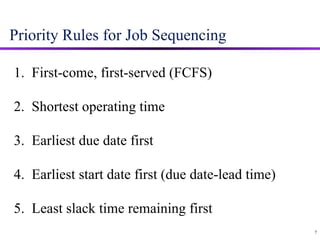
Priority Rules for Job Sequencing 1.  First-come, first-served (FCFS) 2.  Shortest operating time 3.  Earliest due date first 4.  Earliest start date first (due date-lead time) 5.  Least slack time remaining first  7
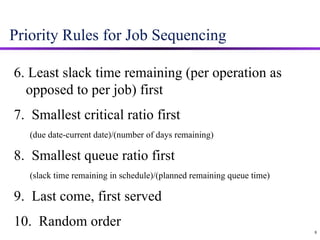
Priority Rules for Job Sequencing 6. Least slack time remaining (per operation as opposed to per job) first 7.  Smallest critical ratio first (due date-current date)/(number of days remaining) 8.  Smallest queue ratio first (slack time remaining in schedule)/(planned remaining queue time) 9.  Last come, first served 10.  Random order  8
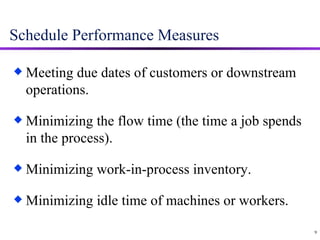
Schedule Performance Measures Meeting due dates of customers or downstream operations. Minimizing the flow time (the time a job spends in the process). Minimizing work-in-process inventory. Minimizing idle time of machines or workers. 9
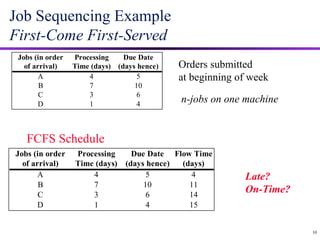
Job Sequencing Example First-Come First-Served 10 FCFS Schedule Late? On-Time? Orders submitted at beginning of week n-jobs on one machine
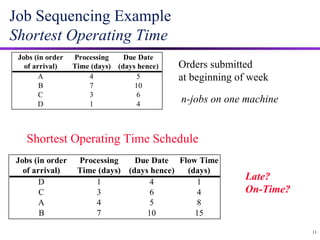
Job Sequencing Example Shortest Operating Time 11 Orders submitted at beginning of week n-jobs on one machine Shortest Operating Time Schedule Late? On-Time?
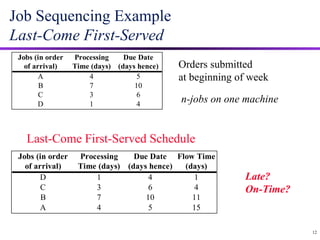
Job Sequencing Example Last-Come First-Served 12 Orders submitted at beginning of week n-jobs on one machine Last-Come First-Served Schedule Late? On-Time?
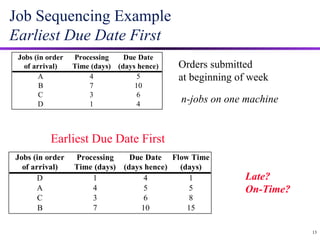
Job Sequencing Example Earliest Due Date First 13 Orders submitted at beginning of week n-jobs on one machine Earliest Due Date First Late? On-Time?
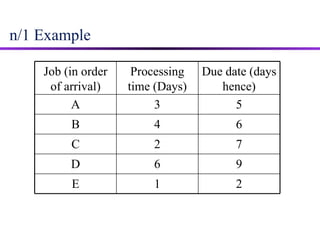
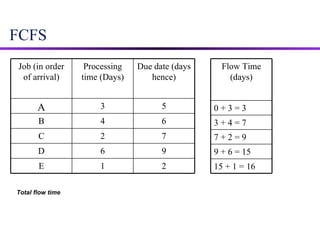
n/1 Example 2 1 E 9 6 D 7 2 C 6 4 B 5 3 A Due date (days hence) Processing time (Days) Job (in order of arrival)
FCFS Total flow time  2 1 E 9 6 D 7 2 C 6 4 B 5 3 A Due date (days hence) Processing time (Days) Job (in order of arrival) 15 + 1 = 16 9 + 6 = 15 7 + 2 = 9 3 + 4 = 7 0 + 3 = 3 Flow Time (days)
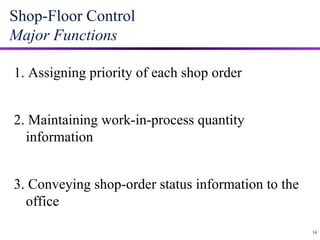
Shop-Floor Control Major Functions 1. Assigning priority of each shop order 2. Maintaining work-in-process quantity information 3. Conveying shop-order status information to the office  14
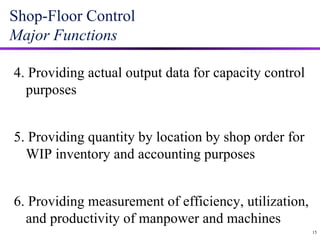
Shop-Floor Control Major Functions 4. Providing actual output data for capacity control purposes 5. Providing quantity by location by shop order for WIP inventory and accounting purposes 6. Providing measurement of efficiency, utilization, and productivity of manpower and machines  15
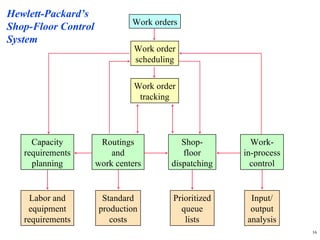
Capacity requirements planning Routings and work centers Shop- floor dispatching Work- in-process control Input/ output analysis Prioritized queue lists Standard production costs Labor and equipment requirements Work orders Work order scheduling Work order tracking Hewlett-Packard’s Shop-Floor Control System 16
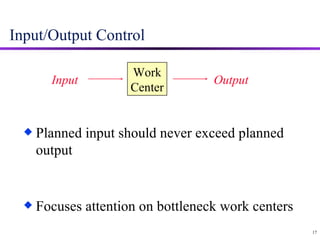
Input/Output Control Planned input should never exceed planned output Focuses attention on bottleneck work centers  17 Work Center Input Output
Principles of Work-Center Scheduling 1. There is a direct equivalence between work flow and cash flow. 2. The effectiveness of any job shop should be measured by speed of flow through the shop. 3. Schedule jobs as a string, with process steps back to back. 4. A job once started should not be interrupted. 18
Principles of Job Shop Scheduling 5. Speed of flow is most efficiently achieved by focusing on bottleneck work centers and jobs. 6. Reschedule every day. 7. Obtain feedback each day on jobs that are not completed at each work center. 8. Match work center input information to what the worker can actually do. 19
Principles of Job Shop Scheduling 9. When seeking improvement in output, look for incompatibility between engineering design and process execution. 10. Certainty of standards, routings, and so forth is not possible in a job shop, but always work towards achieving it. 20
Personnel Scheduling in Services Scheduling consecutive days off Scheduling daily work times Scheduling hourly work times  21

Ch17 scheduling

  • 1.
    Production andOperations Management: Manufacturing and Services PowerPoint Presentation for Chapter 17 Operations Scheduling Chase Aquilano Jacobs Eighth Edition
  • 2.
    Work Center Areain a business in which productive resources are organized and work is completed. May be a single machine, a group of machines, or an area where a particular type of work is done. Job shop (by function) Flow (product) Assembly line GT cell 3
  • 3.
    Typical Scheduling andControl Functions Allocating orders, equipment, and personnel Determining the sequence of order performance Initiating performance of the scheduled work Shop-floor control 5
  • 4.
    Work-Center Scheduling ObjectivesMeet due dates Minimize lead time Minimize setup time or cost Minimize work-in-process inventory Maximize machine utilization 6
  • 5.
    Priority Rules forJob Sequencing 1. First-come, first-served (FCFS) 2. Shortest operating time 3. Earliest due date first 4. Earliest start date first (due date-lead time) 5. Least slack time remaining first 7
  • 6.
    Priority Rules forJob Sequencing 6. Least slack time remaining (per operation as opposed to per job) first 7. Smallest critical ratio first (due date-current date)/(number of days remaining) 8. Smallest queue ratio first (slack time remaining in schedule)/(planned remaining queue time) 9. Last come, first served 10. Random order 8
  • 7.
    Schedule Performance MeasuresMeeting due dates of customers or downstream operations. Minimizing the flow time (the time a job spends in the process). Minimizing work-in-process inventory. Minimizing idle time of machines or workers. 9
  • 8.
    Job Sequencing ExampleFirst-Come First-Served 10 FCFS Schedule Late? On-Time? Orders submitted at beginning of week n-jobs on one machine
  • 9.
    Job Sequencing ExampleShortest Operating Time 11 Orders submitted at beginning of week n-jobs on one machine Shortest Operating Time Schedule Late? On-Time?
  • 10.
    Job Sequencing ExampleLast-Come First-Served 12 Orders submitted at beginning of week n-jobs on one machine Last-Come First-Served Schedule Late? On-Time?
  • 11.
    Job Sequencing ExampleEarliest Due Date First 13 Orders submitted at beginning of week n-jobs on one machine Earliest Due Date First Late? On-Time?
  • 12.
    n/1 Example 21 E 9 6 D 7 2 C 6 4 B 5 3 A Due date (days hence) Processing time (Days) Job (in order of arrival)
  • 13.
    FCFS Total flowtime 2 1 E 9 6 D 7 2 C 6 4 B 5 3 A Due date (days hence) Processing time (Days) Job (in order of arrival) 15 + 1 = 16 9 + 6 = 15 7 + 2 = 9 3 + 4 = 7 0 + 3 = 3 Flow Time (days)
  • 14.
    Shop-Floor Control MajorFunctions 1. Assigning priority of each shop order 2. Maintaining work-in-process quantity information 3. Conveying shop-order status information to the office 14
  • 15.
    Shop-Floor Control MajorFunctions 4. Providing actual output data for capacity control purposes 5. Providing quantity by location by shop order for WIP inventory and accounting purposes 6. Providing measurement of efficiency, utilization, and productivity of manpower and machines 15
  • 16.
    Capacity requirements planningRoutings and work centers Shop- floor dispatching Work- in-process control Input/ output analysis Prioritized queue lists Standard production costs Labor and equipment requirements Work orders Work order scheduling Work order tracking Hewlett-Packard’s Shop-Floor Control System 16
  • 17.
    Input/Output Control Plannedinput should never exceed planned output Focuses attention on bottleneck work centers 17 Work Center Input Output
  • 18.
    Principles of Work-CenterScheduling 1. There is a direct equivalence between work flow and cash flow. 2. The effectiveness of any job shop should be measured by speed of flow through the shop. 3. Schedule jobs as a string, with process steps back to back. 4. A job once started should not be interrupted. 18
  • 19.
    Principles of JobShop Scheduling 5. Speed of flow is most efficiently achieved by focusing on bottleneck work centers and jobs. 6. Reschedule every day. 7. Obtain feedback each day on jobs that are not completed at each work center. 8. Match work center input information to what the worker can actually do. 19
  • 20.
    Principles of JobShop Scheduling 9. When seeking improvement in output, look for incompatibility between engineering design and process execution. 10. Certainty of standards, routings, and so forth is not possible in a job shop, but always work towards achieving it. 20
  • 21.
    Personnel Scheduling inServices Scheduling consecutive days off Scheduling daily work times Scheduling hourly work times 21

Editor's Notes