Java 
EE 
7 
Batch 
Processing 
in 
the 
Real 
World 
Roberto 
Cortez 
& 
Ivan 
St. 
Ivanov 
JavaOne 
2014 
#CON2818
Who 
are 
we? 
Roberto 
Cortez 
@radcortez 
h/p://www.radcortez.com 
Freelancer, 
Speaker, 
RebelLabs 
Author, 
Blogger 
Ivan 
St. 
Ivanov 
@ivan_stefanov 
h/p://nosoGskills.com 
Architect, 
SAP 
Labs 
Bulgaria, 
JBoss 
Forge 
contributor
QuesHons? 
As 
soon 
as 
you 
have 
them!
What 
is 
Batch? 
“A 
group 
of 
records 
processed 
as 
a 
single 
unit, 
usually 
without 
input 
from 
a 
user.” 
(from 
Google)
Why 
Batch? 
(Computers) 
• Make 
use 
of 
idle 
resources 
• ShiT 
the 
Hme 
of 
processing 
• Manage 
large 
repeated 
work 
easily 
• Shared 
by 
mulHple 
users
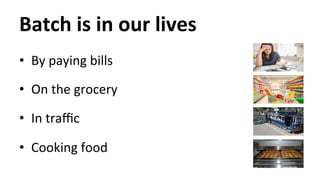
Batch 
is 
in 
our 
lives 
• By 
paying 
bills 
• On 
the 
grocery 
• In 
traffic 
• Cooking 
food
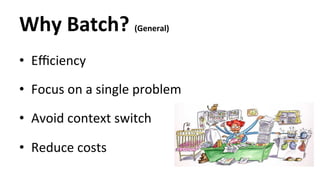
Why 
Batch? 
(General) 
• Efficiency 
• Focus 
on 
a 
single 
problem 
• Avoid 
context 
switch 
• Reduce 
costs
State 
of 
the 
Art 
• Spring 
Batch 
• IBM 
Websphere 
• Hadoop 
• Java 
SE, 
Scheduler, 
in-­‐house 
frameworks
The 
JSR-­‐352 
• Batch 
ApplicaHons 
for 
the 
Java 
pla]orm 
• Heavily 
inspired 
by 
Spring 
Batch 
• Available 
since 
Java 
EE 
7 
• Also 
designed 
for 
Java 
SE
The 
JSR-­‐352 
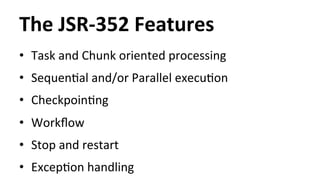
Features 
• Task 
and 
Chunk 
oriented 
processing 
• SequenHal 
and/or 
Parallel 
execuHon 
• CheckpoinHng 
• Workflow 
• Stop 
and 
restart 
• ExcepHon 
handling
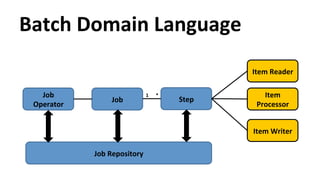
Batch 
Domain 
Language 
Job 
Operator 
Job 
Step 
Job 
Repository 
Item 
Reader 
Item 
Processor 
Item 
Writer 
1 
*
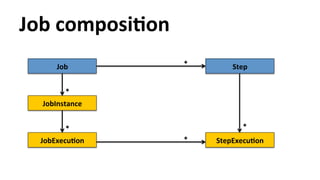
Job 
composiYon 
* 
Job 
Step 
* 
JobInstance 
* 
* 
* 
JobExecuYon 
StepExecuYon
Java 
EE 
Batch 
API
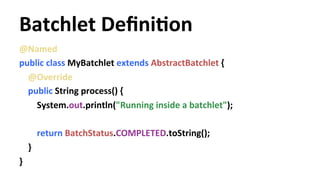
Batchlet 
DefiniYon 
@Named 
public 
class 
MyBatchlet 
extends 
AbstractBatchlet 
{ 
@Override 
public 
String 
process() 
{ 
System.out.println("Running 
inside 
a 
batchlet"); 
return 
BatchStatus.COMPLETED.toString(); 
} 
}
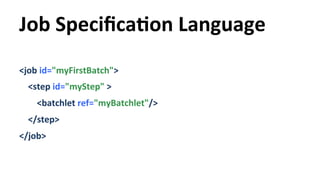
Job 
SpecificaYon 
Language 
<job 
id="myFirstBatch"> 
<step 
id="myStep" 
> 
<batchlet 
ref="myBatchlet"/> 
</step> 
</job>
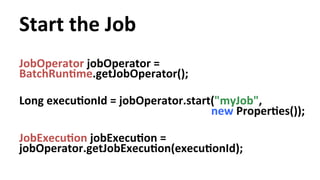
Start 
the 
Job 
JobOperator 
jobOperator 
= 
BatchRunYme.getJobOperator(); 
Long 
execuYonId 
= 
jobOperator.start("myJob", 
new 
ProperYes()); 
JobExecuYon 
jobExecuYon 
= 
jobOperator.getJobExecuYon(execuYonId);
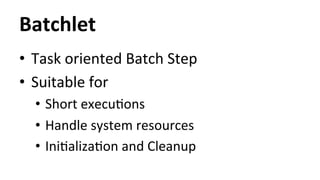
Batchlet 
• Task 
oriented 
Batch 
Step 
• Suitable 
for 
• Short 
execuHons 
• Handle 
system 
resources 
• IniHalizaHon 
and 
Cleanup
Chunk 
• ETL 
style 
(Reader, 
Processor, 
Writer) 
• Suitable 
for 
• Handle 
large 
amounts 
of 
data 
• Failover 
safety 
(checkpoint) 
• Long 
running 
applicaHons
Chunk 
Processing 
Step 
ItemReader 
ItemProcessor 
ItemWriter 
read() 
read() 
process(item) 
process(item) 
write(items) 
item 
item 
item 
item 
execute() 
ExitStatus
Defining 
Chunk 
Step 
<step 
id="myChunk"> 
<chunk 
checkpoint-­‐policy="item" 
item-­‐count="3"> 
<reader 
ref=“myItemReader"/> 
<processor 
ref=“myItemProcessor"/> 
<writer 
ref=“myItemWriter"/> 
</chunk> 
</step>
Item 
Reader 
@Named 
public 
class 
MyItemReader 
extends 
AbstractItemReader 
{ 
public 
Object 
readItem() 
throws 
ExcepYon 
{…} 
}
Item 
Processor 
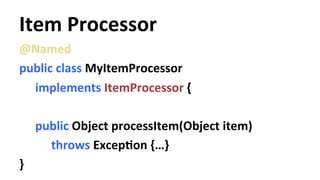
@Named 
public 
class 
MyItemProcessor 
implements 
ItemProcessor 
{ 
public 
Object 
processItem(Object 
item) 
throws 
ExcepYon 
{…} 
}
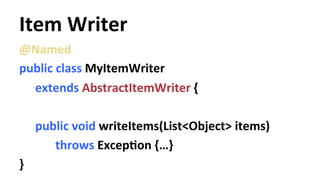
Item 
Writer 
@Named 
public 
class 
MyItemWriter 
extends 
AbstractItemWriter 
{ 
public 
void 
writeItems(List<Object> 
items) 
throws 
ExcepYon 
{…} 
}
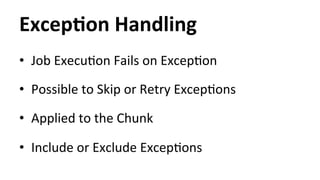
ExcepYon 
Handling 
• Job 
ExecuHon 
Fails 
on 
ExcepHon 
• Possible 
to 
Skip 
or 
Retry 
ExcepHons 
• Applied 
to 
the 
Chunk 
• Include 
or 
Exclude 
ExcepHons
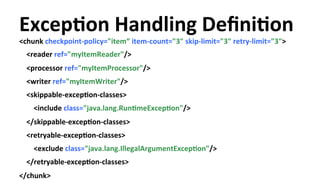
ExcepYon 
Handling 
DefiniYon 
<chunk 
checkpoint-­‐policy="item” 
item-­‐count="3" 
skip-­‐limit="3" 
retry-­‐limit="3"> 
<reader 
ref="myItemReader"/> 
<processor 
ref="myItemProcessor"/> 
<writer 
ref="myItemWriter"/> 
<skippable-­‐excepYon-­‐classes> 
<include 
class="java.lang.RunYmeExcepYon"/> 
</skippable-­‐excepYon-­‐classes> 
<retryable-­‐excepYon-­‐classes> 
<exclude 
class="java.lang.IllegalArgumentExcepYon"/> 
</retryable-­‐excepYon-­‐classes> 
</chunk>
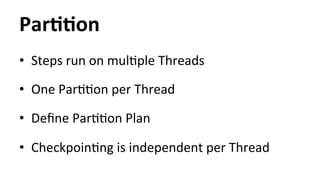
ParYYon 
• Steps 
run 
on 
mulHple 
Threads 
• One 
ParHHon 
per 
Thread 
• Define 
ParHHon 
Plan 
• CheckpoinHng 
is 
independent 
per 
Thread
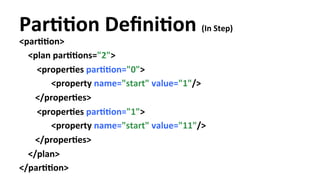
ParYYon 
DefiniYon 
(In 
Step) 
<parYYon> 
<plan 
parYYons="2"> 
<properYes 
parYYon="0"> 
<property 
name="start" 
value="1"/> 
</properYes> 
<properYes 
parYYon="1"> 
<property 
name="start" 
value="11"/> 
</properYes> 
</plan> 
</parYYon>
ParYYon 
DefiniYon 
(In 
Step) 
<chunk 
item-­‐count="3"> 
<reader 
ref="myItemReader"> 
<properYes> 
<property 
name="start” 
value="#{parYYonPlan['start']}" 
/> 
</properYes> 
</reader> 
<processor 
ref="myItemProcessor"/> 
<writer 
ref="myItemWriter"/> 
</chunk>
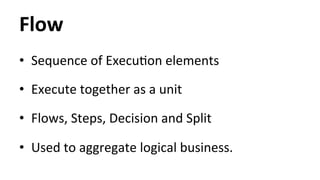
Flow 
• Sequence 
of 
ExecuHon 
elements 
• Execute 
together 
as 
a 
unit 
• Flows, 
Steps, 
Decision 
and 
Split 
• Used 
to 
aggregate 
logical 
business.
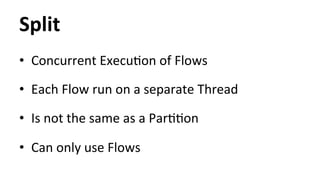
Split 
• Concurrent 
ExecuHon 
of 
Flows 
• Each 
Flow 
run 
on 
a 
separate 
Thread 
• Is 
not 
the 
same 
as 
a 
ParHHon 
• Can 
only 
use 
Flows
Split 
and 
Flow 
DefiniYon 
<split 
id="mySplit"> 
<flow 
id="flow1"> 
<step 
id="myChunk" 
next="myBatchlet”>…</step> 
<step 
id="myBatchlet">...</step> 
</flow> 
<flow 
id="flow2"> 
<step 
id=”otherChunk" 
next=”otherBatchlet”>…</step> 
<step 
id=”otherBatchlet">...</step> 
</flow> 
</split>
ParYYon 
vs 
Split 
• ParHHon 
is 
used 
at 
the 
data 
level 
• Split 
is 
used 
at 
the 
business 
level
Decision 
• Decide 
the 
next 
TransiHon 
• Applied 
to 
Steps, 
Flows 
and 
Splits 
• It’s 
almost 
like 
an 
if 
/ 
else 
if 
• Requires 
an 
implementaHon
Decision 
DefiniYon 
<step 
id=”myStep" 
next="myDecider"> 
<batchlet 
ref="myBatchlet”/> 
</step> 
<decision 
id="myDecider" 
ref="MyDecider"> 
<next 
on="foo" 
to="myFooStep"/> 
<next 
on="bar" 
to="myBarStep"/> 
</decision>
Decision 
@Named 
public 
class 
MyDecider 
implements 
Decider 
{ 
public 
String 
decide(StepExecuYon[] 
execuYons) 
throws 
ExcepYon 
{…} 
}
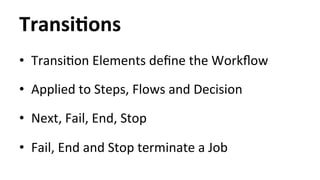
TransiYons 
• TransiHon 
Elements 
define 
the 
Workflow 
• Applied 
to 
Steps, 
Flows 
and 
Decision 
• Next, 
Fail, 
End, 
Stop 
• Fail, 
End 
and 
Stop 
terminate 
a 
Job
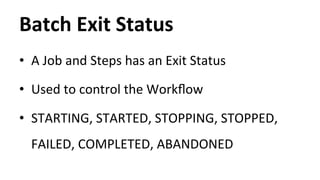
Batch 
Exit 
Status 
• A 
Job 
and 
Steps 
has 
an 
Exit 
Status 
• Used 
to 
control 
the 
Workflow 
• STARTING, 
STARTED, 
STOPPING, 
STOPPED, 
FAILED, 
COMPLETED, 
ABANDONED
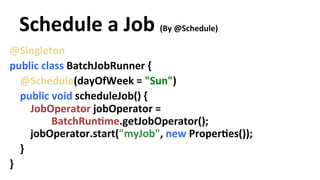
Schedule 
a 
Job 
(By 
@Schedule) 
@Singleton 
public 
class 
BatchJobRunner 
{ 
@Schedule(dayOfWeek 
= 
"Sun") 
public 
void 
scheduleJob() 
{ 
JobOperator 
jobOperator 
= 
BatchRunYme.getJobOperator(); 
jobOperator.start("myJob", 
new 
ProperYes()); 
} 
}
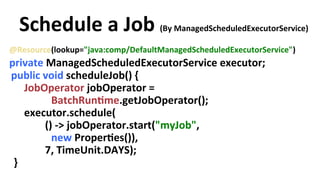
Schedule 
a 
Job 
(By 
ManagedScheduledExecutorService) 
@Resource(lookup="java:comp/DefaultManagedScheduledExecutorService") 
private 
ManagedScheduledExecutorService 
executor; 
public 
void 
scheduleJob() 
{ 
JobOperator 
jobOperator 
= 
BatchRunYme.getJobOperator(); 
executor.schedule( 
() 
-­‐> 
jobOperator.start("myJob", 
new 
ProperYes()), 
7, 
TimeUnit.DAYS); 
}
ImplementaYons 
• JBatch 
IBM 
(Glassfish, 
JEUS) 
• JBeret 
(Wildfly) 
• Spring 
Batch
A 
Few 
Cons 
• Lacks 
standard 
Readers 
/ 
Writers 
• No 
Generics 
• ParHHon 
only 
supports 
a 
single 
Step 
• No 
Sync 
mode
Demo 
Time
WoW 
AucYon 
House 
• World 
of 
WacraT 
is 
MMORPG 
• More 
than 
500 
servers 
in 
US 
and 
EU 
• Each 
server 
has 
2 
AucHon 
Houses 
• Trades 
around 
70k 
items 
/ 
server 
/ 
hour
WoW 
AucYon 
House 
• Data 
available 
to 
download 
• Let’s 
process 
the 
data 
• Extract 
metrics 
• Share 
the 
knowledge
Live 
Code
Resources 
• JSR-­‐352 
SpecificaHon 
hips://jcp.org/en/jsr/detail?id=352 
• Java 
EE 
Samples 
hips://github.com/javaee-­‐samples 
• Wow 
AucHon 
House 
hips://github.com/radcortez/wow-­‐aucHons
Thank 
you 
for 
A/ending! 
Roberto 
Cortez 
@radcortez 
h/p://www.radcortez.com 
Ivan 
St. 
Ivanov 
@ivan_stefanov 
h/p://nosoGskills.com

Java EE 7 Batch processing in the Real World

  • 1.
    Java EE 7 Batch Processing in the Real World Roberto Cortez & Ivan St. Ivanov JavaOne 2014 #CON2818
  • 2.
    Who are we? Roberto Cortez @radcortez h/p://www.radcortez.com Freelancer, Speaker, RebelLabs Author, Blogger Ivan St. Ivanov @ivan_stefanov h/p://nosoGskills.com Architect, SAP Labs Bulgaria, JBoss Forge contributor
  • 3.
    QuesHons? As soon as you have them!
  • 4.
    What is Batch? “A group of records processed as a single unit, usually without input from a user.” (from Google)
  • 5.
    Why Batch? (Computers) • Make use of idle resources • ShiT the Hme of processing • Manage large repeated work easily • Shared by mulHple users
  • 6.
    Batch is in our lives • By paying bills • On the grocery • In traffic • Cooking food
  • 7.
    Why Batch? (General) • Efficiency • Focus on a single problem • Avoid context switch • Reduce costs
  • 8.
    State of the Art • Spring Batch • IBM Websphere • Hadoop • Java SE, Scheduler, in-­‐house frameworks
  • 9.
    The JSR-­‐352 •Batch ApplicaHons for the Java pla]orm • Heavily inspired by Spring Batch • Available since Java EE 7 • Also designed for Java SE
  • 10.
    The JSR-­‐352 Features • Task and Chunk oriented processing • SequenHal and/or Parallel execuHon • CheckpoinHng • Workflow • Stop and restart • ExcepHon handling
  • 11.
    Batch Domain Language Job Operator Job Step Job Repository Item Reader Item Processor Item Writer 1 *
  • 12.
    Job composiYon * Job Step * JobInstance * * * JobExecuYon StepExecuYon
  • 13.
  • 14.
    Batchlet DefiniYon @Named public class MyBatchlet extends AbstractBatchlet { @Override public String process() { System.out.println("Running inside a batchlet"); return BatchStatus.COMPLETED.toString(); } }
  • 15.
    Job SpecificaYon Language <job id="myFirstBatch"> <step id="myStep" > <batchlet ref="myBatchlet"/> </step> </job>
  • 16.
    Start the Job JobOperator jobOperator = BatchRunYme.getJobOperator(); Long execuYonId = jobOperator.start("myJob", new ProperYes()); JobExecuYon jobExecuYon = jobOperator.getJobExecuYon(execuYonId);
  • 17.
    Batchlet • Task oriented Batch Step • Suitable for • Short execuHons • Handle system resources • IniHalizaHon and Cleanup
  • 18.
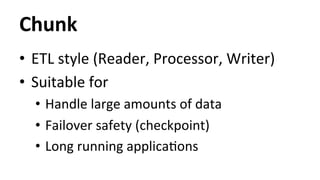
    Chunk • ETL style (Reader, Processor, Writer) • Suitable for • Handle large amounts of data • Failover safety (checkpoint) • Long running applicaHons
  • 19.
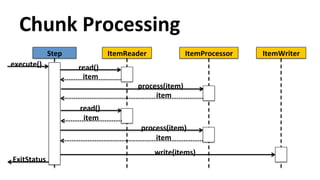
    Chunk Processing Step ItemReader ItemProcessor ItemWriter read() read() process(item) process(item) write(items) item item item item execute() ExitStatus
  • 20.
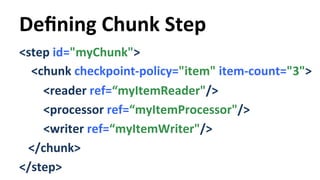
    Defining Chunk Step <step id="myChunk"> <chunk checkpoint-­‐policy="item" item-­‐count="3"> <reader ref=“myItemReader"/> <processor ref=“myItemProcessor"/> <writer ref=“myItemWriter"/> </chunk> </step>
  • 21.
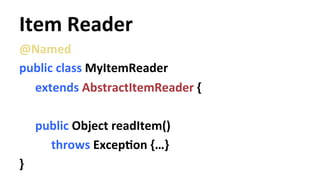
    Item Reader @Named public class MyItemReader extends AbstractItemReader { public Object readItem() throws ExcepYon {…} }
  • 22.
    Item Processor @Named public class MyItemProcessor implements ItemProcessor { public Object processItem(Object item) throws ExcepYon {…} }
  • 23.
    Item Writer @Named public class MyItemWriter extends AbstractItemWriter { public void writeItems(List<Object> items) throws ExcepYon {…} }
  • 24.
    ExcepYon Handling •Job ExecuHon Fails on ExcepHon • Possible to Skip or Retry ExcepHons • Applied to the Chunk • Include or Exclude ExcepHons
  • 25.
    ExcepYon Handling DefiniYon <chunk checkpoint-­‐policy="item” item-­‐count="3" skip-­‐limit="3" retry-­‐limit="3"> <reader ref="myItemReader"/> <processor ref="myItemProcessor"/> <writer ref="myItemWriter"/> <skippable-­‐excepYon-­‐classes> <include class="java.lang.RunYmeExcepYon"/> </skippable-­‐excepYon-­‐classes> <retryable-­‐excepYon-­‐classes> <exclude class="java.lang.IllegalArgumentExcepYon"/> </retryable-­‐excepYon-­‐classes> </chunk>
  • 26.
    ParYYon • Steps run on mulHple Threads • One ParHHon per Thread • Define ParHHon Plan • CheckpoinHng is independent per Thread
  • 27.
    ParYYon DefiniYon (In Step) <parYYon> <plan parYYons="2"> <properYes parYYon="0"> <property name="start" value="1"/> </properYes> <properYes parYYon="1"> <property name="start" value="11"/> </properYes> </plan> </parYYon>
  • 28.
    ParYYon DefiniYon (In Step) <chunk item-­‐count="3"> <reader ref="myItemReader"> <properYes> <property name="start” value="#{parYYonPlan['start']}" /> </properYes> </reader> <processor ref="myItemProcessor"/> <writer ref="myItemWriter"/> </chunk>
  • 29.
    Flow • Sequence of ExecuHon elements • Execute together as a unit • Flows, Steps, Decision and Split • Used to aggregate logical business.
  • 30.
    Split • Concurrent ExecuHon of Flows • Each Flow run on a separate Thread • Is not the same as a ParHHon • Can only use Flows
  • 31.
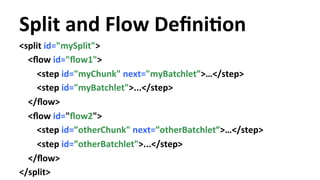
    Split and Flow DefiniYon <split id="mySplit"> <flow id="flow1"> <step id="myChunk" next="myBatchlet”>…</step> <step id="myBatchlet">...</step> </flow> <flow id="flow2"> <step id=”otherChunk" next=”otherBatchlet”>…</step> <step id=”otherBatchlet">...</step> </flow> </split>
  • 32.
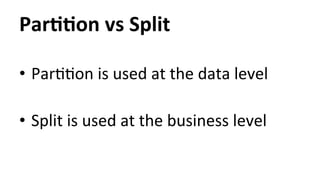
    ParYYon vs Split • ParHHon is used at the data level • Split is used at the business level
  • 33.
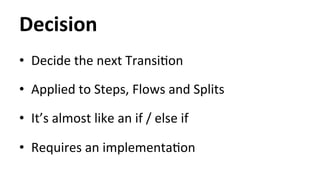
    Decision • Decide the next TransiHon • Applied to Steps, Flows and Splits • It’s almost like an if / else if • Requires an implementaHon
  • 34.
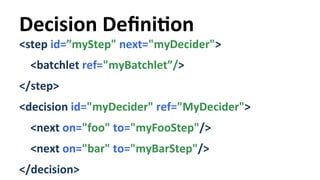
    Decision DefiniYon <step id=”myStep" next="myDecider"> <batchlet ref="myBatchlet”/> </step> <decision id="myDecider" ref="MyDecider"> <next on="foo" to="myFooStep"/> <next on="bar" to="myBarStep"/> </decision>
  • 35.
    Decision @Named public class MyDecider implements Decider { public String decide(StepExecuYon[] execuYons) throws ExcepYon {…} }
  • 36.
    TransiYons • TransiHon Elements define the Workflow • Applied to Steps, Flows and Decision • Next, Fail, End, Stop • Fail, End and Stop terminate a Job
  • 37.
    Batch Exit Status • A Job and Steps has an Exit Status • Used to control the Workflow • STARTING, STARTED, STOPPING, STOPPED, FAILED, COMPLETED, ABANDONED
  • 38.
    Schedule a Job (By @Schedule) @Singleton public class BatchJobRunner { @Schedule(dayOfWeek = "Sun") public void scheduleJob() { JobOperator jobOperator = BatchRunYme.getJobOperator(); jobOperator.start("myJob", new ProperYes()); } }
  • 39.
    Schedule a Job (By ManagedScheduledExecutorService) @Resource(lookup="java:comp/DefaultManagedScheduledExecutorService") private ManagedScheduledExecutorService executor; public void scheduleJob() { JobOperator jobOperator = BatchRunYme.getJobOperator(); executor.schedule( () -­‐> jobOperator.start("myJob", new ProperYes()), 7, TimeUnit.DAYS); }
  • 40.
    ImplementaYons • JBatch IBM (Glassfish, JEUS) • JBeret (Wildfly) • Spring Batch
  • 41.
    A Few Cons • Lacks standard Readers / Writers • No Generics • ParHHon only supports a single Step • No Sync mode
  • 42.
  • 43.
    WoW AucYon House • World of WacraT is MMORPG • More than 500 servers in US and EU • Each server has 2 AucHon Houses • Trades around 70k items / server / hour
  • 44.
    WoW AucYon House • Data available to download • Let’s process the data • Extract metrics • Share the knowledge
  • 45.
  • 46.
    Resources • JSR-­‐352 SpecificaHon hips://jcp.org/en/jsr/detail?id=352 • Java EE Samples hips://github.com/javaee-­‐samples • Wow AucHon House hips://github.com/radcortez/wow-­‐aucHons
  • 47.
    Thank you for A/ending! Roberto Cortez @radcortez h/p://www.radcortez.com Ivan St. Ivanov @ivan_stefanov h/p://nosoGskills.com