Mastes Scheduling Producción I IITI MC. Ma. del Pilar C. León Franco
Master  Scheduling  (MPS) It forms the link between production planning and what manufacturing will actually build. It forms the basis for calculating the capacity and resources needed The MPS drives the material requirements plan It keeps priorities valid. The MPS is a priority plan for manufacturing.
Master Scheduling (MPS) The end items made by the company are assembled from component and subcomponents parts. These must be available in the right quantities at the right time to support the master production schedule.  The material requirements planning system plan the schedule for these components based on the needs of the MPS.
Master Scheduling (MPS) The master production schedule is a plan for manufacturing.  It reflects the needs of the marketplace and the capacity of manufacturing and forms a priority plan for manufacturing to follow.
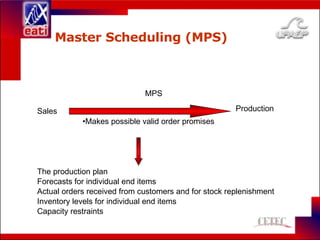
Master Scheduling (MPS) MPS Makes possible valid order promises Sales Production The production plan Forecasts for individual end items Actual orders received from customers and for stock replenishment Inventory levels for individual end items Capacity restraints
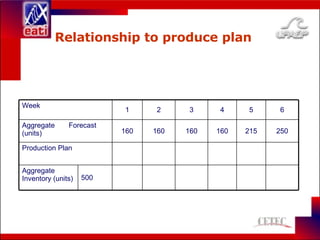
Relationship to  produce plan 500 Aggregate Inventory (units) Production Plan 250 215 160 160 160 160 Aggregate  Forecast (units) 6 5 4 3 2 1 Week
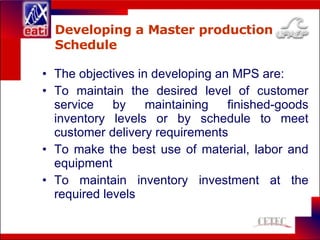
Developing a Master production Schedule The objectives in developing an MPS are: To maintain the desired level of customer service by maintaining finished-goods inventory levels or by schedule to meet customer delivery requirements To make the best use of material, labor and equipment To maintain inventory investment at the required levels
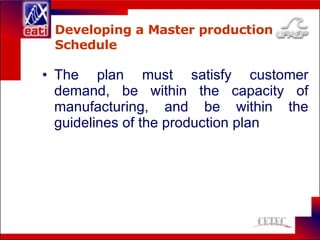
Developing a Master production Schedule The plan must satisfy customer demand, be within the capacity of manufacturing, and be within the guidelines of the production plan
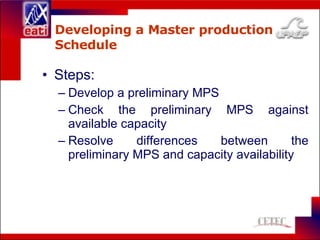
Developing a Master production Schedule Steps: Develop a preliminary MPS Check the preliminary MPS against available capacity Resolve differences between the preliminary MPS and capacity availability
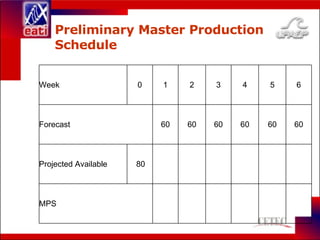
Preliminary Master Production  Schedule   100 100   100   MPS 20 80 40 0 60 20 80 Projected Available 60 60 60 60 60 60 Forecast 6 5 4 3 2 1 0 Week
Rough-Cut Capacity Planning RCCP checks whether critical resources are available to support the preliminary master production schedules.  Critical resources include bottleneck operations, labor, and critical materials.
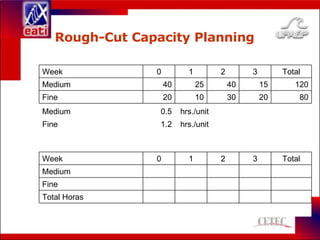
Rough-Cut Capacity  Planning           Total Horas           Fine           Medium Total 3 2 1 0 Week hrs./unit 1.2 Fine hrs./unit 0.5 Medium 80 20 30 10 20 Fine 120 15 40 25 40 Medium Total 3 2 1 0 Week
Resolution of Differences Compare the total time required to the available capacity of the work center Resources use Customer service Cost
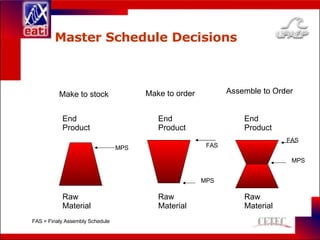
Master Schedule Decisions The MPS should represent as efficiently as possible what manufacturing will make. Make to stock products:  Limited number of standard items are assembled from many components Make to order products:  Many different ended items are made form a small number of components Assemble to order products:  Many end items can be made form combinations of basic components and subassemblies.
Master Schedule Decisions Make to stock Assemble to Order Make to order End Product Raw Material End Product Raw Material End Product Raw Material MPS MPS MPS FAS FAS FAS = Finaly Assembly Schedule

Master Scheduling

  • 1.
    Mastes Scheduling ProducciónI IITI MC. Ma. del Pilar C. León Franco
  • 2.
    Master Scheduling (MPS) It forms the link between production planning and what manufacturing will actually build. It forms the basis for calculating the capacity and resources needed The MPS drives the material requirements plan It keeps priorities valid. The MPS is a priority plan for manufacturing.
  • 3.
    Master Scheduling (MPS)The end items made by the company are assembled from component and subcomponents parts. These must be available in the right quantities at the right time to support the master production schedule. The material requirements planning system plan the schedule for these components based on the needs of the MPS.
  • 4.
    Master Scheduling (MPS)The master production schedule is a plan for manufacturing. It reflects the needs of the marketplace and the capacity of manufacturing and forms a priority plan for manufacturing to follow.
  • 5.
    Master Scheduling (MPS)MPS Makes possible valid order promises Sales Production The production plan Forecasts for individual end items Actual orders received from customers and for stock replenishment Inventory levels for individual end items Capacity restraints
  • 6.
    Relationship to produce plan 500 Aggregate Inventory (units) Production Plan 250 215 160 160 160 160 Aggregate Forecast (units) 6 5 4 3 2 1 Week
  • 7.
    Developing a Masterproduction Schedule The objectives in developing an MPS are: To maintain the desired level of customer service by maintaining finished-goods inventory levels or by schedule to meet customer delivery requirements To make the best use of material, labor and equipment To maintain inventory investment at the required levels
  • 8.
    Developing a Masterproduction Schedule The plan must satisfy customer demand, be within the capacity of manufacturing, and be within the guidelines of the production plan
  • 9.
    Developing a Masterproduction Schedule Steps: Develop a preliminary MPS Check the preliminary MPS against available capacity Resolve differences between the preliminary MPS and capacity availability
  • 10.
    Preliminary Master Production Schedule   100 100   100   MPS 20 80 40 0 60 20 80 Projected Available 60 60 60 60 60 60 Forecast 6 5 4 3 2 1 0 Week
  • 11.
    Rough-Cut Capacity PlanningRCCP checks whether critical resources are available to support the preliminary master production schedules. Critical resources include bottleneck operations, labor, and critical materials.
  • 12.
    Rough-Cut Capacity Planning           Total Horas           Fine           Medium Total 3 2 1 0 Week hrs./unit 1.2 Fine hrs./unit 0.5 Medium 80 20 30 10 20 Fine 120 15 40 25 40 Medium Total 3 2 1 0 Week
  • 13.
    Resolution of DifferencesCompare the total time required to the available capacity of the work center Resources use Customer service Cost
  • 14.
    Master Schedule DecisionsThe MPS should represent as efficiently as possible what manufacturing will make. Make to stock products: Limited number of standard items are assembled from many components Make to order products: Many different ended items are made form a small number of components Assemble to order products: Many end items can be made form combinations of basic components and subassemblies.
  • 15.
    Master Schedule DecisionsMake to stock Assemble to Order Make to order End Product Raw Material End Product Raw Material End Product Raw Material MPS MPS MPS FAS FAS FAS = Finaly Assembly Schedule